

Support us by contributing to StratNewsGlobal on the following UPI ID
ultramodern@hdfcbank

Strategic affairs is our game, South Asia and beyond our playground. Put together by an experienced team led by Nitin A. Gokhale. Our focus is on strategic affairs, foreign policy and international relations, with higher quality reportage, analysis and commentary with new tie-ups across the South Asian region.
You can support our endeavours. Visit us at www.stratnewsglobal.com and follow us on YouTube, Twitter, Facebook and Instagram.
र 500 per month
र 1000 per month
र 5000 per year
र 10000 per year
Donate an amount of your choice
र 500 per month
Donate र 500 per month

र 1000 per month
Donate र 1000 per month
र 5000 per year
Donate र 5,000 per year
र 10000 per year
Donate र 10,000 per year
Donate an amount of your choice
Donate an amount of your choice
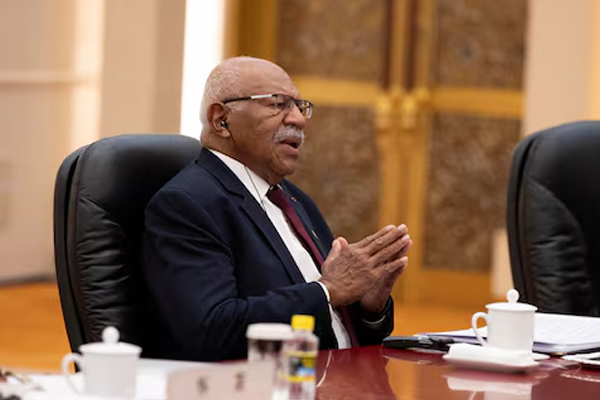

Fiji Prime Minister Rabuka’s Visit Underscores India’s Pacific Focus
There was a time when South Block saw red when the name Sitiveni Rabuka came up: in 1987 he as Fiji’s army chief, carried out a coup against the elected government of Timoci Bavadra, and triggered a massive exodus of ethnic Indians from the South Pacific island.
It brought down the ethnic Indian population steeply, to around today’s 37%, perhaps the first instance of ethnic cleansing (but that phrase got renown only a decade later, in Kosovo).
On Monday, India will roll out the red carpet for the same Sitiveni Rabuka, now a duly elected prime minister of Fiji, who while he still champions the unity of ethnic Fijians, has publicly apologised for the coup and the exodus of Indians.
Rabuka arrived in Delhi on Sunday on a four-day visit, his first to this country. But India’s outreach to Fiji goes back to 2014 when Prime Minister Modi travelled there, symbolically shutting the door on a turbulent and tragic past.
“Fiji represents one corner of our Act East policy,” government sources told StratNewsGlobal, “it’s geopolitical location in the South Pacific straddling vital sea lanes, makes it a key node in India’s vision of a free, open and inclusive Indo-Pacific.”
The broadening of the Act East policy to include the Indo-Pacific has been driven by Modi and Fiji comprising more than 300 islands, is seen as an influential regional leader and power broker. It is in fact India’s largest partner in the pacific.
“Prime Minister Rabuka has opposed Chinese bases in the region, which is important for India and its strategic partners given Chinese facilities on the Solomon Islands,” Vinod Kumar, former Indian high commissioner to Fiji told StratNewsGlobal.
“Rabuka said some time ago in Australia that he will try and persuade other countries in the region to not allow such facilities. Of course each country will make its own decision on that but he did say he would try to persuade them.”
Geopolitically these islands have become important given the competition between major powers. India can cooperate with its Quad partners, and potentially France, on Fiji as has been done in the past particularly with regard to capacity building and include other areas of trilateral cooperation, Ambassador Kumar noted.
“India is also in a good position to leverage its influence, enhance its presence and remain engaged thanks to our cooperation in various fora and the large diaspora,” he said, underscoring that Fiji’s deputy prime minister is of Indian origin.
India remains a valued development partner of Fiji not only bilaterally, but also through the Forum for India Pacific Islands Cooperation (FIPIC). It is now the cornerstone of India’s engagement with the 14 Pacific island states. Fiji in fact hosted the inaugural summit in Suva, its capital.
FIPIC focuses on key priorities such as climate change adaptation and disaster resilience, renewable energy, healthcare including a 100-bed hospital in Suva, IT, digital connectivity, capacity building and so on.
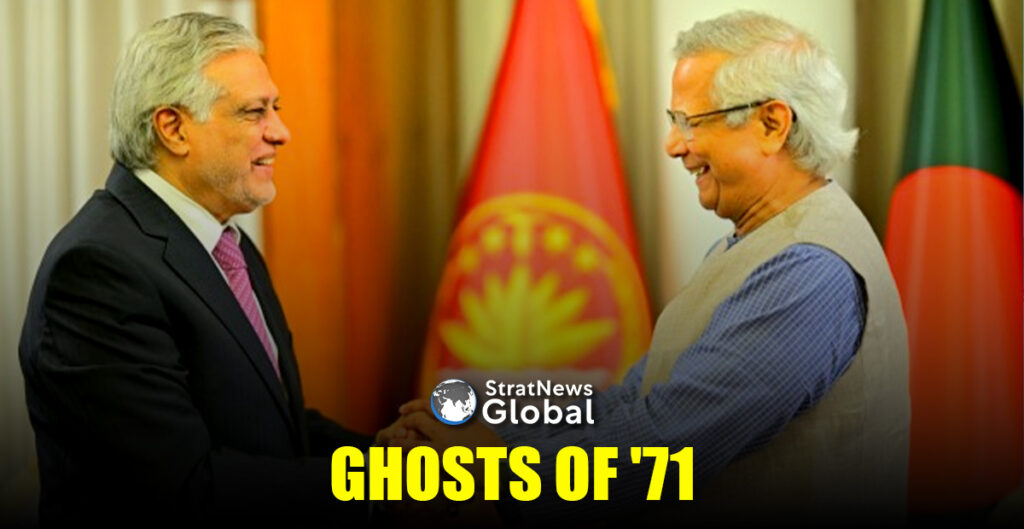
Pakistan’s FM Visits Dhaka, But 1971 Still Haunts The Room
It took Pakistan’s Deputy Prime Minister and Foreign Minister Ishaq Dar 13 years to visit Bangladesh, and within 13 minutes the ghosts of 1971 had barged into the room.
The Pakistani diplomat, on a “historic” visit to Dhaka, cheerfully announced that all “unresolved issues” between the two countries had been resolved twice over.
Bangladesh’s Foreign Affairs Adviser Touhid Hossain, poker-faced, shot back: “I do not agree at all.”
The trip, laden with symbolism, comes against the backdrop of political change in Bangladesh. Since Sheikh Hasina’s ouster last year, interim leader Muhammad Yunus has pursued a “friendship to all” foreign policy, loosening Dhaka’s heavy tilt toward India and creating diplomatic space for Pakistan.
Pakistan and Bangladesh signed six agreements during Dar’s visit, ranging from trade facilitation and cultural exchanges to academic partnerships, foreign service academy cooperation, and the abolition of visas for officials. Pakistani officials say the priority is to grow bilateral trade from the current $865 million to as much as $3 billion annually—a target that would represent more than a threefold jump.
Islamabad is eager to emphasise the potential upside. Pakistani textiles, pharmaceuticals, and cement already find buyers in Bangladesh, while Dhaka’s ready-made garments and jute products are competitive in Pakistan. Banking channels are also being revived, with discussions on direct shipping lines and smoother customs clearances.
The thaw is not confined to economics. Pakistan has quietly reopened military and intelligence channels with Bangladesh. For Dhaka, those links complement its “Forces Goal 2030” military modernisation plan, which aims to significantly upgrade its army, navy and air force. Military-to-military contacts have included meetings on training and defence cooperation, signalling that both sides are willing to explore security convergence after decades of distance.
Yet, behind the handshakes and communiqués, history looms large.
Dhaka has repeatedly raised its three core demands from 1971: a formal apology from Islamabad for the mass killings and atrocities during the Liberation War; the settlement of $4.52 billion in frozen assets dating back to the breakup of Pakistan; and accountability for war crimes.
Successive governments in Islamabad have skirted these demands, offering carefully worded “expressions of regret” but never the explicit apology Bangladesh insists upon. The financial dispute, too, remains unresolved, with Bangladesh insisting that Pakistan release the frozen accounts and pay outstanding claims.
For Prime Minister Yunus’s interim administration, ignoring 1971 is not an option. Any suggestion of backtracking risks domestic backlash, particularly with elections scheduled for February. The genocide issue retains emotional and political weight across Bangladeshi society, and no leader can afford to be seen as compromising on it.
Dar’s visit is equally significant for what it signals about Dhaka’s shifting regional calculus. Under Sheikh Hasina, Bangladesh maintained close strategic and economic ties with India, with trade valued at over $18 billion and deep cooperation on counter-terrorism and border security.
That relationship, however, has frayed. Hasina’s exile in India after her ouster has fuelled perceptions in Dhaka that New Delhi was too closely aligned with her. Popular resentment has been amplified by specific incidents, such as India’s unannounced release of water from the Dumbur dam during Bangladesh’s 2024 floods, which worsened the damage. The episode fed into the growing “India Out” movement, giving Yunus further reason to diversify Bangladesh’s external partnerships.
For Pakistan, this estrangement represents an opening. Beyond boosting trade, Islamabad sees an opportunity to carve out a role in Bangladesh’s security calculus and to present itself as a counterbalance to India. For Dhaka, engaging with Pakistan offers leverage — a reminder to New Delhi that Bangladesh is not beholden to a single partner.
In public, Dar has pitched his trip as a “reset”—a chance to move beyond the bitterness of the past and “write a new chapter” in Pakistan-Bangladesh relations. But even as new agreements are inked, the old grievances refuse to fade.
The asymmetry is stark. Pakistan talks about raising trade to $3 billion. Bangladesh talks about $4.52 billion in frozen assets. Pakistan prefers to highlight cultural exchanges. Bangladesh insists an apology is still due. For now, both sides seem content to let these contradictions coexist, if only to keep the diplomatic momentum alive.
The symbolism of Dar’s visit is undeniable. It marks Pakistan’s re-entry into a relationship frozen for over a decade, and it reflects Bangladesh’s willingness under Yunus to recalibrate its foreign ties. But symbolism does not erase substance.
Until Islamabad confronts the unfinished business of 1971, every meeting in Dhaka will remain crowded — with ministers at the table, and ghosts in the room.
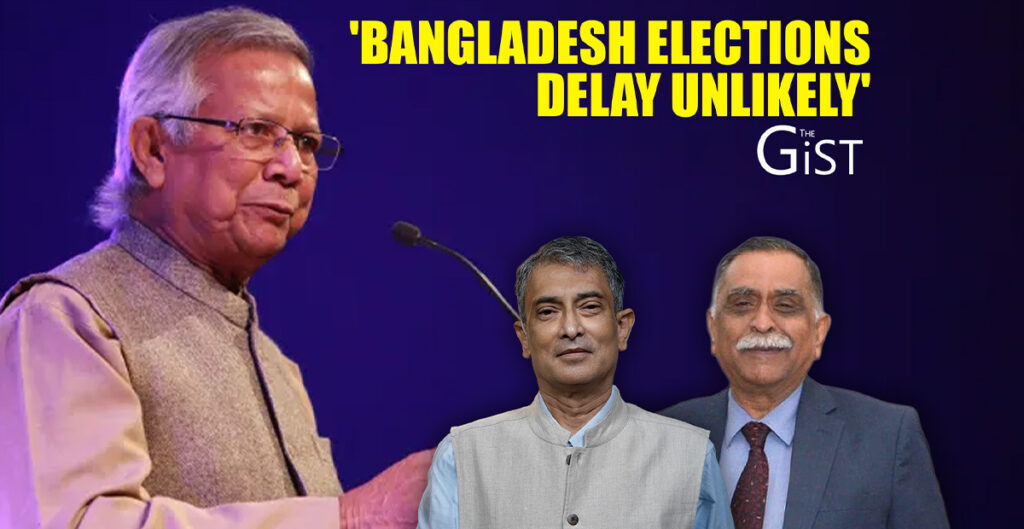
‘The Next Government Won’t Be Friendly to India’
Security analyst Shantanu Mukharji believes that national elections in Bangladesh are likely to be held in February 2026, as announced by the interim government led by Nobel laureate Muhammad Yunus, despite differences over reforms.
“I don’t think reforms or anything will delay the elections further unless there is something extraordinary,” Mukharji said, referring to a consensus reached in London a few months ago.
However, he noted that the polls would not be free and fair, as the Awami League, led earlier by Sheikh Hasina who fled to India after last year’s student uprising, has been barred from contesting. “Technically, you are right. It cannot be free and fair,” he said, adding that the ruling dispensation would go ahead without the League as it suited their political ambitions.
On the role of other parties, Mukharji said the BNP and Jamaat-e-Islami, despite differences, are likely to collaborate after the polls in a “marriage of convenience,” united by hostility toward pro-India and secular forces. He predicted that such a government would be “very unlikely” to be friendly to India, citing past instances where BNP-Jamaat governments sheltered insurgents and leaned toward Pakistan.
Mukharji dismissed the electoral prospects of student groups who led the uprising, saying they lacked grassroots support. He suggested BNP and Jamaat could even co-opt Awami League figures as independents in certain constituencies.
On law and order, Mukharji said the situation remains fragile even a year after Hasina’s ouster. He cited violence in Gopalganj and the ransacking of Sheikh Mujibur Rahman’s historic residence as examples. While the army has pledged neutrality, he cautioned that it could step in if unrest escalates, as it has repeatedly done in Bangladesh’s history.
Mukharji said Yunus is unlikely to have a role after elections, except possibly a ceremonial one, while students may remain confined to agitation outside parliament. On foreign relations, he said India has maintained friendly gestures and will reach out to the next government, though ties remain strained.
Regarding regional dynamics, he dismissed Pakistani threats as rhetorical and said India was capable of responding effectively, while downplaying concerns about China’s role.
Syria Postpones Elections In Sweida Following Sectarian Violence
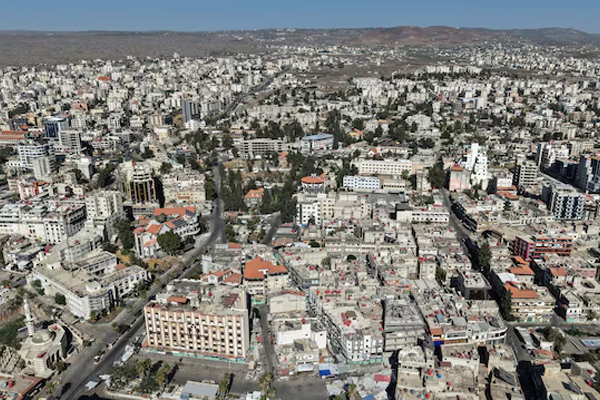
Syria’s electoral commission said Saturday that parliamentary elections set for September will be delayed in Sweida and two other provinces because of security concerns following recent sectarian violence.
Hundreds of people were reported killed in July in clashes in Sweida province pitting Druze fighters against Sunni Bedouin tribes and government forces.
Israel intervened with airstrikes to prevent what it said were mass killings of Druze by government forces.
The Druze are a minority offshoot of Islam with followers in Syria, Lebanon and Israel. Sweida province is predominantly Druze but is also home to Sunni tribes, and the communities have had longstanding tensions over land and other resources.
The Higher Committee for People’s Assembly Elections said the ballot would also be delayed in the northern provinces of Hasaka and Raqqa until a “safe environment” is in place, according to state news agency SANA.
Seats allocated to the three provinces will remain vacant until elections can be held there, commission spokesperson Nawar Najmeh told SANA.
“The elections are a sovereign matter that can only be conducted in areas fully under government control,” he added.
The head of the electoral commission said last month that voting for the 210-member People’s Assembly was due to take place between September 15 and 20.
(With inputs from Reuters)
France Summons Italian Envoy Over Deputy PM’s Ukraine Remarks
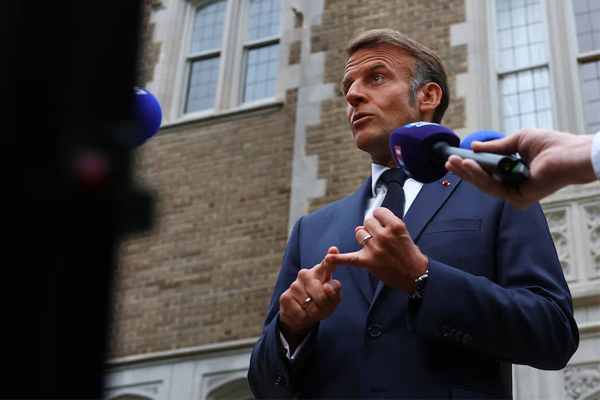
France summoned Italy’s ambassador after the country’s deputy prime minister criticised President Emmanuel Macron for suggesting European troops could be deployed in Ukraine as part of a postwar settlement, a French diplomatic source said Saturday.
Asked earlier this week to comment on French President Emmanuel Macron’s appeals to deploy European soldiers in Ukraine after any settlement with Russia, Deputy Prime Minister Matteo Salvini used a Milanese dialect phrase loosely translatable as “get lost”.
“You go there if you want. “Put your helmet on, your jacket on, and your rifle on, and you go to Ukraine,” he told reporters, referring to Macron.
Salvini, the populist leader of the right-wing League party and also Italy’s transport minister in the nationalist, conservative government led by Giorgia Meloni, has repeatedly criticised Macron, especially over Ukraine.
The Italian ambassador was summoned on Friday, the diplomatic source said, marking the latest in a series of diplomatic clashes between Paris and Rome before and after Meloni took power in 2022.
“The ambassador was reminded that these remarks ran counter to the climate of trust and the historical relationship between our two countries, as well as to recent bilateral developments, which have highlighted strong convergences between the two countries, particularly with regard to unwavering support for Ukraine,” the source said.
Macron, a vocal supporter of Ukraine over its war with Russia, has been working with other world leaders, notably British Prime Minister Keir Starmer, to mobilise support for Ukraine in the event of a ceasefire.
(With inputs from Reuters)
Trump’s New Design Chief To Overhaul U.S. Government Websites
President Donald Trump has appointed Airbnb co-founder Joe Gebbia to lead a new National Design Studio, saying the initiative will revamp thousands of federal websites and make government services as user-friendly as Apple’s App Store.
Gebbia said on X on Saturday he aims to make government websites beautifully designed and running on modern software with a great user experience.
“An experience that projects a level of excellence for our nation and makes life less complicated for everyday Americans,” he said.
Trump signed an executive order on Thursday to create the studio – a new body that an official familiar with the plan said appears to be a stripped-down successor to the controversial Department of Government Efficiency, formerly headed by billionaire Elon Musk.
Gebbia, who has led efforts to revamp the federal retirement process at the federal human resources agency, is the new chief design officer.
Reuters reported this week that tackling problems at the Internal Revenue Service would be a focus, citing a government official.
Many U.S. government websites were designed by lowest-cost bidders and are hard to use or have not been significantly updated for years.
White House official David Sacks said on X that Gebbia will “oversee the redesign of roughly 26,000 federal web portals, many of which are obsolete, so they better serve Social Security recipients, veterans, and all citizens.”
According to Trump’s executive order, the National Design Studio will improve the “usability and aesthetics” of federal digital services.
The studio will advise agencies on how to reduce duplicative design costs and use standardised design on sites where people interact with the government.
The order also said that the studio will close in three years.
(With inputs from Reuters)
Thousands Rally In Australia In Support Of Palestinians
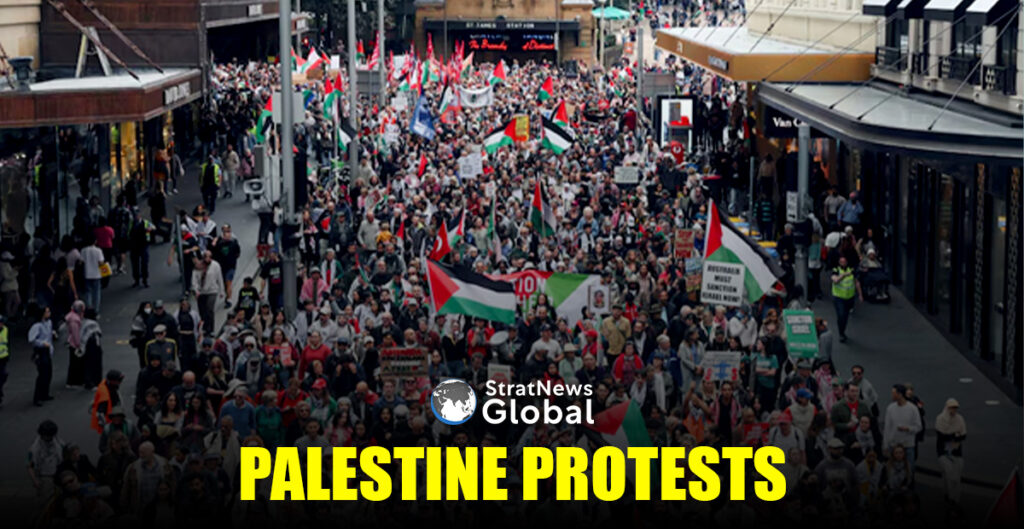
Thousands of Australians joined pro-Palestinian demonstrations Sunday as relations between Israel and Canberra remained tense after the centre-left government moved to recognise a Palestinian state, organisers said.
More than 40 protests took place across Australia on Sunday, the Palestine Action Group said, including large turnouts in state capitals Sydney, Brisbane and Melbourne.
The group said around 350,000 attended the rallies nationwide, including around 50,000 in Brisbane, though police estimated the numbers there at closer to 10,000. Police did not have estimates for crowd sizes in Sydney and Melbourne.
In Sydney, organiser Josh Lees said Australians were out in force to “demand an end to this genocide in Gaza and to demand that our government sanction Israel” as rallygoers, many with Palestinian flags, chanted “free, free Palestine”.
Alex Ryvchin, co-CEO of the Executive Council of Australian Jewry, the umbrella group for Australia’s Jews, told Sky News television that the rallies created “an unsafe environment and shouldn’t be happening”.
Israel-Australia Relations Remains Tense
The protests follow Israeli Prime Minister Benjamin Netanyahu this week stepping up his personal attacks on his Australian counterpart Anthony Albanese over his government’s decision this month to recognise a Palestinian state.
Diplomatic ties between Australia and Israel soured after Albanese’s Labour government said it would conditionally recognise Palestinian statehood, following similar moves by France, Britain and Canada.
The August 11 announcement came days after tens of thousands of people marched across Sydney’s iconic Harbour Bridge, calling for peace and aid deliveries to Gaza, where Israel began an offensive nearly two years ago after the Hamas militant group launched a deadly cross-border attack.
Palestinian authorities say the conflict has claimed the lives of more than 60,000 people in Gaza, while humanitarian organisations say a shortage of food is leading to widespread starvation.
(With inputs from Reuters)
Pentagon Drafts Plan For Possible Military Deployment In Chicago, Report Says
The Pentagon is preparing plans to send U.S. troops to Chicago as part of President Donald Trump’s push to address crime, homelessness and undocumented immigration, the Washington Post reported Saturday.
The Defence Department planning, in the works for weeks, involves several options, including mobilising at least a few thousand members of the National Guard as soon as September, the Post reported, citing officials familiar with the matter.
Trump Calls Chicago A Mess
“Chicago is a mess,” Trump, a Republican, told reporters on Friday, deriding its mayor as he continued his attacks on cities run by Democratic politicians. “And we’ll straighten that one out probably next.”
The Pentagon said in a statement late on Saturday, “We won’t speculate on further operations. The department is a planning organisation and is continuously working with other agency partners on plans to protect federal assets and personnel.”
Asked for a comment, the White House referred to Trump’s statement on Friday.
JB Pritzker, the Democratic governor of Illinois, which includes Chicago, said in a statement the state had received no outreach from the federal government on whether it needed assistance.
He said there was no emergency warranting a National Guard or other military deployment.
“Manufacture A Crisis”
“Donald Trump is attempting to manufacture a crisis, politicise Americans who serve in uniform and continue abusing his power to distract from the pain he is causing working families,” Pritzker said.
A spokesperson for Chicago Mayor Brandon Johnson did not immediately respond to a request for comment.
On Friday Johnson said the city had grave concerns about the impact of any unlawful deployment of National Guard troops.
“The problem with the president’s approach is that it is uncoordinated, uncalled for and unsound,” the mayor said, adding that over the past year, homicides in Chicago have fallen by more than 30%, robberies by 35% and shootings by almost 40%.
At Trump’s request last weekend, the Republican governors of three states said they were sending hundreds of National Guard troops hundreds of miles to Washington, D.C.
The president has portrayed the nation’s capital as a city awash in crime, although Justice Department data shows violent crime hit a 30-year low last year in Washington, a self-governing federal district under the jurisdiction of Congress.
In June, Trump ordered 700 Marines and 4,000 National Guard troops to Los Angeles, against the wishes of California’s Democratic governor, during protests over mass immigration raids by federal officials.
(With inputs from Reuters)
Sovereignty Trumps Multilateralism In Global Governance
International organisations once seen as the backbone of global governance are losing credibility as more nations opt for self-sufficiency, bilateral deals, or outright defiance of multilateral rulings.
The shift is driven by stalled mechanisms, political paralysis, and a growing sense that international bodies lack the teeth to enforce decisions.
Canada, historically a staunch supporter of multilateralism, illustrates this change. Long among the top five litigants at the World Trade Organization (WTO), it has often used dispute panels to challenge U.S. trade actions. But between U.S. tariffs under Donald Trump and the disruption caused by the Russia-Ukraine conflict, Ottawa is now prioritising deeper military ties with Nordic NATO allies such as Sweden and Finland. It has also begun redesigning its trade and Arctic strategies through direct bilateral mechanisms, signaling reduced reliance on the WTO or the Arctic Council.
India has also shifted stance. Though it once complied with World Bank arbitration on Indus Water Treaty disputes over the Baglihar and Kishanganga dams, it has resisted Pakistan’s efforts to involve the Permanent Court of Arbitration (PCA) since 2016. On August 14 this year, India rejected a PCA ruling that the Indus Water Treaty cannot be revoked, underscoring its determination to manage disputes without third-party intervention.
In Europe, cracks are showing even within one of the world’s strongest supranational legal systems. On August 12, Poland refused to comply with a European Court of Justice ruling striking down a judicial review reform law. Warsaw insisted such decisions were matters of national sovereignty, rejecting the idea of external oversight.
Elsewhere, nations continue to file complaints with international bodies but often pursue their own fixes instead. In 2019, South Korea brought a case against Japan at the WTO, arguing that Tokyo’s export controls violated free trade rules. Months later, the WTO Appellate Body became paralysed after the U.S. blocked judge appointments, leaving the dispute unresolved. Rather than waiting, Seoul rebuilt supply chains by diversifying trade partners and investing in R&D. By 2023, it had largely replaced Japanese suppliers.
The reasons behind this drift are varied but interconnected. U.S. tariffs and protectionist policies undermined trust in the WTO’s ability to safeguard free trade. Russia’s invasion of Ukraine exposed the limits of bodies like the UN in restraining powerful states. Meanwhile, institutional gridlock—such as the WTO Appellate Body’s collapse—has left disputes in limbo. For many countries, especially middle powers, bilateral routes now appear faster and more effective than prolonged legal battles.
Even major powers are disengaging. The U.S. has cut funding to several UN agencies and pledged to leave UNESCO and the UN Human Rights Council. Within the EU, Hungary passed legislation to withdraw from the Rome Statute that created the International Criminal Court, echoing the Philippines’ 2018 departure.
Some leaders are instead pushing for alternatives. Last month, German Chancellor Friedrich Merz called for an EU-led global trade organisation to gradually replace the WTO, an idea backed by European Commission President Ursula von der Leyen. Earlier this year, China signed a convention in Hong Kong to establish a new international mediation body, aiming to rival the International Court of Justice and the PCA.
What emerges is a picture of fragmentation: from Canada’s Arctic strategy to India’s water disputes, from South Korea’s supply chains to Poland’s judicial laws, countries are steadily reducing their reliance on multilateral organisations. For now, sovereignty and bilateralism appear to be trumping cooperation through international institutions.
(This article was written by Tisya Sharma, she is an intern at StratNewsGlobal)
As India-Nepal Trade Barbs Over Kalapani, Key Project Remains In Limbo
In less than a month from now, Prime Minister Modi will host his Nepali counterpart K P Sharma Oli, in the monastic town of Bodhgaya, Bihar. For Oli, it ends an obvious embarrassment, of not meriting an official invitation to visit India 13 months into his fourth term.
But the tone in sections of the Nepali media is negative, questioning the rationale for the visit when India has shown no inclination to address the “territorial dispute” over Kalapani, Lympiadhura and Lipulekh.
Last week there was an exchange on the issue between the two foreign ministries, with India dismissing Nepal’s objections to border trade being resumed with China through Lipulekh. External Affairs Ministry spokesman Randhir Jaiswal said:
“Our position remains that such claims are neither justified nor based on historical facts and evidence. Any unilateral artificial enlargement of territorial claims is untenable.”
Nepal’s Online Khabar quoted Indra Adhikari, a commentator on security issues as saying that “This is not the time to travel merely for formalities. Such visits usually cover issues where both countries have reached agreement. That requires long preparation. In times of disputes and without a special agenda, it’s better not to go just for protocol.”
But India’s former ambassador to Nepal Ranjit Rae, has a different perspective on that. He told StratNewsGlobal that “There’s a very close relationship between India and Nepal and India looms quite large in the Nepali consciousness. And India becomes a factor in their domestic politics.”
The point is to ensure the political discord does not spill over and affect the economic cooperation that has been steadily expanding into areas like hydropower.
“Nepal has started exporting a fair amount of electricity to India and that’s a good development,” Ambassador Rae said, “People always said that India is not giving Nepal a good deal. Hopefully these issues will not be as salient as they used to be.”
Nepal is also exporting power to Bangladesh via India, which brings much needed revenues into Nepal government coffers.
The big ticket would be resolution of disagreements over the Pancheswar multipurpose power project. When completed it would generate over 6000 MW of power to be shared equally between India and Nepal.
But it has stalled reportedly over the height of the proposed dam on the Mahakali river, area of submergence and the benefits of irrigation that should accrue to both sides. For the record, the word from Kathmandu and Delhi is they are serious about it. Hopefully, by the time Modi and Oli meet, the issue would no longer be hanging fire.