

Support us by contributing to StratNewsGlobal on the following UPI ID
ultramodern@hdfcbank

Strategic affairs is our game, South Asia and beyond our playground. Put together by an experienced team led by Nitin A. Gokhale. Our focus is on strategic affairs, foreign policy and international relations, with higher quality reportage, analysis and commentary with new tie-ups across the South Asian region.
You can support our endeavours. Visit us at www.stratnewsglobal.com and follow us on YouTube, Twitter, Facebook and Instagram.
र 500 per month
र 1000 per month
र 5000 per year
र 10000 per year
Donate an amount of your choice
र 500 per month
Donate र 500 per month

र 1000 per month
Donate र 1000 per month
र 5000 per year
Donate र 5,000 per year
र 10000 per year
Donate र 10,000 per year
Donate an amount of your choice
Donate an amount of your choice
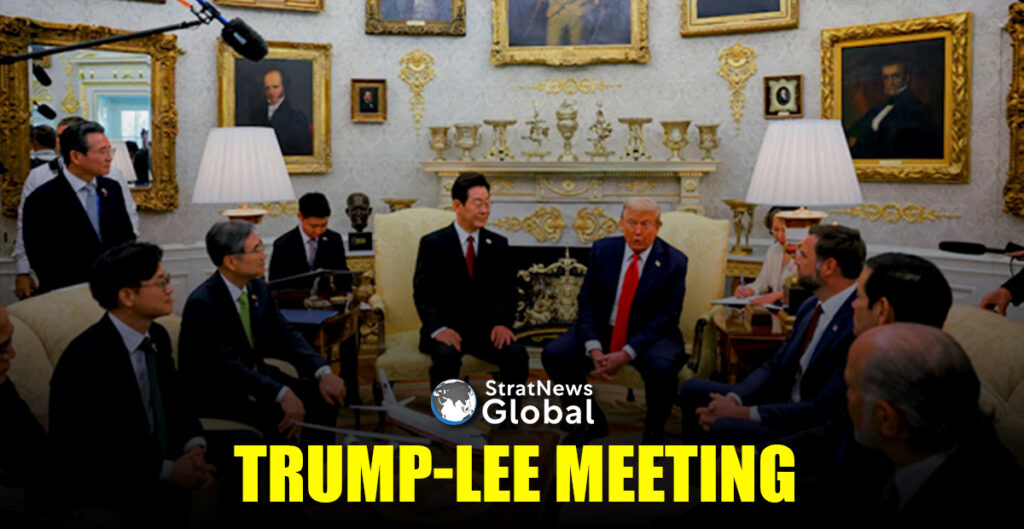


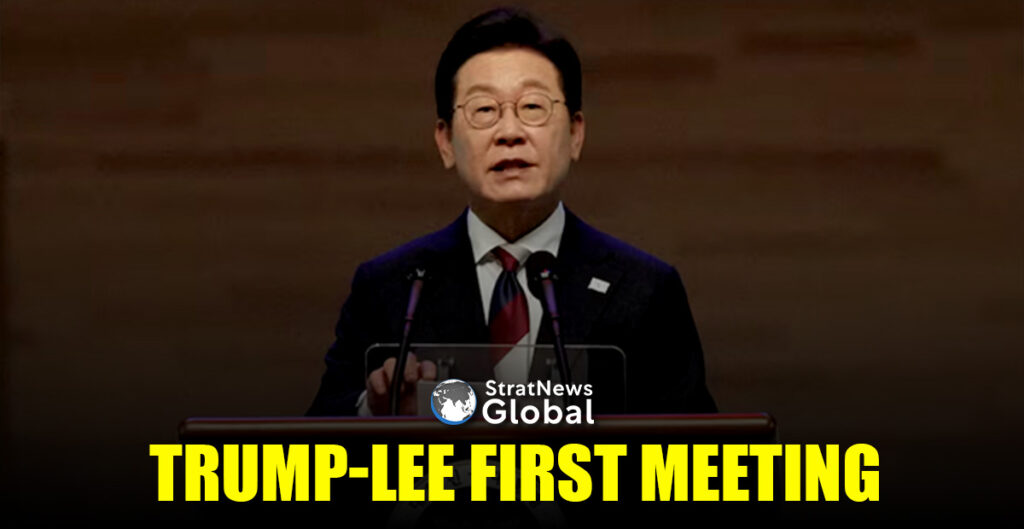



Trump Seeks Meeting With Kim Jong Un As He Hosts Lee At White House
U.S. President Donald Trump said on Monday that he wanted a meeting with North Korean leader Kim Jong Un and emphasised that he remained open to pursuing additional trade talks with South Korea, even as he directed fresh criticisms toward the visiting Asian ally.
“I’d like to meet him this year,” Trump told reporters in the Oval Office as he welcomed South Korea’s new president, Lee Jae Myung, to the White House for the first time. “I look forward to meeting with Kim Jong Un in the appropriate future.”
Despite clinching a trade deal in July that spared South Korean exports harsher U.S. tariffs, the two sides continue to wrangle over nuclear energy, military spending, and details of a deal that included $350 billion in promised South Korean investments in the United States.
After meeting with Trump, Lee attended a business forum with senior U.S. officials and CEOs of South Korean and U.S. companies.
To coincide with the visit, South Korea’s flag carrier, Korean Air, announced an order for 103 Boeing aircraft, the largest order in the airline’s history.
Kim Ignores Trump Calls
North Korea did not immediately respond to a request for comment on Trump’s remarks. Its state media said later that U.S.-South Korea joint military drills proved Washington’s intention to “occupy” the Korean peninsula and target countries in the region.
Since Trump’s January inauguration, Kim has ignored Trump’s repeated calls to revive the direct diplomacy he pursued during his 2017-2021 term in office, which produced no deal to halt North Korea’s nuclear program.
In the Oval Office, Lee avoided the theatrical confrontations that dominated a February visit by Ukrainian President Volodymyr Zelenskyy and a May visit from South African President Cyril Ramaphosa.
Lee talked golf and lavished praise on the Republican president’s interior decorating and peacemaking, telling reporters earlier he had read the president’s 1987 memoir, “Trump: The Art of the Deal,” to prepare.
“I hope you can bring peace to the Korean Peninsula, the only divided nation in the world, so that you can meet with Kim Jong Un, build a Trump World (real-estate complex) in North Korea so that I can play golf there, and so that you can truly play a role as a world-historical peacemaker,” Lee told Trump, speaking in Korean.
Lee’s office said he and Trump discussed shipbuilding and the assassination attempts against both men. Lee also invited Trump to attend the summit of the Asia-Pacific Economic Cooperation (APEC) grouping in October, and suggested the American president try to meet with Kim during the trip, Lee’s office added.
“Despite the massive sanctions imposed to deter North Korea, the result has been the continuous development of nuclear weapons and missiles,” Lee said during an event at the Centre for Strategic and International Studies in Washington after the summit.
He said North Korea now has the capacity to build 10 to 20 nuclear warheads per year, and only needs to perfect a reentry vehicle to carry those warheads on its largest ballistic missiles that can reach the U.S.
Difficult Issues
South Korea’s economy relies heavily on the U.S., with Washington underwriting its security with troops and nuclear deterrence. Trump has called Seoul a “money machine” that takes advantage of American military protection.
“I think we have a deal done” on trade, Trump told reporters. “They had some problems with it, but we stuck to our guns.” He did not elaborate, and the White House did not immediately respond to a request for comment.
Trump said while sitting with Lee, he would raise “intel” he had received about South Korean investigations, which he said targeted churches and a military base. The White House did not respond to a request for more information.
This month, Seoul police raided Sarang Jeil Church, headed by an evangelical preacher who led protests backing Lee’s ousted predecessor, Yoon Suk Yeol.
In July, prosecutors investigating Yoon’s declaration of martial law served a search warrant on the Korean part of a military base jointly operated with the U.S. Officials have said U.S. troops and materials were not subject to the search.
South Korea’s far-right movement, especially evangelical Christians and Yoon supporters, sees him as a victim of communist persecution.
Trump was expected to pressure Lee to commit to more defence spending, including toward upkeep of the 28,500 U.S. troops in South Korea.
Asked if he would reduce those numbers to give the U.S. more regional flexibility, Trump said: “I don’t want to say that now,” but that maybe Seoul should give the U.S. ownership of the “land where we have the big fort,” an apparent reference to Camp Humphreys, a U.S. Army garrison in South Korea.
Before the meeting, Lee told reporters it would be difficult for Seoul to accept U.S. demands to adopt such “flexibility” – a reference to using U.S. forces for a wider range of operations, including China-related threats.
(With inputs from Reuters)
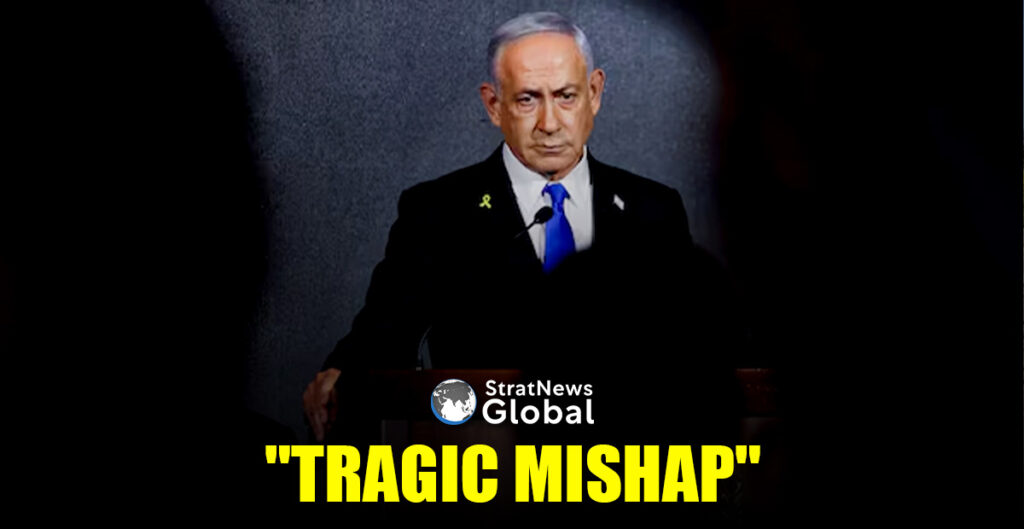
‘Tragic Mishap’: Netanyahu Expresses Regret After Israeli Strike On Gaza Hospital Kills 20
Prime Minister Benjamin Netanyahu said that Israel deeply regretted what he called the “tragic mishap” at Nasser hospital in southern Gaza on Monday.
An Israeli strike on Nasser hospital killed at least 20 people, including five journalists who worked for agencies including Reuters, the Associated Press and Al Jazeera.
“Our war is with Hamas terrorists. Our just goals are defeating Hamas and bringing our hostages home,” Netanyahu said.
Five Journalists Among 20 Dead
At least 20 people, including five journalists who worked for Reuters, the Associated Press, Al Jazeera and others, were killed in the Israeli strike on Nasser hospital on Monday.
Cameraman Hussam al-Masri, a Reuters contractor, was killed near a live broadcasting position operated by Reuters on an upper floor just below the roof of the hospital in Khan Younis in an initial strike, Palestinian health officials said.
Officials at the hospital and witnesses said Israel then struck the site a second time, killing other journalists as well as rescue workers and medics who had rushed to the scene to help.
The journalists killed included Mariam Abu Dagga, who freelanced for the Associated Press and other outlets, Mohammed Salama, who worked for Qatar-based broadcaster Al Jazeera, Moaz Abu Taha, a freelance journalist who worked with several news organisations, including occasionally contributing to Reuters, and Ahmed Abu Aziz.
Photographer Hatem Khaled, also a Reuters contractor, was wounded.
Israel’s military, the Israel Defence Forces, acknowledged striking the area of Nasser hospital and said the chief of the general staff had ordered an inquiry.
The IDF “regrets any harm to uninvolved individuals and does not target journalists as such. The IDF acts to mitigate harm to uninvolved individuals as much as possible while maintaining the safety of IDF troops,” it said.
Trump Reacts Strongly
U.S. President Donald Trump expressed his displeasure when asked for a reaction.
“When did this happen?” he asked a reporter in the White House. “I didn’t know that. Well, I’m not happy about it. I don’t want to see it. At the same time, we have to end that whole nightmare.”
Rising Death Toll
In the Israeli-occupied West Bank, the Palestinian presidency urged the international community, particularly the U.N. Security Council and the United Nations, to provide protection for journalists and hold Israel accountable.
The Palestinian Journalists Syndicate condemned Israel for the strikes, saying it represented “an open war against free media, with the aim of terrorising journalists and preventing them from fulfilling their professional duty of exposing its crimes to the world”.
The syndicate said more than 240 Palestinian journalists had been killed by Israeli fire in Gaza since the war started on October 7, 2023.
The Committee to Protect Journalists, which put the number of journalists and media workers killed since the war began at 197, including 189 Palestinians in Gaza, called for “the international community to hold Israel accountable for its continued unlawful attacks on the press”.
(With inputs from Reuters)
SpaceX Gears Up For Tenth Starship Launch After Repeated Setbacks
SpaceX is set to attempt the tenth launch of its massive Starship rocket from Texas on Monday, as Elon Musk’s team looks to move past earlier setbacks and hit key milestones crucial to making the Mars-bound rocket fully reusable.
The 232-foot (71-meter) tall Super Heavy booster and its 171-foot tall Starship upper half – together taller than New York’s Statue of Liberty – sat stacked on a launch mount at SpaceX’s Starbase rocket facilities ahead of a 7:30 p.m. ET liftoff time.
Repeated Hiccups
A liquid oxygen leak at the Starship launchpad nixed a Sunday launch attempt, billionaire Musk wrote on X overnight, adding SpaceX would try again on Monday. It was unclear whether Musk intended to give a pre-launch Starship talk that had been planned but cancelled on Sunday.
Development of SpaceX’s next-generation rocket, key to the company’s powerful launch business and Musk’s goal to send humans to Mars, has faced repeated hiccups this year.
Musk The Soothsayer?
NASA hopes to use the rocket as soon as 2027 for its first crewed moon landing since the Apollo programme. SpaceX’s Starlink satellite internet business, a major source of company revenue, is also tied to Starship’s success. Musk aims to use Starship to launch larger batches of Starlink satellites, which have so far been deployed by SpaceX’s workhorse Falcon 9 rocket, into space.
“In about 6 or 7 years, there will be days where Starship launches more than 24 times in 24 hours,” Musk said on Sunday, replying to a user on X.
Different Approach
This year, two Starship testing failures early in flight, another failure in space on its ninth flight, and a massive test stand explosion in June that sent debris flying into nearby Mexican territory have tested SpaceX’s capital-intensive test-to-failure development approach, in which new iterations of rocket prototypes are flown to their technical limits.
That ethos is markedly different from SpaceX’s rivals such as Jeff Bezos’ Blue Origin, whose New Glenn rocket made an operational debut in January following years of on-the-ground development and testing. The new Vulcan rocket from United Launch Alliance, co-owned by Boeing and Lockheed Martin, had a similar upbringing before its 2024 debut.
With SpaceX’s approach, testing failures early in Starship’s flight prevent the company from gathering vital technical data needed to advance the rocket’s design.
Still, SpaceX, which Musk expects to record around $15.5 billion in revenue this year, has continued to swiftly produce new Starships for test flights at Starbase, a sprawling and rapidly growing rocket industrial complex. The area was made a municipality in May by local voters, many of them SpaceX workers.
More Capable
Starship’s setbacks underscore the technical complexities of the latest iteration. The ship is packed with far more capabilities than predecessor models such as increased thrust, a potentially more resilient heat shield and stronger steering flaps crucial to nailing its atmospheric reentry – key traits of its rapidly reusable design that Musk has long pushed for.
SpaceX has a lengthy to-do list for Starship’s development before the rocket begins routine missions envisioned by Musk. That includes demonstrating safe returns from space, payload deployments in orbit and complex in-space propellant refuelings crucial to its moon mission assignments from NASA.
On Monday, the rocket system will launch from Texas and separate in half dozens of miles in altitude, with its Super Heavy booster returning for a water landing off the Texas coast while Starship ignites its own engines to blast further into space.
In space, Starship will attempt to deploy mock Starlink satellites and reignite an engine along its suborbital path around the globe. Atmospheric reentry over the Indian Ocean will test its exterior steering flaps and an array of experimental heat shield tiles as the ship blazes through intense friction and heat.
(With inputs from Reuters)
Israel Says Troop Pullback In Lebanon Possible If Hezbollah Is Disarmed By Lebanese Forces
Israel said on Monday it would consider reducing its forces in southern Lebanon if the Lebanese military took steps to disarm the Iran-backed Shi’ite group Hezbollah.
The announcement from the Israeli prime minister’s office came a day after Benjamin Netanyahu met with U.S. envoy Tom Barrack, who has been heavily involved in a plan that would disarm Hezbollah and withdraw Israeli forces from Lebanon.
“If the Lebanese Armed Forces take the necessary steps to implement the disarmament of Hezbollah, Israel will engage in reciprocal measures, including a phased reduction” by the Israeli military, the Israeli prime minister’s office said.
The statement did not explicitly say if Israeli forces would fully withdraw from the five positions they hold in Lebanon.
The Israeli military has maintained a presence in southern Lebanon near the border since agreeing to a United States-backed ceasefire with Hezbollah in November.
Israel was to withdraw its forces within two months and Lebanon’s armed forces were to take control of the country’s south, territory that has long been a stronghold for Hezbollah.
Challenge To Hezbollah
This month, Lebanon’s cabinet tasked the army with drawing up a plan to establish state control over arms by December, a challenge to Hezbollah, which has rejected calls to disarm.
The prime minister’s office described the Lebanese cabinet’s decision to back the move as a momentous decision. Israel stood “ready to support Lebanon in its efforts to disarm Hezbollah”, the statement said without saying what support it could provide.
Barrack, the U.S. ambassador to Turkey and special envoy for Syria, has said Israel should comply with the plan for Hezbollah disarmament, which would mean the withdrawal of Israeli forces.
The Israeli military continues to carry out periodic air strikes in Lebanon that it said targeted Hezbollah terrorists and facilities used by the group to store weapons.
Palestinian factions in Lebanon surrendered some weapons to the armed forces last week as part of the disarmament plan.
(With inputs from Reuters)
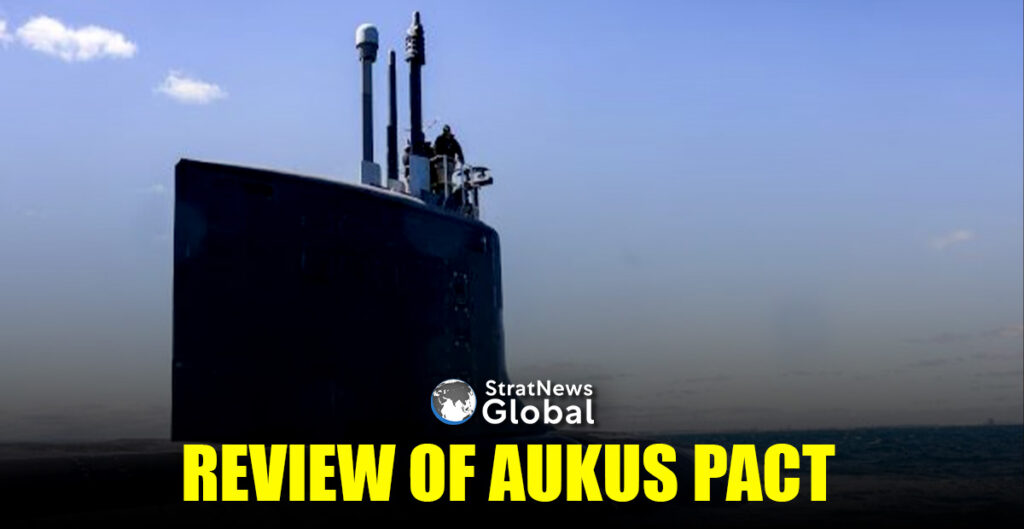
Biden Adviser Urges Continuation Of AUKUS Submarine Pact Despite Ongoing Issues
An adviser to former U.S. President Joe Biden, defended the AUKUS pact on Monday, cautioning against its cancellation as the Pentagon reviews the project to supply Australia with nuclear-powered submarines.
The adviser acknowledged, however, that the initiative faces significant hurdles that must be addressed for it to move forward successfully.
In a joint paper authored with a former State Department official, Abraham Denmark recognized the need for “a thorough review of AUKUS by the Trump administration.”
But he added: “Should AUKUS fail or be scrapped, the United States would become less capable in the Indo-Pacific … its international credibility would be dramatically undercut, deterrence would be undermined, and propaganda from Beijing and Moscow declaring the unreliability of American commitments would gain significant credibility.”
The paper, written for Washington’s Center for the Strategic and International Studies think tank, listed well-known problems that need to be addressed, including lagging U.S. submarine production rates and the question of whether Australia would use submarines supplied by the U.S. in an Indo-Pacific conflict while depleting U.S. resources in acquiring them.
Issues To Be Addressed
The report also highlighted the high costs of AUKUS – it is estimated it will cost Australia $240 billion (A$368 billion) over more than 30 years – a shortage of skilled labor for submarine production in all three countries, and other practical issues such as a lack of progress in ensuring “AUKUS visas” to facilitate movement for people involved in the project.
It also pointed at a vague focus of the so-called Pillar Two of AUKUS aimed at collaboration in high-tech weaponry and said this needs to be narrowed.
The report, which Denmark co-authored with Charles Edel, a former State Department official now also at CSIS, said despite the issues, “shoring up AUKUS” was a “strategic imperative.”
It said AUKUS would “boost the United States’ defence industrial base, strengthen its closest allies, send a powerful deterrent message to Beijing, and help stabilize the (Indo-Pacific) region.”
Details of the AUKUS plan to provide Australia with nuclear-powered attack submarines from the early 2030s were unveiled in 2023 under former President Joe Biden, part of efforts to counter China’s ambitions in the Indo-Pacific.
The Pentagon has said a review it announced in June of the three-way collaboration between Australia, Britain and the United States to ensure it aligns with President Donald Trump’s “America First agenda” will be completed in the autumn.
The review has been led by Elbridge Colby, the Pentagon’s under secretary of defence for policy, who has previously expressed concern the U.S. would lose submarines to Australia at a critical time for deterrence against China.
Last month, the Republican and Democratic heads of a U.S. congressional committee for strategic competition with China stressed their strong support for AUKUS.
(With inputs from Reuters)
Trump Criticizes South Korea Ahead Of First Summit With President Lee
Hours before his planned meeting on Monday with South Korea’s new President Lee Jae Myung, U.S. President Donald Trump criticized Seoul, as disputes over defence spending and trade weigh on the long-standing alliance.
The leaders were gearing up for their first summit when Trump said on social media, without providing evidence, that there “Seems like a Purge or Revolution” in South Korea and that “We can’t have that and do business there.”
The remarks cast a dark mood over what, for Lee, are high-stakes talks. He took office in June following a snap election called after his conservative predecessor, Yoon Suk Yeol, was removed for his December attempt to impose martial law.
South Korea’s economy relies heavily on the U.S., with Washington underwriting its security with troops and nuclear deterrence. Lee wants to chart a balanced path of cooperation with the U.S., while avoiding antagonizing South Korea’s top trade partner, China.
Trump did not spell out the reasons for his complaint. But they appeared aligned with those lodged by Korea’s far-right movement, especially evangelical Christians and supporters of Yoon, who is on trial on charges of inciting an insurrection.
Those Yoon supporters see the ex-president as the subject of communist persecution and have leveled unsubstantiated claims of election tampering in the vote that brought Lee to power in June.
South Korea’s presidential office told local media they were looking into the matter. The White House did not immediately respond to emailed questions about Trump’s post.
Complex Negotiations
South Korea has long come under targeted criticism from Trump, who has called it a “money machine” that takes advantage of American military protection.
“Regardless of how this specific incident plays out, Trump has nicely illustrated how unreliable and capricious he is for allies,” said Mason Richey, professor at Seoul’s Hankuk University.
The two countries are engaged in lower-level negotiations over trade, nuclear power, and military spending. Several top officials, including the foreign minister, rushed to Washington over the weekend to try to iron out final details.
Trump planned to discuss “North Korea, defence posture, trade barriers, maritime security, American shipbuilding, energy dominance, and more,” according to a White House official.
Lee’s goal coming into the meeting has been to sidestep some of the thorniest issues, make a good impression, connect personally with Trump, and above all, avoid any unpleasant surprises, analysts said.
As part of his preparations for the summit, Lee told reporters during his flight to Washington that he had read “Trump: The Art of the Deal,” the president’s 1987 memoir.
Under heavy pressure from Trump’s administration, South Korean negotiators secured a last-minute deal last month to avoid the harshest of new U.S. tariffs, but they must still hammer out details of billions of dollars in promised investments in the United States.
More Spending On Defence
“There are many major topics in the security field,” Lee’s top policy aide, Kim Yong-beom, said last week. “Our position is that trade was already finalized last time. We hope that specific implementation plans for trade won’t be included in the summit at all, or at least should be kept simple if discussed.”
Lee, who arrived in Washington on Sunday, will highlight some of South Korea’s expected investments when he visits a shipyard in Philadelphia owned by the country’s Hanwha Group after the summit. Cooperation to help the ailing U.S. shipbuilding sector is part of the broad tariff agreement reached between the countries.
Trump is expected to pressure Lee to commit to more spending on defence, including potentially billions of dollars more toward the upkeep of 28,500 American troops stationed in South Korea.
Wi Sung-lac, Lee’s top security adviser, said South Korea was in talks with Washington over defence spending, taking as a reference NATO’s agreement on a big new defence spending target. Wi added that the government was also looking into a plan for the purchase of American weapons.
While focusing on increasing military spending, Lee will likely seek to avoid conversations about a potential reduction of U.S. troops or using them for a wider range of operations, or details on modernizing the alliance, said Duyeon Kim, from the Center for a New American Security.
Engaging North Korea
Lee told reporters it would be difficult for Seoul to accept the demand by the U.S. to adopt “flexibility” in operating the U.S. military stationed in South Korea. The phrase means allowing U.S. troops in the country to address regional security issues, such as China, in addition to North Korea.
“They should leave those topics for working-level officials to hash out,” Kim said. “Ambition could backfire.”
As he headed to the U.S., Lee sent a special delegation to Beijing, which delivered a message calling for normalized relations with China that have been strained in recent years.
Trump and Lee may also discuss efforts to persuade North Korea to freeze and eventually abandon its nuclear weapons program. Both leaders support engaging Pyongyang, and Lee has called for a phased approach to denuclearization.
North Korean leader Kim Jong Un says South Korea and the U.S. remain hostile to his country, and he will never give up his nuclear arsenal. Over the weekend, Kim supervised the test firing of new air defence systems.
Before meeting Trump, the South Korean leader traveled to Tokyo to meet Japanese Prime Minister Shigeru Ishiba on Saturday to build on cooperation between South Korea, Japan, and the U.S.
A commentary carried by North Korea’s state media on Monday criticized Lee’s “despicable” trip to Tokyo as a “begging message towards the master of the White House” by highlighting trilateral military cooperation.
(With inputs from Reuters)
White House Hints At More Equity Stakes After Intel Deal
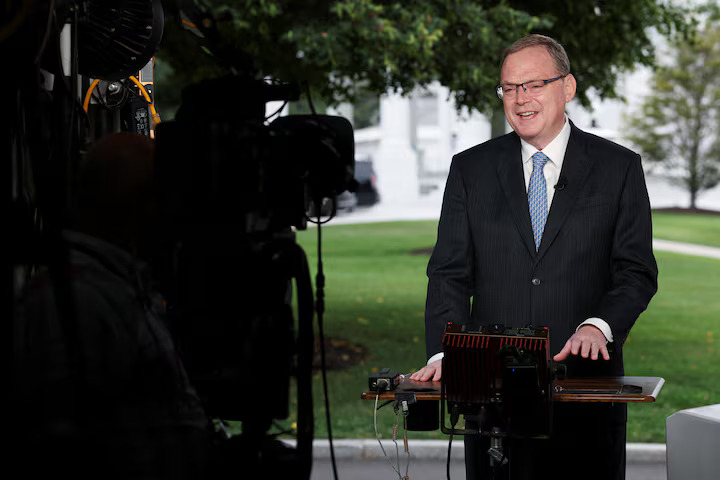
The central government may acquire stakes in more American chip firms or even diversify into other industries, White House economic adviser Kevin Hassett told CNBC on Monday, following its recent equity deal with Intel.
Hassett, asked if the Intel deal was the start of a larger effort by the US government to take equity stakes in other industries that it subsidizes, or other companies in the AI and chip space that are subsidized such as Advanced Micro Devices Inc, or Taiwan Semiconductor Manufacturing Co, said there could be other similar transactions.
US Govt Stake Deals Widen
“I think this is a very, very special circumstance because of the massive amount of CHIPS Act spending that was coming Intel’s way,” the National Economic Council director told CNBC.
“But the president has made it clear all the way back to the campaign that he thinks that, in the end, it would be great if the US could start to build up a sovereign wealth fund. And so, I’m sure that at some point there’ll be more transactions, if not in this industry in other industries,” Hassett said.
Corporate Risk Concerns Grow
The Intel investment marks the latest unusual deal with US companies that has worried critics, who say President Donald Trump’s actions create new categories of corporate risk.
Under Trump, the US government has allowed AI chip giant Nvidia to sell its H20 chips to China, allowed the Pentagon to become the largest shareholder in mining company MP Materials, and acquired a “golden share” with certain veto rights as part of Japan’s Nippon Steel purchase of US Steel.
Intel Flags Risks
Intel on Monday said the US government’s 10% stake in the company could bring business risks, including possible impact on international sales and challenges in securing future government grants.
The company laid out the new “risk factors” in a securities filing after the government decided to convert government grants into an equity stake in Intel.
It is uncertain if this deal may result in other government entities trying to convert their existing grants into equity investments or if they might be unwilling to support future grants, the company said.
(With Inputs from Reuters)
US Ownership A Risk To Global Biz, Says Intel
Intel on Monday said the US government’s 10% stake in the company could bring business risks, including possible impact on international sales and challenges in securing future government grants.
The company laid out the new “risk factors” in a securities filing after the government decided to convert government grants into an equity stake in Intel, the latest extraordinary intervention in corporate America by President Donald Trump.
It is uncertain if this deal may result in other government entities trying to convert their existing grants into equity investments or if they might be unwilling to support future grants, the company said.
Grants Converted To Equity
Intel shares will be bought with the $5.7 billion in unpaid grants from the Biden-era CHIPS Act and $3.2 billion awarded to Intel for the Secure Enclave programme, also given under Trump’s predecessor, Democratic President Joe Biden.
“To the maximum extent permissible under applicable law,” Intel’s obligations under the CHIPS Act will be considered discharged, barring the Secure Enclave programme, according to the filing.
The transaction is expected to close on August 26.
Global Business Impact Possible
Intel’s non-US business may also be impacted by the US government being a significant stockholder as this could subject the company to additional regulations or restrictions such as foreign subsidy laws in other countries, the filing said.
Sales outside the US accounted for 76% of its revenue for the fiscal year ended December 28, 2024, while revenue from China contributed 29% to total revenue.
Trump’s deal with Intel came after CEO Lip-Bu Tan’s meeting with the president, who had demanded his resignation over his ties to Chinese firms.
Shareholder Power To Shrink
The company also said that the shares to be issued to the US government at a discount to the current market price is dilutive to existing stockholders.
The government is purchasing Intel shares at a $4 discount to Intel’s closing stock price of $24.80 on Friday.
The government’s stake also reduces the voting influence of other stockholders, while its substantial additional powers over laws and regulations impacting Intel, may limit Intel’s ability to pursue transactions that benefit shareholders, the filing said.
(With Inputs from Reuters)
Wrongfully Deported Migrant Abrego Faces Possible Removal To Uganda Or Costa Rica
Kilmar Abrego, the migrant whose erroneous deportation to El Salvador turned him into a symbol of United States President Donald Trump’s stringent immigration policies, has been called to appear before federal officials in Baltimore on Monday, confronting the possibility of being deported once more, this time to Uganda.
Abrego, 30, was released from criminal custody in Tennessee on Friday and returned to a family home in Maryland after more than five months of detention, including time in a controversial mega-prison in his native El Salvador known for its harsh conditions. But he may not be free for long, as immigration officials could take him into custody and initiate new deportation proceedings.
U.S. officials have offered to deport him to Costa Rica – like El Salvador, a Spanish-speaking country in Central America – if he pleads guilty to charges of transporting migrants living illegally in the U.S., according to his lawyers. Without a guilty plea, he could be removed to Uganda, an East African country that is “far more dangerous,” his lawyers said in court documents filed on Saturday.
Abrego has pleaded not guilty, but his lawyers acknowledged they have entered plea discussions with the government to possibly avoid deportation to Uganda.
His lawyers are also asking the court to dismiss the charges, saying he had been “vindictively and selectively” prosecuted out of Trump administration retaliation for challenging his previous deportation.
Abrego was deported to El Salvador in March despite a 2019 immigration court ruling that he not be sent there due to a risk of persecution by gangs. He was flown back to the U.S. in June to face the new charges.
‘Administrative Error’
His case drew attention as the Trump administration, for months, took no apparent steps to bring him back despite an official’s acknowledgement that his deportation had been an “administrative error” and a federal judge’s order to facilitate his return.
U.S. District Judge Waverly Crenshaw last month affirmed U.S. Magistrate Judge Barbara Holmes’ order for Abrego to be released from pre-trial custody, finding he was neither a danger to the community nor a risk of flight.
Homeland Security Secretary Kristi Noem said the U.S. government still considered him a dangerous criminal and an immigration violator, calling him a “monster” who was released by “activist liberal judges.”
Immigration activists have announced they will hold a prayer vigil in support of Abrego outside the Baltimore field office at 7 a.m. EDT (1100 GMT), an hour before his scheduled check-in with U.S. Immigration and Customs Enforcement.
(With inputs from Reuters)
US Confirms First Travel-Linked Human Case Of New World Screwworm
The U.S. Department of Health and Human Services on Sunday reported the nation’s first human case of travel-associated New World screwworm, a flesh-eating parasite, originating from an outbreak-affected country.
The case, investigated by the Maryland Department of Health and the U.S. Centres for Disease Control and Prevention, was confirmed by the CDC as New World screwworm on August 4, and involved a patient who returned from travel to El Salvador, HHS spokesman Andrew G. Nixon said in an email to Reuters.
Earlier, Reuters reported that beef industry sources said last week that the CDC had confirmed a case of New World screwworm in a person in Maryland who had travelled to the United States from Guatemala.
Nixon did not address the discrepancy in the source of the human case.
“The risk to public health in the United States from this introduction is very low,” he said.
The U.S. government has not confirmed any cases in animals this year.
The differing accounts from the U.S. government and industry sources on the human case are likely to further rattle an industry of cattle ranchers, beef producers and livestock traders already on high alert for potential U.S. infestations as screwworm has moved northward from Central America and southern Mexico.
Texas Outbreak
The government’s confirmation of a screwworm case comes just over a week after U.S. Department of Agriculture Secretary Brooke Rollins travelled to Texas to announce plans to build a sterile fly facility there as part of efforts to combat the pest.
The USDA has estimated a screwworm outbreak could cost the economy in Texas, the biggest U.S. cattle-producing state, about $1.8 billion in livestock deaths, labour costs and medication expenses.
An executive of the industry group Beef Alliance sent emails last week to about two dozen people in the livestock and beef sectors, informing them that the CDC had confirmed a human case of screwworm in Maryland in a person who had traveled to the U.S. from Guatemala, according to a source, who asked not to be identified, and who shared the contents of the emails with Reuters.
Beth Thompson, South Dakota’s state veterinarian, told Reuters on Sunday that she was notified of a human case in Maryland within the last week by a person with direct knowledge of it.CDC deferred questions to Maryland on a call with state animal health officials, Thompson said.“We found out via other routes and then had to go to CDC to tell us what was going on,” she said. “They weren’t forthcoming at all. They turned it back over to the state to confirm anything that had happened or what had been found in this traveller.”
Another source said that state veterinarians had learned about a human case in Maryland during a call last week with the CDC. A Maryland state government official also confirmed a case.
A spokesperson for the Maryland Department of Health did not immediately respond to requests for comment.
What Are Screwworms?
Screwworms are parasitic flies whose females lay eggs in wounds on any warm-blooded animal. Once the eggs hatch, hundreds of screwworm larvae use their sharp mouths to burrow through living flesh, eventually killing their host if left untreated.
The maggots’ feeding is similar to a screw being driven into wood, giving the pests their name.
Screwworms can be devastating in cattle and wildlife, and rarely infest humans, though an infestation in either an animal or a person can be fatal.
Treatment is onerous and involves removing hundreds of larvae and thoroughly disinfecting wounds. But infestations are typically survivable if treated early enough.
The emails from the Beef Alliance executive said that due to patient privacy laws, there were no other details available about the positive human case of screwworm. The person was treated, and prevention measures were implemented in the state, the email said.
A livestock economist at Texas A&M University was asked to prepare a report for Rollins on the impacts to industry of the border closure to Mexican cattle, according to the emails, a measure that has largely been in effect since November to prevent the arrival of screwworm to the United States.
The CDC was required to report the positive New World screwworm case to both Maryland health officials and the Maryland state veterinarian, one of the emails said, adding that the CDC also notified other agriculture stakeholders.
“We remain hopeful that, since awareness is currently limited to industry representatives and state veterinarians, the likelihood of a positive case being leaked is low, minimising market impact,” the beef industry executive wrote.
A representative for the Beef Alliance did not respond to requests for comment.
Impact On Beef And Cattle Futures
Livestock traders and beef producers have been on edge about the potential for cases in cattle as prices have already hit record highs because the U.S. cattle herd is at its smallest size in seven decades.
A human case and the lack of transparency around it could present a political challenge for Rollins. The USDA has set traps and sent mounted officers along the border, but it has faced criticism from some cattle producers and market analysts for not acting faster to pursue increased fly production.
Rollins first announced plans for a sterile fly facility at Moore Air Force Base in Edinburg, Texas – near where a production facility to combat screwworm operated during the last major outbreak 50 years ago – in June, saying that the facility would take two to three years to come online.
A spokesperson for the USDA did not immediately respond to a request for comment.
Mexico has also taken efforts to limit the spread of the pest, which can kill livestock within weeks if not treated. The Mexican government said in July that it started to build a $51 million sterile fly production facility in the country’s south.
The sole operating plant is in Panama City and can produce a maximum of 100 million sterile screwworm flies each week. The USDA has estimated that 500 million flies would need to be released weekly to push the flies back to the Darien Gap, the stretch of rainforest between Panama and Colombia.
Spreading Northward
Screwworms have been travelling north through Mexico from Central America since 2023. They are endemic in Cuba, Haiti, the Dominican Republic and countries in South America, according to the USDA.
Mexico reported a new case about 370 miles (595 km) south of the U.S. border in Ixhuatlan de Madero, Veracruz, in July. The USDA immediately ordered the closure of livestock trade through southern ports of entry, after previously halting imports in November and May.
The U.S. typically imports over a million cattle from Mexico a year to fatten in feedlots and process into beef.
Screwworms were eradicated from the United States in the 1960s when researchers began releasing massive numbers of sterilised male screwworm flies that mate with wild female screwworms to produce infertile eggs.
(With inputs from Reuters)