

Support us by contributing to StratNewsGlobal on the following UPI ID
ultramodern@hdfcbank

Strategic affairs is our game, South Asia and beyond our playground. Put together by an experienced team led by Nitin A. Gokhale. Our focus is on strategic affairs, foreign policy and international relations, with higher quality reportage, analysis and commentary with new tie-ups across the South Asian region.
You can support our endeavours. Visit us at www.stratnewsglobal.com and follow us on YouTube, Twitter, Facebook and Instagram.
र 500 per month
र 1000 per month
र 5000 per year
र 10000 per year
Donate an amount of your choice
र 500 per month
Donate र 500 per month

र 1000 per month
Donate र 1000 per month
र 5000 per year
Donate र 5,000 per year
र 10000 per year
Donate र 10,000 per year
Donate an amount of your choice
Donate an amount of your choice







Trump Admin To Reclaim Control Of Washington Union Station
The US Transportation Department is set to take back control of Washington Union Station, one of America’s busiest rail hubs, in President Donald Trump’s latest push to expand federal oversight in what he often describes as a neglected and poorly managed capital city.
“We think we can manage the property better,” Transportation Secretary Sean Duffy said. “We are going to make the investments to make sure that this station isn’t dirty and we don’t have homelessness in Union Station.”
Seeking More Control
The plan to reclaim Union Station follows Trump’s move this month to deploy hundreds of National Guard troops to Washington after he took control of the local police department over the objections of local leaders.
In March, the White House forced the CEO of US passenger railroad company Amtrak, Stephen Gardner, to step down following orders by Trump.
Duffy said the plan for Union Station was not a “power play” but to attract new tenants and revenue to overhaul the station, adding that formal action confirming his department’s renewed control of Union Station was expected next month.
Current Management
The majestic Beaux-Arts style station, which opened in 1907, is owned by the federal government but has been run by a non-profit corporation working with Amtrak.
The station has billions of dollars of spending pending in long-delayed maintenance, tracks, parking and other needs. It also has faced homeless and crime issues including a murder in February in a Union Station parking garage.
National Guard troops have guarded sites in Washington since mid-August including Union Station, and Vice President JD Vance visited soldiers at the station last week.
New Plan
President Joe Biden’s administration awarded the station a $24 million grant in November. Deputy Transportation Secretary Steve Bradbury said a $10 billion planned redevelopment of Union Station announced during the Biden administration would be scrapped and a new plan will be adopted.
Duffy said the department was renegotiating a cooperative agreement with the non-profit Union Station Redevelopment Corporation, which controls the station, and Amtrak.
New Trains
Amtrak inaugurated new high-speed Acela trains on Wednesday on the Northeast Corridor that links Boston to Washington, the busiest US rail route with 800,000 daily trips in a region representing 20% of the US economy.
The new trains can run at speeds up to 160 mph (260 kph), 10 mph faster than the current trains, but they will initially only be able to run at that faster speed on a very limited portion of track until additional works are undertaken.
In April, the Transportation Department said it would withdraw the Metropolitan Transportation Authority from leading the Penn Station Reconstruction project in New York City. Instead, Amtrak, backed by the department, will oversee the project in midtown Manhattan.
Old Habits
During his first term, Trump repeatedly sought to cut funding to Amtrak, which received about $2.4 billion in annual federal support in 2023. Congress in March approved $2.42 billion for Amtrak through September 30 in annual funding.
Duffy said on Wednesday that the department supports “appropriate” funding for Amtrak, which set a new passenger record last year.
(With inputs from Reuters)
Coastal Surges Devastate Nigerian Community As Commonwealth Pledges Remain Unfulfilled
In June, an ocean surge ravaged Apakin, one of Lagos’ last indigenous coastal communities, where 3,000 residents already battling rising seas now fear losing their ancestral land despite unfulfilled Commonwealth pledges of support.
“We only have two graves left from my father’s lineage. “We’ve been trying to move them, but we haven’t found the place to move them to,” Iyowun said, pointing into the ocean where his house and that of his father once stood.
About 80% of the Lagos shoreline has been washed away in the past five decades, according to a 2022 report in the Journal of African Earth Sciences. The study blamed deepwater ports along the Bight of Benin as the main reason for erosion.
Lagos has more than a dozen coastal communities battling ocean surges, but Apakin’s residents say they’re among the worst hit. On land once known for coconut farming, a final 50-metre stretch of trees vanished four years ago.
Iyowun said the building he used as a palace when he was appointed the village head three years ago had also gone.
Long-Term Climate Threat
Lagos State says rising seas pose the biggest long-term climate threat, but environmentalist Philip Jakpor argues that government-backed projects like the massive Dangote oil refinery and deep-sea ports are equally damaging to coastal communities.
“A lot of dredging is happening, which is pushing water in the direction of communities, swallowing communities,” said Jakpor.
Meanwhile, Nigerian activist Akinbode Oluwafemi pointed out that the ‘Living Lands Charter’ adopted by leaders at the 2022 Commonwealth summit in Kigali, Rwanda, was non-binding, unenforced and failing to deliver a concrete plan to protect coastal communities.
“The Kigali Declaration acknowledges human factors that will worsen climate change. However, it did not expressly adopt any clear resolution in terms of bringing corporations that are causing climate change into accountability,” he said.
(With inputs from Reuters)
England Flags Stir Pride And Concerns Amid Anti-Migrant Protests
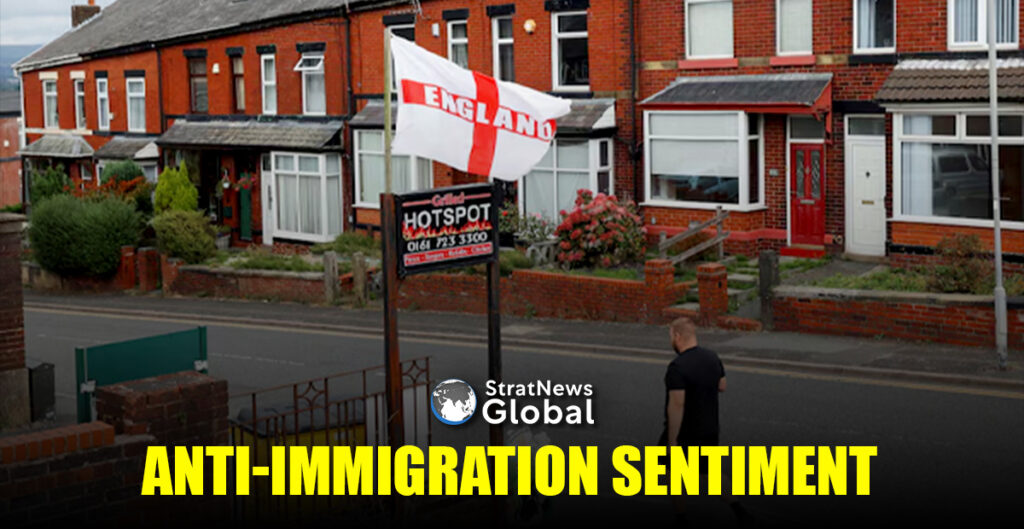
The recent proliferation of St George’s Cross and Union Jack flags across England has become a flashpoint in a politically charged summer dominated by migration debates, with supporters citing national pride and critics warning of rising anti-immigration sentiment.
“It’s our flag, we should be able to feel proud to fly it,” said Livvy McCarthy, a 32-year-old bartender, as she walked past a pedestrian crossing in the Isle of Dogs, London, painted to resemble the English flag. “Every other country can do the same, so what’s the problem?”
National flags often hang from public buildings in Britain, but it is rare for them to appear in the streets outside of sporting, royal or military events.
The appearance of flags has coincided with a wave of protests in recent weeks outside hotels sheltering asylum seekers.
Fuelled by social media, the movement appears to have originated with the Birmingham-based Weoley Warriors, with several groups now encouraging the display of more flags.
‘Proud English Men’
The Warriors call themselves a group of “proud English men” on their fundraising page, which says they want to show how “proud we are of our history, freedoms and achievements”. They did not give any further details as to their motives for hanging the flags, which have appeared in several English cities, predominantly in the West Midlands.
In the 1970s, the Union flag was adopted as a symbol by the far-right National Front party, which openly promoted white supremacist views, while the Cross of St George, the patron saint of England, likewise was brandished by English soccer hooligans and extreme right-wing groups.
As a result, while some regard displaying the flag as showing patriotism, others, including those from migrant communities or ethnically diverse backgrounds, are concerned they are being targeted.
Stanley Oronsaye, a 52-year-old hospitality worker from Nigeria and a resident of the Isle of Dogs, said people should be free to express their views on migration policy, so long as it remains within the law.
Yet he felt uneasy. The Tower Hamlets borough, which is home to the Isle of Dogs, is one of the most diverse areas in Britain, with nearly half of the residents born outside the UK.
“The worry is from the fact that if it escalates, it can turn into something else,” Oronsaye said. “It’s worrisome when… nationalism is allowed to take a different tone.”
Jason, 25, who declined to give his last name, said the flags were about “getting English culture back”.
“We are seeing more of other cultures than we are of our own now,” he said on the streets of Tower Hamlets.
Waves Of Protest
The protests outside hotels housing asylum seekers in recent weeks were triggered in part after an Ethiopian asylum seeker staying in a hotel north of London was charged last month with sexual assault. He denies the charge.
It follows a wave of riots last summer targeting asylum seekers and ethnic minorities in several British cities, after three young girls were murdered at a Taylor Swift-themed dance event, with social media falsely attributing the attack to a radical Islamist immigrant.
Prime Minister Keir Starmer said at the time the violence was the result of “far-right thuggery”.
Asked about the flag movement, a spokesperson for Starmer said the prime minister views flags as symbols of the nation’s heritage and values, but has recognised that some want to use them to cause conflict.
The prime minister, the spokesperson said on Tuesday, recognises people’s frustrations with the economy and the pressures illegal migration is putting on local communities.
Some councils have removed flags, citing safety reasons.
Tower Hamlets council said flags may be displayed on private property, but that any flag attached to council infrastructure would be removed.
“We are aware that some individuals putting up flags are not from our borough and that there have been wider attempts by some coming from outside our borough to sow division,” it said in a statement, without providing further details.
Politicians Endorse Flag Displays
The display of flags has been endorsed by several politicians, including Nigel Farage, the former Brexit campaigner, whose Reform UK tops opinion polls and the opposition Conservative Party.
Robert Jenrick, a leading Conservative politician, described councils removing the flags as “Britain-hating councils” and said on X: “We must be one country, under the Union Flag.”
U.S. billionaire Elon Musk, who has promoted far-right politicians across Europe, including in the UK, posted a picture of the English flag on his X platform on Tuesday.
In the Isle of Dogs, a peninsula in east London near the Canary Wharf financial district, many of the flags were displayed near the Britannia Hotel, a government-designated hotel for asylum seekers that has been the site of protests.
Local resident Shriya Joshi, a 26-year-old from India, said she remained unsure about the flags’ true purpose.
“If it’s a message to the immigrant community or anything of that sort, then it’s not that pleasant,” she said.
(With inputs from Reuters)
US: 3 Dead In Minneapolis School Shooting, 17 Injured
A tragic shooting rocked a Catholic school in Minneapolis on Wednesday, as a gunman in black opened fire during Mass, killing two children and injuring 17 others, authorities said — marking a horrific start to the new US school year.
The assailant, a man in his early 20s, fired dozens of rounds through the church windows at students sitting in church pews and then took his own life, officials said. The children killed were 8 years old and 10 years old, they said.
‘Deliberate Act Of Violence’
“This was a deliberate act of violence against innocent children and other people worshiping. The sheer cruelty and cowardice of firing into a church full of children is absolutely incomprehensible,” Minneapolis Police Chief Brian O’Hara told reporters.
The shooting occurred two days after school started at Annunciation Catholic School, a private elementary school with about 395 students connected to a Roman Catholic church in a residential area in the southeast part of Minnesota’s largest city. Local TV showed parents ducking under yellow police crime tape and leading students out of the school.
At least two of the chapel doors had been barricaded from the outside using 2″ x 4″ planks, O’Hara said.
Investigating Motive
Officials said the shooter was armed with a rifle, a shotgun and a pistol and did not have an extensive criminal history. They did not provide his name and said they were trying to identify a motive. Officials also said they found a smoke bomb at the scene and were searching a vehicle in the parking lot.
Law enforcement was investigating multiple online videos to determine if they were posted by the shooter, according to two sources who spoke on condition of anonymity.
Regular Occurrence
Local hospitals said they were treating 15 children and two adults, with many suffering gunshot wounds.
School shootings occur on a regular basis in the US, spurring ongoing debates about gun laws and school safety. There have been more than 140 such incidents so far this year, according to the K-12 School Shooting Database.
“Don’t just say this is about thoughts and prayers right now. These kids were literally praying. It was the first week of school. They were in a church,” Minneapolis Mayor Jacob Frey said at a news conference, visibly angry.
US President Donald Trump said he had been briefed on the shooting and said the FBI was on the scene. “Please join me in praying for everyone involved!” he said on social media.
There have been three other shootings in the midwestern city since Tuesday afternoon, including one at a Jesuit high school, that have together left three people dead and seven wounded, according to police.
Wednesday’s shooting did not appear to be related to the others, O’Hara said.
Rise In Homicide
Minneapolis has experienced a significant rise in homicides in the years following the 2020 police killing of George Floyd, which prompted nationwide protests, civil disturbances and staffing shortages in the city’s police department. The city recorded 54 homicides last year, down from 71 in 2021 but well above the 29 recorded in 2019.
Minnesota as a whole has a gun death rate below the national average, according to Everytown for Gun Safety, a gun violence prevention group.
Minnesota also experienced an outburst of political violence in May, when a gunman posing as a police officer killed the Democratic state House speaker and her husband and wounded a Democratic state senator and his wife, in what authorities said were targeted assassinations. The suspect has pleaded not guilty to federal murder charges.
(With inputs from Reuters)
Protests Erupt In Lebanon Over US Envoy’s Remarks
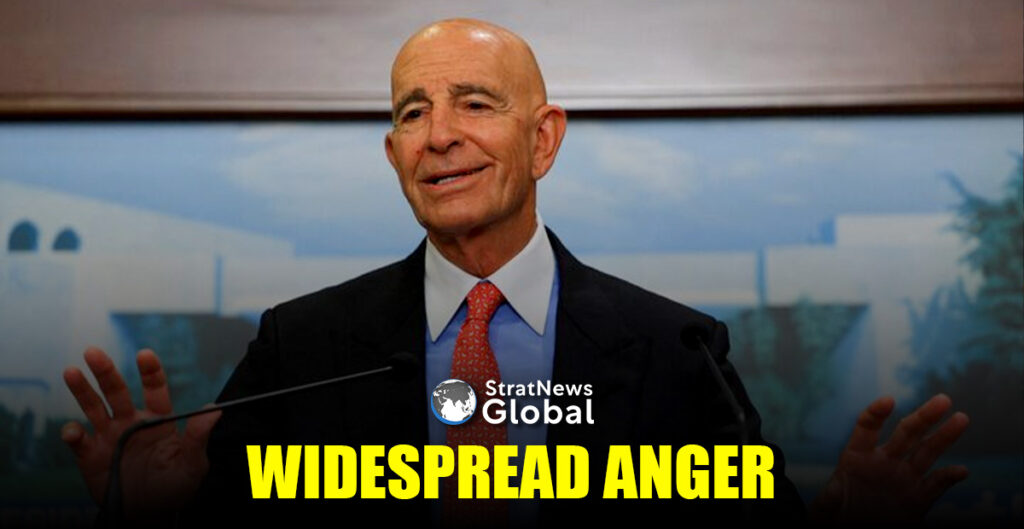
Hundreds gathered in southern Lebanon on Wednesday to protest against the visit of US envoy Thomas Barrack, a day after he sparked outrage by publicly rebuking Lebanese journalists.
Lebanon’s state news agency said Barrack’s visit to Tyre and the border town of Khiyam had been cancelled due to the demonstrations.
‘Death To America’
Protesters carried banners reading “Death to America” and waved the flags of Iran-backed militant group Hezbollah and its Shiite ally, the Amal movement, according to social media footage and witnesses.
The US embassy in Beirut did not immediately respond to a request for comment.
Potential Disruption
Popular opposition in southern Lebanon could complicate US efforts to promote a plan for Hezbollah’s disarmament. The plan resulted from a US-brokered truce in November between Lebanon and Israel following more than a year of conflict sparked by the war in Gaza.
The US is linking the plan to a phased Israeli withdrawal from southern Lebanon, while also promoting a US and Gulf-backed economic development zone in Lebanon’s south aimed at reducing Hezbollah’s reliance on Iranian funding.
In Khiyam, a town battered by intense clashes between Hezbollah and Israel, Siham Idrees, a 50-year-old resident, said she joined the protest with her husband and children “because we are against these decisions – Israel and America want our land, our country”.
“This is the land of the resistance and martyrs. How could an American come here after all our youth were killed?,” she told Reuters by phone.
Witnesses said the Lebanese army deployed heavily in Tyre, a UNESCO-listed city hit by Israeli strikes in last year’s war.
‘Laughable’
Nour Fares, 33, among demonstrators in Tyre, said he was protesting because he considered Barrack the head of a “colonial project” and the US-backed development plans “laughable”.
“Since 1978 people of the south never abandoned their villages,” he said.
Clash With Lebanese Reporters
On Tuesday in Beirut, Barrack clashed with Lebanese reporters at a press conference, saying he would leave if they did not “act civilized, act kind, act tolerant”.
Many Lebanese saw the remarks, widely circulated on Lebanese media, as disrespectful, and the Lebanese presidency issued a statement in support of the journalists following what it called Barrack’s “inadvertent” comments.
Hezbollah has repeatedly refused to surrender its weapons. Barrack has said the Lebanese army will present a plan on August 31 aimed at persuading the Iran-aligned movement to disarm.
(With inputs from Reuters)
Thailand To Allow Myanmar Refugees In Border Camps To Work Legally
Thailand announced on Wednesday that thousands of Myanmar refugees living in border camps between the two countries will be granted the right to take up legal employment, a decision welcomed by the United Nations refugee agency.
The policy change will grant the right to legal work in Thailand to around 80,000 refugees, many of whom have been living in the camps for more than 40 years, the government said.
Among the eligible Myanmar refugees living in nine temporary shelters along the Thai-Myanmar border since 1984, 42,601 are of working age, it said.
The decision could also help solve a potential migrant labour shortage in Thailand following an armed border conflict with Cambodia, which led to an exodus of Cambodian workers.
Around 520,000 Cambodians – about 12% of the total workforce – were employed in Thailand before the fighting erupted in July, according to official Labor Ministry data.
Migrant Labour
As of July 25, Thailand also employed nearly 3 million Myanmar workers, the ministry said Friday. It has previously said that migrant labour is critical in sectors like construction, agriculture and services.
Government spokesperson Jirayu Hongsub said on Wednesday that the Thai cabinet backed a Labor Ministry proposal to allow long-staying refugees from Myanmar living in Thailand to work, a move that officials say will bolster the economy.
The UN Refugee Agency described the policy as a “strategic investment” that would unlock the potential of refugees, enabling them to support their families and also spur local demand and job opportunities.
The agency added in a statement on Wednesday that the expansion in employment could lift GDP and strengthen economic resilience. It would also reduce reliance on humanitarian aid among the refugees, nearly half of whom were born in the camps.
“With this policy shift, Thailand transforms hosting refugees into an engine of growth – for refugees, for host communities and for the nation as a whole,” said Tammi Sharpe, the UN agency’s representative in Thailand, in the statement.
The policy could also set an example to other countries in the face of aid cuts for millions of displaced people around the world, the agency said.
(With inputs from Reuters)
Report Highlights Strains In Mali’s Military Over Wagner Presence
A new report says the presence of Russia’s Wagner mercenaries in Mali has fueled discontent within the army and government, leading to security gaps and delivering little in return, including no promised mining deals.
The Wagner group began operating in Mali after the military, which seized power in two coups in 2020 and 2021, ejected French and United Nations forces that had been involved in fighting Islamist insurgents for a decade.
Wagner announced its departure in June, but Africa Corps, a Kremlin-controlled paramilitary force, said it would stay on. About 70-80% of the Africa Corps is made up of former Wagner mercenaries, according to several Telegram chats used by Russian mercenaries seen by Reuters.
Rights groups including New York-based Human Rights Watch have repeatedly accused Wagner, fighting alongside Mali’s army, of committing atrocities against civilians.
But the report – based on interviews with officials from Mali’s military, intelligence agency, finance and mines ministries, and published on Wednesday by investigative research group The Sentry – found that Wagner had also caused trouble for the military and government it was hired to support.
Citing interviews with Malian soldiers, it said Wagner fighters would “often operate outside the chain of command”, using army equipment and even carrying out security operations without permission or prior notice.
These missions sometimes led to the loss of equipment, vehicles or personnel, the report said. At other times, they had left Malian soldiers unexpectedly without equipment to fight when insurgent attacks took place, it said.
According to the report, Malian soldiers resent Russian mercenaries who receive “preferential treatment”, such as medical evacuations that are otherwise limited due to a scarcity of fuel.
The Russian Defence Ministry and Wagner did not immediately respond to requests for comment.
Destabilisation Attempt
Earlier this month, Mali arrested more than 30 soldiers and military officers accused of trying to destabilise the military government.
Sentry investigators told Reuters that the arrests followed a meeting between two generals and several colonels to discuss grievances, including the fact that “Russians” still appeared to be in command in the military bases where they operated.
Any destabilisation attempt would likely be related at least in part to how Wagner and Africa Corps have treated Malian troops, The Sentry investigators said.
Defence Minister Sadio Camara is believed by U.S. officials to have secured the agreement for Wagner to operate in Mali; the U.S. Treasury Department in 2023 sanctioned him for doing so. But The Sentry report said President Assimi Goita himself blocked Wagner from obtaining mining licenses or concessions as payment.
Instead, it found that for Wagner and Africa Corps, “no viable business has been set up; relations with the military… have only worsened with time; and Wagner’s fearsome reputation has been undercut by a series of military setbacks”.
(With inputs from Reuters)
Ukraine Sees Digital Battlefield Data As Crucial To Securing Western Support
Ukraine is exploring ways to share its vast trove of battlefield data with allied nations, Deputy Prime Minister Mykhailo Fedorov said. He described the information as a key asset that could help Kyiv secure stronger backing from its partners.
“The data we have is priceless for any country,” Fedorov, who heads Ukraine’s digitalisation ministry, said in an interview, adding that Ukraine is currently “very careful” about sharing it.
Vast datasets are crucial for training artificial intelligence (AI) models to recognise patterns and make predictions.
That need is particularly pressing in the burgeoning global defence sector. While datasets for most civilian activities can be found commercially, the 21st century’s biggest war between advanced armies has given Ukraine a set of combat data with no parallel, which could help Kyiv prove its value as an ally to Washington.
Battlefield Statistics
Since Russia launched its 2022 invasion, Ukraine has collected reams of meticulously logged battlefield statistics. And with the war increasingly fought by drones, it now has millions of hours of combat footage filmed from the air.
“I think this is one of the ‘cards’, as our colleagues and partners say, to build win-win relations,” Fedorov said, an apparent nod to U.S. President Donald Trump, who told Ukraine’s President Volodymyr Zelenskyy in a disastrous Oval Office meeting in February that “you don’t have the cards”.
“The demand for the data is incredibly high, but at the moment we are forming policy how to organise this process correctly,” Fedorov said.
Ukraine has also sought to position itself as a testing ground for international defence companies, inviting them to try out new weapons in Ukraine. Fedorov said that nearly 1,000 applications had been received so far, and 50 different products were “coming to Ukraine”.
Ukraine now uses AI to help pilot drones, including several of its systems used for long-range attacks deep inside Russia, Fedorov said. Computers can scan detailed aerial and satellite reconnaissance imagery for targets which would take a human “dozens of hours” to find, he said.
Fedorov said work was ongoing on systems which would make drones fully autonomous, which would allow them to fly without a pilot and work in swarms.
AI Technology
He added that Ukraine was using AI technology from U.S. data analysis firm Palantir for a wide variety of purposes, such as analysing Russian strikes on Ukraine for patterns or tracking Moscow’s disinformation campaigns.
Palantir was founded by U.S. billionaire Peter Thiel, a figure influential among members of the Trump administration.
Not all Ukraine’s uses of Palantir are military: the minister said it also helped to decide where to build bomb-proof underground schools, or which territories to prioritise in demining efforts.
These days, between 80% and 90% of Russian targets struck on the battlefield are now destroyed with drones, Fedorov said.
That is an increase from 2024, when nearly 70% of troops and 75% of vehicles hit by Ukraine were struck with drones.
Fedorov, who is seen as an ally of President Zelenskyy, has at the age of 34 already served for five years as the minister in charge of Ukraine’s digitalisation effort, which has led him to be heavily involved in Ukraine’s search for innovative defence technologies to beat back its richer and better armed foe.
As part of this, his ministry has been operating a video game-style points system for confirmed kills or the destruction of Russian vehicles and equipment.
Those points can then be exchanged for drones, electronic signal jammers and other weapon systems on a sleek, Amazon-style marketplace, while units are ranked on monthly leaderboards.
‘Kill Zone’
Fedorov said that since the system was introduced a year ago, about 500,000 drones had been handed out to units in exchange for points.
“This stimulates units to kill more, to share data on the basis of which decisions are later made about what is effective and what is not.”
Ukrainian troops now regularly speak of a ‘kill zone’ on both sides of the front, where moving around in the open is rendered almost impossible by the constant threat of drones.
Fedorov estimated that this zone now stretched about 10-15 km from the front line, and that it could reach as far as 20 km in the next year.
Fedorov said that operating in such an environment was “hellish work”.
As a result, he said Ukraine is now using several thousand unmanned ground vehicles (UGVs) on the battlefield to bring in ammunition and supplies to soldiers holding the frontline in dugouts.
(With inputs from Reuters)
Polls Show Most French Favour New Elections If Government Collapses
Opinion polls released on Wednesday indicated that a majority of French citizens want new parliamentary and presidential elections, as Prime Minister Francois Bayrou’s minority government appears likely to collapse next month.
Two-thirds of people surveyed in two of the three polls also wanted President Emmanuel Macron to resign, and the far-right National Rally (RN) got the most backing to lead the next government in one poll, although not a majority.
The polling points to a deepening of the uncertainty and dissatisfaction with politics in a country that has had only minority cabinets and fragmented parliaments since Macron’s re-election in 2022.
Bayrou’s surprise announcement on Monday that he will seek a confidence vote on September 8 over his 2026 budget plans has thrown France back into crisis, prompting a steep selloff in its stocks and bonds.
The main opposition parties said they would vote against him, meaning the government is all but certain to fall.
If the government falls, Macron could name a new prime minister immediately or call a snap parliamentary election. Some opposition figures have said he should resign.
Macron said last week he does not want a snap election and has ruled out resigning.
Macron lost his previous prime minister, Michel Barnier, to a no-confidence vote over the budget in late 2024, after Barnier had been in office just three months following a previous snap election.
But a vast majority of French people want parliament dissolved for another election, separate surveys by Ifop, Elabe and Toluna Harris Interactive pollsters showed. The surveys showed that from 56% to 69% of those polled want snap parliamentary elections.
The Elabe poll for BFM TV showed 67% wanted Macron to resign if Bayrou loses the confidence vote. The Ifop poll for LCI showed a similar result.
Bulging Debt
The Toluna Harris Interactive poll for RTL showed 41% would want the RN to lead the next government – the highest score for any party, but without a majority. Some 59% were against having an RN prime minister.
The second-highest score, at 38%, would be for the next prime minister not to be a career politician.
Not all the polls asked the same questions in their surveys.
“We want to stress that, in any case, both scenarios (ie new PM or snap elections) would likely mean a prolonged period of uncertainty,” Morgan Stanley analysts wrote in a note.
There is no guarantee, under either scenario, that any new prime minister would be able to pass the budget.
Bayrou has proposed a 44 billion euro budget squeeze, as he tries to tame a deficit that hit 5.8% of gross domestic product last year, nearly double the official EU limit of 3%. He wants to scrap two public holidays and freeze most public spending.
Opposition parties say they agree with Bayrou’s assessment that France’s deficit and debt are too high, but they disagree with his proposals on how to tackle this. The left wants more of the effort to rely on the wealthy, and the far right wants to target migration policies.
“And we suspect that the closer we get to the March 2026 local elections, the more complicated it will be to reach a compromise in parliament,” Morgan Stanley said, pointing towards each group pushing their own agenda as they seek to build support among voters.
Then a political outsider, Macron was first elected in 2017 on promises to break the right-left divide and modernise the euro zone’s second-biggest economy with growth-friendly tax cuts and reforms.
Successive crises – from the protests, COVID-19 and runaway inflation – have shown he has failed to change the country’s overspending habit.
More protests have been called for September 10, two days after the confidence vote, by various groups with disparate aims on social media and backed by leftist parties and some unions.
(With inputs from Reuters)
Merz Says Franco-German Fighter Jet Decision Expected By Year-End
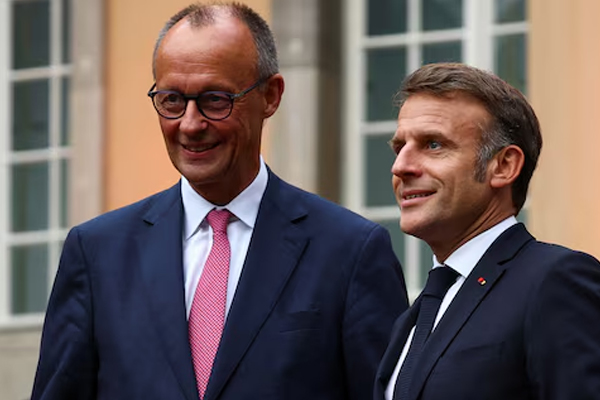
German Chancellor Friedrich Merz stated on Wednesday that he has reached an agreement with French President Emmanuel Macron to make a decision regarding the future of the Franco-German fighter jet programme FCAS by the end of the year.
“This will not be discussed at the upcoming government consultations (on Thursday and Friday in the south of France),” Merz told reporters in Berlin.
“I hope we will find a solution because we need to develop a new fighter jet in Europe,” he added.
Berlin blames French industry for blocking the next phase in the development of the FCAS programme, estimated to cost more than 100 billion euros ($117 billion), by demanding sole leadership of the project, Reuters reported on Tuesday.
France’s Dassault Aviation, which is responsible for the core crewed fighter part of the project, declined to comment.
Airbus and Indra are also involved in the scheme to start replacing French Rafale and German and Spanish Eurofighters with a sixth-generation fighter jet from 2040.
FCAS Dispute
But Berlin and Paris are at odds over the composition of the consortium. France has told Germany it wants a work-share of some 80% in FCAS, a defence industry source told Reuters in July.
The differences jeopardise the launch of the second phase of the programme, targeted by the end of the year: the development of airworthy demonstrators, defence sources said.
At the end of July, Dassault CEO Eric Trappier said FCAS needed clearer leadership and organisation as partners move towards the second phase, and that in practice, decisions over key parts of the current design phase were having to be cleared with Airbus, adding complexity and contributing to delays.
On Thursday, Macron is set to receive Merz for dinner at his Bregancon residence on the Mediterranean coast, with ministers joining the talks on Friday in nearby Toulon.
A French presidency official told reporters in a briefing on Monday that the talks would touch upon the “slight” differences surrounding the fighter jet, adding there was a strong resolve by both sides to make the project work.
($1 = 0.8542 euros)
(With inputs from Reuters)