

Support us by contributing to StratNewsGlobal on the following UPI ID
ultramodern@hdfcbank

Strategic affairs is our game, South Asia and beyond our playground. Put together by an experienced team led by Nitin A. Gokhale. Our focus is on strategic affairs, foreign policy and international relations, with higher quality reportage, analysis and commentary with new tie-ups across the South Asian region.
You can support our endeavours. Visit us at www.stratnewsglobal.com and follow us on YouTube, Twitter, Facebook and Instagram.
र 500 per month
र 1000 per month
र 5000 per year
र 10000 per year
Donate an amount of your choice
र 500 per month
Donate र 500 per month

र 1000 per month
Donate र 1000 per month
र 5000 per year
Donate र 5,000 per year
र 10000 per year
Donate र 10,000 per year
Donate an amount of your choice
Donate an amount of your choice
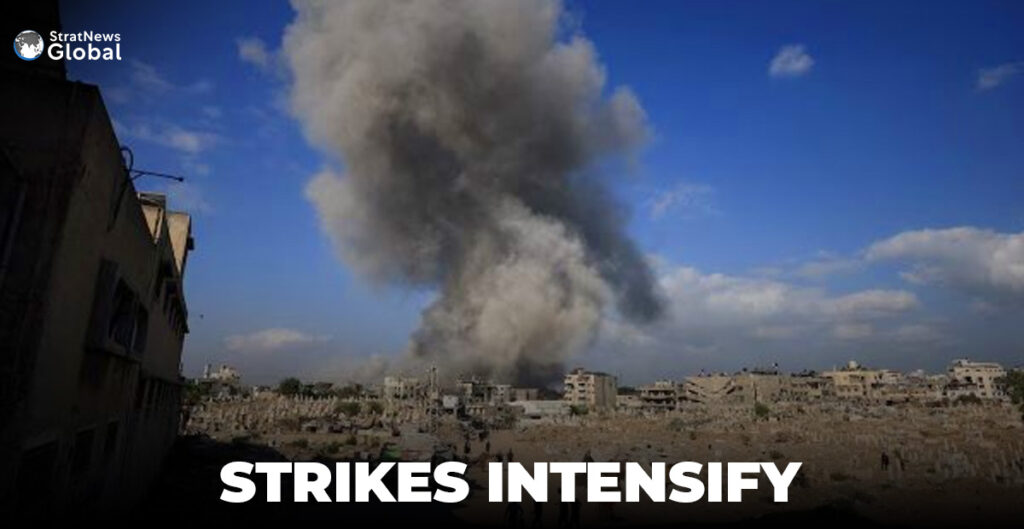



Israel Intensifies Strikes On Gaza City Outskirts As Offensive Accelerates
The Israeli military escalated its operations around Gaza City on Friday, bringing an end to brief pauses that had allowed humanitarian aid to pass through. Officials also confirmed the recovery of the body of Ilan Weiss, a hostage taken by Hamas.
Israel is pushing ahead with a plan to take full control of the whole Gaza Strip, starting with Gaza City, with the goal of destroying Hamas after nearly 23 months of war, while facing a global outcry over starvation in the besieged enclave.
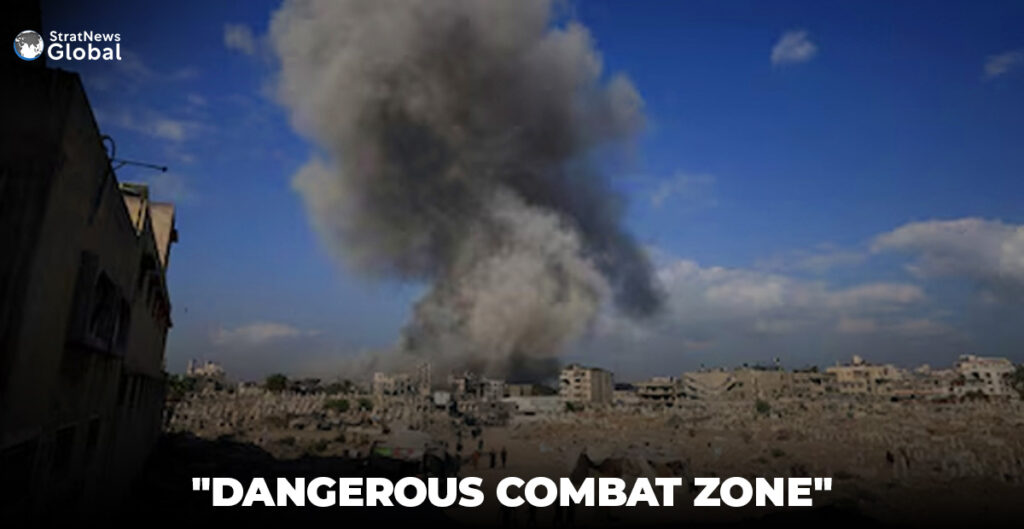
“The local tactical pause in military activity will not apply to the area of Gaza City, which constitutes a dangerous combat zone,” the Israeli military said.
The assault on Gaza City has gradually intensified over the past week as Israel has urged civilians to leave for the south of the Palestinian enclave.
The Israeli military’s Arabic-language spokesman Avichay Adraee said the military was operating with great intensity on the outskirts of Gaza City and would “deepen our strikes” as it pressed its assault.
Malnutrition And Starvation
It announced daily 10-hour tactical pauses in fighting across the enclave and new aid corridors in late July, after months of severely restricted humanitarian deliveries as images of emaciated children drew international criticism.
Last week the global hunger monitor that works with the United Nations and major aid agencies said it had determined there was famine in Gaza. Israel has rejected that determination.
Five people, including two children, died from malnutrition and starvation in Gaza over the previous 24 hours, the Gaza Health Ministry said on Friday, bringing the total number of deaths from such cases to 322 since the start of the war.
Israeli fire across the besieged Palestinian enclave killed 48 people on Friday, local health authorities said.
Video footage showed a line of bodies in white bags lying outside al-Shifa Hospital in Gaza City early on Friday as relatives sat crying nearby. One man cradled a much smaller body, one hand held across his face.
“What is the reason? Why did they strike them? Let them tell us, what did they do while they were sleeping? What did a three-year-old child do?” said Manal Sahweil, a relative of people killed in an airstrike.
The conflict began with a Hamas-led attack on Israeli communities on October 7, 2023, when gunmen stormed border defences, killing around 1,200 people according to Israeli tallies and seizing about 250 hostages.
Body Of Weiss Recovered
Israeli forces recovered the body of Weiss as well as the remains of a second individual whose identity had yet to be cleared for publication, the office of Israeli Prime Minister Benjamin Netanyahu said.
An Israeli military official said Weiss was killed on October 7, 2023, and taken from his home by Hamas fighters. His death was determined on December 3, 2023, the official said.
Weiss, 55, a resident of Kibbutz Be’eri, in southern Israel, was kidnapped from his home and killed during the October 7, 2023, cross-border attack by Hamas, the Israeli military said.
His wife, Shiri, and daughter, Noga, were also abducted and later released as part of a hostage-prisoner swap deal in November 2023.
With Weiss’s body recovered, Israel says 49 hostages remain in Gaza, of whom only 20 are believed to be alive.
The prime minister’s office said the campaign to return the hostages was ongoing. “We will neither rest nor be silent until we bring all of our hostages back home, the living and the deceased,” the statement said.
Israel’s military campaign in Gaza has killed more than 63,000 people in Gaza, mostly civilians, according to Gaza health officials.
(With inputs from Reuters)
Mexico Weighs Higher Tariffs On Chinese Imports Amid US Pressure: Report
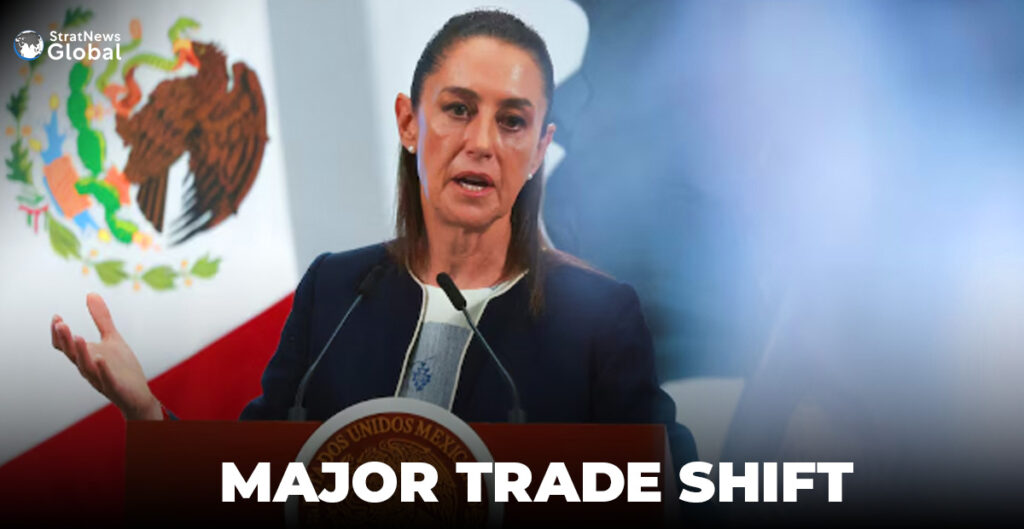
Mexico is preparing to impose higher tariffs on Chinese imports — including automobiles, textiles, and plastics — as part of its 2026 budget proposal, Bloomberg reported on Thursday.
The measure, expected to be presented to Congress next month, would represent one of the country’s most significant trade shifts in recent years.
Trump’s North America Strategy
The plan comes amid U.S. pressure to reduce reliance on Chinese supply chains, a central pillar of President Donald Trump’s “Fortress North America” strategy.
Washington has long criticised what it sees as loopholes in the U.S.-Mexico-Canada Agreement (USMCA), which allow Chinese goods to reach the American market through Mexico.
Trump has been particularly vocal about Chinese carmakers building massive plants in Mexico to export vehicles northward, warning during last year’s election campaign that such moves would trigger tariffs as high as 250%.
Mexico imported more than $51 billion worth of goods from China in 2024, accounting for nearly 20% of its total purchases abroad.
This surge has made Mexico China’s biggest overseas vehicle market, but has also fueled complaints from local manufacturers, who say they cannot compete against heavily subsidised Chinese goods.
While China is the main target, officials have suggested that tariff hikes could extend to other Asian exporters.
‘Plan Mexico’
The proposal, according to three sources cited by Bloomberg, is part of “Plan Mexico” — a broader government strategy to expand industrial parks, channel public investment into manufacturing, and close budget gaps.
This follows earlier measures aimed at curbing Chinese e-commerce.
In January, Mexico imposed a 19% tax on low-value parcels from platforms like Shein and Temu, later raising it to 33.5% in July.
Authorities framed these steps as both a response to U.S. concerns about cheap imports flooding North America and a way to close customs loopholes.
Mexico is also seeking new revenue sources after its budget deficit reached 5.9% of GDP in 2024, the highest in over three decades.
The final tariff details are still being negotiated, and figures may change before the budget is submitted on September 8.
China Condemns
China has already condemned the move. At a press briefing in Beijing, Foreign Ministry spokesperson Guo Jiakun said the government “firmly opposes coercive measures taken under any pretext to constrain China or undermine its legitimate rights and interests.”
Guo added that Beijing expects Mexico to “act independently and handle relevant matters properly,” stressing that China supports “inclusive globalisation” and rejects unilateral or protectionist trade measures.
Mexican lawmakers are set to debate the budget through the autumn, with industries and consumers awaiting clarity on how far Mexico will go in reshaping its trade relationship with China.
(With inputs from IBNS)
South Korea, US Struggle To Bridge Gaps Despite Summit, Tariff Agreement
Talks covering tariffs and defence between South Korea and the United States remained stalled, overshadowing a handshake deal and an otherwise promising presidential summit, Seoul officials said.
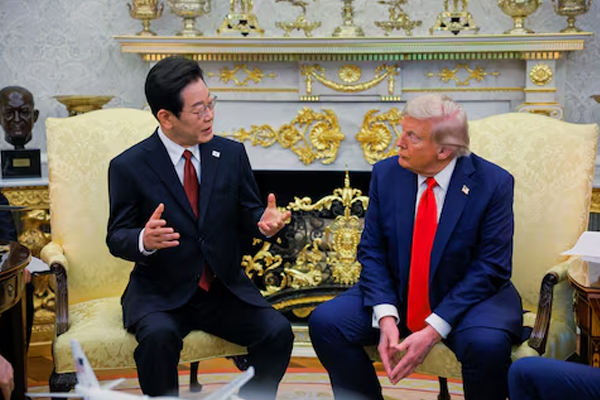
South Korean President Lee Jae Myung met U.S. President Donald Trump for the first time on Monday, and emerged declaring success after displaying personal chemistry and avoiding any public split between the two long-time allies.
Behind the scenes, however, the two sides were unable to agree on a joint statement or even a fact sheet, and a month after announcing a deal on tariffs, the agreement still has not been finalised on paper.
Lee’s national security adviser, Wi Sung-lac, said on Friday that the two countries did not produce documents covering security, economy, trade or investments because progress remained slow in some areas while large strides had been made in other areas.
More discussions and reviews were needed to hash out their details, he added, without providing specific details.
South Korean presidential chief of staff Kang Hoon-sik told reporters on Thursday that it was a “very difficult negotiation” because issues ranging from investments to security are closely intertwined.
“If the negotiations for one minister don’t go well, they put a break on another negotiation that is going well,” he said.
“We’ve overcome a significant obstacle, but there is still a long way to go.”
Kang added that Washington could leverage several issues, such as tariffs on cars, chips, and pharmaceuticals, as well as defence costs and around U.S. forces stationed in Korea.
Speaking to his cabinet after the summit, Trump acknowledged a “problem with South Korea” but that Seoul had ultimately “kept the same deal.” Neither Seoul nor Washington has elaborated.
The U.S. Embassy in Seoul did not immediately respond to questions about the talks.
‘Big Losses’
Even before Lee and Trump’s meeting, disagreements over a $350 billion investment fund, as well as a U.S. push to open up South Korea’s agriculture market, were hampering negotiations.
Meanwhile, cuts to tariffs on automobiles are yet to be finalised, and Seoul has not secured assurances on chip levies, both expected to be capped at 15% – the same rate as Europe.
An auto industry official said the summit has done little to ease uncertainty: “We are really worried… We are having big losses.”
South Korean newspaper JoongAng Ilbo said the U.S. wanted to use the summit to produce documents detailing the $350 billion investments in return for accepting Seoul’s demand for formalising 15% tariffs on cars and chips, and ruling out the opening of rice and beef imports.
A South Korean official said Seoul has asked that loans and equity only account for a fraction of the fund.
After the summit, Seoul said it was in talks with the U.S. to work out a non-binding deal on the fund.
Japan, the only other country to propose such a large investment fund, is also facing delays in finalising its deal over unresolved issues with Washington.
It remains unclear what payments Trump will demand from South Korea for maintaining the 28,500 American troops based there. He has also raised a fresh demand for the U.S. to own the land on which its bases are located.
South Korean officials have said it is a political non-starter, and there has been no such formal request from Washington.
(With inputs from Reuters)
India And Japan Building For The World: Modi To Yomiuri Shimbun
Prime Minister Modi has called for India and Japan to design and produce the “next generation of defence platforms, not just for ourselves but for the world.”
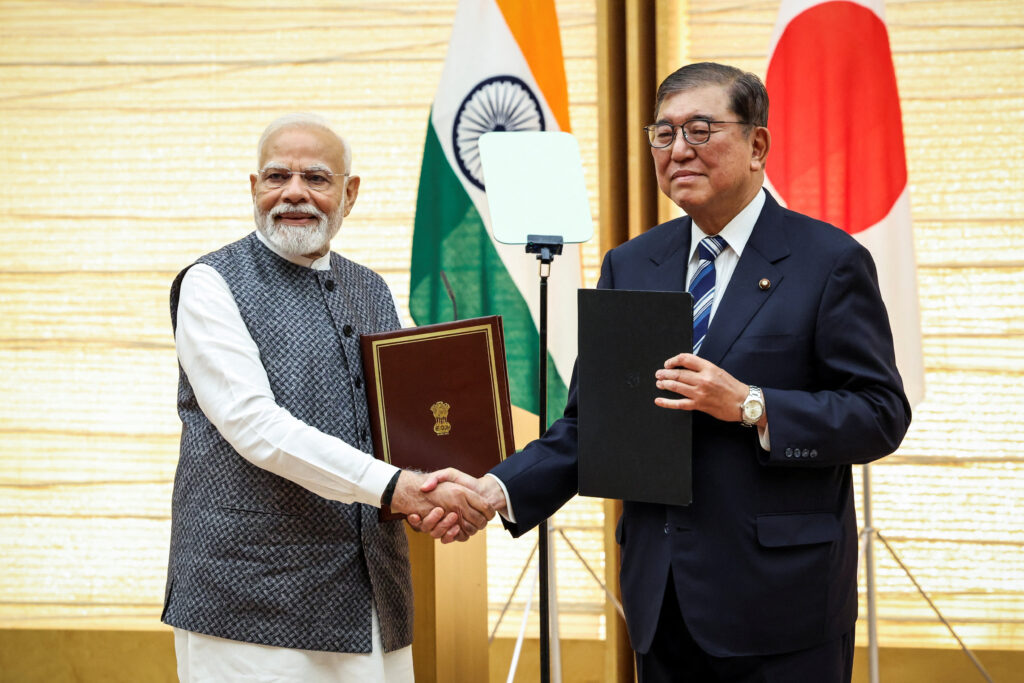
In written responses to questions posed by the leading Japanese newspaper Yomiuri Shimbun, he said a Joint Declaration on Security Cooperation will be adopted during his visit. This will help military modernisation and defence industry collaboration.
Lauding the work of the Quad, Modi said “We greatly value Japan’s role in strengthening the Quad’s agenda … we can continue to deliver practical solutions and tangible outcomes that benefit not only our region but the wider world.”
He said there was “strong convergence” between Japan’s version of a Free & Open Indo-Pacific and India’s own approach. Both countries have strong linkages with countries in the Indo-Pacific region and we engage with them in some plurilateral formats.”
He described economic cooperation as the key pillar of the Special Strategic & Global Partnership and noted that Japan is not only a major source of FDI in sectors like electronics and automobiles, but 1,500 Japanese firms are now in India, and 400 Indian firms in Japan.
He was particularly enthusiastic about India’s rapidly growing semiconductor industry, noting that the first Made in India chips would roll off the assembly line later this year. He proposed “combining India’s scale and capabilities with Japan’s advanced technologies … to build a resilient and trusted semiconductor value chain.”
In the space sector, Modi appreciated the cooperation between the two countries on the Lunar Polar Exploration Mission, that will help further understanding of the permanently shadowed regions of the Lunar South Pole. He said it was creating an ecosystem with innovation flows in both directions.
He praised Japan’s role in helping India build its own high speed rail network, noting that his government was working on a plan for 7000-km of high speed railway and urged Japanese firms to take part in its design, development and construction.
He regretted that “Trade has not yet reached the levels envisaged under the CEPA (Comprehensive Economic Partnership Agreement)”, and urged that the trade basket by diversified to make it more balanced.
On China, which is his next port of call, he called for “stable, amicable and predictable” bilateral relations that can have a positive impact on global and regional peace. “This is crucial for a multipolar Asia and a multipolar world.”
UK Bars Israeli Officials From Attending Its Largest Defence Trade Show
Britain has prohibited Israeli officials from attending its largest defence trade show in response to Israel’s escalating war against Hamas in Gaza, marking its latest move to pressure a historically close ally over the conflict.
Prime Minister Keir Starmer‘s government said in July it would recognise a Palestinian state unless Israel took steps to relieve suffering in the enclave and met other conditions, enraging the Israeli government.
Israel’s Ministry of Defence said that, as a result of the trade fair ban, it would not run its national pavilion as it has done previously at London’s Defence & Security Equipment International event.
Israeli defence companies, such as Elbit Systems, Rafael, IAI and Uvision, will still be able to attend.
Britain’s move had echoes of a dispute at the Paris Air Show three months ago, when France blocked off with black partitions the stands of Israeli defence companies after they refused to remove attack weapons from display, sparking a furious response from Israel.
UK Criticises Gaza Escalation
A British government spokesperson said on Friday that the Israeli government’s decision to further escalate its military operation in Gaza was wrong.
“As a result, we can confirm that no Israeli government delegation will be invited to attend DSEI UK 2025.”
“There must be a diplomatic solution to end this war now, with an immediate ceasefire, the return of the hostages and a surge in humanitarian aid to the people of Gaza,” the spokesperson added.
Israel said Britain’s decision was a “regrettable act of discrimination” and “introduces political considerations wholly inappropriate for a professional defence industry exhibition”.
The four-day show, due to open on September 9, features national delegations and private companies, who showcase military kit and weapons at London’s Excel centre. The event takes place every other year.
DSEI is organised by a private company, Clarion Defence and Security, but with backing from the British government and the military.
(With inputs from Reuters)
Andaman & Nicobar Command: In Conversation With The Commanding Officer INS Saryu | Arc of Power Ep V
Indian Naval Ship Saryu
“Overall, she’s a complete combat-ready package for patrolling the seas”. The Commanding Officer of the Indian Naval Ship Saryu, Commander Nilesh Athare tells us proudly. We’re sailing just off the Car Nicobar Island, the northernmost island of the Nicobar group. The island is nestled in the Andaman Sea in the Andaman and Nicobar Command’s (ANC) Area of Responsibility. We’ve been sailing on the Saryu for nine days documenting India’s tri-service springboard, the ANC, in this series, ‘Arc Of Power’.
Series In 4K
Watch this series in 4K. Click the gear icon in YouTube’s settings and choose 2160p/4K, if your device is compatible. We recommend big screen viewing for the best experience.
Editor’s Note: Since StratNews filmed this episode, Cdr Nilesh Athare has been promoted to a Captain and has taken up a new assignment.
In this conversation, the Saryu’s 11 th Commanding Officer also
elaborates on:
👉Why the vessel is the ‘Most Spirited Ship’.
👉Its role and capabilities.
👉Its legacy and the connection with the Sri Lankan Navy.
👉Complex naval exercises with countries in the region
👉Commanding a ship at sea.
👉The crew that comes from the length and breadth of India.
👉And the ship’s war cry that evokes the Mahabharata and Abhimanyu’s legendary courage in the ‘Chakravyuh’.
‘Arc Of Power’ Series
A StratNews Global team of Amitabh P. Revi, Rohit Pandita and Vashisht Mattoo documented this series. Deepankar Varma provides all the informational graphics.We boarded the INS Saryu in Sri Vijaya Puram (SVP), the capital of the Andaman and Nicobar Islands (ANI). SVP was known as Port Blair till September 2024. Our first journey was from SVP to Rutland Island to film tri-service beach assault exercises that we documented in episode I.
From Rutland, she took us to the Aerial Bay Jetty, Diglipur and INS Kohassa in Episode II.
Part III is an extended interview with the then Commander-in-Chief, ANC (CINCAN), Air Marshal Saju Balakrishnan on board Saryu.
Part IV is about extended tri-service beach assault exercises on Tarasa Island.
Stay tuned as we continue to document the ANC’s strategic significance in our travels across the seas and islands.
Egypt Cracks Down On Teen TikTok Stars
Egyptian authorities have launched a fresh crackdown on popular teenage TikTok influencers, detaining dozens in recent weeks over charges ranging from flouting family values to alleged money laundering.
Police have announced dozens of arrests and prosecutors say they are investigating at least 10 cases of alleged unlawful financial gains. They have imposed travel bans and asset freezes and confiscated devices.
Policing Speech, Conduct
Critics say the escalation fits into a broader effort by the state to police speech and codify conduct, in a country where social media has long served as one of the few alternatives to traditional media largely controlled by the state.
Many of those who have been detained were only small children when activists used Facebook to mobilise the 2011 protests that toppled long-serving president Hosni Mubarak.
Vague Laws
Lawyers say indecency laws are vague. The authorities can go through a TikTokker’s entire back catalogue of posts, and if they find even a single post they consider indecent, they can declare influencers’ income illegal and charge them with financial crimes over their earnings.
Mariam Ayman, a 19-year-old who has gathered 9.4 million followers posting videos since she was a schoolgirl under the name Suzy El Ordonia, has been jailed since August 2. She faces charges of distributing indecent content and laundering 15 million pounds ($300,000).
The Interior Ministry said she was arrested after the authorities received complaints about her posts. In her final video, posted the day before her arrest, she seemed aware that she was facing a threat.
“Egyptians don’t get arrested just because they appear on TikTok,” she said.
She acknowledged that in previous videos she may have “agitated, cursed, or told a bad joke”, but said this was meant to vent frustration, and “not meant to teach the younger generation to follow suit”.
Arbitrary Laws
Her lawyer, Marawan al-Gindy, declined to comment directly on her case, but said that in general indecency laws were being applied arbitrarily.
“There is a law that criminalises indecent acts, but what we need is consistent application and defined rules, not just for TikTok, for all platforms,” he said.
Path To Fame
The path to TikTok fame in Egypt, as elsewhere, can seem random. Suzy, like millions of other teens, had a habit of posting videos of her daily life and morning makeup routine.
A few years ago, one of her livestreams went viral when she replied to a comment from her father, a bus conductor, with a rhyming Arabic quip that soon swept the country as a catchphrase.
She racked up millions of followers, who tuned in to see her share a meal with friends or dance to street musicians in Turkiye. Thirty-one million people watched her have a photo shoot with her boyfriend. Her sister, who has a mental disability, appeared in some videos, helping lift social stigma around disability.
But even such generally upbeat videos with no overt political content can imply criticism of the hardships of daily life.
In an interview with a podcaster recorded before her arrest, Suzy said that if she had 10 million Egyptian pounds, she would spend half of it to move her family to a better home, help her parents start a shop and enrol her sister in a private school to receive better care.
Shortly after that appearance, her interviewer, podcaster Mohamed Abdel Aaty, was also arrested.
‘Aggressive Security Campaign’
The Egyptian Initiative for Personal Rights (EIPR) earlier this month urged the Interior Ministry and the public prosecution to halt “an aggressive security campaign” based on what morality provisions it described as vague.
The prosecutions rely on a broadly worded article of a 2018 cybercrime law that criminalises infringing on “any of the principles or family values in Egyptian society”, said EIPR lawyer Lobna Darwish.
The broad standard means TikTokkers have been arrested for content that would not be out of place on mainstream TV, Darwish said.
The rights organisation has tracked at least 151 people charged under the article across more than 109 cases in the past five years, a tally it says is probably an undercount.
As the campaign has escalated, prosecutors have encouraged citizens to report objectionable content. The Interior Ministry itself runs an account on TikTok which has posted comments on hundreds of videos urging creators to abide by morals.
Casting The Net Wider
TikTokkers lately have found themselves inundated with comments accusing them of immorality. Some people calling for arrests have even circulated a claim, without evidence, that influencers were running an organ trafficking network.
Darwish said the campaign has widened from targeting female TikTok users to including people with dissenting religious views or LGBT Egyptians. Some people had been investigated over private content that had not been publicly shared but had leaked from their phones, she said.
The State Information Service did not immediately respond to a Reuters request for comment.
TikTok says it enforces its own community guidelines through automation and human moderation. In its latest quarterly report, it said it had removed over 2.9 million videos from Egypt. TikTok representatives declined to answer Reuters’ request for comment.
‘Huge Source Of Income’
Social media adviser Ramy Abdel Aziz said TikTok creators in Egypt can earn around $1.20 per thousand views of a video, around a tenth of what creators can earn in the United States but still potentially a windfall in a low-wage country.
“Social media can be a huge source of income, but it would still require a long time to generate it especially if the [income] is made in legitimate ways,” Abdel Aziz said.
Financial analyst and anti-money-laundering expert Tamer Abdul Aziz said that if the state’s real concern was illegal financial flows, it should be looking at companies, not content creators.
“If there’s a crime, you look at the owner or the financial flows, not the performers,” he added.
(1 Egyptian pound= $0.021)
(With inputs from Reuters)
Italy PM Meloni ‘Outraged’ By Websites Targeting Women Amid Online Abuse Outcry
Italy’s Prime Minister Giorgia Meloni on Friday voiced outrage over an adult website that published unauthorised images of women, including herself, amid a nationwide outcry against online misogyny and abuse.
Administrators of the phica.eu website, whose name is a play on a vulgar Italian slang term for female genitalia, took it down on Thursday following widespread condemnation and legal complaints.
“I am disgusted by what has happened, and I want to express my solidarity and closeness to all the women who have been offended, insulted, and violated in their intimacy by the administrators of this forum and its ‘users,'” Meloni was quoted as saying by the daily Corriere della Sera.
The website had been running since 2005 and had more than 200,000 registered members, but came under intense media and political scrutiny this week following another highly-publicised case of misogynist online abuse.
Earlier this month, Facebook took down the Mia Moglie (‘My Wife’) group, where users shared intimate photos of women without their consent, after a wave of public complaints initiated by author and activist Carolina Capria.
The group had over 32,000 members.
In announcing its shutdown, a spokesperson for Facebook’s parent company, Meta, said the group violated the social media company’s policy against the sexual exploitation of adults.
‘Disheartening’
“It is disheartening to see that in 2025, there are still those who consider it normal and legitimate to trample on a woman’s dignity and make her the object of sexist and vulgar insults, hiding behind anonymity or a keyboard,” Meloni said.
The 48-year-old, in office since 2022, is Italy’s first woman prime minister.
Heeding calls from women’s rights advocates and lawmakers, Equality Minister Eugenia Roccella said the government was working on stronger online protections and cultural reforms to combat misogyny and sexism.
The phica.eu site hosted thousands of manipulated images and videos of female public figures, often accompanied by obscene and violent commentary. It also featured photos of ordinary women, classified by geographical location.
Its administrators said in a message they were closing down the forum “with great regret” due to “toxic behaviours” that had “damaged the original spirit”.
As well as Meloni, it published images of opposition leader Elly Schlein, influencer Chiara Ferragni and EU lawmaker Alessandra Moretti, who filed a criminal complaint and said such websites “incite rape and violence”.
(With inputs from Reuters)
Israeli Military Says Gaza City Excluded From Local Tactical Pause
Israel‘s military announced that beginning from Friday, a local humanitarian pause in military operations will not extend to Gaza City, describing the area as “a dangerous combat zone.”
Israel’s security cabinet had approved a plan to take control of Gaza City, a move expanding military operations in the shattered Palestinian territory that drew strong criticism at home and abroad over its pursuit of the almost two-year-old war.
Last month, Israel announced a halt in military operations for 10 hours a day in parts of Gaza and new aid corridors as Jordan and the United Arab Emirates airdropped supplies into the enclave.
The Israeli military said on Friday that it “will continue to support humanitarian efforts alongside ongoing manoeuvring and offensive operations against terrorist organisations in the Gaza Strip in order to protect the state of Israel”.
Mounting Criticism
Israel has been facing growing international criticism, which the government rejects, over the humanitarian crisis in Gaza, and indirect ceasefire talks in Doha between Israel and the Palestinian militant group Hamas have broken off with no deal in sight.
Israeli Prime Minister Benjamin Netanyahu has said there will be no end to the war until Hamas is disarmed.
The war began on October 7, 2023, when Hamas-led fighters stormed southern Israel, killing 1,200 people, mostly civilians, and taking 251 hostages back to Gaza, according to Israeli tallies.
Since then, Israel’s offensive has killed over 62,000 people in Gaza, mostly civilians, according to Gaza health officials, reduced much of the enclave to ruins and displaced nearly the entire population.
(With inputs from Reuters)
The Abrupt End Of Second Indo-U.S. ‘Honeymoon’
The Shanghai Cooperation Organisation (SCO) Summit 2025 in Tianjin, China, marks a pivotal moment in global geopolitics. With Indian Prime Minister Narendra Modi, Chinese President Xi Jinping, Russian President Vladimir Putin, and leaders from Central Asia, West Asia, South Asia and Southeast Asia in attendance, the summit underscores the SCO’s growing influence as a platform for Eurasian cooperation.
For India, this event is particularly significant, as it marks PM Modi’s first visit to China in seven years, signalling a thaw in Sino-Indian relations strained since the deadly Galwan Valley clashes of 2020 that plunged India-China relations into a deep freeze. Recent developments, such as Chinese Foreign Minister Wang Yi’s visit to New Delhi and the two countries’ acceptance of incremental border de-escalation measures indicate a pragmatic approach to rebuilding ties.
However, the thaw is not entirely organic. It occurs against the backdrop of strained Indo-U.S. relations, particularly following the Trump administration’s decision to impose 50% tariffs on Indian exports. This move, described by India’s Foreign Minister S. Jaishankar as “unjustified,” reflects a selective geopolitical strategy by Washington, which has spared China and Europe from similar penalties. The U.S.’ apparent pivot toward Pakistan, especially after referring to India as a “dead economy,” has further eroded trust in the Indo-U.S. partnership, reminiscent of historical betrayals that shaped India’s foreign policy. Therefore, it is hard to deny that India’s strategic move eastward is not shaped by a shifting global order, accelerated by President Donald Trump’s drive to “Make America Great Again” by weaponising America’s financial and economic heft.
The current strain in Indo-U.S. relations evokes memories of the mid-20th century, when Washington briefly courted New Delhi before abruptly disengaging. In the late 1950s, post-Suez crisis, India and the U.S. collaborated to highlight China’s occupation of Tibet marking the beginning of a golden period in Indo-U.S. relations. To bolster India’s economic development and strategic position, the U.S. formed a consortium of Western nations to fund India’s Third Five-Year Plan (1961-66), aimed at industrial growth. This initiative, spearheaded by the Kennedy-Cooper Resolution passed by the U.S. Congress provided critical financial aid, including loans and technical assistance. On January 4,1961, the U.S. gave $50 million loan to India at 5.75% interest for the purchase of capital equipment from United States to meet the development goals envisaged in the Third Five Year Plan.
A cornerstone of this golden era was the burgeoning Indo-U.S. nuclear cooperation, spearheaded by the US Technical Cooperation Administration mission (US Technical Cooperation Administration mission (TCM was later renamed US Agency for International Development (USAID).
As has been reported, on July 11, 1959, this partnership was already well-established, involving the purchase of heavy water, the sharing of research and the training of Indian scientists in the US.
This report served as a prelude to a landmark announcement the very next day, July 12, 1959. The United States agreed to lease 15 tons of heavy water to India for its research reactor at Trombay, which was designed for peaceful atomic energy research. This agreement was historic; it marked the first time the American Atomic Energy Commission had leased—not sold—heavy water to a foreign government, signifying a new level of trust and cooperation that moved beyond mere commercial transactions.
However, this happy story was nearly spoiled by a diplomatic faux pas. The two governments had carefully coordinated to announce the deal simultaneously with a press release scheduled for July 13 at 9.00 am Washington time. In an awkward misstep, the United States Information Service (USIS) in New Delhi jumped the gun and released the news a day early. The breach of the agreement left the Indian Ministry of External Affairs (MEA) displeased, leading them to register a mild protest with their American counterparts.
During this period, the United States overlooked Jawaharlal Nehru’s launch of the Non-Aligned Movement (NAM) in 1961, alongside other non-communist nations, as India boldly confronted China. Defying Mao Zedong’s regime, India granted asylum to the Dalai Lama and thousands of Tibetans fleeing Chinese oppression, a move that heightened tensions and contributed to China’s invasion of India in 1962. However, the Indo-U.S. partnership soon faltered. The U.S., having leveraged the 1962 Sino-Indian War to widen the Sino-Soviet rift, appeared to have achieved its strategic objective. Consequently, Washington disengaged, effectively nudging India toward the Soviet Union. As U.S. priorities shifted to pursue closer ties with China, India found itself sidelined, no longer central to America’s geopolitical calculus.
Following President Kennedy’s assassination, the Johnson administration’s indifference toward New Delhi created a diplomatic chill. In 1966, new Prime Minister Indira Gandhi visited Washington and, under pressure, agreed to devalue India’s currency. The devaluation on June 6, 1966, was meant to unlock a World Bank loan, but the Bank withdrew its promise, leaving India in the lurch. The resulting financial crisis plunged the nation into political turmoil.
The U.S.’ support for Pakistan during the 1971 Bangladesh liberation war further signalled that India was no longer central to American geopolitical calculus. The current U.S. tilt toward Pakistan, coupled with tariffs and dismissive rhetoric, suggests a similar pattern.
Historical precedent shows that the United States, through its indifference in the 1960s, effectively pushed India toward a strategic partnership with the Soviet Union. Today, the modern Indo-U.S. “honeymoon,” which began at the turn of the century, appears to be nearing a similar end. Last time, the U.S. withdrawal coincided with its pivot to China. The critical question we must ask now is: what is the catalyst this time?
This raises critical questions: Why has the U.S. suddenly deprioritized India? Is it abandoning its “Pivot to Asia” policy, which aimed to counter China in the Indo-Pacific? Or is it shifting focus to Central Asia and Eurasia, potentially seeking a G2 arrangement with China to divide global spheres of influence?
India must recognise that engaging with the United States cannot be on equal terms. The established American empire is in decline, desperately clinging to its primacy, which makes it an unpredictable and self-interested partner. In contrast, China is still ascending and has not yet solidified its imperial dominance. This fluidity offers India a critical window of opportunity to shape a more balanced relationship with Beijing. India must act strategically to define these terms on a more equal footing before this window closes and the power disparity becomes permanent.
(Atul Bhardwaj is the author of ‘India-America Relations (1942-62): Rooted in the Liberal International Order’. Views expressed in this article are personal)