

Support us by contributing to StratNewsGlobal on the following UPI ID
ultramodern@hdfcbank

Strategic affairs is our game, South Asia and beyond our playground. Put together by an experienced team led by Nitin A. Gokhale. Our focus is on strategic affairs, foreign policy and international relations, with higher quality reportage, analysis and commentary with new tie-ups across the South Asian region.
You can support our endeavours. Visit us at www.stratnewsglobal.com and follow us on YouTube, Twitter, Facebook and Instagram.
र 500 per month
र 1000 per month
र 5000 per year
र 10000 per year
Donate an amount of your choice
र 500 per month
Donate र 500 per month

र 1000 per month
Donate र 1000 per month
र 5000 per year
Donate र 5,000 per year
र 10000 per year
Donate र 10,000 per year
Donate an amount of your choice
Donate an amount of your choice
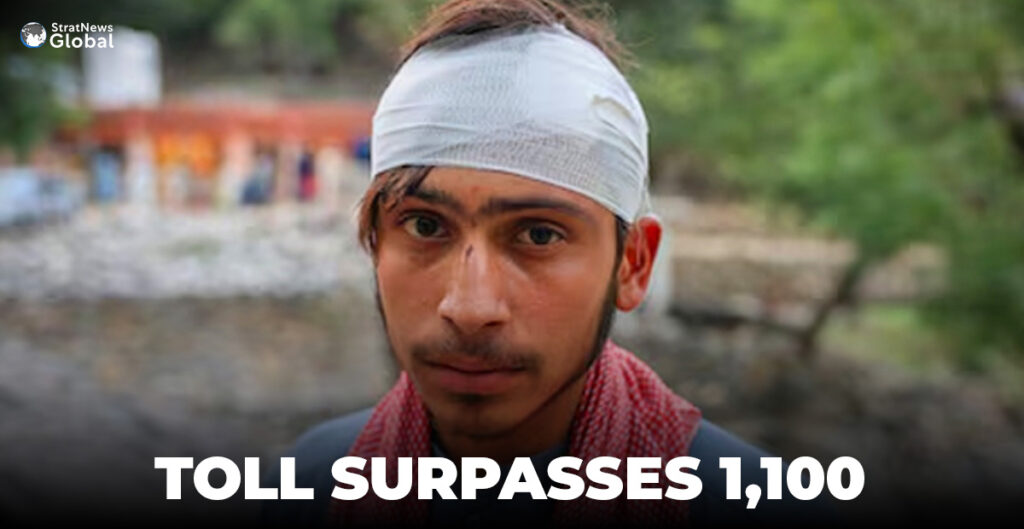
Afghanistan Earthquake Death Toll Rises To 1,124, Says Red Crescent
The Afghan Red Crescent Society said on Tuesday that the death toll from Afghanistan’s earthquake has climbed to 1,124.
At least 3,251 people have been injured and more than 8,000 houses have been destroyed in the disaster, the group said.
Rescuers Rush To Remote Areas
Rescuers in Afghanistan are attempting to reach isolated villages in eastern Kunar on Tuesday, the epicentre of the earthquake, authorities said.
Rescue operations were carried out in four villages in Kunar on Monday after the quake struck, and efforts will now be focused on reaching more remote mountain areas, said Ehsanullah Ehsan, the provincial head of disaster management.
“We cannot accurately predict how many bodies might still be trapped under the rubble,” said Ehsan. “Our effort is to complete these operations as soon as possible and to begin distributing aid to the affected families.”
One of Afghanistan’s worst earthquakes, with a magnitude of 6, struck around midnight local time on Monday, at a shallow depth of 10 km (6 miles), killing 812 people in the eastern provinces of Kunar and Nangarhar.
Quake Rescues Face Obstacles
Mountainous terrain and inclement weather have hindered rescuers from reaching remote areas along the Pakistani border where the quake flattened mudbrick homes.
Gaining access for vehicles on the narrow mountain roads was the main obstacle for relief work, said Ehsan, adding that machinery was being brought in to clear roads of debris.
On Tuesday, a line of ambulances was on the damaged mountain road trying to reach Kunar villages, as helicopters flew in, bringing aid supplies and taking the injured to hospitals, according to a Reuters witness.
Some of those injured have been transferred to hospitals in Kabul and the adjacent province of Nangarhar, said Ehsan.
Thousands of children were at risk, the United Nations Children’s Fund warned on Tuesday.
UNICEF said it was sending medicines, warm clothing, tents and tarpaulins for shelter, and hygiene items such as soap, detergent, towels, sanitary pads, and water buckets.
“Our response focuses on addressing urgent needs across health, safe water, sanitation, nutrition, child protection, temporary shelter, and psychosocial support to ensure that children and families receive life-saving assistance as quickly as possible,” Tajudeen Oyewale, UNICEF’s representative in Afghanistan, said in a statement.
Taliban Struggle Amid Crisis
Taliban soldiers were deployed in the area, providing help and security. The disaster has further stretched the war-torn nation’s Taliban administration, already grappling with a sharp drop in foreign aid and deportations of hundreds of thousands of Afghans by neighbouring countries.
“National and international organisations are present in the area, have organised their assistance, and, God willing, aid will be distributed in an orderly manner,” said Ehsan.
Rescue teams and authorities are trying to dispose of animal carcasses quickly so as to minimise the risk of contamination to water resources, a U.N. official said on Monday.
“Damaged roads, ongoing aftershocks, and remote locations of many villages severely impede the delivery of aid,” the World Health Organisation said in a situation update, adding that over 12,000 people had been affected by the quake.
“The pre-earthquake fragility of the health system means local capacity is overwhelmed, creating total dependence on external actors,” said the update.
(With inputs from Reuters)
India In Discussions With US On Trade Agreement: Piyush Goyal
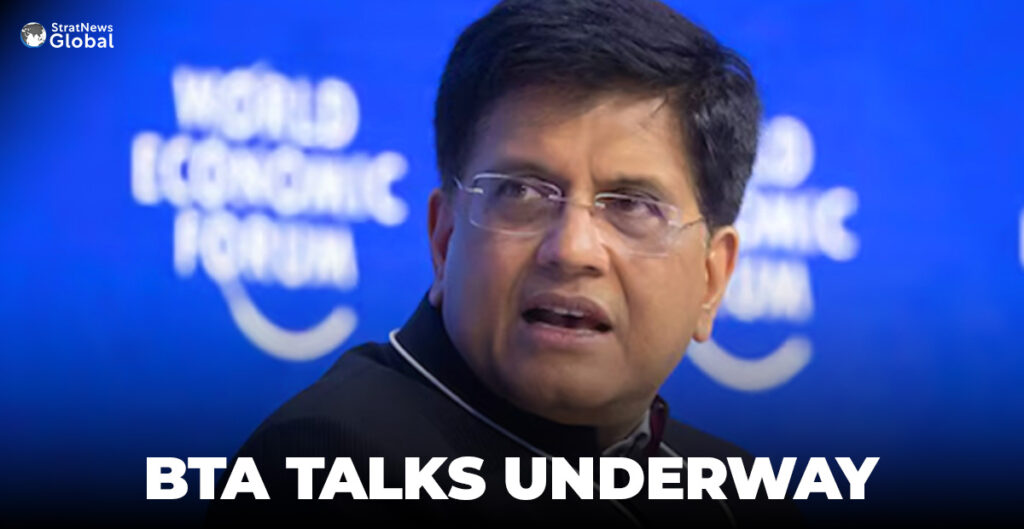
India is holding talks with the U.S. on a bilateral trade agreement (BTA), Minister for Commerce and Industry, Piyush Goyal, said on Tuesday, days after Washington doubled tariffs on Indian goods over New Delhi’s continued Russian oil imports.
Speaking at an industry event in the capital, Goyal emphasised that India is simultaneously pursuing new trade partnerships with the European Union (EU), Chile, Peru, New Zealand, Australia, and Oman, while deals have already been concluded with the EFTA bloc, the UK, and the UAE.
“A lot has been achieved, and much more remains to be done,” Goyal noted, highlighting that India now accounts for 18% of global economic growth.
Earlier on August 28, The Economic Times reported, citing its unnamed government sources, that India hoped to resume negotiations with Washington soon, though addressing the steep 50% U.S. tariff on Indian goods remains central to sealing the agreement.
According to Bloomberg, informal talks are continuing, even as New Delhi has avoided announcing retaliatory measures against U.S. President Donald Trump’s tariff hikes.
Trump’s Tariff Salvo
The shock to Indian exporters has been severe. On August 27, the U.S. imposed an additional 25% duty on several key imports from India, effectively doubling the levy to 50%.
The move is linked to India’s ongoing purchases of Russian crude oil and defence equipment—transactions Washington claims indirectly fund Moscow’s war in Ukraine.
Senior U.S. officials, including White House trade adviser Peter Navarro and Treasury Secretary Scott Bessent, have publicly accused India of enabling Russia’s war effort through these purchases.
This escalation comes amid months of back-and-forth trade negotiations.
Ongoing BTA Negotiations
The sixth round of talks for the BTA, scheduled for August 25 in New Delhi, was abruptly cancelled after the U.S. delegation pulled out.
Both governments had been aiming to wrap up the first phase of discussions by autumn, with a long-term goal of more than doubling bilateral trade from $191 billion today to $500 billion by 2030.
Washington, for its part, has pressed India to lower tariffs on agricultural products such as corn, soybeans, apples, almonds, and ethanol, and to allow greater market access for U.S. dairy exports.
New Delhi has rejected these demands, arguing that they could devastate the livelihoods of millions of small farmers.
Trump’s Zero-Tariff Claim
Meanwhile, Trump claimed in a post on Truth Social that India has now offered to slash tariffs to “nothing” following Washington’s punitive 50% duties.
“They should have done so years ago,” he wrote, adding, “It may be too late now.” It remains unclear when, or if, such an offer was formally made, and whether the White House is prepared to restart negotiations.
Analysts say Trump’s statement could signal a softening of Washington’s position.
(With inputs from Reuters and IBNS)
Xi Brings Russia, North Korea Together In Beijing Show Of Solidarity Against West
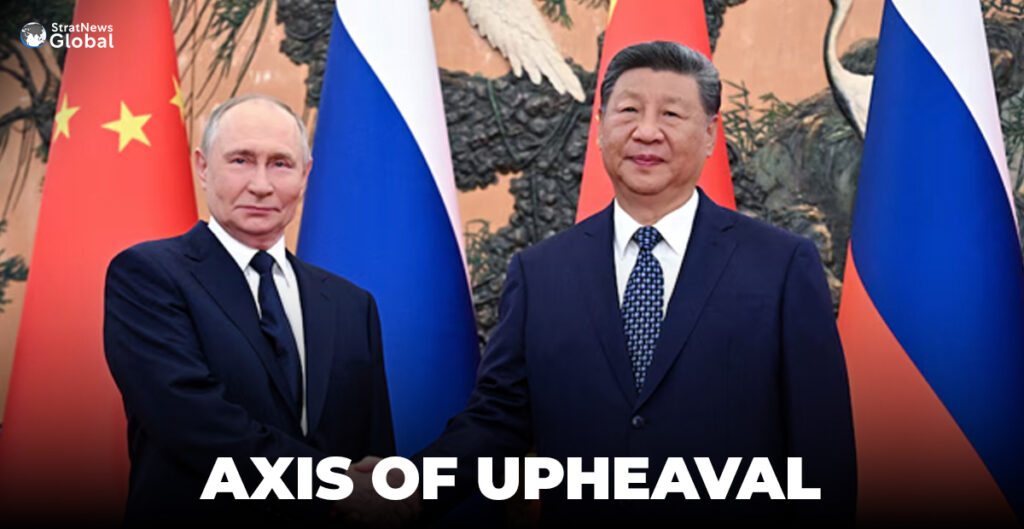
For the first time on Tuesday, Chinese President Xi Jinping convened his Russian and North Korean leaders together, signalling solidarity with nations isolated by the West over their role in Europe’s deadliest conflict in eight decades.
Vladimir Putin hailed “unprecedentedly high relations” with China and thanked his “dear friend” Xi for the warm welcome during talks at Beijing’s Great Hall of the People, while Kim Jong Un’s armoured special train snaked towards the Chinese capital.
With Iran’s leader also due to attend China’s massive military parade on Wednesday, Xi’s diplomatic clout with a group of authoritarian regimes dubbed the ‘Axis of Upheaval’ by some Western analysts comes at a time when U.S. President Donald Trump’s isolationist policies strain Washington’s alliances.
Beyond the pomp, analysts are watching whether the trio may signal closer defence relations following a pact signed by Russia and North Korea in June 2024, and a similar alliance between Beijing and Pyongyang, an outcome that may alter the military calculus in the Asia-Pacific region.
Blow For Trump?
It would also be a blow for Trump, who has talked up his close relations with Putin, Xi and Kim and touted his peacemaking credentials as Russia’s three-and-a-half-year war with Ukraine has raged on.
In a thinly veiled swipe at this rival across the Pacific Ocean on Monday, Xi told a gathering of more than 20 leaders of non-Western countries: “We must continue to take a clear stand against hegemonism and power politics.”
Xi also held talks on Monday with Prime Minister Narendra Modi of India, which, alongside China, has been targeted by Trump over its purchases of Russian oil seen as helping finance Russia’s war effort.
Trump’s Treasury Secretary Scott Bessent on Monday called the summit “performative” and accused China and India of being “bad actors” by fuelling Russia’s war.
As Putin and Xi met on Tuesday, Russia’s Gazprom and China National Petroleum Corporation signed a deal to increase gas supplies and penned an agreement on a new pipeline that could supply China for 30 years.
The leaders later retired to the Chinese president’s personal residence to continue unspecified negotiations with their delegations.
Alarm Bells
At a time when Trump has set his sights on a Nobel Peace Prize, any new concentration of military power in the East that includes Russia will ring alarm bells for the West.
“Trilateral military exercises between Russia, China and North Korea seem nearly inevitable,” wrote Youngjun Kim, an analyst at the U.S.-based National Bureau of Asian Research, in March, citing how the conflict in Ukraine has pushed Moscow and Pyongyang closer together.
“Until a few years ago, China and Russia were important partners in imposing international sanctions on North Korea for its nuclear and missile tests… (they) are now potential military partners of the Democratic People’s Republic of Korea during a crisis on the Korean peninsula,” he added, using the diplomatically isolated country’s official name.
Kim is an important stakeholder in the conflict in Ukraine: the North Korean leader has supplied over 15,000 troops to support Putin’s war.
In 2024, he also hosted the Russian leader in Pyongyang – the first summit of its kind in 24 years – in a move widely interpreted as a snub to Xi and an attempt to ease his pariah status by reducing North Korea’s dependence on China.
About 600 North Korean soldiers have died fighting for Russia in the Kursk region, according to South Korea’s intelligence agency, which believes Pyongyang is planning another deployment.
‘Fair Balance In Security Sphere’
Putin also told the Shanghai Cooperation Organisation summit in Tianjin that a “fair balance in the security sphere” must be restored, shorthand for Russia’s criticism of the eastward expansion of NATO and European Security.
His visit to Beijing and expected meeting with Xi and Kim may offer clues to Putin’s intentions.
For Kim, the parade will mark the largest multilateral diplomatic event he has ever attended.
North Korea’s state newspaper Rodong Sinmun published photographs of Kim and his entourage on the train, including Foreign Minister Choe Son Hui, who has been involved in Pyongyang’s diplomacy on weapons developments for more than two decades.
Nuclear Power Status
Before crossing to China early on Tuesday, Kim visited a missile laboratory, described by analysts as a planned move.
The visit is geared toward “showing off (North Korea’s) status as a nuclear power” just before “standing alongside Xi and Putin, which is intended to suggest support for North Korea as a nuclear state,” said Hong Min, North Korea analyst at the Korea Institute for National Unification.
Weeks of preparation have gone into the highly choreographed ‘Victory Day’ parade, marking 80 years since Japan’s defeat at the end of World War Two, with downtown Beijing paralysed by security measures and traffic controls.
Alongside the showcase of cutting-edge military hardware in front of an estimated 50,000 spectators, authorities will release more than 80,000 peace doves and colourful balloons.
(With inputs from Reuters)
Kim Jong Un Travels By Train To Beijing To Attend Parade: State Media
North Korean state media reported on Tuesday that leader Kim Jong Un crossed into China by special train early in the day to attend celebrations marking Japan’s World War II surrender.
Kim left Pyongyang for China on Monday and crossed into China early Tuesday morning, North Korea’s state newspaper Rodong Sinmun said, en route to the largest multilateral diplomatic event he has ever been to.
Kim is expected to attend the military parade in Beijing on Wednesday, joining Chinese President Xi Jinping and other leaders, including Russian President Vladimir Putin and Iranian President Masoud Pezeshkian.
Rodong Sinmun published photographs of Kim and his entourage, including Foreign Minister Choe Son Hui, who has been involved in Pyongyang’s diplomacy on weapons developments for more than two decades.
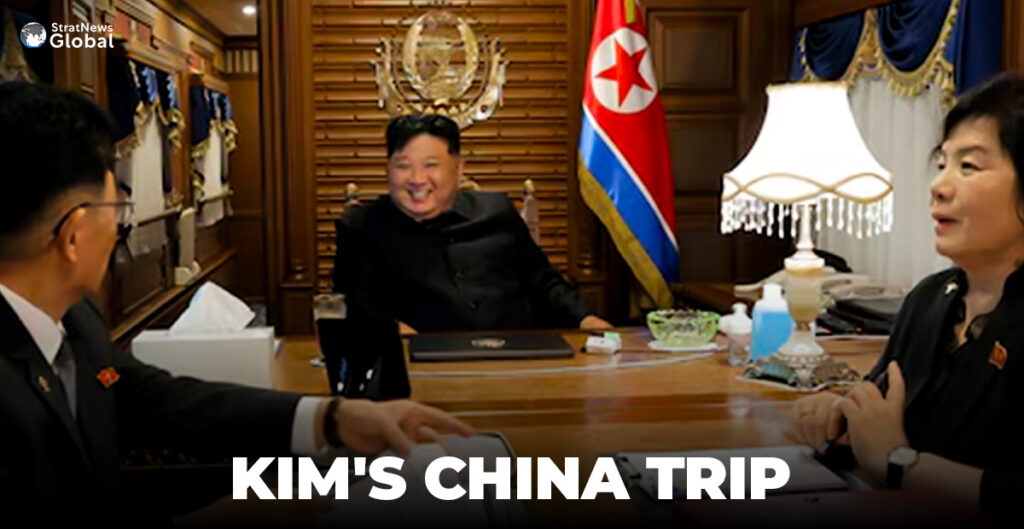
In one photograph, Kim can be seen standing next to the dark green train with a cigarette in his hand.
In another, he is seated at a desk inside the train with a North Korean flag behind him and with a closed laptop computer in a carriage ornately furnished with wood panelling.
The train appeared to be similar to the bulletproof train he had used before to travel to other countries.
En Route To Beijing
Before crossing into China, Kim on Monday visited a missile laboratory that is researching carbon fibre composite materials to be used in engines for intercontinental ballistic missiles, state media KCNA said.
Kim’s visit to a missile laboratory just ahead of the multilateral summit appeared highly symbolic, experts said.
The visit is geared toward “showing off (North Korea’s) status as a nuclear power” just before “standing alongside Xi and Putin, which is intended to suggest support for North Korea as a nuclear state,” said Hong Min, North Korea analyst at the Korea Institute for National Unification.
Hong said it also sent a message to the U.S. about North Korea’s “will to advance nuclear weapons and the status of a nuclear power that is difficult to reverse.”
North Korea on Monday expressed support for remarks made by Xi at a summit calling for fairer global governance, adding that cooperation between North Korea and China will grow to pursue such a value, according to a vice foreign minister in comments posted on the North Korean foreign ministry’s website.
Xi on Monday pressed his vision for a new global security and economic order that prioritises the “Global South”, in a direct challenge to the United States, during a summit that included the leaders of Russia and India.
South Korean President Lee Jae Myung, who has been seeking to improve ties with Pyongyang, was receiving real-time reports about Kim’s trip to China, the presidential office said. Seoul is sending National Assembly speaker Woo Won-shik to Beijing, but the country’s Unification Ministry said it was unsure whether he would be able to hold bilateral talks with the North Korean leader on the sidelines of the event.
(With inputs from Reuters)
Pakistan’s Story Of ‘Elite Capture’ Of Institutions, Retold
Much has been said and written about how a cabal of rich and influential elites have “captured” Pakistan and with the help of the army, ensured nothing changes politically or economically.
The influential Dawn has carried an analysis by former ambassador Maleeha Lodhi, who some would say, belongs to the same elite circle given her upper middle class origins, foreign education including teaching at the London School of Economics and successive tenures as Pakistan’s ambassador to the UK and the US.
But Lodhi is unsparing in her analysis of “elite capture”, noting that “a few hundred families have dominated virtually all of Pakistan’s legislatures including the present ones, maintaining their grip on power through generations.”
Party and electoral politics is dominated by wealthy families, she writes, by clans and networks of regional and ‘local’ influentials, who co-opt even those from non-elite backgrounds into their culture.
Even though Pakistan has changed in terms of greater urbanisation, and therefore shift in the political gravity from the rural areas to the city, growth of the middle class and the emergence of a more connected and informed citizenry, politics has not changed.
The power elite has resisted reform, whether of the land, tax or governance and uses its control of public office to transfer wealth and acquire unearned income. It has left the country with daunting problems of state solvency, security, energy and water shortages.
While elites do dominate in other countries, in Pakistan what is distinctive is the intersection and symbiotic relationship between the political and military elites.
“The military whose background is increasingly middle or lower middle class, often counter poses itself as a meritocratic institution that offers social mobility and functions on the basis of professionalism.”
But as Lodhi underscores, “the alliances it forges are with the very political elites it sees as self-serving, venal and inept. The status quo of interests … bind them together .. both use patron client relationships to reinforce their ascendancy and protect their privileged position.”
She quotes the UNDP’s Human Development Report of 2021, which says that elite groups including the political class, corporate sector, feudal lords and the military have cornered $17.4 billion or 6% of GDP. The richest 20% own 50% of the national income while the landed elite that make up 1.1% of the population control 22% of cultivable farmland.
Research by the Pakistan Institute of Development Economics shows that elite capture has widened inequalities, constrained economic growth, curbed the development of human capital, impeded social mobility and so on.
“Poor governance is inescapable,” Lodhi writes, “when policy decisions are made to further the interests of the elite rather than the public.”
The oligarchy of economic interests perpetuates political instability as that helps curb the competition. Amply clear from all this is that unless public welfare becomes central to the enterprise of governance, Pakistan cannot achieve its full potential. This choice more than anything else, Lodhi concludes, will determine the country’s fate and fortune.
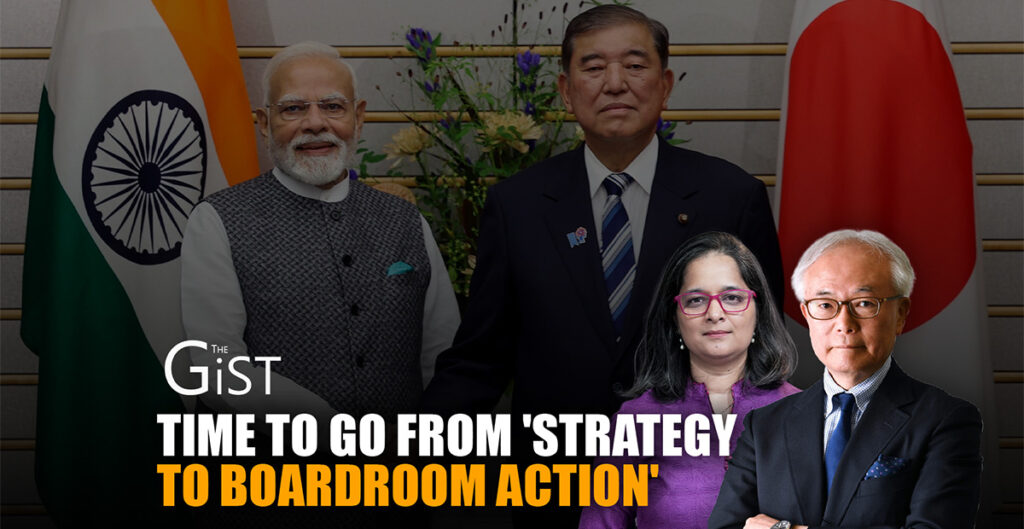
India-Japan Ties: From Tech To Trade, ‘Golden Chapter’ Rests On People-To-People Links
Prime Minister Narendra Modi’s recent visit to Japan, his first in seven years, has rebooted a relationship that, despite warm rhetoric, has too often lagged in concrete economic delivery. In a wide-ranging conversation with StratNews Global, Dr Tomohiko Taniguchi, former special adviser to the late Shinzo Abe, sketched both the promise and the persistent gaps.
Tokyo and New Delhi have historically placed security first, building early consensus on an ‘Indo-Pacific’ vision Abe outlined in his 2007 ‘Confluence of Two Seas’ speech. Yet Japanese brands, barring outliers such as Maruti Suzuki, still underperform in India’s vast consumer market. Modi’s trip therefore “was instrumental to boost commercial ties,” Taniguchi said, noting that strategic trust now needs to be matched by board-room commitment. Too many top Japanese executives still choose New York or London postings over Delhi, he observed; that mindset must change if Japan hopes to close the gap with South Korean and Chinese rivals.
The summit produced a long to-do list: a U.S. $68 billion private-investment target over 10 years, semiconductor and AI collaboration, lunar science links and a bilateral mobility scheme that could send up to 500,000 skilled Indians to help ease Japan’s labour crunch.
Taniguchi cautioned, however, that success hinges on “intensive people-to-people exchanges”, especially student flows. Japan’s universities are currently dominated by Chinese PhD candidates; attracting more Indian talent in physics and mathematics would diversify campuses and seed long-term technological cooperation.
Political uncertainty in Tokyo clouds the outlook. With Prime Minister Shigeru Ishiba weakened by three straight election setbacks and talk of an early party leadership contest, Japan today “punches below its weight,” Taniguchi admitted. That lowers Japanese diplomatic bandwidth just as the Quadrilateral Security Dialogue (QUAD) faces questions over a possible no-show by US President Donald Trump at a planned Delhi summit. Rather than waiting on Washington, Taniguchi urged India and Japan to “incentivise” American engagement and keep the four-nation format on track.
“At the core identity of the Indians is their commitment in basic, fundamental freedom values. So for that matter, we, India and Japan should not lose sight of that big picture. Short term, there will be disruptions in the bilateral relationship between India and the United States as has always been the case between Japan and the United States,” explained Dr Taniguchi. “But the future will not lie in despotic, authoritarian regimes, but in open, democratic, accountable regimes.”
For New Delhi, the message is two-fold: Japan remains a like-minded democracy that “buys into India’s future,” yet the clock is ticking on translating plans into factories, labs and joint patents. After years of caution, both New Delhi and Tokyo now need to push from co-operative intent to competitive scale.
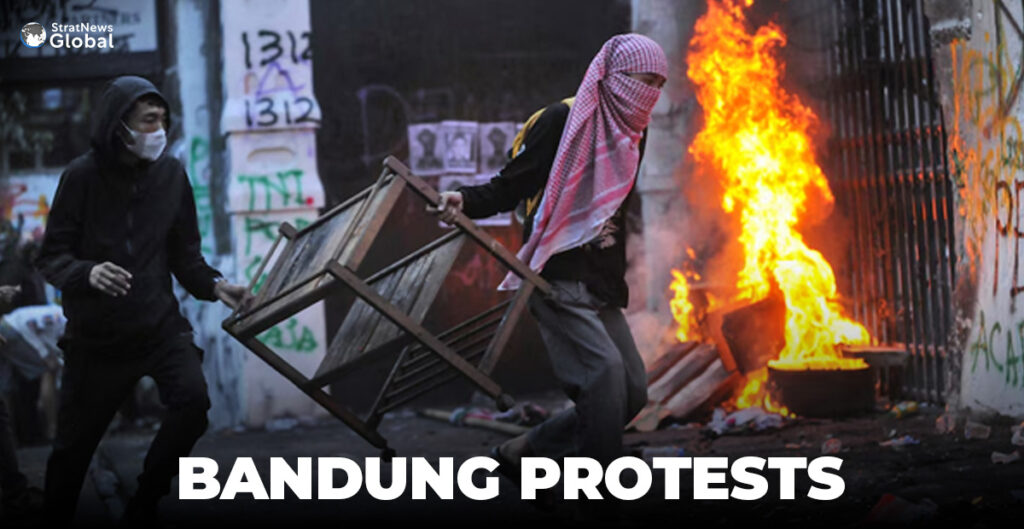
Indonesian Police Fire Tear Gas Near University Campuses, Sparking Rights Concerns
Indonesian police fired tear gas at protesters near two universities in the regional city of Bandung on Tuesday, student groups and authorities reported, escalating tensions amid demonstrations that have claimed eight lives since last week.
Protests began a week ago in Jakarta, the capital, targeting government spending, such as enhanced perks for lawmakers, and have escalated nationwide, with some rioting and looting after a police vehicle hit and killed a motorcycle taxi driver.
At least eight people have died in the protests, senior minister Airlangga Hartarto said on Monday.
Tear Gas Near Campuses
Authorities fired tear gas into crowds near the campuses, the groups at the Islamic University of Bandung, or UNISBA, and nearby Pasundan University, more than 140 km (87 miles) west of Jakarta, said on Instagram.
Authorities fired tear gas from outside the campus gates and fired rubber bullets as well, injuring one person, Muhammad Ilham, a Pasundan student, told Reuters.
“There was a student who got hit by the rubber bullet, two shots,” he said on Tuesday.
Police official Hendra Rochmawan said authorities did not enter the campuses but tried to break up crowds of non-student protesters seeking protection within the grounds, as the crowds blocked roads in the area.
UNISBA Rector Harits Nu’man echoed the police statement, saying the campus served as a medical hub for protesters.
The UNISBA student body accused security forces of seeking to silence dissent, saying they “brutally attacked” the campus with tear gas that caused breathing problems for some students.
University students have long been regarded as vanguards of Indonesia’s democracy, having taken a leading role in protests that helped topple authoritarian leader President Suharto in 1998.
Prabowo Meets Labour Unions
Current president Prabowo Subianto, a military leader under Suharto, met labour unions, some of whom joined last week’s protest for a hike in the minimum wage, and said he told lawmakers to discuss labour laws, according to a statement from his office.
The head of the Indonesia Trade Union Confederation, Said Iqbal, told a press conference he had told Prabowo of workers’ demands, such as an end to cheap labour, job outsourcing and income-tax cuts.
Prabowo has warned that the police and military would stand firm against violent escalations.
International rights groups have criticised the security response to the protests.
“The Indonesian authorities acted irresponsibly by treating the protests as acts of treason or terrorism,” said Meenakshi Ganguly, deputy Asia director of New York-based Human Rights Watch.
The United Nations’ rights office called for accusations of rights violations by security forces to be investigated.
“We call for prompt, thorough, and transparent investigations into all alleged violations of international human rights law, including with respect to use of force,” said its spokesperson, Ravina Shamdasani.
Jakarta police said they had arrested as a criminal suspect the director of the non-profit legal aid group Lokataru Foundation, Delpedro Marhaen, over accusations of inciting a riot among underage children.
The group did not immediately respond to a request for comment, but it has said the arrest was unlawful.
Indonesians added pink and green hues to their pictures in profiles on social media in response to the protests, with some using the hashtag #ResetIndonesia and listing demands for the government.
(With inputs from Reuters)
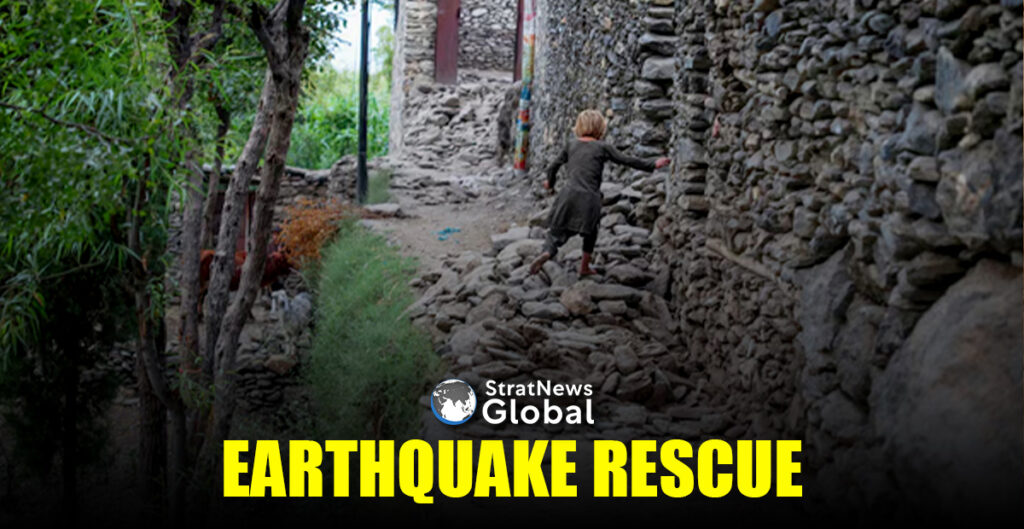
Afghanistan Rescuers Rush To Remote Quake-Hit Mountain Villages
Rescuers in Afghanistan will attempt to reach isolated villages in eastern Kunar on Tuesday, the epicentre of an earthquake that has killed over 800 people and injured more than 2,800, authorities said.
Rescue operations were carried out in four villages in Kunar on Monday after the quake struck, and efforts will now be focused on reaching more remote mountain areas, said Ehsanullah Ehsan, the provincial head of disaster management.
“We cannot accurately predict how many bodies might still be trapped under the rubble,” said Ehsan. “Our effort is to complete these operations as soon as possible and to begin distributing aid to the affected families.”
One of Afghanistan’s worst earthquakes, with a magnitude of 6, struck around midnight local time on Monday, at a shallow depth of 10 km (6 miles), killing 812 people in the eastern provinces of Kunar and Nangarhar.
Quake Rescues Face Obstacles
Mountainous terrain and inclement weather have hindered rescuers from reaching remote areas along the Pakistani border where the quake flattened mudbrick homes.
Gaining access for vehicles on the narrow mountain roads was the main obstacle for relief work, said Ehsan, adding that machinery was being brought in to clear roads of debris.
On Tuesday, a line of ambulances was on the damaged mountain road trying to reach Kunar villages, as helicopters flew in, bringing aid supplies and taking the injured to hospitals, according to a Reuters witness.
Some of those injured have been transferred to hospitals in Kabul and the adjacent province of Nangarhar, said Ehsan.
Thousands of children were at risk, the United Nations Children’s Fund warned on Tuesday.
UNICEF said it was sending medicines, warm clothing, tents and tarpaulins for shelter, and hygiene items such as soap, detergent, towels, sanitary pads, and water buckets.
“Our response focuses on addressing urgent needs across health, safe water, sanitation, nutrition, child protection, temporary shelter, and psychosocial support to ensure that children and families receive life-saving assistance as quickly as possible,” Tajudeen Oyewale, UNICEF’s representative in Afghanistan, said in a statement.
Taliban Struggle Amid Crisis
Taliban soldiers were deployed in the area, providing help and security. The disaster has further stretched the war-torn nation’s Taliban administration, already grappling with a sharp drop in foreign aid and deportations of hundreds of thousands of Afghans by neighbouring countries.
“National and international organisations are present in the area, have organised their assistance, and, God willing, aid will be distributed in an orderly manner,” said Ehsan.
Rescue teams and authorities are trying to dispose of animal carcasses quickly so as to minimise the risk of contamination to water resources, a U.N. official said on Monday.
“Damaged roads, ongoing aftershocks, and remote locations of many villages severely impede the delivery of aid,” the World Health Organisation said in a situation update, adding that over 12,000 people had been affected by the quake.
“The pre-earthquake fragility of the health system means local capacity is overwhelmed, creating total dependence on external actors,” said the update.
Aid Cuts
Afghanistan has been badly hit by U.S. President Donald Trump’s decision in January to cut funding to its humanitarian arm, USAID and reductions in other foreign aid programmes.
Crises elsewhere in the world, along with donor frustration over the Taliban’s policies toward women and curbs on aid workers, have been a factor in funding cuts, according to diplomats and aid officials.
Humanitarian officials said the shrinking of funding was hampering the response to the quake.
In the wake of the latest disaster, Britain allocated 1 million pounds ($1.35 million) to support the efforts of the U.N. and the International Red Cross in delivering critical healthcare and emergency supplies to affected Afghans.
China said it was ready to provide disaster relief assistance “according to Afghanistan’s needs and within its capacity”, while India delivered 1,000 family tents to Kabul and was moving 15 tonnes of food supplies to Kunar, with more relief materials to be sent on Tuesday.
Afghanistan is prone to deadly earthquakes, particularly in the Hindu Kush mountain range, where the Indian and Eurasian tectonic plates meet.
A 6.1-magnitude earthquake that killed 1,000 people in the eastern region in 2022 was the first major natural disaster faced by the Taliban government.
($1 = 0.7402 pounds)
(With inputs from Reuters)
Landslide Kills 1,000 In Sudan’s Marra Mountains
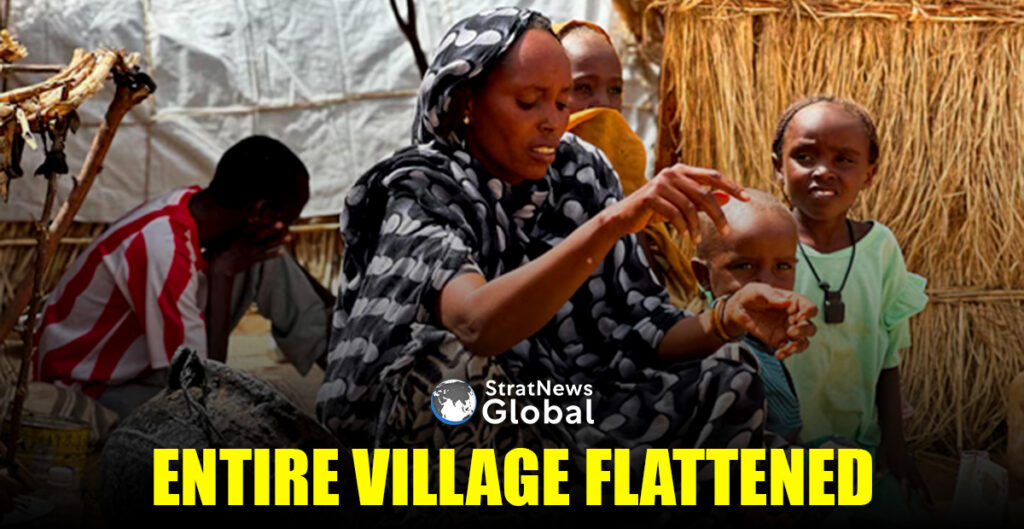
At least 1,000 people have been killed in a devastating landslide that wiped out an entire village in Sudan’s Marra Mountains region, leaving just one survivor, the Sudan Liberation Movement/Army said on Monday.
The landslide struck on August 31 after days of heavy rainfall, the group led by Abdelwahid Mohamed Nour said in a statement.
Appeal For Aid
The movement, which controls the area located in Darfur region, appealed to the United Nations and international aid agencies to help recover the bodies of victims, including men, women and children.
The village “has now been completely levelled to the ground,” the movement added.
Fleeing War
Fleeing the raging war between the Sudanese army and the paramilitary Rapid Support Forces (RSF) in North Darfur state, residents sought shelter in the Marra Mountains area where food and medication are insufficient.
The two-year civil war has left more than half the population facing crisis levels of hunger and driven millions from their homes with the capital of North Darfur state, Al-Fashir, being under fire.
The vast Kordofan region that lies between the two forces’ strongholds remains the site of fighting and attacks on small villages.
Cost Of War
UNICEF said in August that more than 1,000 children had been killed or maimed by air, artillery, and ground attacks. The RSF says it has given civilians ample opportunity to leave.
Yale Humanitarian Lab said that satellite imagery showed the force had constructed physical barriers, preventing people from leaving. Those who have managed to escape report violent attacks and robberies by RSF soldiers.
The Sudanese army has retaken control of central and eastern regions of Sudan, and has been setting up its first government since the start of the war, which held its first cabinet meeting earlier this week.
Hemedti Sworn In
Meanwhile, Mohamed Hamdan Dagalo, leader of the RSF, was sworn in as the head of a rival Sudanese government, the government announced in a statement on August 31, bringing the country a step closer to de facto partition.
Dagalo, known as Hemedti, has rarely been seen in Sudan since the start of a 28-month-long war with the country’s national army, but was sworn in in the Sudanese city of Nyala, the statement said. Reuters could not independently confirm his location.
(With inputs from Reuters)
Bessent Says Supreme Court Likely To Back Trump Tariffs, But Prepares Alternative Plan
U.S. Treasury Secretary Scott Bessent said on Monday he believes the Supreme Court will side with President Donald Trump’s decision to use a 1977 emergency powers law to impose tariffs on most U.S. trading partners. He also noted that the administration has an alternative plan in case the court rules otherwise.
Bessent said he was preparing a legal brief for the U.S. solicitor general, who will oversee the government’s appeal to the Supreme Court, that will underscore the urgency of addressing decades of trade imbalances and stopping the flow of deadly fentanyl into the United States.
A divided U.S. appeals court ruled on Friday that most of Donald Trump’s tariffs are illegal, undercutting the Republican president’s use of the levies as a key economic policy tool. The court allowed the tariffs to remain in place through October 14 to give the Trump administration a chance to file an appeal with the Supreme Court.
Reciprocal Tariffs
The 7-4 decision by the U.S. Court of Appeals for the Federal Circuit in Washington, D.C., addressed the legality of what Trump calls “reciprocal” tariffs imposed as part of his trade war in April, as well as a separate set of tariffs imposed in February against China, Canada and Mexico aimed at halting imports of fentanyl.
The court’s decision does not affect tariffs issued under other legal authority, such as Trump’s tariffs on steel and aluminum imports.
Trump justified both sets of tariffs – as well as more recent levies – under the 1977 International Emergency Economic Powers Act. IEEPA gives the president the power to address “unusual and extraordinary” threats during national emergencies.
“I’m confident the Supreme Court will uphold it – will uphold the president’s authority to use IEEPA. And there are lots of other authorities that can be used – not as efficient, not as powerful,” Bessent said.
One of those authorities, he added, could be Section 338 of the Smoot-Hawley Tariff Act of 1930, which allows the president to impose tariffs of up to 50% for five months against imports from countries that are found to discriminate against U.S. commerce.
Fentanyl Influx
Bessent said the influx of deadly fentanyl, linked to some 70,000 deaths a year in the United States, was a legitimate reason to call an emergency.
“If this is not a national emergency, what is?” Bessent said, referring to thousands of drug overdoses linked to fentanyl. “When can you use IEEPA if not for fentanyl?”
He said the brief, to be submitted Tuesday or Wednesday, would focus on the idea that U.S. trade deficits with other countries had been expanding for years and were reaching a tipping point that could lead to far greater consequences.
“We’ve had these trade deficits for years, but they keep getting bigger and bigger,” he said. “We are approaching a tipping point … so preventing a calamity is an emergency.”
Bessent noted that action by then-President George W. Bush on mortgages might have averted the global financial crisis of 2008-2009, which was triggered by excessive speculation on property values by both homeowners and financial institutions.
Allies To ‘Step Up’?
Bessent played down the notion that Trump’s tariffs were bringing countries like Russia, China and India closer together, dismissing a China-hosted gathering in Shanghai of 20 leaders from non-Western countries as “performative.”
“It happens every year for the Shanghai Cooperation Organization,” he said. “It’s more of the same. And look, these are bad actors … India is fueling the Russian war machine, China is fueling the Russian war machine … I think at a point we and the allies are going to step up.”
He said the U.S. was making headway in convincing Europe to join Washington’s crackdown on India over its purchases of Russian oil through a 25% additional tariff, but did not comment on whether the U.S. would use similar pressure on China.
China, he said, would struggle to find sufficient markets for its goods outside the United States, Europe, and other English-speaking countries. “They don’t have a high enough per capita income in these other countries,” he said.
(With inputs from Reuters)