

Support us by contributing to StratNewsGlobal on the following UPI ID
ultramodern@hdfcbank

Strategic affairs is our game, South Asia and beyond our playground. Put together by an experienced team led by Nitin A. Gokhale. Our focus is on strategic affairs, foreign policy and international relations, with higher quality reportage, analysis and commentary with new tie-ups across the South Asian region.
You can support our endeavours. Visit us at www.stratnewsglobal.com and follow us on YouTube, Twitter, Facebook and Instagram.
र 500 per month
र 1000 per month
र 5000 per year
र 10000 per year
Donate an amount of your choice
र 500 per month
Donate र 500 per month

र 1000 per month
Donate र 1000 per month
र 5000 per year
Donate र 5,000 per year
र 10000 per year
Donate र 10,000 per year
Donate an amount of your choice
Donate an amount of your choice




Venezuelan Winner Machado Safe But Couldn’t Travel For Nobel Ceremony
Democracies must be prepared to fight for freedom in order to survive, Nobel Peace Prize laureate Maria Corina Machado said on Wednesday, in a speech delivered by her daughter during a ceremony Machado could not attend.
The Venezuelan opposition leader said that the prize held profound significance, not only for her country but for the world.
“It reminds the world that democracy is essential to peace,” she said, via her daughter Ana Corina Sosa Machado. “And the most important, the lesson Venezuelans can share with the world, is a lesson forged on a long and difficult path: if we want democracy, we must be prepared to fight for freedom.”
A large portrait of a smiling Machado hung in the Oslo City Hall to represent her.
Couldn’t Reach In Time
The 58-year-old engineer was due to receive the award at Oslo City Hall in the presence of King Harald, in defiance of a decade-long travel ban imposed by authorities in her home country and after spending more than a year in hiding.
But she was unable to reach the Norwegian capital in time for the ceremony.
“I will be in Oslo, I am on my way to Oslo right now,” Machado told Nobel Committee leader Joergen Watne Frydnes, in an audio recording released by the Norwegian Nobel Institute.
It was unclear where she was calling from.
“We don’t know exactly when she will land, but sometime in the course of the night,” the institute’s director, Kristian Berg Harpviken, told Reuters.
Fight For Freedom
“Freedom is conquered every day as long as we are ready to fight for it. This is the reason why the cause of Venezuela transcends our borders,” she said in the transcript of her prepared speech.
“A people that chooses to be free not only liberates itself, but it also contributes to the whole of humanity.”
In 2024, Machado was barred from running in the presidential election despite having won the opposition’s primary by a landslide. She went into hiding in August 2024 after authorities expanded arrests of opposition figures following the disputed vote.
The electoral authority and top court declared President Nicolas Maduro the winner, but international observers and the opposition say their candidate handily won, and the opposition has published ballot box-level tallies as evidence of its victory.
‘Fragile’ Democratic Institutions
In her speech, Machado said Venezuelans did not realise in time that their country was sliding into what she described as a dictatorship.
“When we understood how fragile our institutions had become, it was already too late,” Machado said.
Referring to the late President Hugo Chavez, who was elected in 1999 and held power until his death in 2013, she said: “When the ringleader of a military coup against democracy was elected president, many thought that charisma could substitute the rule of law.”
“Since 1999, the regime has dedicated itself to dismantling our democracy.”
President Nicolas Maduro, in power since 2013, says U.S. President Donald Trump is trying to overthrow him to gain access to Venezuela’s vast oil reserves and that Venezuelan citizens and armed forces will resist any such attempt.
Venezuela’s armed forces are planning to mount a guerrilla-style resistance or sow chaos in the event of a U.S. air or ground attack, according to sources with knowledge of the efforts and planning documents seen by Reuters.
Dedicated To Trump
When Machado won the Nobel Peace Prize in October, she dedicated it in part to Trump, who has said he himself deserved the honour.
She has aligned herself with hawks close to Trump who argue that Maduro has links to criminal gangs that pose a direct threat to U.S. national security, despite doubts raised by the U.S. intelligence community.
The Trump administration has ordered more than 20 military strikes in recent months against alleged drug-trafficking vessels in the Caribbean and off Latin America’s Pacific coast.
Human rights groups, some Democrats and several Latin American countries have condemned the attacks as unlawful extrajudicial killings of civilians.
(with inputs from Reuters)
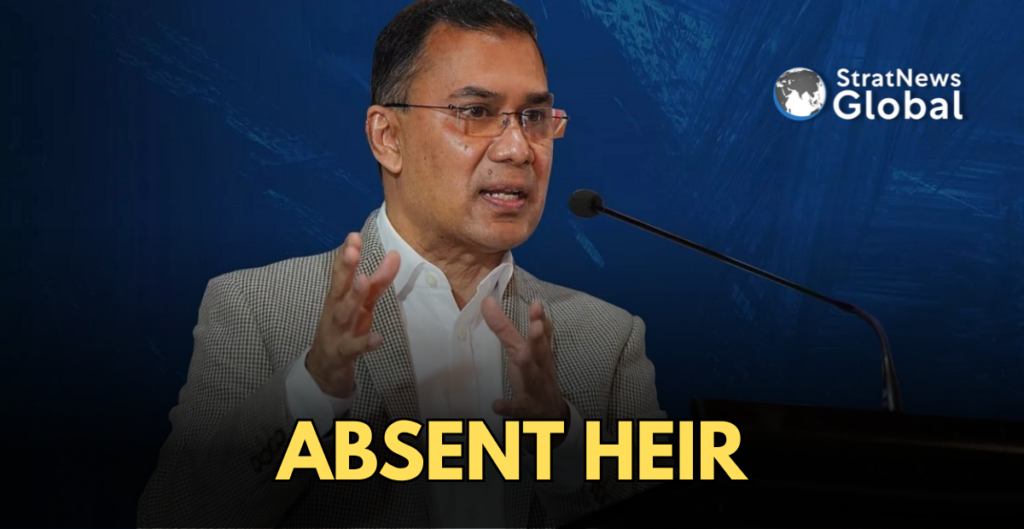
Exiled Heirs Dominate Bangladesh Election Landscape
Bangladesh’s election season is unfolding with both major political forces led by successors who live abroad, face legal or political obstacles, and have yet to return home before voting.
With the Awami League facing a ban and its longtime leader, Sheikh Hasina, continuing to reside in India, senior party figures are increasingly looking toward her son, Sajeeb Wazed Joy, as the next potential leader. Similarly, on the opposition side, Bangladesh Nationalist Party (BNP) chairperson Khaleda Zia remains critically ill, and attention has turned decisively to her son, Tarique Rahman. The shift reflects a political field where traditional leaders are absent, and their heirs are expected to shape the next phase of national politics despite being outside the country.
A recent Prothom Alo survey points to significant momentum for the BNP. According to the poll, 47.5% of respondents view Tarique Rahman as the leading contender for prime minister in the upcoming election. This support comes despite Rahman spending years in exile in the United Kingdom and without any parliamentary experience.
The poll names Jamaat-e-Islami chief Shafiqur Rahman as the next most likely candidate for the prime minister’s role, signalling a shifting electoral field where established political figures are no longer dominating public preference. Combined support for Khaleda Zia and Tarique Rahman accounts for more than 66% of responses, and 57.5% of those surveyed say a BNP victory would be the best outcome for the country.
However, there is still no indication that Tarique Rahman will return to Bangladesh in the immediate future. BNP leaders quoted in the Dhaka Tribune referred to “practical limitations and complexities” surrounding his return but said he would travel back when political conditions and international considerations were favourable. The government has publicly stated it will provide “all possible cooperation” if he decides to return. Rahman has cleared several past legal cases and currently faces no judicial obstacles preventing his entry.
Meanwhile, Sajeeb Wazed Joy, long regarded as Sheikh Hasina’s strategic and technological adviser, is also abroad and confronting mounting legal challenges. Anadolu Agency reported that the International Crimes Tribunal issued an arrest warrant accusing Joy of involvement in decisions to shut down nationwide internet access during the final phase of the July 2024 uprising. Separate corruption complaints are also under review, including allegations involving members of Hasina’s immediate family. Despite this, 8.5% of respondents in the Prothom Alo survey believe an Awami League victory would be best for the nation.
With both political heirs remaining overseas, facing legal scrutiny, public expectation and internal party dependence, Bangladesh enters an election cycle defined by leaders who are not presently in the country but are central to its political future.
IMF Urges China To Curb Exports, Boost Consumption
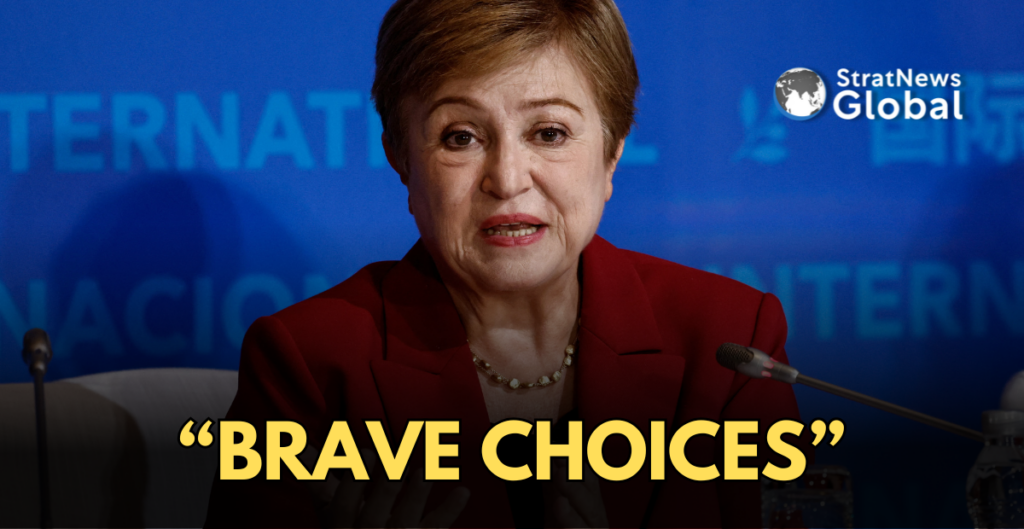
The International Monetary Fund on Wednesday urged China to make the “brave choice” of speeding up structural reform, as pressure grows on the world’s second-largest economy to shift towards a consumption-led model and curb reliance on debt-driven exports.
“China is simply too big to generate much (more) growth from exports, and continuing to depend on export-led growth risks furthering global trade tensions,” IMF Managing Director Kristalina Georgieva told a press conference concluding the Fund’s regular review of the $19 trillion economy.
“It requires brave choices and determined policy action,” Georgieva added, while pressing Chinese policymakers to adopt a comprehensive macroeconomic policy package including additional fiscal stimulus and greater monetary easing, alongside targeted steps to rein in local government debt, resolve a protracted property crisis and improve social welfare provision.
Ending Property Crisis
Increased social spending and accelerating reform of China’s internal passport “Hukou” system, which has largely tethered people’s destinies to their place of origin since the 1950s, could boost consumption by up to 3 percentage points of GDP, she added.
Meanwhile, bringing an end to the property crisis within the next three years, which weighs heavily on domestic demand as some 70% of Chinese household wealth is in real estate, will require China to spend 5% of GDP, the IMF forecasts.
“We have been urging more attention to closure on this problem. We call them ‘zombie firms’. Let the zombies go away,” Georgieva said, encouraging officials to speed up the exit of unviable property developers from the market.
Beijing closely watches the IMF’s “Article IV” review for approval or criticism of its economic management, with its endorsement serving as a valuable counter amid rising tensions with major trading partners.
Trade Tensions
IMF MD Georgieva said it was not in China’s interests to provoke its trading partners to impose curbs on Chinese imports over fears that a flood of cheap goods would devastate their manufacturing sectors.
The IMF upgraded its China growth forecast for 2025 to 5%, from 4.8%, citing the production powerhouse’s strong outbound shipments, also lifting its 2026 forecast to 4.5%, from 4.2%.
Net exports constituted 1.1% of China’s 5% growth for this year, the IMF chief said, while adding that the Chinese economy was on course to contribute 30% of global growth.
China has posted a record $1 trillion trade surplus for the first time, November trade data showed, sparking criticism that its slowing economy was being propped up by dominating an ever-growing share of the global industrial value chain and flooding emerging markets with cheap goods diverted from the U.S. due to President Donald Trump’s tariffs that deny its manufacturing sectors a chance to develop.
Economists have also accused Beijing of benefiting for too long from an undervalued renminbi.
“We haven’t recommended explicit action to appreciate the RMB,” Georgieva said. “We would like to see China with an exchange rate that is flexible both ways, up and down.”
French President Emmanuel Macron said on Sunday that he had threatened Beijing with tariffs during his state visit last week, which coincided with the European Commission unveiling plans to strengthen Europe’s resilience against dumped goods and unfair subsidies granted by trading partners to their manufacturers.
That said, Trump’s tariffs appear to have done little to slow the production powerhouse, which has recorded a monthly trade surplus exceeding $100 billion six times since he returned to the White House in January, compared with just once in 2024.
Scale Back Spending
Georgieva talked up China’s preparedness for artificial intelligence and other transformative technologies, but urged Beijing to give private firms a greater voice in shaping their development.
More broadly, “public investment and industrial policies in support of selected firms and sectors should be scaled back”.
“Putting market forces in the front seat, reducing the size of industrial policy support, would also generate fiscal savings, which could be redeployed to increase social spending and resolve the problems in the real estate sector,” Georgieva added.
China’s penchant for industrial policy constitutes a 1.2% drag on productivity, according to IMF calculations.
But reducing the role of industrial policy will not come naturally to China’s policymakers, who oversee a planned economy.
Georgieva said greater emphasis should be placed on China’s young people, rather than on the current model, in which households save large sums that state banks predominantly channel into infrastructure and state-backed firms.
(with inputs from Reuters)
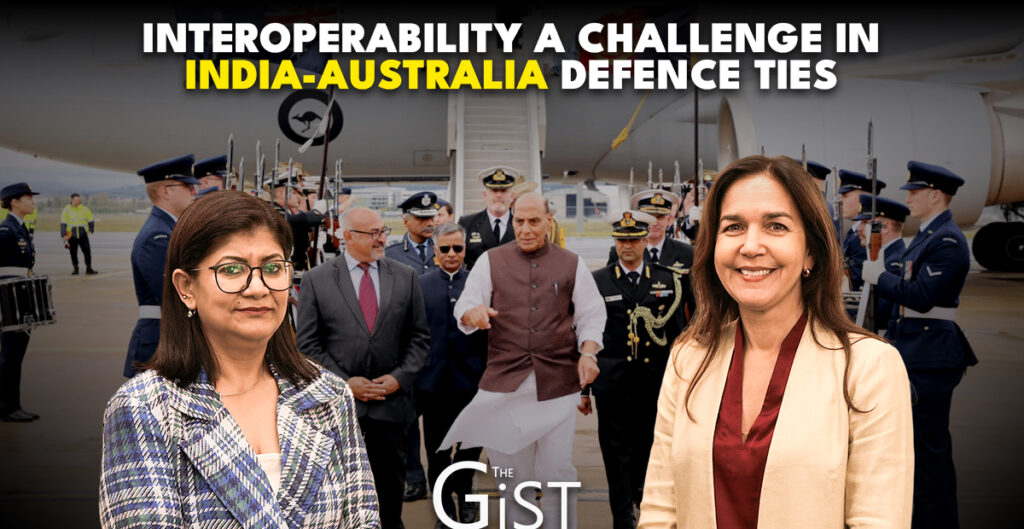
India-Australia Defence Ties ‘Challenged By Interoperability Issues’
While defence and strategic ties between India and Australia have enhanced in an unprecedented manner post-Covid, interoperability continues to act as a stumbling block in the expansion of the ties, says Lisa Singh, CEO, Australia India Institute at the University of Melbourne.
Speaking exclusively to StratNews Global, Singh said India can also benefit from AUKUS, which has led to significant development in naval ship-building expertise in Australia.
“We already have quite an uptake in naval shipbuilding and focus through AUKUS. But that can also be extended into our relationship with India because India is also doing its own naval shipbuilding. I think this is where knowledge sharing comes into play,” said Singh, a former Australian Senator and the first woman of South Asian heritage to be elected to the Australian Parliament.
The AUKUS trilateral security partnership is moving “full steam ahead” following a recent high-level meeting during which the U.S. reaffirmed its commitment after an internal review. The agreement is being strengthened to work for all three partner nations (Australia, the U.K., and the U.S.).
The partnership is structured around two main initiatives – supporting Australia in acquiring a fleet of conventionally armed, nuclear-powered submarines (SSNs) and collaborative development and sharing of advanced military technologies and capabilities amongst the partner countries.
However, according to Lisa, when it comes to deepening India-Australia bilateral defence ties, the challenge of interoperability looms large.
“I think one of the challenges, to be frank in the defence relationship, is interoperability … Obviously India has a legacy with Russia in terms of its maintenance of its current kit that is not interoperable with the Australian kit.
“So I think it’s going to take time for that to change. But I think this is where innovation is so important. If we can find new ways that we can use defence technologies to create interoperable, changeable, interchangeable equipment through that then the future seems much more broader,” she added.
Singh stressed both countries can develop the joint military exercises that they conduct into maritime domain awareness, knowledge sharing, information sharing and fusion centres.
“If we start developing our exercises into maritime domain awareness, knowledge sharing, information sharing, fusion centers, then I think we can overcome some of the barriers that interoperability puts on the table through the differences in the ships and the kit that we both use. I think though a lot of this comes down to political will,” she said.
India and Australia signed key defence agreements during the visit of Defence Minister Rajnath Singh to Canberra in October this year.
India and Australia conduct several joint military exercises across army, navy and air forde to enhance interoperability and strengthen their defence cooperation. The main exercises include, AUSTRAHIND and AUSINDEX. Both countries are also part of several multilateral exercises such as Pitch Black, MALABAR and Talisman Sabre.
Trade
According to Singh, two-way trade has witnessed significant uptick ever since India and Australia signed the Economic Cooperation and Trade Agreement (ECTA), which came into force on 29 December, 2022.
“Of course, ECTA was a great achievement and I know that it was very hard fought. It proved to be a fantastic outcome for both of our countries. Our trading relationship was very low before ECTA. So we’re in a much better position now. But the full story hasn’t been met in our trading relationship,” she said.
“There are so many more goods or services that we could be doing that are tariff free. So I think that is where our trade negotiators, I understand, are working really hard to make sure that we get there. When we get there I guess that is more of the question. The sooner it would happen, the better for both of our countries, particularly where India finds itself with the US situation.”
“We both have a lot to gain through a full CECA. That said, I won’t deny the fact that ECTA is giving us some comfort at least in the reality we live in right now. Of course, India for a long time has had issues, though, in the area of agriculture, and I think we’re very aware of that,” she said, adding that this has proved to be a “sticking point” that both sides have to address.
The total India-Australia bilateral merchandise trade in the financial year 2024-25 stood at $24.1 billion. The two-way trade grew significantly in specific categories, with India’s total exports registering an 8 percent growth in FY 2024-25 following a 14 percent growth in the previous fiscal year.
Chinese Investment Surge Reshapes Vietnam’s Industrial Landscape
Chinese companies are deepening their presence in Vietnam, leading investment inflows and sending record shipments to Hanoi despite Washington’s calls for economic decoupling. The two communist neighbours are strengthening cooperation across technology, transport, and manufacturing.
Hanoi has recently approved several projects it once resisted on security grounds, including contracts with Chinese telecoms firms Huawei and ZTE, loans for high-speed rail projects, and clearance for Chinese-made COMAC aircraft to operate with a leading Vietnamese airline.
According to Alexander Vuving of the Asia Pacific Center for Security Studies, Vietnam’s overtures to Beijing reflect a balancing act after trade pledges made to Washington. However, he warned that if this trend continues, Vietnam “may become a ‘torn country’ rather than a ‘swing state’,” risking its ties with Western partners.
Trade Shifts and Technology Transfers
After decades of cautious engagement following the 1979 border war and maritime disputes, Vietnam is now drawing closer to China as U.S. tariffs strain their trade relations. Chinese firms are offering rare technology transfer deals and increasingly view Vietnam as a consumer market rather than merely a manufacturing hub, according to a Reuters review of industry data and interviews.
This trend has accelerated since Washington imposed 20% tariffs on Vietnamese exports. “Vietnamese officials were displeased by what they saw as punitive U.S. measures, and this pushed them to hedge by leaning economically further into China,” said Phan Xuan Dung of the ISEAS-Yusof Ishak Institute in Singapore.
Record Imports and Rising Consumer Demand
Despite U.S. pressure to limit Chinese technology, Vietnam’s imports from China reached around $168 billion by November—up nearly 30% year-on-year and surpassing all of 2024, already a record year. Electronics make up nearly one-third of the imports, much of which are re-exported in goods bound for the U.S., while consumer goods like vegetables and vehicles are also climbing.
Diminishing anti-China sentiment among younger Vietnamese has reinforced this shift. E-scooter maker Yadea sold over 36,000 units in the first ten months of the year, ranking fourth nationwide and emerging as a key rival to domestic EV leader VinFast. BYD, another Chinese electric vehicle giant, is also expanding its dealer and charging network across Vietnam.
Meanwhile, Chinese retail and technology brands are growing rapidly. Real estate agency CBRE noted the expansion of chains such as KKV in Ho Chi Minh City and Hanoi. TikTok, owned by ByteDance, has become Vietnam’s leading shopping platform, while Alibaba’s Lazada and Tencent-backed Shopee and Tiki dominate e-commerce.
Long-Term Investment and Industrial Integration
Chinese investment in Vietnam has been building steadily, but a new phase of joint ventures and technology-sharing has begun. Steve Bui, chairman of the Vietnam China Business Council, said that 12 Chinese companies have either transferred or plan to transfer technology to Vietnamese partners this year, compared with none in 2024.
One such venture involves CNTE, backed by battery maker CATL, which partnered with Delta E&C to establish a factory in northern Vietnam producing battery energy storage systems for export by 2026. Official data shows that from January to November, Chinese and Hong Kong firms pledged over $6.7 billion, making them Vietnam’s largest investors.
At the DEEP C industrial park in northern Vietnam, Chinese manufacturers now represent a quarter of all tenants, up from just 10% in 2019. “What started as tariff hedging has evolved into a strategy focused on both insurance and growth,” said Dan Martin of consultancy Dezan Shira. He added that the growing scale and diversity of Chinese projects “is reshaping Vietnam’s industrial landscape.”
(with inputs from Reuters)
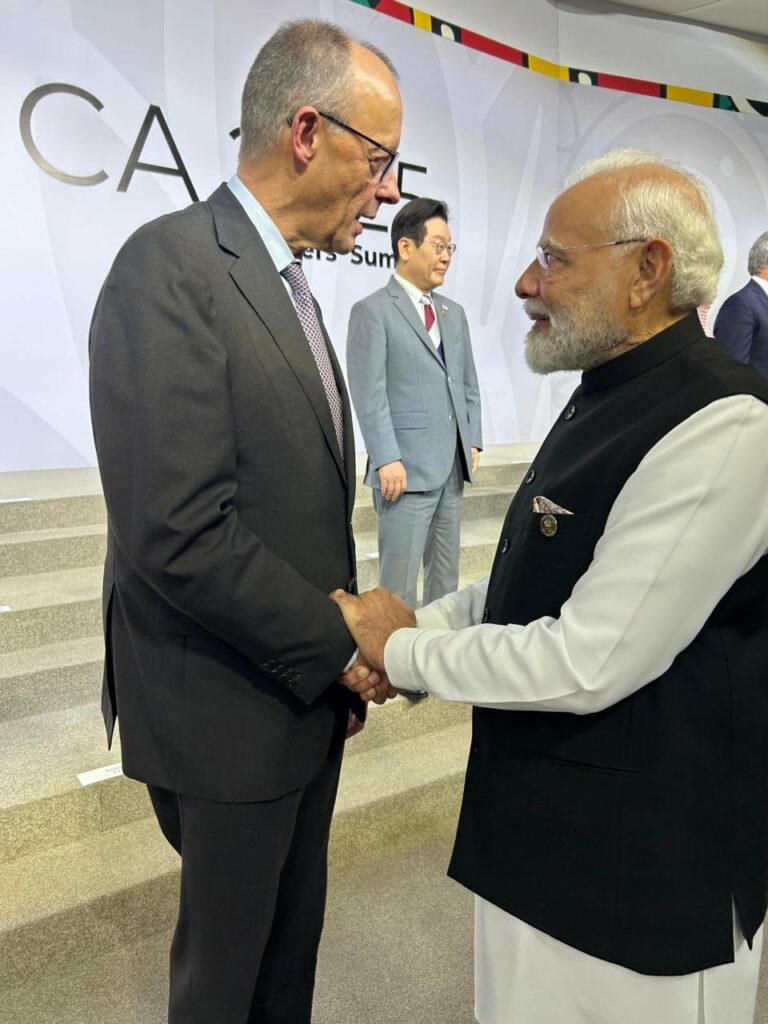
German Chancellor Merz To Talk Submarines, Trade During January Visit
It’s now official: January 2026 is going to be crowded with the big guns of Europe in Delhi. First off the mark will be Germany’s Chancellor Friedrich Merz sometime in the third week of the month followed by the EU’s Ursula von der Leyen along with others.
The Merz visit could see forward movement on India’s plans to buy and build the German Type 214 conventional submarine with air-independent propulsion. Plans involve ThyssenKrupp Marine Systems tying up with Mazgaon Dock to build six vessels at a cost of around $8 billion.
The submarine project is the biggest defence deal between the two countries and it is expected to be a Government to Government (G2G) one, a first for Germany.
Berlin is also looking at sourcing from India and there were discussions on common projects in the military domain during the visit of Defence Minister Boris Pistorius recently. The Merz visit could see some daylight on these plans.
There are 2000 German companies doing business in India and many are talking to Indian SMEs about collaborations in various fields. But the complaint is that rules do not allow a foreign firm to set up a wholly-owned unit in India.
A case in point is Rheinmetall, Europe’s fifth-largest arms maker, which is reportedly interested in setting up shop in India. Current rules allow joint ventures but German companies prefer complete control over their operations in third countries. This is a matter of discussion.
Indian industry sources confirmed that “The movement of skilled Indian labour has been helped by Germany’s requirement of skilled labour and not only in IT. Germany is working on training Indians in being able to speak and understand German. Working with the states on this issue.”
Indian graduates of German universities have 18 months to find a job, an indication that the immigration laws are liberal for skilled persons. The entry of Indians into Germany, currently estimated at 300,000, is surprisingly not an issue with Germany’s far right parties. It suggests a consensus on the entry of skilled labour.
But industry sources flagged a point of concern: the movement of labour from states like Punjab to Germany, ostensibly to study but actually to work. The food delivery business in Berlin, for instance, is dominated by Punjabis.
It is a job that requires no skills and while there are no complaints from Berliners now, that could change if large groups of such workers are seen in public, hanging out at intersections, doing nothing or getting into trouble with the police.
A word on Ukraine: Merz is expected to lay out the standard European line on the war in Ukraine even though at the highest levels in Brussels, there is a sense that Kyiv will have to cede territory if it wants fighting to end. President Zelenskyy is standing firm for now but with Trump keen to end the war on terms he has set (that seem to favour Russia), the die is cast.
Vietnam Tightens Grip On Press Freedom
On Wednesday, Vietnam’s parliament passed reforms to media and state secrets laws, a move that press freedom advocates warn will heighten legal risks for journalists and make it more difficult to safeguard the identities of their sources.
“We are appalled by the further restriction to the legal framework governing press freedom in Vietnam,” Aleksandra Bielakowska, from Reporters Without Borders, said on Wednesday.
The changes will make Vietnam “an almost impossible place for journalists to report freely”, said Bielakowska.
Reporters Without Borders ranks Vietnam 173rd of 180 countries in its world press freedom index.
Expanding State Secrets
Vietnam’s lawmakers adopted a revamped press law, to take effect in July, which will require journalists to reveal sources at the request of authorities investigating any crime, according to the amended text reviewed by Reuters.
Under the current press law, a journalist can only be compelled to disclose a source in probes of “serious crimes”.
The reformed press law will also allow the public security ministry and local police to order source disclosures, whereas at present only judges can do so.
Mounting Restrictions
The reform comes amid an escalation of restrictive measures in recent months in the Communist-run country, such as the withdrawal of passports from foreign media reporters, including a BBC Vietnamese journalist, the ban of a printed edition of the Economist, the temporary suspension of Telegram messaging app and an expanded role for the public security ministry.
While domestic media are under state control, foreign journalists face surveillance, trip-approval requirements and limited access to press events.
Bielakowska said at least 28 journalists are currently imprisoned in Vietnam “often in inhumane conditions, simply for doing their jobs”.
In a separate move, legislators also amended the state secrets law, expanding the categories of protected information.
The new law, which is set to take effect in March, designates as additional state secrets details of leaders’ overseas programmes, state compensation and settlements of international investment disputes.
Disclosing state secrets is already punishable by fines and prison terms.
“This amendment is granting authorities with yet another tool of repression against an already shattered media landscape,” Bielakowska said.
(With inputs from Reuters)
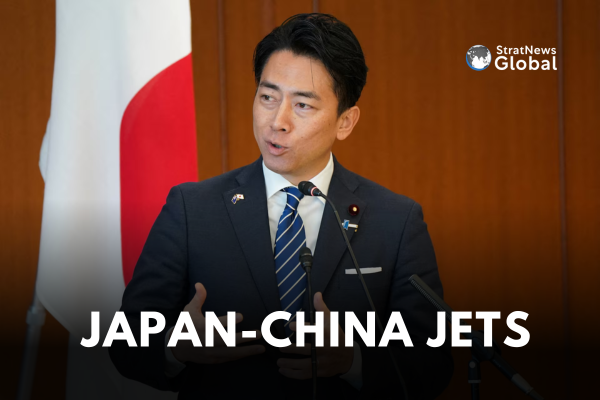
Japan Denies Aiming Radar at Chinese Jets Amid Close Encounter Claims
Japan’s Defence Minister, Shinjiro Koizumi, has denied reports that Japanese fighter jets targeted Chinese aircraft with radar during a close encounter over the weekend. His remarks came on Wednesday following a Chinese media report disputing Japan’s version of the incident.
Tokyo Dismisses Beijing’s Allegations
Koizumi clarified that Japanese aircraft did not lock radar on Chinese jets during the event on Saturday. He stressed that Japan’s actions were standard defensive responses to monitor foreign aircraft approaching its airspace. The minister emphasised that the situation was handled in accordance with international norms and Japan’s defence protocols.
Prior Notification from Chinese Navy
Before the incident, a Chinese navy vessel had informed Japanese authorities about planned air drills but failed to provide detailed information. Koizumi noted that, despite the notification, Japan’s decision to scramble its fighter jets was entirely appropriate. “It is natural for Japan to respond in such circumstances as part of its air defence measures,” he told reporters.
Tensions Near Okinawa
Japan had previously reported that Chinese fighter jets operating from the aircraft carrier Liaoning had aimed radar at Japanese aircraft in two separate encounters near Okinawa. The area is frequently patrolled by both Japanese and Chinese forces, reflecting heightened regional tensions over air and maritime boundaries. Koizumi’s statement aimed to de-escalate concerns by reaffirming Japan’s adherence to professional conduct in aerial operations.
As both nations continue to conduct military exercises in the region, defence analysts warn that such close interactions risk miscalculations if communication channels are not maintained. Japan’s Ministry of Defence reaffirmed its commitment to transparency and restraint while continuing to monitor China’s military activities closely.
(with inputs from Reuters)
India Preps for First Global South AI Summit
India will host the India–AI Impact Summit 2026 at Bharat Mandapam in New Delhi from 15 to 20 February, positioning itself as a key convener in global artificial intelligence governance.
Organised under the IndiaAI Mission of the Ministry of Electronics & Information Technology, the Summit marks the first time the international series—previously held in Bletchley Park, Seoul, Paris, and Kigali—will be hosted in the Global South.
Designed to move global AI dialogue from broad commitments to measurable outcomes, the Summit framework is built around the guiding principles of People, Planet and Progress.
These are operationalised through seven thematic working groups or “Chakras”, covering Human Capital, Inclusion for Social Empowerment, Safe and Trusted AI, Resilience and Innovation, Science, Democratising AI Resources, and AI for Economic Growth and Social Good.
Working group meetings will take place from October to December in hybrid format, anchored in Indian cities including Guwahati, Hyderabad, Chennai, Bengaluru, Mumbai, Bhubaneswar, and Kanpur.
Preparations have included five rounds of national consultations, more than 600 citizen responses via MyGov, and international outreach across Paris, Berlin, Oslo, New York, Geneva, Bangkok, and Tokyo. Additionally, more than 50 affiliated pre-summit AI events have already been organised across India and abroad, with a total of 375 applications received from governments, universities, research institutions, civil society groups and private sector organisations worldwide.
To broaden participation and surface practical solutions, the Summit will feature a series of flagship initiatives. These include YUVAi – Global Youth Challenge, AI by HER – Global Impact Challenge, AI for ALL – Global Impact Challenge, and UDAAN – Global AI Pitch Fest for startups.
A large-scale AI Impact Expo from 16 to 20 February will showcase applications and innovations from governments, enterprises, and startups. A dedicated Research Symposium on AI and its Impact will be held on 18 February to feature work from India, the Global South and international researchers.
The provisional programme begins with a cultural day on 15 February, followed by three days of flagship events. The main Summit sessions on 19 and 20 February will include a Leaders’ Plenary, CEO Roundtable, GPAI Council Meeting, panel discussions, keynotes and expert-level roundtables.
Reflecting the government’s emphasis on participatory design, a nationwide MyGov logo contest drew nearly 600 submissions. The final AI Summit logo incorporates elements from the winning entry and aligns with the motto “Sarvajana Hitaya | Sarvajana Sukhaya”—“for the welfare of all, for the happiness of all.”
With its focus on access, safety, innovation and equitable deployment, the India–AI Impact Summit 2026 seeks to demonstrate how AI can advance development, inclusion and global collaboration at scale.
Bitcoin’s 2025 Rollercoaster May End On A Low
With a series of record highs and crushing sell-offs, 2025 has been a rollercoaster ride for bitcoin, the world’s largest cryptocurrency, which is at risk of ending the year with its first annual decline since 2022.
The world’s main stock benchmarks have also had a turbulent year, repeatedly hitting record peaks and then pulling back as worries over tariffs, interest rates and a possible AI bubble whipsawed markets. While equities are mostly up year-to-date, bitcoin’s overall correlation with share prices has strengthened markedly this year.
Analysts say bitcoin’s gyrations increasingly tracked stock market sentiment as traditional retail and institutional investors jumped into cryptocurrencies, which next year may be even more closely tethered to factors driving stocks and other risk assets, such as monetary policy shifts and nervousness over the lofty valuations of AI-related stocks.
“Crypto reacting to broader equities has been a consistent theme in 2025,” said Jasper De Maere, desk strategist at crypto algorithmic trading firm Wintermute.
Bitcoin BTC= was hovering around $89,000 on Monday.
Regaining Footing
After soaring earlier this year with the election of crypto-friendly U.S. President Donald Trump, cryptocurrencies – along with stocks – plummeted in April on his tariff announcements, but quickly rebounded. Bitcoin went on to hit an all-time peak above $126,000 in early October 2025.
But just days later, on October 10, the market plunged again when Trump announced a new tariff on Chinese imports and threatened export controls on critical software. That sparked more than $19 billion worth of liquidations across leveraged crypto market positions, the largest liquidation in crypto history.
Bitcoin has struggled to regain its footing ever since and in November experienced its biggest monthly drop since mid-2021, although options market bearishness has ebbed a little in recent weeks, according to options platform Derive.xyz.
Traders as of late last week had assigned a 15% probability that bitcoin will finish the year 2025 below $80,000, compared with the 20% probability they had assigned just a few weeks ago.
That’s still a blow for crypto bulls, including Michael Saylor’s Strategy, the world’s biggest bitcoin hoarding company, which had projected as recently as October 30 that the token would hit $150,000 this year. Analysts at Standard Chartered last year forecast bitcoin would hit $200,000 by the end of 2025, due in part to flows into bitcoin exchange-traded funds.
In a change of tune, Strategy CEO Phong Le warned on a podcast last month of a possible “bitcoin winter.” In October, Standard Chartered forecast that bitcoin would fall below $100,000 but said that may be the last time it will hit that low, according to media reports.
Saylor, speaking to Reuters last week, said his company could survive a 95% fall in the price of bitcoin.
Equities Correlation
Those April and October plunges highlighted the growing correlation between bitcoin and equities, and in particular, artificial intelligence stocks, which share similar attributes and have been hit by worries that valuations are in bubble territory.
Historically, bitcoin and stocks did not move in tandem because crypto was seen as an alternative investment. But with broader crypto adoption by traditional retail investors and some institutions, the correlation looks to be strengthening, analysts said.
Correlation is measured from -1 to 1, with figures above zero indicating a positive correlation. In 2025, the average correlation between bitcoin and the S&P 500 – which tracks a broad basket of companies – was 0.5, compared with an average correlation in 2024 of 0.29, LSEG data shows.
For the tech-heavy NASDAQ 100 index, the average correlation this year was 0.52, compared with 0.23 in 2024, according to LSEG data.
Crypto has grown especially sensitive to AI stock moves partly because they have been drivers of broader equity markets, and partly because, like crypto, they are currently seen as somewhat speculative investments, largely dependent on investor sentiment and risk appetite, analysts said.
“Crypto (was) already a little weak after October 10,” said Cosmo Jiang, a general partner at Pantera Capital, a crypto investor. “Things really started to break in risk markets in the recent weeks, because of the AI bull case coming under question.”
Rate Cut Questions
Like stocks, cryptocurrencies also appear increasingly sensitive to the path of interest rates. Fidelity research from last year found that, while there is little historical data to indicate that the price of bitcoin increases when the Federal Reserve cuts rates, some analysts have observed that crypto tends to rally in line with dovish signals from the central bank.
Analysts also point out that hawkish Fed signals from October onwards weighed on bitcoin. Since then, the release of fresh economic data has the market pricing an 86% chance of a 25-basis-point cut this week.
That rate decision, along with the outlook for AI stocks, will likely be a key driver for crypto prices in the near term, analysts said.
“The Fed’s support of monetary supply in this particular scenario is going to be an indicator that crypto is all looking at,” said Mo Shaikh, co-founder and general partner at Maximum Frequency Ventures.
(with inputs from Reuters)