

Support us by contributing to StratNewsGlobal on the following UPI ID
ultramodern@hdfcbank

Strategic affairs is our game, South Asia and beyond our playground. Put together by an experienced team led by Nitin A. Gokhale. Our focus is on strategic affairs, foreign policy and international relations, with higher quality reportage, analysis and commentary with new tie-ups across the South Asian region.
You can support our endeavours. Visit us at www.stratnewsglobal.com and follow us on YouTube, Twitter, Facebook and Instagram.
र 500 per month
र 1000 per month
र 5000 per year
र 10000 per year
Donate an amount of your choice
र 500 per month
Donate र 500 per month

र 1000 per month
Donate र 1000 per month
र 5000 per year
Donate र 5,000 per year
र 10000 per year
Donate र 10,000 per year
Donate an amount of your choice
Donate an amount of your choice
Afghanistan Earthquake: Commandos Airdropped To Rescue Survivors
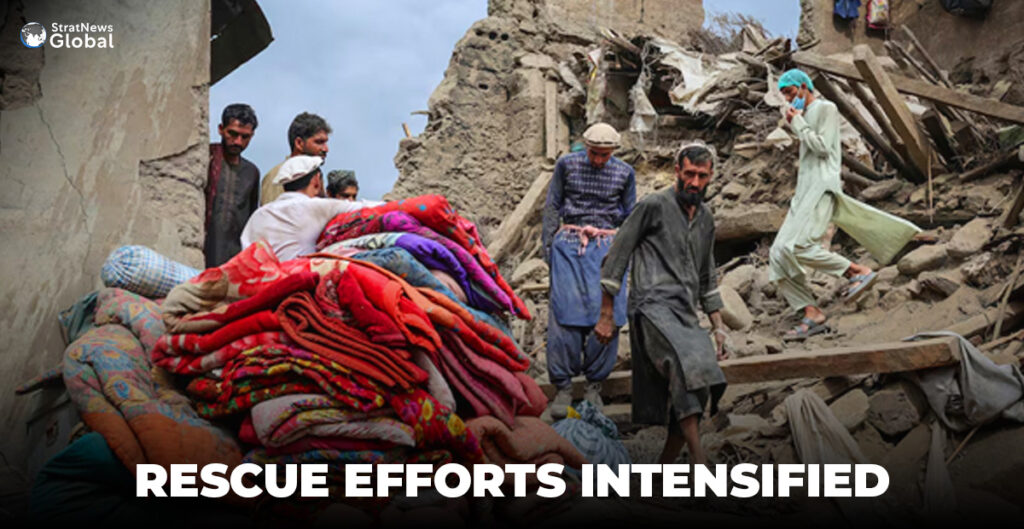
Afghanistan on Wednesday deployed commandos through airdrops to rescue survivors trapped beneath the rubble of homes in mountainous eastern regions devastated by earthquakes this week that have already claimed 1,400 lives, while simultaneously intensifying efforts to provide food, shelter, and medical assistance.
The first earthquake of magnitude 6, one of Afghanistan’s worst in recent years, unleashed widespread damage and destruction when it struck the provinces of Kunar and Nangarhar around midnight on Sunday at a shallow depth of 10 km (6 miles).
A second quake of magnitude 5.5 on Tuesday caused panic and interrupted rescue efforts as it sent rocks sliding down mountains and cut off roads to villages in remote areas.
Dozens of commando forces were being airdropped at sites where helicopters cannot land, to help carry the injured to safer ground, said Ehsanullah Ehsan, the head of disaster management in Kunar.
“A camp has been set up where service and relief committees are coordinating supplies and emergency aid,” he said. Two centres were also overseeing the transfer of the injured, the burial of the dead and the rescue of survivors, he added.
Helicopters In Rescue Ops
Earlier, rescuers had used helicopters to ferry the wounded to the hospital as they battled with mountainous terrain and harsh weather to reach quake-hit villages along the border with Pakistan, where the tremors flattened mudbrick homes.
The toll stands at 1,411 deaths, 3,124 injuries and more than 5,400 destroyed homes, the Taliban administration said, as the United Nations has warned it could rise, with victims trapped under rubble.
A Reuters journalist, who arrived in the area before Tuesday’s tremors, saw that every home had been damaged or destroyed, while people dug through rubble in the desperate search for those still trapped.
The second earthquake levelled homes that were only partially damaged by the first, residents said.
Resources for rescue and relief work are tight resources in the impoverished nation of 42 million people, which has received limited global help after the tragedy.
Fragile Homes Intensify Devastation
The impact was worsened by flimsy or poorly-built homes made of dry masonry, stone and timber, giving little protection from earthquakes, in ground left unstable by days of heavy rain, according to the U.N. Office for the Coordination of Humanitarian Affairs (OCHA).
The agency, which is pulling together the global disaster effort, called for emergency shelter, food assistance and sanitation facilities, along with drinking water, critical medical supplies and other items.
The humanitarian response needed to scale up urgently, said an official of the international group Médecins Sans Frontières that distributed trauma kits at two hospitals in the affected areas.
“We saw many patients treated in the corridors and health workers in need of supplies,” said Dr Fazal Hadi, its deputy medical coordinator in Afghanistan, adding that the hospitals had been working at full capacity even before the quake.
Afghanistan is prone to deadly earthquakes, particularly in the Hindu Kush mountain range, where the Indian and Eurasian tectonic plates meet.
(With inputs from Reuters)
SCO Gave India Some Geopolitical Space To Counter Trump’s Tariff War
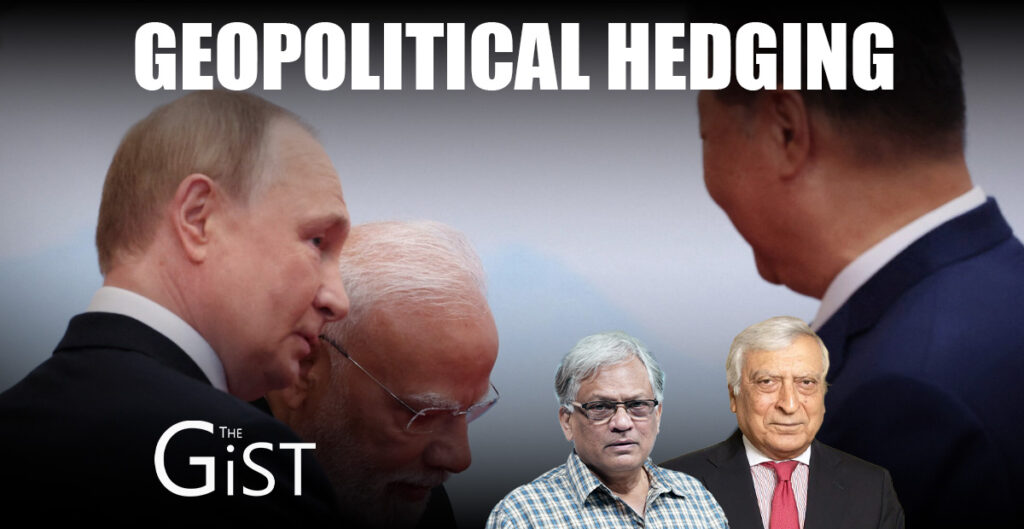
After skipping the 2024 SCO summit in Kazakhstan, apparently due to scheduling issues, Prime Minister Modi saw fit to attend the summit in Tianjin, China, and with good reason.
“Some progress has been made in terms of reducing tensions (with China),” Kanwal Sibal, former foreign secretary and ambassador to Russia told StratNewsGlobal on The Gist programme.
“There was a need to consolidate on the improved understanding with China without making it a bilateral visit because that would have a totally different connotation, implying that we had actually resolved the issues between us. The SCO gave us a reason to be there, a multilateral setting with no bilateral joint statement to be issued,” he said.
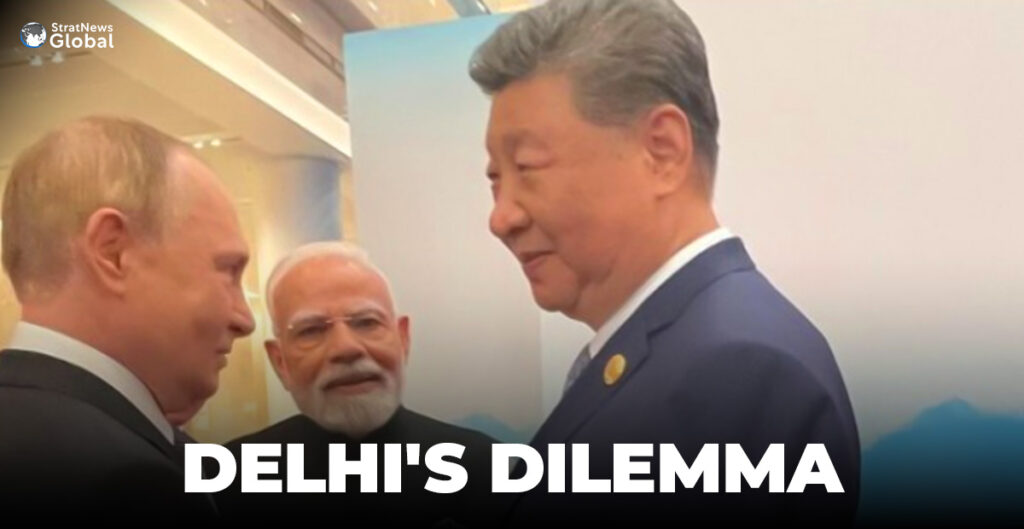
Modi was able to talk to President Xi Jinping, presumably freely, without all of the above hanging over his head. Add to that, a meeting with Putin in his personal limousine followed by another round of discussions in a more conventional setting. Not to forget the Central Asian leaders.
“Given the background of what is happening with the US, it was a reinforced message that you have to do your sums again. Does Trump want to be the president who, wittingly or otherwise, pushed India more into the arms of China? They should be clear about their geopolitical priorities,” Ambassador Sibal said.
“I can understand if there were serious fundamental differences (between US and India), but if it is pure vanity and pique, what should I say? Trump’s, obsession to obtain a Nobel Peace Prize cannot be the basis of serious foreign policy towards a major country like India.”
Ambassador Sibal believes the SCO summit has helped India ensure some diplomatic space for itself at the geopolitical level and there’s a degree of nervousness in the West that India is warming up to Chin a.
Geopolitics apart, how has the SCO helped on the terrorism front? Sibal believes there’s no easy answer to that. American declared war on terror and ended up handing back Afghanistan to the Taliban, similar is the case with Syria.
Add to that terrorism is viewed differently by SCO states. Central Asian countries are extremely concerned about the spillover of Islamic radicalism and terrorism from Afghanistan and Pakistan. They are secular regimes who want to maintain their secular identity.
Tune in for more in this conversation with Kanwal Sibal, former foreign secretary and ambassador to Russia.
Russian Overnight Airstrikes On Ukraine Injure Four, Damage Critical Infrastructure
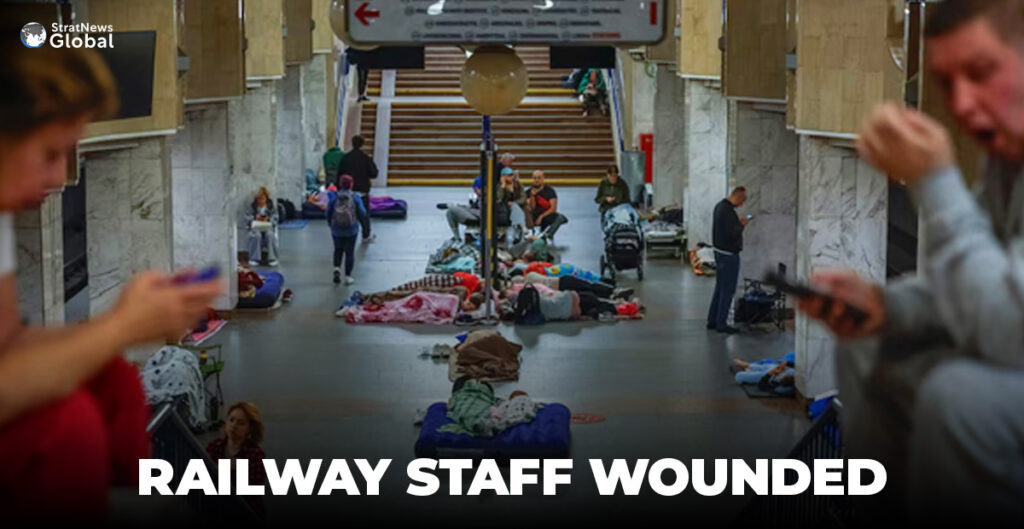
Ukraine said on Wednesday that a massive overnight Russian air assault left at least four railway workers injured and inflicted damage on critical infrastructure.
The attacks came as Russian President Vladimir Putin attended a military parade in Beijing, to mark the end of World War II, at which Chinese President Xi Jinping warned that the world faced a choice between peace and war.
Air raid alerts sounded for hours across Ukraine, with explosions heard in nine of its 24 regions, from Kyiv to Lviv and Volyn in the west, Ukrainian officials and media said.
Ukraine’s air force said it downed 430 of 502 drones and 21 of 24 missiles launched by Russia overnight, adding that three missiles and 69 drones struck 14 locations.
Ukraine’s western neighbour and NATO member, Poland, activated its own and allied aircraft to ensure safety, its armed forces command said.
Railway Workers Wounded
Four railway workers in Ukraine’s central Kirovohrad region were in hospital after the Russian attack, the state-owned railway said on messaging app Telegram, flagging delays of up to 7 hours to scores of services following damaged facilities.
The railway workers were among five injured in the major rail hub of Znamianka, where 28 houses were also damaged, Ukraine’s emergency services said on Telegram.
In northern Chernihiv, the attack cut power to 30,000 consumers and damaged critical civilian infrastructure, Governor Viacheslav Chaus said.
Public transport in the western city of Khmelnytskyi faced “significant schedule disruptions” after the attack, its administration said on Telegram, with the regional governor flagging fires and damage to residential buildings among others.
Firefighters in the Ivano-Frankivsk region were battling flames that engulfed 9,000 sq m (10,800 sq yards) of storage facilities, emergency services said.
There was no immediate comment from Russia. Both sides deny targeting civilians in their strikes in the war that Russia launched with a full-scale invasion of Ukraine in February 2022.
(With inputs from Reuters)
Bomb Blast At A Rally In Southwestern Pakistan’s Quetta Kills 11
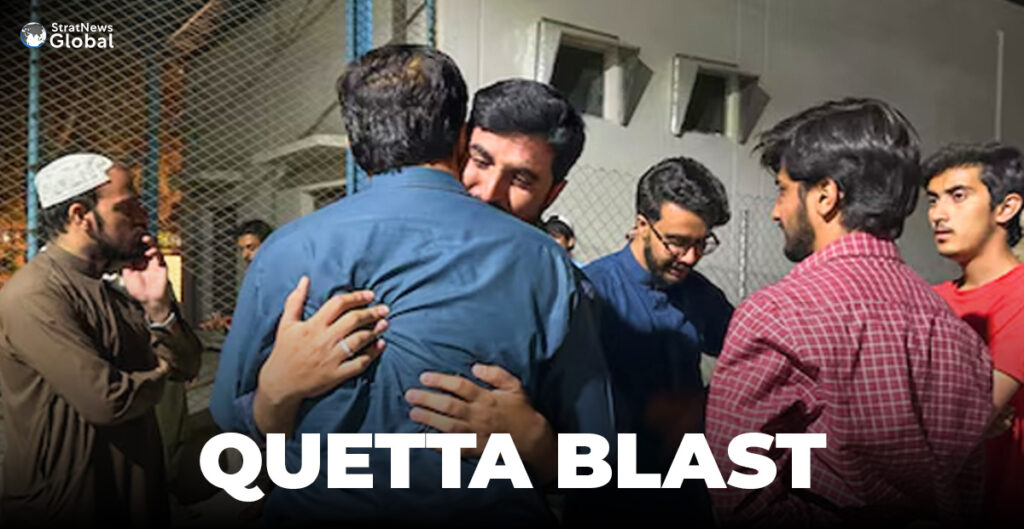
A bomb explosion claimed the lives of at least 11 people during a public rally in Quetta, southwestern Pakistan, late on Tuesday, officials said.
Government official Hamza Shafaat said the rally was held to commemorate the anniversary of the death of Sardar Ataullah Mengal, a nationalist leader and former provincial chief minister.
His son Sardar Akhtar Mengal, who was in attendance, is safe, Shafaat said, adding that another 30 people were injured.
“The reports we have say that the bomb went off in a parking area as the people were leaving the rally,” he said.
Police were investigating the blast, which appeared to be a suicide bombing, police official Athar Rasheed said.
No one has claimed responsibility.
Quetta is the capital of restive Balochistan province, which borders Afghanistan and Iran.
Both Islamist militants and Baloch separatist insurgents operate in the region.
Since 2014, China has poured substantial resources into developing a major road and infrastructure network in Balochistan, as part of its broader One Belt One Road initiative.
Yet, many Baloch residents argue that the advantages of these projects have been monopolised by outsiders rather than benefiting the local population.
Rising Attacks In Balochistan
For more than ten years, Pakistani security forces have been locked in a persistent struggle against a violent insurgency in the province. The year 2024 witnessed a particularly sharp escalation, with 782 fatalities recorded in Balochistan alone.
On Tuesday, violence again flared elsewhere in the province when a homemade explosive device struck a paramilitary convoy near the Iranian border, leaving five personnel dead and another four injured, according to a senior local administrator.
Since the beginning of 2025, armed groups waging war against the state in Balochistan and neighbouring Khyber Pakhtunkhwa have killed more than 430 people, the majority of them members of the security services.
The same day, the military reported that six soldiers were killed in Khyber Pakhtunkhwa’s city of Bannu, following a major assault on a paramilitary headquarters.
A government source said on condition of anonymity, “a suicide bomber rammed a vehicle packed with explosives into the entrance of the FC camp, after which five additional suicide attackers forced their way inside.”
The firefight that followed raged for nearly 12 hours before concluding with the deaths of all six assailants, the official confirmed.
Responsibility for the Bannu attack was later claimed by the militant faction Ittehad-ul-Mujahideen Pakistan.
(With inputs from Reuters and IBNS)
Tariff King Meets Payback Time: India’s Xi–Trump Dilemma
India is being forced to navigate the space between the unpredictability of Donald Trump’s America and the relentless rise of China, and Ambassador Nirupama Rao, former Foreign Secretary and envoy to both Washington and Beijing, does not pretend that the task is anything but fraught.
Speaking to Sinologist Manoj Kewalramani on The Great Power Show podcast titled ‘The Revolt of the Orchestra‘, she offered a candid assessment of both relationships, stripped of illusions and softened rhetoric.
Her memories of China capture the scale of transformation. On her first visit in 1986, Beijing was a “kingdom of bicycles” where Soviet-made aircraft rattled through the skies and Maoist slogans still decorated hotel lobbies.
Two decades later, when she arrived as ambassador, the capital was preparing for the 2008 Olympics, the pollution briefly tamed, the self-image transformed. That year’s global financial crisis gave Chinese officials fresh confidence, with what she described as “a new sense of authority, a new sense of confidence, perhaps a sense of having arrived.”
India, by contrast, was left confronting a widening asymmetry. At the same time, Beijing’s embrace of Pakistan never loosened. Rao recalled Premier Li Peng telling India’s defence minister in 1992 that “we don’t abandon our friends” and that Pakistan had stood by China when it was isolated.
She described the impression this left: China insisting it would continue to arm and support Islamabad, while tossing India a token assurance of wanting good relations too. By the late 2000s, the imbalance in economic and strategic weight had only grown, with Beijing pressing its advantage. As she put it starkly, “China sees it as payback time.”
If China radiates certainty, the United States radiates volatility. Rao described the India-U.S. relationship as being at “a very odd and very uncomfortable inflection point”, a place where “strategic convergence as well as political friction are coexisting.” For two decades, defence ties, the Quad, technology partnerships, and a shared concern about China had given the partnership ballast.
That changed under Trump’s second term. Rao did not mince words: the day-to-day political mood now feels “very, very sour, unusually sour”, as if the relationship “has been hit by a hurricane”.
Trump’s decision to slap tariffs on India, including an extra 25 per cent levy tied to Russian oil imports, amounted in her description to India being “thrown under the bus”. The rhetoric has been particularly bruising. She recalled Trump calling India a “tariff king”, adding that “he’s heaped insults on us, really.”
The difficulty, she explained, lies not just in the president’s style but in the political currents shaping him. She pointed to the pull of the MAGA movement, which has hardened American populist nationalism on trade and immigration. In her words, “We matter less to the United States than China in the Trumpian definition of the universe. We’re not an indispensable nation.” For India, that recognition is unavoidable.
Rao was equally clear-eyed about the role of public opinion. In a democracy, she said, “We cannot afford to ignore” domestic outcry, whether it is anger at China after Galwan or resentment over American tariffs.
Diplomats, however, are not supposed to echo rage but to frame it. “Diplomacy is ….not only life without maps, but it should also be life without illusions,” she said. Their job is to convey popular anger “in as civilised a manner as you can”, while also “encouraging a very rational way of thinking about the problems we face”.
Her criticism extended to India’s own blind spots. She noted the growth of China studies in recent decades, contrasting it with the thin scholarship on the United States. India, she observed, has tended to assume it understands America because of English and media access, but “there is so much more to understanding the United States.”
She cited her own exposure to American literature and music long before she ever visited the country, from Faulkner and Hemingway to Dylan and Joan Baez, as shaping her understanding of American history, culture, and contradictions. Without such depth, she implied, Indian assessments risk being shallow, particularly at a time when U.S. domestic politics directly drive policy on trade, immigration, and technology.
She also stressed that illusions cut both ways. If India must understand the United States more seriously, Americans too lack comprehension of India. She recalled Harold Isaacs’ Scratches on Our Minds, which described the superficial stereotypes through which Americans often saw India, in contrast to their deeper engagement with China.
Decades later, she noted, this gap still persists, especially in “flyover country”, where there is little academic engagement with India. For her, this mismatch in perceptions and imagination remains a structural obstacle in bilateral ties.
On China, she was unsentimental. The brief period of trust-building in the late 1980s and 1990s, which she helped shape through the peace and tranquillity agreements, has collapsed. The Tibetan question repeatedly soured her time as ambassador, with midnight summons to the foreign ministry after protests in India.
Today, she said flatly, “that trust is completely eroded.” Economic decoupling is “not going to be possible in the near term,” but disengagement on the border and efforts at de-escalation are “extremely important.”
Essentially, she argues, China is a neighbour that has raced ahead and shows little inclination to accommodate India. The United States is a partner of consequence but also of sharp mood swings, where insults are hurled as easily as handshakes. At home, emotion cannot be ignored, but diplomacy cannot be allowed to drown in it either.
Banned Leader Dodik Drives Cabinet Overhaul In Bosnia
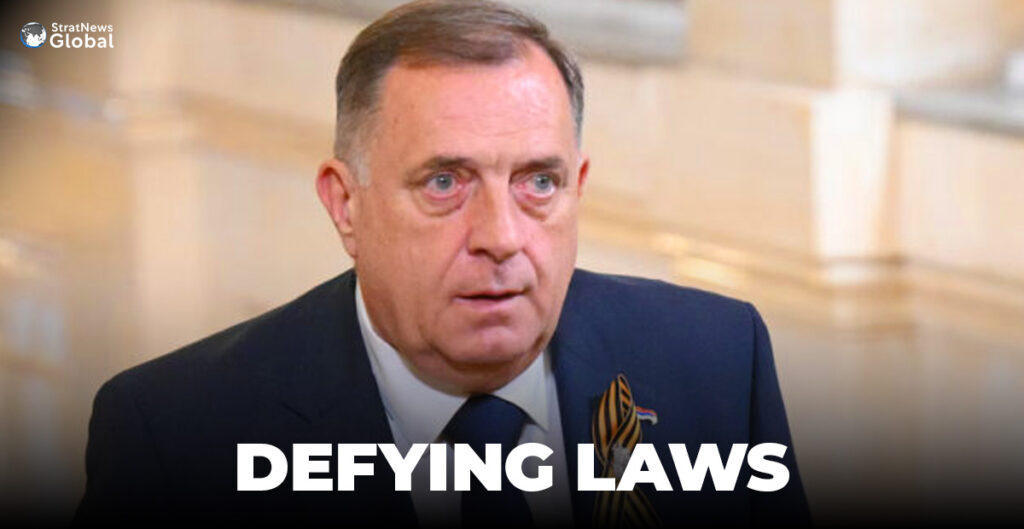
Bosnia’s Serb Republic parliament has approved a government reshuffle, triggering opposition backlash over its legality — as it was initiated by the region’s president Milorad Dodik, who is currently banned from holding political office.
The vote late on Tuesday deepens a crisis over a Serb separatist drive that amounts to one of the biggest threats to peace in the Balkans since the wars that followed Yugoslavia’s collapse.
Dayton Peace Accords
The Serb Republic makes up Bosnia and Herzegovina along with a federation shared by Bosniaks and Croats under the Dayton peace accords that ended a 1992-95 conflict that killed about 100,000 people and displaced around 2 million.
Dodik, last month was stripped of his mandate as the Serb Republic’s president by Bosnia’s election commission.
An appeals court had earlier upheld a verdict jailing Dodik for a year and banning him from politics for six years for defying the rulings of the international envoy who oversees civilian implementation of the Dayton accords.
Meeting ‘Challenges Ahead’
Dodik, a Russian-backed separatist who wants the Serb region to secede from Bosnia, has rejected the commission’s decision and stayed on, but the election commission has called a November 23 election to elect a successor.
Saying changes were needed in the Serb Republic’s government to meet “challenges ahead”, Dodik asked regional Prime Minister Radovan Viskovic to resign and nominated former agriculture minister Savo Minic to replace him.
The reshuffled government, which includes only four new faces, was approved by 50 deputies from the governing coalition led by Dodik’s SNSD party.
Opposition deputies did not attend the vote. They said the government would be illegal because Dodik had lost his mandate as president.
Minic said the government would work to return Bosnia to what he depicted as post-war basics, echoing Dodik’s stance that only institutions that existed in the so-called “original Dayton deal” were acceptable to Bosnian Serbs.
Minic announced a referendum on Dodik’s status and said the Serb Republic had the right to self-determination.
(With inputs from Reuters)
How Modi And Putin Set China’s Weibo Abuzz
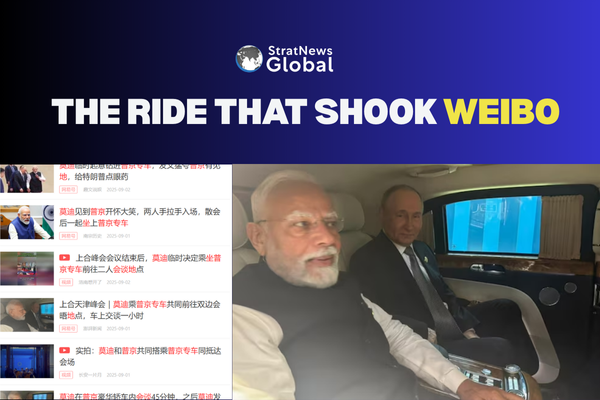
It’s been two days since the images of Modi and President Putin seated together in the latter’s limousine hit the internet … and the buzz continues.
On Weibo (China’s equivalent of X) the hashtag #Modi took Putin’s special car to the meeting, garnered nearly three million views and inspired over 200 articles across platforms like Zhihu, Wechat, Netease, and Weibo.
A Chinese podcast (screenshot attached below) asked the question, “On Chinese soil, Modi got into Putin’s car, where the two held a private talk for nearly an hour, worried that walls might have ears?”
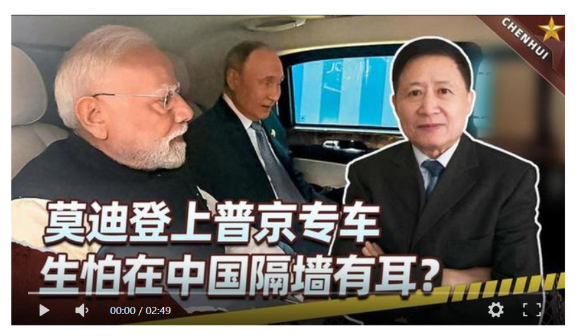
It hinted at something Chinese probably face in their daily lives, the fear of being spied upon by the government’s oppressive surveillance apparatus. That the Modi-Putin ride lasted over 40 minutes with Modi later remarking that it was “insightful”, added grist to the Weibo mill.
Chinese social media platform Zhihu, claimed that Modi’s action was without any prior invitation. He simply got into Putin’s car and the two proceeded together to their talks.
Another verified Weibo account with more than a million followers made a meme from the viral photo of Modi and Putin in the same car. The post showed a made-up conversation where Modi asks Putin how his talks in Alaska went and if there will be a ceasefire. Putin tells him not to worry, and promises a ceasefire soon.
Modi then asks for a bigger discount (on oil) in the future, whilch seems to leave Putin speechless. The exchange spread quickly online. Among the flood of reactions, one comment stood out: “What was Lao Chuan’s mood after watching this?” Lao Chuan meaning “Old Trump,” a nickname for the US president on Chinese Social media platforms.
Another verified Weibo blogger, posting under the handle Zhaolishuoshi and followed by more than half a million users, shared a report with the caption: “Putin follows Trump’s example, riding in the same car with Modi. Russia–India friendship is unbreakable, leaving the United States dumbfounded.” The post drew a parallel to Donald Trump’s earlier rides with Modi first at the “Howdy, Modi” event in Houston in 2019, and later during the “Namaste Trump” visit in Ahmedabad in 2020.
On the same Weibo handle Shenzhen Satellite TV posted on Weibo that such ‘hitchhiking diplomacy’ between leaders is extremely rare, which was factually inaccurate. This was the second time in half a month that Putin shared a car with a foreign leader. The previous instance was on 15 August in Anchorage, Alaska, when he got into US President Donald Trump’s car and held a one-on-one conversation without interpreters.
Australia To Ease Deportation Rules, Signs Refugee Deal With Nauru
Australia is set to pass a new law on Thursday easing the deportation of non-citizens to third countries — a move that has reignited criticism from human rights groups, who accuse it of “dumping” refugees on small island nations and drawing parallels with US President Donald Trump’s hardline immigration policies.
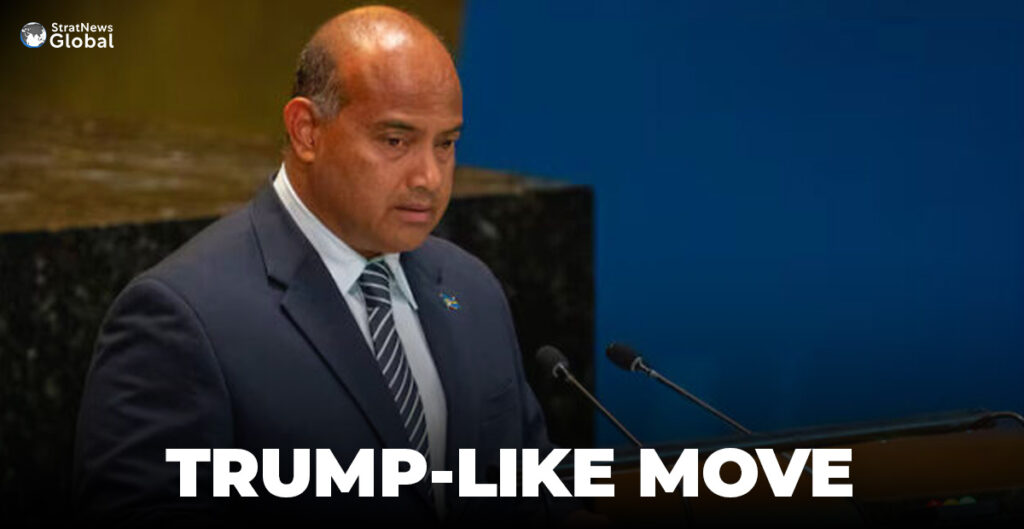
As the United States seeks Pacific Island nations willing to accept deported non-citizens, Australia last Friday signed a deal with Nauru to resettle hundreds of people who have been denied refugee visas because of criminal convictions.
Limiting Court Appeals
The planned new law removes procedural fairness when Australia deports a non-citizen to a third country and is designed to limit court appeals, said the government. It is expected to pass in Australia’s parliament after the opposition Liberal Party said it would support the move.
Australia will pay an upfront A$400 million to establish an endowment fund for the resettlement scheme, plus A$70 million a year in costs, Nauruan President David Adeang said in a budget speech last Friday.
Two-thirds of Nauru’s revenue last year, or A$200 million ($129.96 million), came from hosting an Australian-funded processing centre for asylum seekers.
Nauru, which has a population of 12,000 and a land area of just 21 square km (eight square miles), is reliant on foreign aid, and faces a 2025 deadline to repay Taiwan A$43 million ($27.94 million) after switching diplomatic ties to Beijing, according to budget documents.
New Law To Cover Different Group
Under a decade-old policy to discourage people smuggling, Australia sends asylum seekers who arrive by boat to offshore detention centres to have refugee claims assessed, denying them Australian visas. The practice has been criticised by the United Nations Human Rights Committee.
The new Nauru resettlement scheme will cover a different group, whose visas were cancelled by Australia because they served prison sentences or were refused visas on character grounds, and cannot return to countries including Iran, Myanmar and Iraq because of the risk of persecution.
Australia’s High Court ruled in 2023 that indefinite immigration detention was unlawful, resulting in around 350 non-citizens being released into the community, with a third subject to electronic monitoring.
One of this group, a 65-year-old Iraqi man, lost a High Court appeal against deportation to Nauru on Wednesday.
Criticisms
Law Council of Australia President Juliana Warner said on Wednesday the deportation law was “troubling” because it could put those sent to Nauru at risk of not receiving necessary healthcare, and is being rushed through parliament without adequate public scrutiny.
Several independent lawmakers said they were concerned it could be applied more widely than the 350 released by the High Court decision, with up to 80,000 people in the community without a visa.
Home Affairs Minister Tony Burke declined to comment on the 80,000 figure, and has said the law change is needed to maintain the integrity of the migration system.
The move was “absolutely Trump-like”, said Jana Favero, the deputy chief executive of the Asylum Seeker Resource Centre.
Independent lawmaker Monique Ryan told parliament she was concerned stateless individuals and refugees who had never been convicted of a crime would be sent offshore without proper oversight, and Australia was “using a small island nation as a dumping ground”.
(With inputs from Reuters)
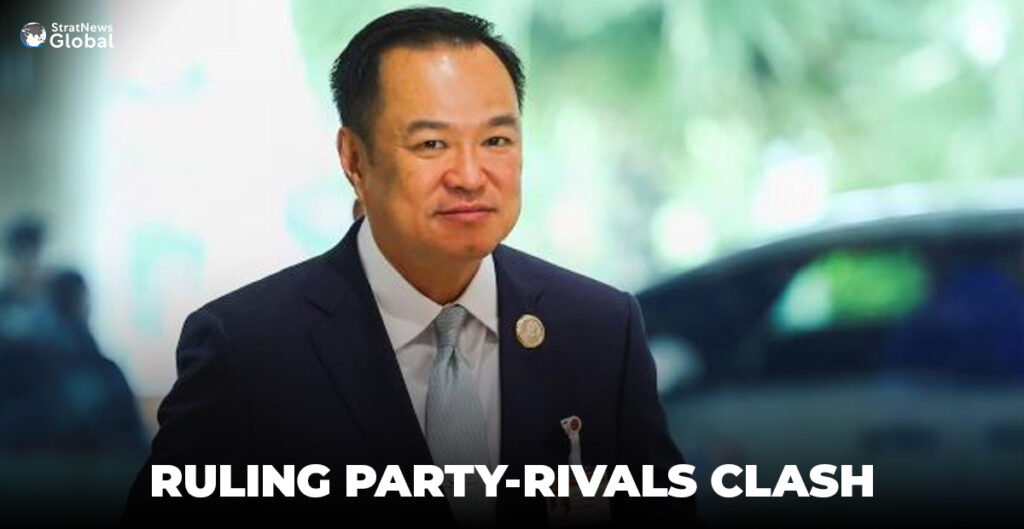
Thailand’s Ruling Party Requests Parliament Dissolution As Opposition Rallies Behind Rival PM
Political turmoil deepened in Thailand on Wednesday after the ruling Pheu Thai party announced it had sought royal approval to dissolve parliament and call new elections. The move came just as the largest group in the house declared its support for a rival party to form the next government.
The chief whip of the Pheu Thai party, which last week suffered the loss of its prime minister, Paetongtarn Shinawatra, to a court ruling, said the party had decided to forge ahead with seeking a snap election.
Moments earlier, the opposition People’s Party, which controls nearly a third of lower house seats , said it was backing the rival Bhumjaithai party’s ambitious leader Anutin Charnvirakul for premier, a potential game-changer that could break days of political deadlock.
Paetongtarn’s dismissal last Friday for an ethics violation triggered a scramble for power, with her Pheu Thai party racing to shore up a fragile coalition with a slender majority as its former alliance partner Bhumjaithai mounted a bold challenge to form its own government.
Thailand’s Rival Elites
Her removal was the latest twist in a tumultuous, two-decade battle for power among Thailand’s rival elites, with Paetongtarn the sixth premier from or backed by the billionaire Shinawatra family to be ousted by the military or judiciary and the second in the space of a year.
Pheu Thai’s move to dissolve the house comes as the once-dominant populist party founded by Paetongtarn’s billionaire father Thaksin Shinawatra has been haemorrhaging support and facing protests against its rule.
There are conflicting opinions among law experts in Thailand, however, as to whether a caretaker government has the authority to seek house dissolution.
People’s Party leader Natthaphong Ruengpanyawut said the party would back Bhumjaithai to prevent the return of a coalition government that was not fit to rule again, but it would not join its government.
He said a parliamentary vote on a new prime minister could take place on Friday.
“There is a risk that there would be a return of the old coalition which has failed to run the country in the last two years, and a risk of the return of the coup maker as prime minister,” he told a press conference, referring to Prayuth Chan-ocha, a general who seized power in 2014 and remains eligible to become premier, despite retiring.
(With inputs from Reuters)
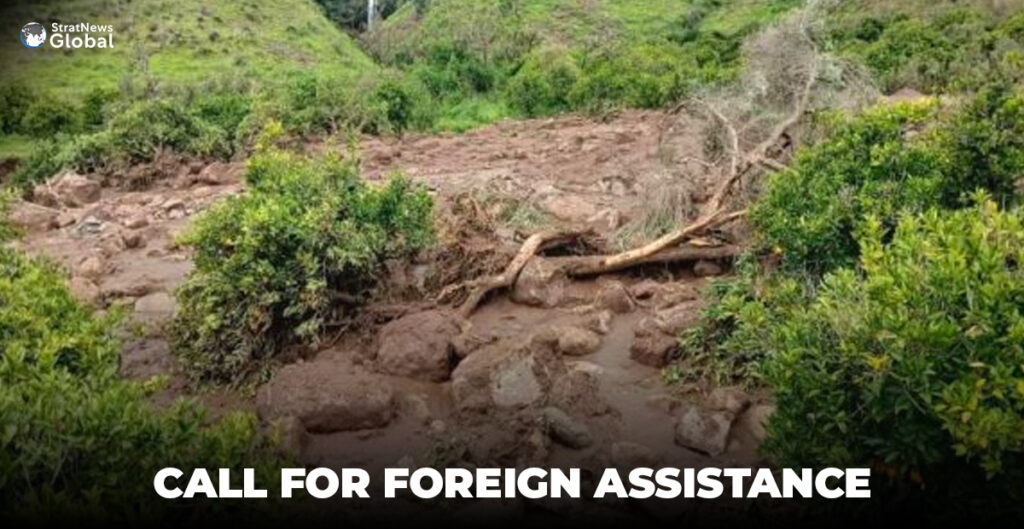
Sudan Armed Group Seeks Aid After Landslide Destroys Village, Killing 1,000
An armed group controlling part of western Sudan appealed for international assistance on Tuesday after a landslide triggered by heavy rains buried a mountain village, leaving at least 1,000 people dead. The group urged help to recover bodies and rescue survivors.
Only one person survived the destruction of the village of Tarseen in the mountainous Jebel Marra area of the Darfur region, said the Sudan Liberation Movement/Army.
SLM/A, which has long controlled and governed an autonomous portion of Jebel Marra, appealed to the United Nations and international aid agencies to help collect the bodies of victims, including men, women and children.
“Tarseen, famed for its citrus production, has now been completely levelled to the ground,” the group said in a statement. Continuing rains have made travel in the region difficult and could impede any rescue or aid efforts.
“Nearby villagers are overwhelmed with fear that a similar fate might befall them if the … torrential rainfall persists, which underscores the urgent need for a comprehensive evacuation plan and provision of emergency shelter,” the group’s leader, Abdelwahid Mohamed Nur, said in a separate appeal.
A statement by the U.N.’s resident coordinator put the death toll at between 300 and 1,000, citing local reports.
Arjimand Hussain, regional response manager for the development group Plan International, said the last 45 km of the route to Tarseen were impassable to motor vehicles and could only be negotiated on foot or by donkey.
Shortage Of Food, Shelter, And Medical Supplies
Nine bodies were recovered by volunteers, said Abdelhafiz Ali from the Jebel Marra Emergency Room, who noted that the village had hosted hundreds of people displaced by fighting.
The SLM/A has remained neutral in the battle between the main enemies in Sudan’s civil war, the Sudanese army and the paramilitary Rapid Support Forces. The two foes are fighting over control of al-Fashir, capital of North Darfur state, which is under siege from the RSF and has suffered famine.
Residents of al-Fashir and nearby areas have sought shelter in Jebel Marra, though food, shelter, and medical supplies are insufficient and hundreds of thousands have been exposed to the rains. Tawila, where most have arrived, is in the throes of a cholera outbreak, as are other parts of Darfur.
The two-year civil war has left more than half of Sudan’s population facing crisis levels of hunger and driven millions from their homes, leaving them especially exposed to the country’s damaging annual floods.
Sudan’s army-controlled government expressed its condolences and willingness to assist.
The prime minister of a newly-installed RSF-controlled rival government, Mohamed Hassan al-Taishi, said he would be coordinating with the SLM/A on the delivery of aid supplies to the area.
Pope Leo sent his condolences and said he was praying for those affected, according to a Vatican statement.
(With inputs from Reuters)