

Support us by contributing to StratNewsGlobal on the following UPI ID
ultramodern@hdfcbank

Strategic affairs is our game, South Asia and beyond our playground. Put together by an experienced team led by Nitin A. Gokhale. Our focus is on strategic affairs, foreign policy and international relations, with higher quality reportage, analysis and commentary with new tie-ups across the South Asian region.
You can support our endeavours. Visit us at www.stratnewsglobal.com and follow us on YouTube, Twitter, Facebook and Instagram.
र 500 per month
र 1000 per month
र 5000 per year
र 10000 per year
Donate an amount of your choice
र 500 per month
Donate र 500 per month

र 1000 per month
Donate र 1000 per month
र 5000 per year
Donate र 5,000 per year
र 10000 per year
Donate र 10,000 per year
Donate an amount of your choice
Donate an amount of your choice
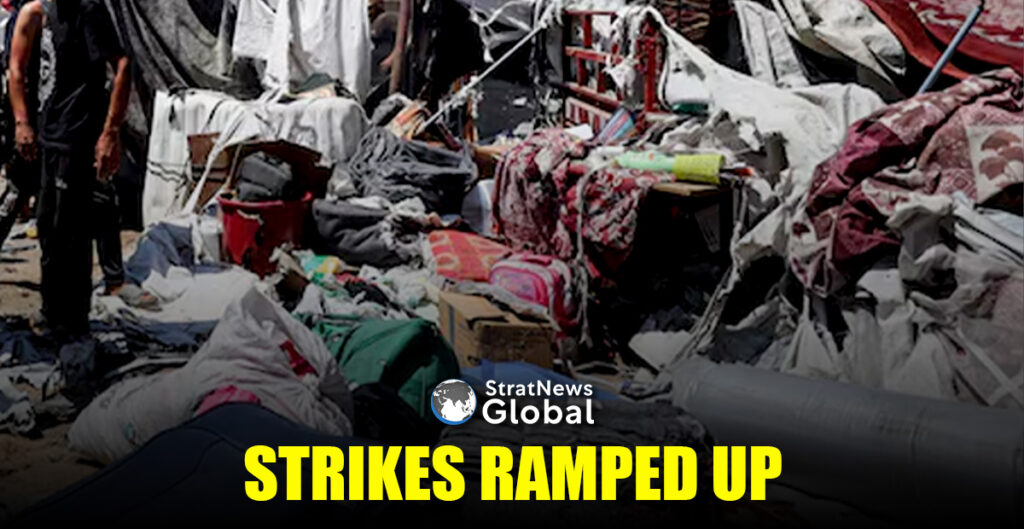








Israeli Bombardments Force More Palestinians To Flee Gaza City
Israeli bombardment forced more Palestinians to flee their homes in Gaza City on Thursday, while thousands defied evacuation orders, staying amid the ruins in the path of Israel’s latest offensive.
Gaza health authorities said Israeli fire across the enclave had killed at least 28 people on Thursday, most of them in Gaza City, where Israeli forces have advanced through the outer suburbs and are now a few km (miles) from the city centre.
Gaza City Offensive
Israel launched the offensive in Gaza City on August 10, in what Prime Minister Benjamin Netanyahu says is a plan to defeat Hamas militants once and for all in the part of Gaza where Israeli troops fought most heavily in the war’s initial phase.
The campaign has prompted international criticism because of the dire humanitarian crisis in the area, and has provoked unusual expressions of concern within Israel, including accounts of tension over strategy between some military commanders and political leaders.
“This time, I am not leaving my house. I want to die here. It doesn’t matter if we move out or stay. Tens of thousands of those who left their homes were killed by Israel, too, so why bother?” Um Nader, a mother of five from Gaza City, told Reuters via text message.
Residents said Israel bombarded Gaza City’s Zeitoun, Sabra and Shejaia districts from ground and air. Tanks pushed into the eastern part of the Sheikh Radwan district northwest of the city centre, destroying houses and causing fires in tent encampments.
There was no immediate Israeli comment on those reports. The Israeli military has said it is operating on the outskirts of the city to dismantle militants’ tunnels and locate weapons.
Much of Gaza City was laid to waste in the war’s initial weeks in October-November 2023. About a million people lived there before the war, and hundreds of thousands are believed to have returned to live among the ruins, especially since Israel ordered people out of other areas and launched offensives elsewhere.
Israel, which has now told civilians to leave Gaza City again for their safety, says 70,000 have done so, heading south. Palestinian officials say less than half that number have left, and many thousands are still in the path of Israel’s advance.
‘Most Dangerous Displacement’
Displacement could further endanger those most vulnerable, including many children who are suffering from malnutrition, said Amjad al-Shawa, the head of the Palestinian NGOs Network, an umbrella group of Palestinian NGOs that coordinates with the UN and international humanitarian agencies.
“This is going to be the most dangerous displacement since the war started,” said Shawa. “People’s refusal to leave despite the bombardment and the killing is a sign that they have lost faith.”
Palestinian and UN officials say there is no safe place in Gaza, including areas Israel designates as humanitarian zones.
The war has caused a humanitarian crisis across the territory. Health officials in Gaza say 370 people, including 131 children, have so far died of malnutrition and starvation caused by acute food shortages, most in recent weeks. Israel says it is taking measures to improve the humanitarian conditions in Gaza, including increasing aid into the enclave.
The war began on October 7, 2023, when gunmen led by Hamas attacked southern Israel, killing some 1,200 people, most of them civilians, and taking 251 hostages into Gaza.
Israel’s offensive has since killed more than 63,000 Palestinians, most of them civilians, according to local health officials, and left much of the territory in ruins.
Prospects for a ceasefire and a deal to release the remaining 48 hostages, 20 of whom are thought to still be alive, appear dim.
Protests in Israel calling to end the war and reach a deal to release the hostages have intensified in the past few weeks.
(With inputs from Reuters)
Afghanistan Earthquake: Death Count Crosses 2,200, Survivors Struggle For Aid
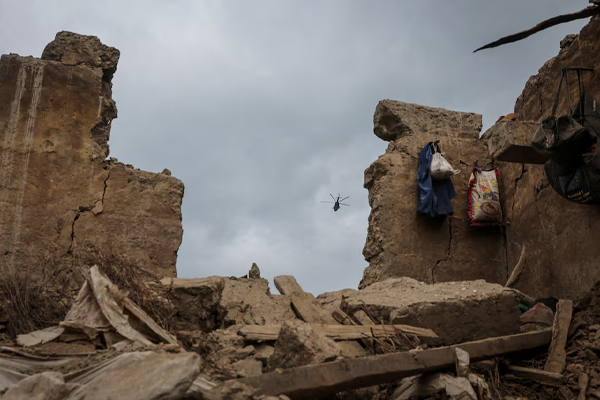
Rescue teams in Afghanistan recovered bodies from earthquake-ravaged homes on Thursday, with the confirmed death toll exceeding 2,200, while homeless survivors faced a grim outlook amid warnings of limited global aid.
Search operations continued in the quake-hit mountainous eastern areas, the Taliban administration said, announcing a new death toll of 2,205 with at least 3,640 people injured.
“Everything we had has been destroyed,” said Aalem Jan, whose house in the worst-affected province of Kunar was flattened by the tremors.
“The only remaining things are these clothes on our backs,” said Jan. His family sat under trees with their belongings piled next to them.
Two Quakes In 3 Days
The first earthquake of magnitude 6, one of Afghanistan’s deadliest in recent years, unleashed widespread damage and destruction in the provinces of Kunar and Nangarhar on Sunday, when it struck at a shallow depth of 10 km (6 miles).
A second quake of magnitude 5.5 on Tuesday caused panic and interrupted rescue efforts as it sent rocks sliding down mountains and cut off roads to villages in remote areas.
More than 6,700 homes have been destroyed, authorities have said. The United Nations has warned the toll could rise with people still trapped under rubble as time runs out for survivors.
Humanitarian needs are “vast and growing rapidly”, said the International Federation of Red Cross and Red Crescent Societies.
“Up to 84,000 people are directly and indirectly affected, with thousands displaced,” it added, citing initial figures.
Search Ops Underway
In some of the worst-affected villages in Kunar province, two out of three people had been killed or injured, while 98% of buildings were either destroyed or damaged by the tremors, according to an assessment by British-based charity Islamic Relief Worldwide.
Survivors desperately searching for family members sifted rubble, carried bodies on woven stretchers and dug graves with pickaxes in the wait for aid to arrive.
Videos showed trucks, some laden with sacks of flour and others carrying men with shovels, travelling to remote villages on higher slopes. Authorities also airdropped dozens of commando forces at sites where helicopters could not land.
Afghanistan is prone to deadly earthquakes, particularly in the Hindu Kush mountain range, where the Indian and Eurasian tectonic plates meet.
With homes made mostly of dry masonry, stone and timber, some families preferred to sit out in the open rather than return home as aftershocks continued at regular intervals.
The houses gave little protection from the quakes, in ground left unstable by days of heavy rain, said the U.N. Office for the Coordination of Humanitarian Affairs.
Aid Crunch
Resources for rescue and relief work are tight in the South Asian nation of 42 million people, pulverised by war, poverty and shrinking aid, where harsh weather presents a further challenge.
U.S. President Donald Trump’s funding cuts to foreign aid and donor frustration over the Taliban’s restrictive policies towards women and its curbs on aid workers have worsened Afghanistan’s isolation.
The World Health Organisation pointed to a funding gap of $3 million, saying it was critical to keep medicines, trauma kits, and essential commodities flowing amid rising demand.
The U.N. World Food Programme has funding and stocks to support the survivors for just four more weeks, its country head, John Aylieff, told Reuters on Wednesday.
Jacopo Caridi of the Norwegian Refugee Council called for donors to go beyond life-saving relief to ensure Afghans a chance at a future beyond perpetual emergency.
“The earthquake should serve as a stark reminder: Afghanistan cannot be left to face one crisis after another alone,” he said.
(With inputs from Reuters)
India’s New China Playbook
This weekend, India and China took baby steps to bridge their historical trust deficit on the sidelines of the Shangai Cooperation Organisation (SCO) summit in Tianjin, China. To at least try and synergise the two economies, who otherwise see each other as strategic rivals.
Undoubtedly, President Donald Trump’s bizarre actions on tariffs, spurred the Elephant and the Dragon to attempt a tango.
The big question is: Can India redraw its economic engagement with China in a way that works to its advantage?
Our guest on StratNewsGlobal.Tech, Nisha Taneja, believes India can do so. Nisha is a professor at Icrier, a Delhi-based think tank, and lead author of a just published report on reimagining India-China trade.
Trump’s Executive Moves May Dominate Supreme Court’s Upcoming Docket
U.S. President Donald Trump has tested the limits of executive authority through broad tariffs, immigration crackdowns, and an attempt to remove a Federal Reserve governor, actions likely to shape the U.S. Supreme Court’s upcoming docket.
“It’s about to be, ‘Does the president have the power to do that?’ season at the Supreme Court,” said Loyola Law School professor Jessica Levinson. “While each case brings up slightly different issues, when and if the Supreme Court tackles deportations, tariffs and the firing of members of executive agencies, the big question will be whether or not President Trump had the authority to take those actions.”
Trump’s administration appealed on Wednesday a lower court’s ruling last week that many of his tariffs pursued under a 1977 law meant for emergencies are illegal, urging the justices to fast-track their review of the case.
The case, and others making their way to the Supreme Court, will test just how amenable the justices are to the Republican president’s expansive view of his authority, and his administration’s ability to find novel ways to justify and carry out his agenda.
The court, which has a 6-3 conservative majority, has already handed major wins to the Republican president in his second term, granting emergency requests to implement his policies while challenges play out in lower courts.
The justices return in September from their summer recess and typically choose 60-70 appeals to hear. In the upcoming October to June term, they could rule on administration actions stemming from Trump’s sweeping claims of executive power.
“The scope of executive power has been – and will continue to be – the recurring legal issue of Trump’s second term,” said Robert Luther III, a George Mason University law professor. “And why wouldn’t President Trump want it to be? The Supreme Court has consistently backed his muscular assertions of presidential power.”
Tariffs
The 7-4 decision on August 29 from the U.S. Court of Appeals for the Federal Circuit addressed what Trump calls “reciprocal” tariffs announced in April as well as other tariffs imposed in February against China, Canada and Mexico.
At issue is whether Trump overstepped his authority in invoking the 1977 International Emergency Economic Powers Act to impose the tariffs, the first time the law was used for that purpose.
Trump has made tariffs a pillar of U.S. foreign policy, employing them to exert political pressure and renegotiate trade deals with exporting countries.
Immigration
Trump’s immigration policy has given rise to similar challenges. A New Orleans-based federal appeals court ruled on Tuesday that Trump’s reliance on a 1798 law to deport Venezuelan migrants accused of being gang members was likely unlawful. Historically, the law has been used only in wartime.
The Alien Enemies Act expansively empowers the government to detain and deport citizens of hostile nations in times of war or during an “invasion or predatory incursion.” The 5th U.S. Circuit Court of Appeals blocked the deportation of Venezuelan migrants under the law, rejecting the administration’s view that the Venezuelan gang Tren de Aragua had made a “predatory incursion” on U.S. soil.
This has been one of the few areas where the Supreme Court has pushed back on the administration so far. In May, the justices faulted his administration for seeking to remove Venezuelan migrants at a Texas detention centre without adequate legal process.
Fed Governor Cook
The limits of Trump’s authority lie at the centre of another case over his announcement last week that he was removing Lisa Cook from the Federal Reserve Board of Governors, which sets U.S. monetary policy.
Cook quickly filed a lawsuit seeking to block the move, setting up a legal battle that could upend long-established norms for the Fed’s independence.
The Trump administration has accused Cook, the first Black woman on the Fed board, of committing mortgage fraud, which she has denied. Cook also contends that, even if she made misstatements on mortgage applications, they do not give the president legal cause to remove her because she disclosed all the relevant information during her 2022 vetting.
The case has major implications for the Federal Reserve’s long-standing independence from political influence.
Other Cases
Trump’s moves to eliminate diversity initiatives, withhold grants and other congressionally appropriated funds and target transgender individuals, among other contentious issues, have drawn hundreds of lawsuits – many of which are rapidly advancing through the appeals process.
The Supreme Court has heard some of them on an emergency basis, as the administration fought attempts to stymie its policies while legal challenges continued. The court has sided with Trump in almost every case so far.
In May, the Supreme Court let the administration end Biden-era temporary deportation protections for hundreds of thousands of Venezuelans as it put on hold a judge’s ruling against the government. A San Francisco-based U.S. appeals court on August 29 upheld the judge’s ruling, setting up a further appeal.
In June, the court allowed the administration to deport migrants to countries other than their own – including politically unstable South Sudan – without a chance to show the harms they could face.
The court also backed Trump’s firing of Democratic members of federal labour boards and the top consumer product safety watchdog, boosting his power over federal agencies that Congress established as independent from presidential control.
The court also permitted implementation of his ban on transgender people in the military in May.
(With inputs from Reuters)
Indonesian Students Plan Parliament Protest, Await Government Meeting
Indonesian students announced plans to protest at Jakarta’s parliament on Thursday, as a scheduled government meeting regarding deadly demonstrations, which have killed 10, has yet to take place.
Led by students, workers and rights groups, last week’s protests over police violence and state spending priorities spread across the world’s third-largest democracy after a police vehicle hit and killed a motorcycle taxi driver.
The demonstrations have at times turned violent. Rights groups said 10 people have died and over 1,000 people were injured in incidents of looting and rioting. Rights groups have condemned the use of force by security forces.
The coalition of student bodies, known locally as BEM SI, said ahead of Thursday’s protest that “the people’s anxiety isn’t due to protests on the street, but it’s due to corruption and the politicisation of the law.”
Students Demand Independent Probe
Ten student unions met with parliamentarians on Wednesday. They called for an independent investigation into police violence, while drawing a contrast between generous benefits for lawmakers and the economic hardship faced by most Indonesians.
The deputy house speaker offered them a chance to meet with the government on Thursday, but BEM SI leader Muzammil Ihsan said there had been no follow-up on the invitation.
The protests have been called for by several Indonesian student bodies with varying and at times unaligned interests.
Workers with the union Gebrak will also stage a demonstration in Jakarta on Thursday against the heavy-handed security response and demand the release of those detained.
Indonesian authorities have detained over 3,000 people in a nationwide crackdown, New York-based rights group Human Rights Watch said on Thursday.
“Indonesian authorities should not respond to protests over government policies by using excessive force and wrongfully locking up demonstrators,” said Meenakshi Ganguly, deputy Asia director of the group.
President Prabowo Subianto has said the military and police would stand firm against violent mobs, and that some of the unrest bore the signs of terrorism and treason.
(With inputs from Reuters)
Ukraine’s Allies Convene Amid Uncertainty Over Guarantees, US Support
Around 30 Western leaders met with Ukrainian President Volodymyr Zelenskyy on Thursday to discuss security guarantees for Kyiv in a potential peace deal with Russia, aiming to secure U.S. support for their initiative.
The summit in Paris of the “coalition of the willing” brought together leaders from Europe, Australia, Japan and Canada, with even neighbouring countries choosing to attend by video-link.
Members of the coalition, which does not include the U.S., have talked for months at various levels to define their prospective military support for Ukraine to help deter Russia from attacking it again if and when there is a final truce – currently still a remote prospect.
But those efforts have stalled as governments have said any European military role would need its own U.S. security guarantees as a “backstop”. President Donald Trump has made no explicit commitment to provide those.
Trump Envoy Meets Europeans
His special envoy, Steve Witkoff, met several senior European officials in Paris on Thursday morning before the meeting, two diplomats said.
French President Emmanuel Macron said alongside Zelenskyy in Paris on Wednesday that the coalition leaders would endorse plans for security guarantees drawn up by their militaries.
Two European officials said the “technical” plans had been finished, without going into detail on what that actually meant.
British and French army chiefs were to brief the leaders on Thursday, according to an outline sent to attendees.
“We are ready, we Europeans, to provide security guarantees to Ukraine for when there is a signed peace,” Macron said, adding that it was now a question of seeing how sincere Russia was.
The two European officials said the aim would be to send a political signal to Trump. This would highlight the lack of progress toward direct peace talks between Russian President Vladimir Putin and Zelenskyy since Trump hosted Putin in August, and prod Trump to raise pressure on Moscow now.
Having rolled out the red carpet in Alaska, Trump on Wednesday accused Putin of conspiring with China and North Korea after the three countries’ leaders staged a show of unity in Beijing at a lavish commemoration of the end of World War Two.
NATO Secretary General Mark Rutte said on Wednesday he expected clarity from the coalition soon on what could be delivered, and this would pave the way for more intense discussions with Washington on what guarantees it could provide.
Peace In Ukraine Still ‘Illusory And Remote’
Putin told Kyiv on Wednesday there was a chance to end the war in Ukraine via negotiations “if common sense prevails”, an option he said he preferred, although he was ready to end it by force if that was the only way.
Western officials say the key element of the guarantees will be continuing strong support for Ukraine’s armed forces.
But they were also expected to include an international force to assist and reassure Kyiv, based both in Ukraine and in neighbouring countries, even though Russia is emphatically opposed to any foreign deployment in Ukraine.
Diplomats say big differences remain among allies on the issue.
European leaders have made clear such a force will only be feasible with U.S. backing – something Trump promised last month in general terms. But Washington has yet to spell out what it is willing to contribute.
Some of the leaders will call Trump after the summit, the French presidency said.
John Foreman, a former British defence attache to Kyiv and Moscow, said it was important to understand exactly what is on offer – especially for Zelenskyy as he weighs his position ahead of any direct talks with Russia.
“That said, there is growing realisation that peace will require a strong Ukraine and Ukrainian army, that European support will need to be long-lasting, and that Ukraine probably can’t rely on its allies coming to its aid to punish Russia should it re-attack,” he said.
“This is all prep work for a peace which remains illusory and remote due to Trump’s incoherent diplomacy and the lack of substantive talks.”
(With inputs from Reuters)
Lisbon Grieves 17 Dead In Cable Car Tragedy As Probe Opens
Flags in Lisbon were lowered to half-mast on Thursday after a hillside funicular railway crash killed at least 17 and injured 21, as Portuguese authorities launched an investigation into the tragedy.
The city’s remaining two lines were shut for inspections, authorities said.
Footage from the site showed the mangled wreckage of the yellow tram-like funicular, which carries people up and down a steep hillside in the Portuguese capital, lying where it had left the track and hit a building, just metres from another car at the bottom of the hill.
Eliane Chaves, a Brazilian who has lived in Lisbon for 20 years, said she walked past the funicular every day.
“National mourning has been declared. It is truly sad,” she said.
“People say that it was negligence, but it was not negligence. They supervise it thoroughly. It was an accident, just like a plane or car accident can happen.”
Manuel Leal, leader of the Fectrans union, told local TV that workers on the Gloria railway – one of the symbols of the city – had complained about problems with the funicular’s haulage cable tension that made braking difficult, but it was too early to say if that was the cause of the crash. The municipal public transport company Carris said in a statement that “all maintenance protocols have been carried out”, including monthly and weekly maintenance programmes and daily inspections.
How The Accident Occurred?
The line’s two cars, each capable of carrying around 40 people, are attached to opposite ends of a haulage cable with traction provided by electric motors on the cars that counterbalance each other.
As the cable apparently snapped, the car that was coming down the 265-metre slope lost its brakes and derailed on a turn, crashing into a corner building.
The car at the bottom of the line jolted back a couple of metres (yards) and was apparently undamaged, but video from bystanders showed several passengers jumping out of its windows.
The line, which opened in 1885, connects Lisbon’s downtown area near the Restauradores Square with the Bairro Alto, or Upper Quarter, famous for its vibrant nightlife.
The Gloria line transports around 3 million people annually, according to the town hall.
Authorities did not identify the victims or disclose their nationalities, but said some foreign nationals were among the dead.
Some local media reported that a German family of three was among the victims, including a three-year-old child who suffered minor injuries, while the father died and the mother was seriously hurt.
Portugal, and Lisbon in particular, has experienced a tourism boom in the past decade, with visitors cramming the popular downtown area in the summer months.
(With inputs from Reuters)
Egypt Abolishes Longstanding Rent Controls, Sparking Tenant Eviction Concerns
For decades, Khaddara Ibrahim Ali relied on capped rent to keep her Cairo apartment affordable, but Egypt’s sweeping new reforms will end that security as the Egyptian parliament in July approved the country’s biggest rent overhaul in decades, scrapping rent caps and rules that had let tenants and their heirs stay in their homes indefinitely.
The change, which will take effect for non-residential units over five years and for homes over seven years, impacts millions of households and has raised fears among many tenants who had counted on their rents to ensure a degree of economic stability.
“I’m afraid all the time,” 84-year-old Ali, who pays just under 11 Egyptian pounds ($0.23) per month for the eighth-story home where she has lived for half a century, said. “After all this familiarity, I would just leave?”
‘Old Rent’ Contracts
The law applies to “old rent” contracts signed before January 31, 1996, when measures were taken to liberalise the rental market, but does not apply retroactively to units rented out before that.
Since then, Egypt has seen a huge divergence in rental prices, with tenants in protected units often paying the equivalent of just a few cents even in upscale and gentrified districts.
Supporters of the changes say they will bring long-awaited relief to landlords, who complain that rent caps have whittled their income to token amounts and stopped them from investing in maintenance.
Safety Net Pledge
“As a tenant, you think you became a pensioner, old and poor, and the landlord remained the same? Is this logic? Landlords and owners also include widowers, divorcees, and pensioners,” said Cairo landlord Tarek Mohammed, 61, who rents out two apartments for six Egyptian pounds a month each and a shop for two pounds a month.
Officials have also pledged to provide safety nets. On Aug. 27, Egypt’s cabinet approved rules for allocating state housing to old-rent tenants under rent, rent-to-own, and ownership schemes.
Mahmoud Fawzi, minister for parliamentary affairs, told a cabinet meeting in early August that the state had a “full and legal commitment” to make sure eligible tenants had suitable housing before the law went into effect and stressed that “there wouldn’t be any family without shelter.”
The measures were taken after a court ruling last November declared the old rent laws unconstitutional and ordered the government to resolve the situation. Some experts have questioned whether the plan was sufficiently studied in the haste to meet the court order.
“(The law) was rushed,” said May Qabeel, a researcher at the Egyptian Initiative for Personal Rights. “The data they relied on hasn’t been shared… We don’t know the exact numbers, details of tenants, or property holdings.”
During the transitional periods of five and seven years, rents will rise twentyfold in “prime” areas and tenfold in “mid-tier” and “economic” zones. Minimum rents are set at 1,000 Egyptian pounds in prime districts, 400 pounds in mid-tier, and 250 pounds in poorer neighbourhoods. The rents will then be reviewed and readjusted by a government committee, thereafter rising 15% annually during the remainder of the transition.
For many, those prices are steep. Egypt’s state-set minimum wage is 7,000 pounds per month, though many private-sector workers earn less, and housing already consumes nearly a quarter of household spending, Qabeel said.
“(Spending on housing) will rise for everyone at a rate they can’t handle … amid constantly increasing prices, without compensation.”
Pressure On Housing Supply
Egypt’s housing supply is under heavy pressure. The country’s social housing programme has delivered about 69,000 units per year over the past decade, according to Finance Ministry figures.
In contrast, the Built Environment Observatory, a housing-focused think tank, estimates that nearly 530,000 families living in old rental apartments will need support. With long waitlists of applicants, the state will face a steep challenge in building and distributing homes quickly enough.
Even if enough housing is delivered, relocating could impose even more financial strains, since many new homes could be located on Cairo’s outskirts, farther from jobs and services, urban designer and researcher Ahmed Zaazaa said.
Zaazaa said a sudden influx of units for sale or rent could also destabilise prices and accelerate gentrification in historic areas. Commercial areas could be transformed, with small grocers and workshops replaced by franchises.
“If there are no safeguards, buildings may be demolished, new ones built under new rules, heights, and designs that erase historical or popular character,” he said.
For Mohammed Hassan, a 35-year-old shopkeeper in al-Khosos district, the law threatens not just his home but his livelihood as well.
“My life is destroyed,” he said. “I will leave my shop in five years and my house in seven years, where shall I go?”
(With inputs from Reuters)
Wildfires Sweep Through California Gold Country, Destroy Parts Of Historic Town
Lightning-sparked wildfires tore through areas of two Northern California counties on Wednesday, prompting mass evacuations and devastating areas of a historic Gold Rush town that was once inhabited by thousands of Chinese immigrants.
Wind-whipped flames from nearly two dozen separate blazes have scorched more than 13,000 acres (5,261 hectares) of sun-baked dry grass, brush and timber since a lightning storm ignited the fires on Tuesday, according to the California Department of Forestry and Fire Protection.
The remote village of Chinese Camp, a town of fewer than 100 residents on the western foothills of the Sierra Nevada in California’s Gold Country region, was particularly hard hit by one of the fires.
The blaze destroyed dozens of homes in and around Chinese Camp, a remnant of the Gold Rush-era mining community first settled by thousands of Chinese laborers in the mid-19th century, a journalist reported.
Flames also gutted two historic buildings, including an old stage coach stop, and scorched a hilltop cemetery but left the adjacent church established in 1854 unscathed, CalFire spokesperson Jaime Williams said.
Three other landmark buildings, the Chinese Camp Store and Tavern, and the town’s post office and its pagoda-style public school, also survived the fire, she said.
Property Losses And Evacuations
The entire town and several other communities in Tuolumne County and neighbouring Calaveras County remained under evacuation orders as a firefighting force of more than 600 personnel battled to contain the blazes, CalFire said.
The full extent of property losses and evacuations had yet to be determined, but there were no immediate reports of casualties.
“We are securing all available resources — including support from our federal partners — to fight this growing lightning complex fire in Calaveras and Tuolumne counties,” Governor Gavin Newsom said in a statement on Wednesday.
At least two evacuation shelters were opened for people displaced by the fires, along with shelters for livestock and smaller domestic pets.
Electricity crews were out in force working to restore power knocked out by fire damage to power lines, transformers and utility poles.
The 22 blazes comprising the TCU September Lightning Complex fires ranked as the largest of about a dozen wildfire incidents documented across the state by CalFire on Wednesday. But they paled in destructive force compared with the Los Angeles fires in January that killed at least 31 people and destroyed nearly 16,000 homes.
(With inputs from Reuters)
Kim Pledges North Korea’s Backing For Russia, Strengthens Partnership With Putin
North Korean leader Kim Jong Un declared that his country would give Russia’s military its “full support” as a matter of “fraternal duty.” Russian President Vladimir Putin, for his part, described the relationship between Moscow and Pyongyang as “special,” according to state media KCNA on Thursday.
Kim and Putin held a meeting on Wednesday on the sidelines of China‘s celebrations to mark the formal surrender of Japan in World War Two in Beijing.
The pair flanked Chinese President Xi Jinping at a massive military parade for the first such gathering of the three countries’ leaders since the early days of the Cold War.
Kim’s Beijing trip offered his first-ever chance to meet Putin and Xi together, as well as mingle with the more than two dozen other national leaders who attended the events.
State media photos showed Kim standing or walking with Putin and Xi side by side with a smile.
“Comrade Kim Jong Un and President Putin exchanged candid opinions on important international and regional issues,” KCNA said.
‘Special Relationship’
Putin “highly praised” North Korean soldiers fighting against Ukraine and said the two countries’ relations are “special ones of trust, friendship and alliance”, KCNA added.
North Korea has sent soldiers, artillery ammunition and missiles to Russia to support Moscow in its war against Ukraine.
South Korea’s intelligence agency estimated this week that some 2,000 North Korean soldiers sent to fight for Russia have been killed.
It believes North Korea plans to deploy another 6,000 troops, with about 1,000 combat soldiers already in Russia.
Kim and Putin discussed in detail the long-term plans for partnership between Russia and North Korea and reaffirmed their “steadfast will” to elevate bilateral relations to a high level, according to KCNA.
Last year, the two leaders signed a mutual defence treaty, which calls for each side to come to the other’s aid in case of an armed attack.
(With inputs from Reuters)