

Support us by contributing to StratNewsGlobal on the following UPI ID
ultramodern@hdfcbank

Strategic affairs is our game, South Asia and beyond our playground. Put together by an experienced team led by Nitin A. Gokhale. Our focus is on strategic affairs, foreign policy and international relations, with higher quality reportage, analysis and commentary with new tie-ups across the South Asian region.
You can support our endeavours. Visit us at www.stratnewsglobal.com and follow us on YouTube, Twitter, Facebook and Instagram.
र 500 per month
र 1000 per month
र 5000 per year
र 10000 per year
Donate an amount of your choice
र 500 per month
Donate र 500 per month

र 1000 per month
Donate र 1000 per month
र 5000 per year
Donate र 5,000 per year
र 10000 per year
Donate र 10,000 per year
Donate an amount of your choice
Donate an amount of your choice
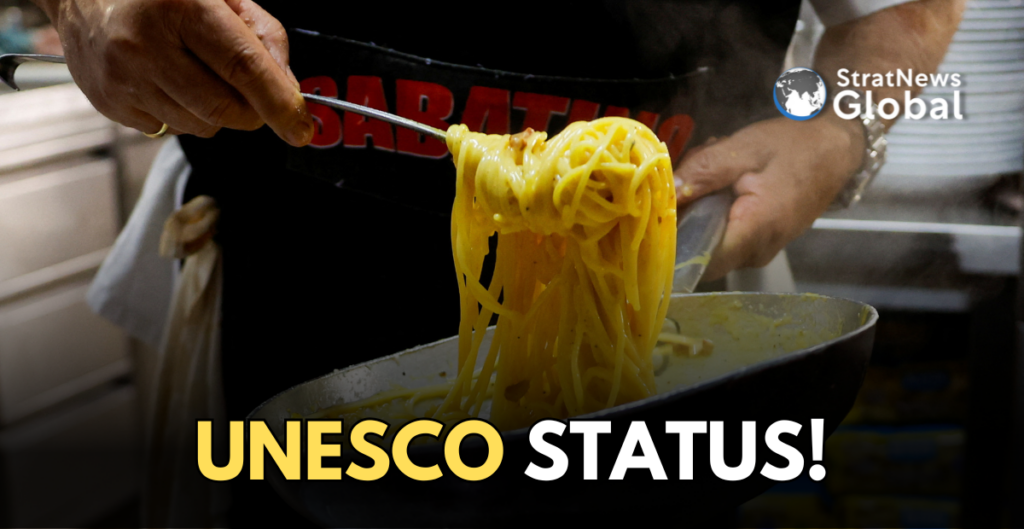

1st Time Ever: Italian Cuisine Gets Awarded UNESCO Status
U.N. cultural agency UNESCO recognised Italy’s national cuisine on Wednesday as an “intangible cultural heritage”, a formal accolade for a cookery tradition passed down through generations, and one that Italy hopes will boost tourism.
The vote by a UNESCO panel meeting in New Delhi culminated a process that Italy launched in 2023. The government cast the nation’s food culture as a social ritual that binds families and communities together, and that goes far beyond pizza, pasta and risotto.
The 20th Intangible Cultural Heritage (ICH) session, meeting in Delhi’s 17th-century Red Fort, also added traditions including the Hindu festival of Diwali and the swimming pool culture in Iceland to its list.
In a lip-smacking statement backing Italy’s case for inclusion, the government depicted a diverse cuisine that is a microcosm of different cultures, from Lombardy’s ossobuco (braised veal shanks with gremolata) to Puglia’s orecchiette con cime di rapa (ear-shaped pasta with turnip greens).
“This is a distinction that can only make us proud,” Prime Minister Giorgia Meloni said in a statement on Wednesday.
“It gives us a powerful tool to further enhance our products and protect them more effectively from imitations and unfair competition.”
Industry Boost
A CNN report suggests that this recognition comes as the country continues to fight against “fake” Italian food, including a recent complaint lodged with the European Parliament after jars of prepackaged carbonara sauce showed up on its shelves. Italy has also fought against the production of fake olive oil and the use of Italian-sounding names on products that were not made in Italy.
The recognition by UNESCO should help protect the cuisine from such culinary abuses, the country’s agriculture minister, Francesco Lollobrigida, said.
Industry groups estimate that UNESCO recognition could boost tourism by up to 8% in two years, resulting in an additional 18 million overnight stays.
Italian cuisine joins a global menu on the intangible cultural heritage list.
Such recognition often leads to a rise in tourism, although as one of the most-visited destinations in Europe, Italy is already being overwhelmed by visitors at peak times.
Meloni said the country would, however, get a financial lift from the decision, as reported by CNN.
That includes French haute cuisine meals celebrating Sundays and festive occasions, Mexican meals honouring the religious rites of an ethnic minority, Korea’s kimchi fermentation technique and Japan’s Washoku cuisine.
(with inputs from Reuters)
Ukrainian Drone Strike Disables Russian Shadow Fleet Tanker
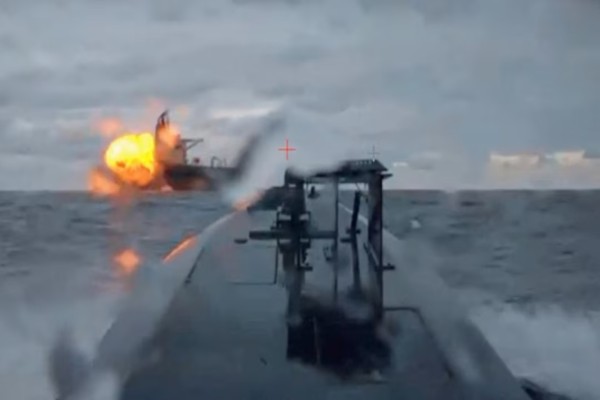
Ukraine said on Wednesday it had disabled a Russian-linked oil tanker in the Black Sea using Sea Baby maritime drones, the latest strike on what it describes as Moscow’s covert “shadow fleet” that helps move sanctioned oil and support its war economy.
The attack, conducted jointly by the Security Service of Ukraine (SBU) and the navy, is the third such operation in two weeks.
Video released by Ukrainian authorities shows a drone closing in on the tanker’s stern before explosions trigger smoke across the vessel. Officials identified the ship as the Dashan, sailing under the flag of the Comoro Islands, and said it had its transponder turned off and was travelling at high speed when it was hit. A Ukrainian security official said the tanker suffered “critical damage” and was effectively “disabled”. Russia has not commented publicly.
Ukrainian authorities said the Dashan had been heading toward Novorossiysk, one of Russia’s key oil export hubs. It remains unclear what cargo it was carrying or whether any spill resulted from the strike.
The SBU said the mission formed part of broader efforts to degrade Russia’s wartime revenue streams. “The SBU continues to take active measures to reduce oil dollar revenues to the Russian budget,” an official familiar with the operation said.
The attack follows similar strikes in late November on two other Russian-linked tankers that Western analysts say belong to Russia’s “shadow fleet” — hundreds of vessels operating under opaque ownership structures and mixed flags, often with transponders disabled. Industry reports had previously flagged the Dashan for irregular movements and links to sanctioned Russian entities.
The strike comes amid renewed political debate over the trajectory of the war. On Tuesday, U.S. President Donald Trump said Russia holds “the upper hand” and that Ukraine is “losing”, comments that drew pushback from Ukrainian and European officials.
While acknowledging battlefield difficulties, Western officials said there is no recent intelligence pointing to a decisive advantage for Moscow. Reports indicate that U.S.-led discussions over a potential peace framework have made little headway, with consultations continuing this week.
Ukrainian President Volodymyr Zelensky said Wednesday that U.S. and Ukrainian delegations held virtual talks on post-war reconstruction featuring Treasury Secretary Scott Bessent, Jared Kushner and BlackRock chief executive Larry Fink. He said Kyiv shared updates on its input to a confidential 20-point framework for ending the war and thanked U.S. partners for what he called “substantive work and support”.
European leaders are expected to continue discussions with Washington this week as disagreements persist over the shape of any settlement and future security guarantees for Ukraine. For Kyiv, the strike on the Dashan underscores its intent to hit Russia’s revenue channels even as diplomatic manoeuvring intensifies, with winter approaching, limited progress on the frontline and uncertainty over international funding next year.
Mexico Approves Tariff Hikes on Asian Goods Amid U.S. Pressure
Mexico’s Senate has approved significant tariff increases of up to 50% on imports from China and several other Asian nations, aiming to strengthen domestic industries despite pushback from business groups and foreign governments.
Tariffs to Target Key Industrial Goods
The legislation, already passed by the lower house, will introduce new or higher tariffs of up to 50% on selected imports from 2026. These include automobiles, auto parts, textiles, clothing, plastics and steel from countries without trade agreements with Mexico notably China, India, South Korea, Thailand and Indonesia. Most affected goods will face duties capped at 35%.
The bill passed with 76 votes in favour, 5 against, and 35 abstentions. It represents a softer version of an earlier proposal that had stalled in the lower chamber. The final measure covers around 1,400 product lines, mainly in textiles, apparel, steel, plastics, auto parts and footwear, with reduced duties on about two-thirds compared with the original draft.
China Condemns Move as Protectionist
China’s Ministry of Commerce said on Thursday it would monitor the impact of Mexico’s new tariff policy, warning that the decision could “substantially undermine” trade interests. The ministry urged Mexico to abandon what it described as “unilateralist and protectionist practices.”
“China has always opposed all forms of unilateral tariff increases and hopes Mexico will correct such practices as soon as possible,” the statement read. China’s Ministry of Foreign Affairs has yet to comment on the issue.
Political and Economic Motivations
Analysts suggest the tariff hikes are partly intended to align Mexico more closely with the United States ahead of the upcoming review of the United States-Mexico-Canada Agreement (USMCA). The measures are also expected to raise approximately $3.76 billion in additional revenue next year, helping to address Mexico’s fiscal deficit.
Mario Vázquez, a senator from the opposition National Action Party (PAN), said the decision aims to protect vulnerable domestic sectors and safeguard employment. “It protects certain local industries that are at a disadvantage compared with Chinese products. But tariffs are also taxes citizens pay. We must ensure these funds strengthen national production chains,” he noted.
Emmanuel Reyes, a senator from the ruling Morena party and chair of the Senate Economy Committee, defended the move as a strategic tool for guiding trade policy. “These adjustments will boost Mexican products in global supply chains and protect jobs in key sectors,” he said. “This is not merely a revenue-raising tool, but a measure for promoting general welfare.”
Mexico first signalled plans to raise tariffs in September, amid growing U.S. pressure on Latin American countries to curb economic reliance on China, a major competitor for regional influence.
(with inputs from Reuters)
Is India Truly Bucking The AI Trend?
India’s ambitions to secure a stronger foothold in the global artificial intelligence race received a major boost this week as Microsoft and Amazon unveiled more than $50bn in planned investments, though analysts say the country still faces steep challenges in matching the scale and speed of leading AI nations.
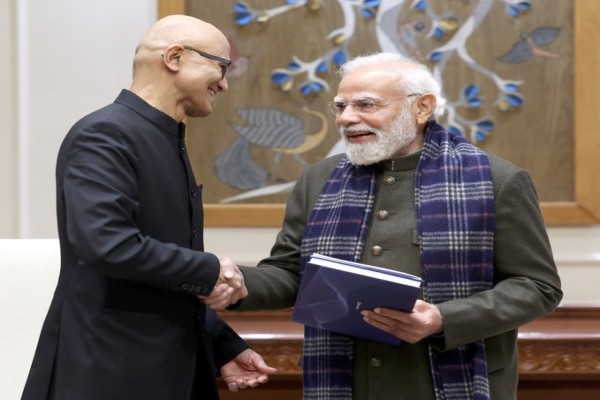
The commitments include Microsoft CEO Satya Nadella’s $17.5bn investment — the company’s largest in Asia — aimed at expanding India’s AI infrastructure, skilling programmes and sovereign capabilities.
Amazon’s parallel plan to deploy over $35bn in India through 2030 adds heft to a narrative of renewed foreign confidence, even as global markets debate whether the extraordinary run-up in AI valuations represents a historic technological shift or the early contours of a speculative bubble.
The scale of these announcements also throws into sharper relief the structural deficiencies that continue to constrain India’s long-term competitive trajectory. Brokerages such as Jefferies and HSBC describe India as a “reverse AI trade,” arguing that the country’s markets could outperform if the broader AI surge falters.
This framing also underscores the reality that India has remained peripheral to the global AI boom: its stock indices have lagged behind those in South Korea and Taiwan, where AI-oriented hardware ecosystems have attracted billions in foreign inflows.
The latest mega-investments inject energy into India’s aspirations, but they do not resolve the central question of whether the country can meaningfully close the distance with the US and China, whose massive compute resources, cohesive data ecosystems and multi-decade R&D pipelines are difficult to replicate at speed.
India’s strengths are real — a deep pool of engineering talent, rapid enterprise adoption of AI, and growing investment in data centres and semiconductor manufacturing, illustrated by Intel’s new partnership with Tata Electronics — but they interact with systemic weaknesses that limit India’s ability to convert momentum into leadership.
At the heart of the challenge is India’s sovereign AI mission. The government is preparing to launch its first homegrown, multilingual AI model, backed by a $1.25bn programme to provide high-end chips to researchers and start-ups.
It is a symbolic milestone, but one that sits uncomfortably beside the expansive, long-horizon commitments made by France, Saudi Arabia, the US and China. These countries are not only spending vastly more, they are building institutional frameworks that link research labs, industry, government and defence—creating layered innovation ecosystems where India still exhibits fragmentation.
The country’s most strategically consequential vulnerability, however, may be talent mobility. India has 2.5 times the global average concentration of AI-skilled professionals, yet its most advanced researchers often leave.
A recent Ernst & Young report warns that without aggressive incentives—preferential visas, research grants, tax support, and liquidity pathways for deep-tech ventures—India will struggle to retain or repatriate the kind of elite talent that drives frontier AI breakthroughs. China’s extensive state-backed incentives have created precisely the opposite dynamic, turning talent acquisition into a competitive instrument of national strategy.
What the new investments reveal, then, is a dual truth: foreign firms increasingly see India as a critical AI market, but not yet as a global AI engine. To bridge that gap, India will need far more than capital inflows and enthusiasm. It must invest deeply in compute, reform data governance, build durable public-private research linkages and craft a talent strategy that treats AI not merely as a growth sector but as a pillar of national capability.
The country’s ability to “buck the AI trend”—to benefit from global volatility rather than be shaped by it—depends on whether it can shift from reactive catch-up to proactive ecosystem-building. The Amazon and Microsoft announcements may mark a turning point, but only if India uses this moment to address the foundational gaps.
U.S. B-52 Bombers Join Japan in Show of Strength After Chinese and Russian Drills
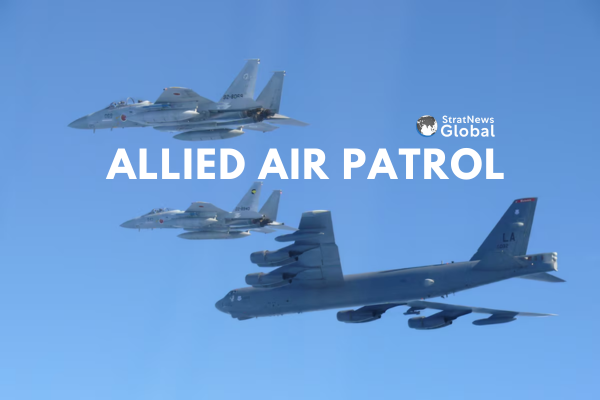
U.S. nuclear-capable B-52 bombers flew over the Sea of Japan on Wednesday, escorted by Japanese fighter jets, in a powerful demonstration of allied strength following recent Chinese and Russian military activities around Japan and South Korea. Tokyo confirmed the mission on Thursday, describing it as a reaffirmation of the allies’ commitment to regional stability and deterrence.
Reinforcing Allied Resolve
Japan’s defence ministry said the joint operation with the United States aimed to “reaffirm their strong resolve to prevent any unilateral attempt to change the status quo by force.” The exercise involved two U.S. B-52 bombers flying alongside three Japanese F-35 stealth fighters and three F-15 air-superiority jets. It marked the first visible U.S. military show of presence since China began large-scale drills in the region the previous week.
The manoeuvre came a day after Chinese and Russian strategic bombers conducted a joint flight over the East China Sea and western Pacific. Around the same time, China’s aircraft carrier group held exercises that prompted Japan to scramble fighter jets, which Tokyo said were targeted by radar beams — a move that drew a sharp rebuke from both Tokyo and Washington.
A U.S. official said the radar incident was “not conducive to regional peace and stability,” stressing that America’s alliance with Japan remained “unwavering.”
Heightened Regional Tensions
Japan and South Korea both host significant U.S. military forces, with Japan home to the largest concentration of American troops overseas, including an aircraft carrier strike group and a Marine expeditionary force. These assets play a central role in maintaining balance amid growing tensions in East Asia.
China denied Japan’s accusation regarding the radar targeting, claiming that Japanese jets had flown dangerously close to its carrier operating south of Japan. Meanwhile, South Korea reported scrambling its own fighter jets when Chinese and Russian aircraft entered its air defence identification zone on Tuesday, an area used for early warning but extending beyond national airspace.
Taiwan and Wider Regional Friction
China continues to intensify military pressure on Taiwan, with daily flights and naval operations around the island. Taiwan’s defence ministry reported on Wednesday that Chinese J-16 fighters and H-6 bombers carried out long-range drills in the western Pacific after passing south of the island.
Tensions have been further inflamed by comments from Japanese Prime Minister Sanae Takaichi, who recently suggested Tokyo would consider its response options in the event of a Chinese attack on Taiwan. Beijing strongly condemned the remarks, reiterating its claim over the self-governed island, which lies just over 100 kilometres from Japan’s southern islands and along vital sea routes crucial to Tokyo’s economy.
(with inputs from Reuters)
Albanese Defends Social Media Ban for Under-16s as Rollout Faces Early Challenges
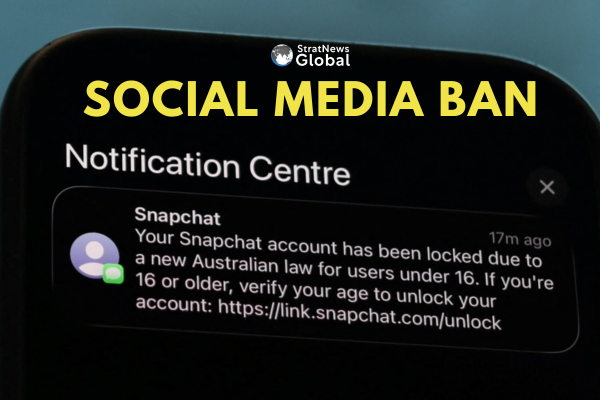
Australian Prime Minister Anthony Albanese has defended the nation’s new social media ban for under-16s, calling it a necessary measure to protect young people, even as the rollout encountered early turbulence. Speaking on Sky News on Thursday, he said the law, which took effect a day earlier, would “ultimately save lives” despite initial confusion and resistance.
Strong Public and Political Support
The ban, which enjoys bipartisan support and approval from around three-quarters of Australian parents, requires ten of the world’s largest social media platforms including TikTok, Instagram, YouTube, and Snapchat to block underage users or face fines of up to A$49.5 million (US$33 million). The government has acknowledged that it may take time for companies to establish effective verification systems.
Albanese criticised young users flaunting their continued presence online, saying, “This is the law, this isn’t something that can be flouted. Some young people are bragging about being online, but that only helps the platforms identify and remove them.”
Communications Minister Anika Wells said the eSafety Commissioner had instructed platforms to report the number of under-16 accounts both before and after the ban took effect, ensuring transparency in enforcement.
Global Reaction and Industry Pushback
Governments worldwide are watching Australia’s approach closely. U.S. Senator Josh Hawley praised the move, while France, Denmark, and Malaysia have expressed interest in adopting similar measures. Psychologist Jonathan Haidt, author of The Anxious Generation, hailed the decision, writing “Bravo Australia” on X.
However, not all responses have been positive. UNICEF warned that restricting access might push children toward less regulated corners of the internet, urging tech companies to improve content moderation and platform design instead. Meta echoed similar concerns, arguing the law could lead to “inconsistent application” and “little interest in compliance,” ultimately failing to enhance safety.
TikTok and Snap declined to comment, while YouTube, X, Twitch, Reddit, and Australian-owned Kick did not respond immediately.
Rising VPN Use and Market Shifts
In the days surrounding the rollout, Australian searches for virtual private networks (VPNs) surged to their highest levels in a decade. Free VPN providers reported dramatic increases in usage Windscribe saw a 400% spike in installations within 24 hours of the ban, while hide.me recorded a 65% rise in Australian visits before implementation.
As the law took effect, platforms not covered by the restrictions climbed app download charts. The government noted that the list of regulated platforms remains “dynamic,” allowing for adjustments as new services emerge. ByteDance-owned Lemon8 quickly adopted a 16-plus policy, while photo-sharing app Yope said it had grown rapidly to around 100,000 Australian users, half of whom were over 16.
Albanese, visiting a Canberra school, said he expects the ban to improve behaviour and learning outcomes, noting that “students interact better when they’re not constantly looking at their devices.”
(with inputs from Reuters)
China’s Intelligence Chief Outlines Hardline Five-Year Security Plan
China’s top intelligence official has set out a sweeping security blueprint for the next five years, highlighting priorities such as countering Taiwan independence, curbing technology theft, intensifying anti-espionage efforts and boosting protection of the country’s overseas interests and trade routes.
In a lengthy article published recently in the Party-run journal Study Times, State Security Minister Chen Yixin said the Ministry of State Security (MSS) must develop into a modern, technologically driven and politically loyal intelligence apparatus capable of addressing what he characterised as rapidly escalating external and internal threats.
Building a New “Great Wall” of National Security
Chen framed his outlook around the need to build what he called an “impenetrable Great Wall of national security,” arguing that defending the Party and the state has become the foundation of China’s modernisation goals. He linked his directives to decisions taken at the recent Fourth Plenum and to guidance from President Xi Jinping, calling them the ideological basis for China’s security posture during the 2026–2030 period.
China expert Manoj Kewalramani, who closely follows the workings of the Communist Party, says Chen is effectively portraying a “grim, threat-laden picture of the world” shaped above all by systemic contestation between major powers. Kewalramani notes that Chen’s framing aligns closely with the Party’s post-Plenum assessment: the shift from unipolarity to multipolarity is underway, but it is also generating geopolitical turbulence, economic fragmentation, and the weaponisation of technology. This, he says, forms the backdrop for China’s push to harden security across all domains.
Jabin Jacob, another noted China expert, points out that Chen’s article does not necessarily introduce new ideas, but its value lies in how clearly and systematically it consolidates the Party’s strategic thinking. He says the publication in a key Party outlet underscores its political weight and should remove any remaining ambiguity about China’s long-term aims. For countries directly affected by Beijing’s growing assertiveness, Jacob argues, the document offers a clear basis to craft responses or even take pre-emptive measures. In his view, no one can reasonably claim to be surprised by China’s actions anymore.
A significant portion of the article depicts what Chen described as a deteriorating global environment. He said the world is entering a “storm belt” marked by rising geopolitical rivalry, weakening U.S. dominance, expanding multipolarity led by the Global South, intensified technology competition and renewed terrorist activity. These developments, he wrote, require deeper integration of China’s intelligence, legal and security systems.
Taiwan: The Core Security Battle
Taiwan is presented as the central security priority. Chen said national reunification is essential to the country’s long-term goals and stated that “Taiwan independence” must be defeated, warning that China would not tolerate foreign intervention—particularly from the United States.
Chen also introduced what he called the “Five Anti-Struggles” framework to guide MSS operations over the coming years. These include resisting subversion, opposing foreign hegemony, countering separatism, combating terrorism and expanding anti-espionage operations.
Economic and Tech Security Move to the Forefront
Economic and technological security feature prominently in the plan, with Chen warning of attempts to restrict China’s access to advanced technologies, disrupt supply chains and weaken its rise through sanctions. He said securing key technologies, strategic resources and industrial systems would be elevated to core national-security priorities.
Chen also highlighted the need to protect China’s expanding overseas footprint, calling for forward-deployed intelligence networks, early-warning systems and mechanisms to secure citizens, companies and Belt and Road infrastructure abroad.
A Modern, AI-Driven Intelligence State
Modernising the MSS through artificial intelligence, real-time surveillance platforms and unified command systems forms another major pillar of the plan. Chen stressed that technological upgrades must be matched with ideological discipline, describing the need for a “loyal, clean, iron-disciplined” security force.
The publication of the article in Study Times suggests high-level political endorsement and indicates that national security will hold greater priority than economic considerations in China’s next Five-Year Plan.
Appointments Delayed As US Checks Social Media For H-1B Visas
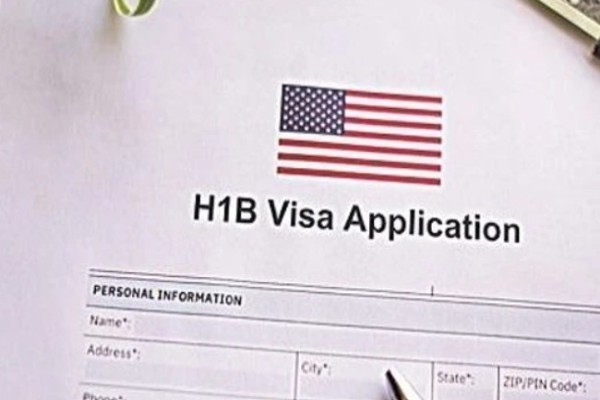
The United States will introduce expanded social-media screening for H-1B skilled-worker visa applicants and their H-4 dependents beginning December 15, triggering major rescheduling of visa interviews during India’s busiest renewal period.
The U.S. Embassy in New Delhi confirmed the new requirement and said the measure extends an existing screening framework used for F, M, and J student and exchange-visitor visa applicants.
“Beginning December 15, we are expanding the online presence review to all speciality occupation temporary worker (H-1B) visa applicants and their dependents in the H-4 visa classification,” a U.S. Embassy spokesperson said.
“In every visa case, we will take the time necessary to ensure an applicant does not pose a risk to the safety and security of the United States… The Department of State regularly shifts appointments as needed to match resource availability. We will communicate any changes directly to affected visa applicants.”
As consular staff prepare for the additional vetting workload, interview slots originally scheduled from mid-December onwards are being pushed to later dates, including appointments now postponed into mid-2026, according to immigration attorneys. Notices sent to applicants explain that consulates must reduce the number of interviews processed per day to accommodate the expanded checks. Previously scheduled biometric appointments have not been altered.
The U.S. Embassy also issued a public advisory on X instructing applicants not to arrive for original appointment times, stating they will not be admitted if schedules have already been adjusted.
The policy change has disrupted travel plans for thousands of H-1B visa holders who arranged year-end trips to India specifically to complete renewal interviews. Legal experts say many workers may now face extended stays in India until new interview dates become available, delaying their return to U.S. employment.
Applicants also cannot seek earlier appointments in another country. A State Department rule introduced in September requires H-1B and H-4 applicants to undergo interviews only in their country of nationality or residence, eliminating what had become a common workaround through faster-processing consulates elsewhere.
The new screening requirement is part of wider changes to the H-1B system. Recent measures include a newly introduced $100,000 fee for certain overseas H-1B petitions, a proposed reform of the annual H-1B lottery, stepped-up enforcement by multiple federal agencies, and earlier expansion of online-presence checks for F-1, M, and J applicants.
Internal guidance directs consular officers to review résumés, LinkedIn profiles, and other digital records for risk indicators including associations linked to restricting free speech.
US Threatens New Sanctions On ICC Unless It Skips Investigating Trump
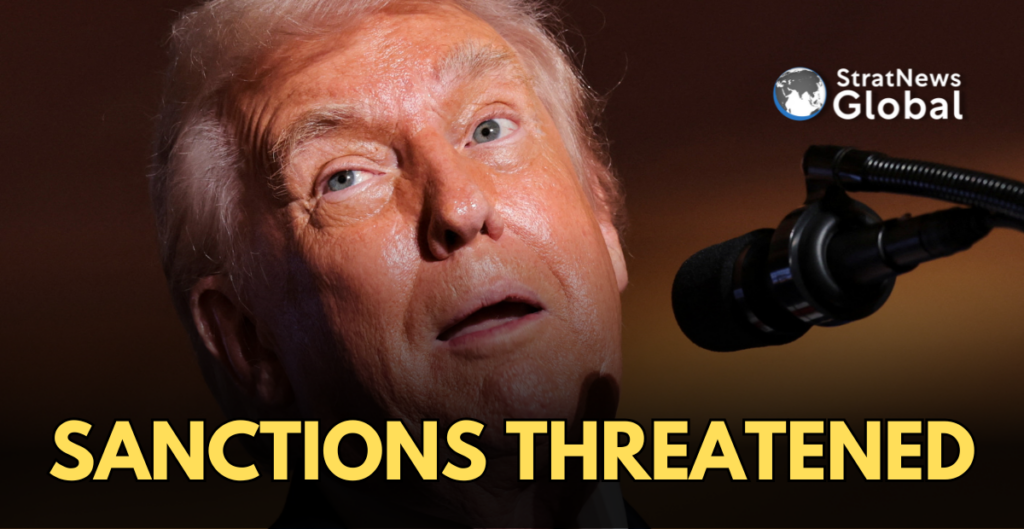
President Donald Trump’s administration wants the International Criminal Court to amend its founding document to ensure it does not investigate the Republican president and his top officials, a Trump administration official said, threatening new U.S. sanctions on the court if it did not.
If the court does not act on this U.S. demand and two others – dropping investigations of Israeli leaders over the Gaza war and formally ending an earlier probe of U.S. troops over their actions in Afghanistan – Washington may penalise more ICC officials and could sanction the court itself, the official said.
Sanctioning the court would significantly escalate the U.S. campaign against the ICC, which has long been criticised by U.S. officials, including both Republicans and Democrats, who say the court infringes on U.S. sovereignty.
The Trump administration official, speaking on the condition of anonymity, said Washington has communicated its demands to ICC members, some of whom are U.S. allies, and has also made them known to the court. The United States is not a party to the Rome Statute that established the ICC in 2002 as a court of last resort, with the power to prosecute heads of state.
The demand and the threat to resume the U.S. sanctions campaign towards the court have not been previously reported.
Washington’s Fears
ICC judges issued arrest warrants for Israeli Prime Minister Benjamin Netanyahu, former Israeli defence chief Yoav Gallant, and Hamas leader Ibrahim al-Masri last November for alleged war crimes and crimes against humanity during the Gaza conflict.
In March 2020, prosecutors opened an investigation in Afghanistan that included possible crimes by U.S. troops. Since 2021, the court has deprioritised looking into the role of the U.S., but it has not formally ended its probe.
To force the war tribunal to drop these charges, the U.S. earlier this year slapped sanctions on nine ICC officials, including judges and prosecutors. But it has stopped short of imposing sanctions on the court as an entity, which would severely disrupt the tribunal’s work.
“There is growing concern … that in 2029 the ICC will turn its attention to the president, to the vice president, to the secretary of war and others, and pursue prosecutions against them,” the Trump administration official said.
“That is unacceptable, and we will not allow it to happen.”
The White House had no immediate comment on the matter.
Any effort to change the Rome Statute to accommodate the U.S. demand would be slow and difficult, requiring the approval of two-thirds of the countries that have ratified the Rome Statute.
“Amendments to the Rome Statute are within the prerogative of States Parties,” the ICC’s public affairs unit, which speaks on behalf of the court and its presidency, said in response to Reuters’ questions. It did not address the question of whether Washington has reached out to seek a prosecution immunity for Trump.
Sanctions applied to the court as an entity could affect its basic day-to-day operations, from its ability to pay staff to access to bank accounts and routine office software on its computers.
‘Open Chatter’
The ICC is the world’s permanent war crimes tribunal with 125 member states, including the entire EU but excluding major powers China, Russia and the United States, among others.
The court’s mandate allows it to prosecute individuals for alleged crimes committed by them or nationals under their command on the territory of a member state, including sitting heads of state.
The Trump official did not say what issues the administration worries could become the subject of an ICC investigation. But the official cited “open chatter” in the international legal community that the court could target Trump and his top officials in 2029, when the Republican president’s term ends.
“The solution is that they need to change the Rome Statute to make very clear that they don’t have jurisdiction,” the official said.
Starting in September, the U.S. military has waged a campaign of deadly strikes against suspected drug vessels in the Caribbean and off the Pacific coasts of Latin America, killing more than 80 people.
Members of Congress have said they will investigate whether the U.S. military broke the law by allegedly killing two survivors of a strike on a suspected drug trafficking vessel in the Caribbean. The White House has defended the strike as lawful.
When asked if the administration was making this demand from the ICC over concerns that the court might pursue charges against U.S. leaders over its conduct in Venezuela, the official declined to elaborate.
The ICC’s two deputy prosecutors told Reuters on Friday they had not received any requests to investigate U.S. actions regarding Venezuela.
The U.S. official also declined to say when Washington began conveying this demand to the court and member states.
(with inputs from Reuters)
Rick Switzer’s Mission Is To Warn India About Crossing US Red Lines?
Has Rick Switzer, US Deputy Trade Representative, come to India to read the riot act about the logistics deal with Russia?
Economist and commentator Prof Jeffrey Sachs described his visit as a “strategic alarm bell disguised as a trade mission. The visit arrives at an extraordinary moment precisely when India and Russia are consolidating a new architecture of energy, logistics and defence that threatens to redraw the strategic map of the Indo-Pacific.”
In a commentary online, Sachs believes the US fears losing India officially. It senses India drifting towards Moscow by structural commitments. The RELOS military logistics pact for one, assured supplies of crude oil and an emerging financial ecosystem that quietly bypasses Western channels.
“Washington’s sudden outreach to Delhi is not routine diplomacy,” says Sachs. “For months the US has watched India’s deepening relationship with Russia with growing unease .. India’s growing dependence on Russian oil, weapons, military logistics has reached a level that Washington considers a strategic threat.”
Washington wants to halt that drift before it becomes irreversible. Switzer is here to convey that India’s drift towards Russia has crossed from “tolerable to dangerous” and if it wants relief from tariffs and sanctions, it must “reconsider the pace and depth of your Moscow alignment.”
The signal is that the US wants India as a democratic counterweight to China, “not as an extension of a Russia led Eurasian system.”
The dilemma for India is that Russian support helps build resilience for the Indian economy. But India also needs capital and technology that flow from the US. The problem, as Sachs says, is that the US does not see this as a negotiation but a geopolitical confrontation over India’s future orientation.
“India must decide whether strategic autonomy is a principle worth paying a price for or a doctrine that collapses the moment great powers push back.”
The US fears India is building infra in the Indian Ocean with Russian help that will alter the balance of power in the Indian Ocean. RELOS will enable Russian vessels to repair, replenish and resupply at Indian bases and will undermine the US in the Indian Ocean.
Russia will probably see the Switzer mission as an attempt to detach India from Moscow before RELOS becomes operational and fresh crude supplies are locked into place. Russia sees India as the only major non-Western power ready to engage with it.
It can therefore be expected to double down on India, offering not only discounted oil but joint development of advanced weapons. Both bring not only revenue but enable Russia to balance its dependence on China. Russia has already committed to help India expand on its Arctic ambitions.
The question Indian diplomats are asking: is the US offering a way out? Or does it see coercion through tariffs as the only tool to get its way?