

Support us by contributing to StratNewsGlobal on the following UPI ID
ultramodern@hdfcbank

Strategic affairs is our game, South Asia and beyond our playground. Put together by an experienced team led by Nitin A. Gokhale. Our focus is on strategic affairs, foreign policy and international relations, with higher quality reportage, analysis and commentary with new tie-ups across the South Asian region.
You can support our endeavours. Visit us at www.stratnewsglobal.com and follow us on YouTube, Twitter, Facebook and Instagram.
र 500 per month
र 1000 per month
र 5000 per year
र 10000 per year
Donate an amount of your choice
र 500 per month
Donate र 500 per month

र 1000 per month
Donate र 1000 per month
र 5000 per year
Donate र 5,000 per year
र 10000 per year
Donate र 10,000 per year
Donate an amount of your choice
Donate an amount of your choice
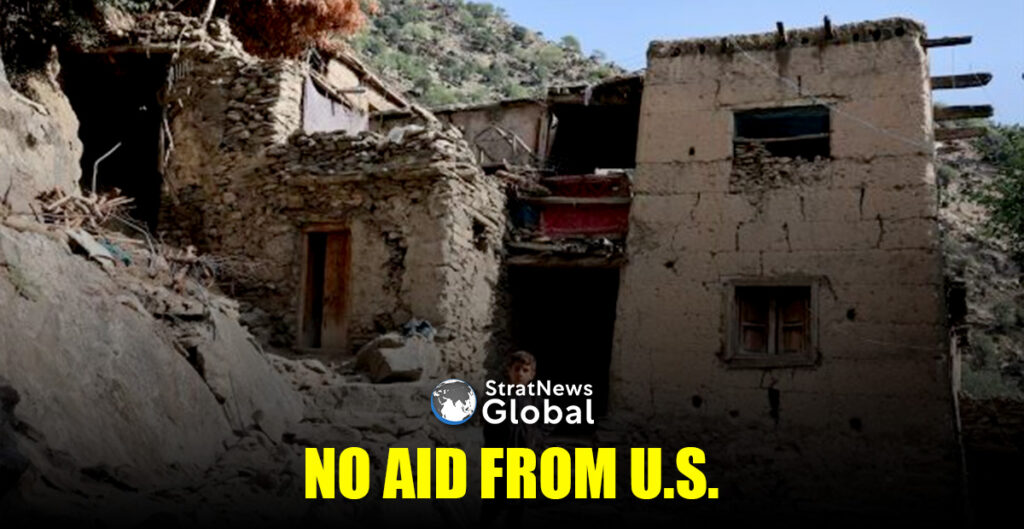
No U.S. Aid Approved Nearly A Week After Deadly Afghanistan Quake: Sources
Almost seven days after a powerful earthquake killed more than 2,200 people and displaced tens of thousands in Afghanistan, the United States has yet to authorize any emergency assistance. According to two former senior U.S. officials and another source familiar with the matter, it remains uncertain whether Washington intends to provide help at all.
The lack of response by Washington to one of Afghanistan’s deadliest quakes in years underscores how President Donald Trump has forfeited decades of U.S. leadership of global disaster relief with his deep foreign aid cuts and closure of the main U.S. foreign assistance agency, said the source and the former officials.
The U.S. Agency for International Development was officially shuttered on Tuesday.
The State Department on Monday extended its “heartfelt condolences” to Afghanistan in an X post.
No Declaration Of Humanitarian Need
As of Friday, however, the State Department had not approved a declaration of humanitarian need, the first step in authorizing U.S. emergency relief, said the former officials, both of whom worked at USAID, and the third source, speaking on condition of anonymity for fear of reprisal.
Such a declaration is usually issued within 24 hours of a major disaster.
The sources said State Department officials had considered recommendations for U.S. disaster aid for Afghanistan. One former senior official said the White House also has considered the issue, but decided against reversing a policy of ending aid to Afghanistan.
When asked if the U.S. would provide any emergency aid to Afghanistan following the magnitude 6 quake on Sunday, which was followed by powerful aftershocks on Thursday and Friday, a State Department spokesperson said: “We have nothing further to announce at this time.”
The United States was, until this year, the largest aid donor to Afghanistan, where it fought a 20-year war that ended with a chaotic U.S. withdrawal and the Taliban’s seizure of Kabul in 2021.
But in April, the Trump administration ended virtually all aid – totaling $562 million – to Afghanistan, citing a U.S. watchdog report that humanitarian groups receiving U.S. funds had paid $10.9 million in taxes, fees, and duties to the Taliban.
Asked whether the U.S. would provide emergency relief for earthquake survivors, a White House official said, “President Trump has been consistent in ensuring aid does not land in the hands of the Taliban regime, which continues to wrongfully detain U.S. citizens.”
‘Stuck In Storage’
United Nations aid chief Tom Fletcher said the Afghan earthquake was “the latest crisis to expose the cost of shrinking resources on vital humanitarian work.”
“Massive funding cuts have already brought essential health and nutrition services for millions to a halt; grounded aircraft, which are often the only lifeline to remote communities; and forced aid agencies to reduce their footprint,” he said in a statement on Thursday.
The Trump administration also has yet to respond to a request by the International Rescue Committee humanitarian organization to send $105,000 worth of U.S.-funded medical supplies following the first earthquake.
The materials include stethoscopes, first aid supplies, stretchers, and other essentials, said Kelly Razzouk, vice president of policy and advocacy for the IRC.
“The stocks are stuck in storage,” said Razzouk, who served on former U.S. President Joe Biden’s National Security Council. “In recent memory, I can’t remember a time when the U.S. did not respond to a crisis like this.”
The IRC needs Washington’s permission to send the equipment to Afghanistan because it had been funded by an unrelated U.S. grant that the Trump administration had since cancelled.
“Beyond the loss of life, we have also seen basic infrastructure and livelihoods destroyed,” Stephen Rodriguez, the representative in Afghanistan for the U.N. Development Programme, told reporters on Friday.
He said donations of money, goods, and services have come from Britain, South Korea, Australia, India, Pakistan, Iran, Turkey, and other countries.
“Far more is needed.”
(With inputs from Reuters)
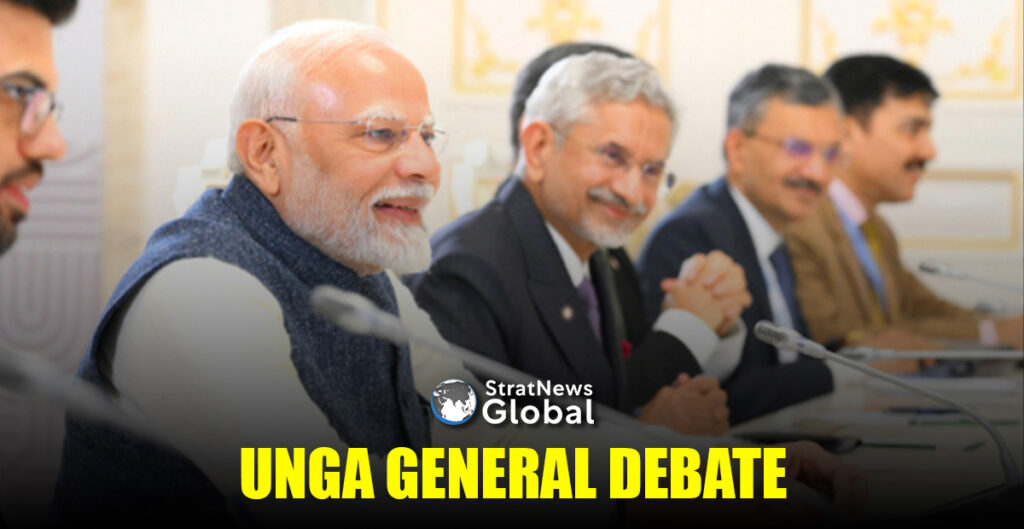
PM Modi To Skip 80th UNGA Session In US, Jaishankar To Represent India
Prime Minister Narendra Modi will not deliver India’s address at the General Debate during the annual high-level session of the United Nations General Assembly (UNGA) later this month, according to a revised provisional speakers’ list that has now been issued.
The 80th session of the UN General Assembly will begin on September 9, with the high-level General Debate scheduled from September 23 to 29. As per long-standing practice, Brazil will open the debate as the first speaker, followed immediately by the United States.
U.S. President Donald Trump is set to address global leaders from the iconic UNGA podium on September 23, marking his first speech at the Assembly in his second presidential term.
According to the updated provisional list released on Friday, India’s statement will not be delivered by Prime Minister Modi but instead by a senior representative. External Affairs Minister S. Jaishankar is scheduled to address the session on September 27.
The earlier draft list circulated in July had slated PM Modi to speak on September 26. That same day, the heads of government of Israel, China, Pakistan, and Bangladesh are scheduled to deliver their statements to the General Assembly.
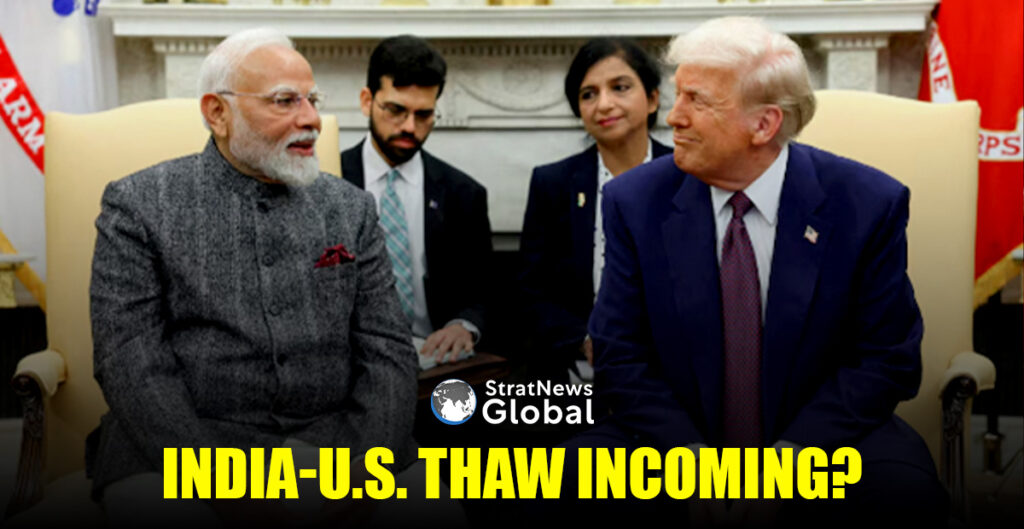
PM Modi last visited the United States in February this year, where he held a bilateral meeting with President Trump at the White House.
The visit took place amid heightened tensions over Washington’s imposition of steep tariffs on India, including a total of 50% levies, with a specific 25% penalty linked to New Delhi’s ongoing imports of Russian oil.
‘Busiest Diplomatic Season’
Officials clarified that the UNGA speakers’ schedule remains provisional and is often subject to adjustments ahead of the commencement of the high-level week. Further modifications are likely, with the list expected to be updated in the days leading up to the debate.
Widely regarded as the “busiest diplomatic season” at United Nations Headquarters, the high-level session takes place annually each September.
This year’s gathering is set against the backdrop of the ongoing Israel-Hamas conflict and the continuing war in Ukraine. The official theme for the 80th UNGA session is: “Better together: 80 years and more for peace, development and human rights.”
Proceedings will begin with a commemorative meeting on September 22 to mark the 80th anniversary of the United Nations.
High-Level UN Meetings
In addition, the UN will convene a high-level meeting to mark the 30th anniversary of the Fourth World Conference on Women, with discussions centred on the theme “Recommitting to, resourcing and accelerating the implementation of the Beijing Declaration and Platform for Action to achieve gender equality and the empowerment of women and girls.”
This meeting will reflect on the progress made since the landmark Beijing conference in 1995 and examine achievements, best practices, gaps, and challenges that remain in advancing women’s rights globally.
UN Secretary-General António Guterres will also host a Climate Summit on September 24, offering world leaders a platform to present updated national climate action strategies while highlighting the benefits of the ongoing transition to clean energy.
Other major high-level meetings scheduled throughout the week include the Summit for a Sustainable, Inclusive and Resilient Global Economy, a special session on Noncommunicable Diseases and Mental Health and Well-being, the 30th Anniversary of the World Programme of Action for Youth, the launch of the Global Dialogue on AI Governance, observance of the International Day for the Total Elimination of Nuclear Weapons, and a session addressing the situation of Rohingya Muslims and other minority groups in Myanmar.
(With inputs from IBNS)
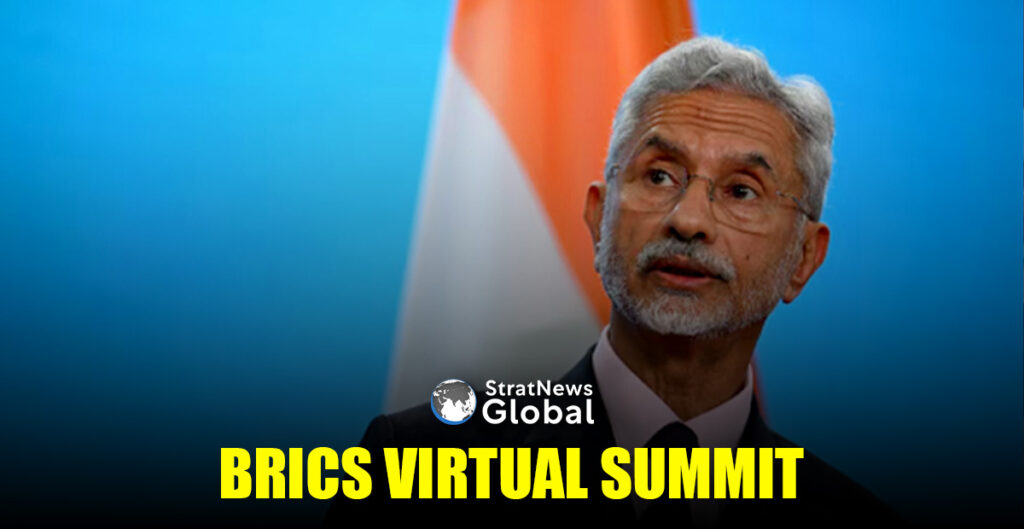
Jaishankar To Participate In Brazil-Led BRICS Virtual Summit On Trump Tariffs: MEA
External Affairs Minister S. Jaishankar will represent India at a virtual BRICS summit scheduled for Monday, the Ministry of External Affairs (MEA) confirmed in New Delhi on Friday.
The meeting, convened by Brazilian President Lula da Silva, is aimed at addressing U.S. tariff measures, with India formally announcing its participation.
The gathering, almost certain to provoke unease in Washington, comes on the heels of Prime Minister Narendra Modi’s visit to China for the SCO summit, where he held conversations with Chinese President Xi Jinping and Russian President Vladimir Putin — a development that drew criticism from U.S. officials.
At present, Brazilian authorities have not revealed how many of the 11 BRICS members will participate in Monday’s summit or at what level.
Immediately after the U.S. imposed tariffs on August 6, Lula telephoned Prime Minister Modi and pledged to consult each BRICS nation individually, in an effort to marshal support and draft a “common” strategy to respond to Washington’s move.
On Friday, Kremlin spokespersons confirmed that President Putin would join the virtual summit, while sources indicated that other confirmations from member states were expected over the weekend.
Jaishankar To Participate
“From India’s side, it will be the External Affairs Minister, S. Jaishankar, who will participate,” MEA spokesperson Randhir Jaiswal told reporters at the weekly briefing.
“This BRICS summit is at the leaders’ level,” he said, though he declined to explain why Prime Minister Modi himself would not be attending the meeting.
India will assume the BRICS chairmanship next year and is scheduled to host the summit of the expanded grouping, which now includes Brazil, Russia, India, China, South Africa, along with six new members — Egypt, Ethiopia, Indonesia, Iran, Saudi Arabia, and the United Arab Emirates.
The Brazilian Ministry of Foreign Affairs has not yet issued a detailed agenda for Monday’s meeting.
However, local reports suggest that the discussions will focus on the economic impact of U.S. tariff policies on global trade and explore collective approaches to reinforce multilateralism in order to mitigate the consequences of unilateral economic actions.
Currently, both Brazil and India face the heaviest U.S. levies, with tariffs exceeding 50% — the steepest imposed worldwide.
China and South Africa have been subjected to 30% duties, while Indonesian exports face tariffs of 19%, though exemptions apply to its key agricultural commodities such as palm oil, cocoa, and rubber.
Other BRICS nations, including Russia and Iran, already heavily sanctioned, fall into the lowest tariff category of 10%.
According to U.S. officials, the elevated tariffs were applied for several reasons beyond trade deficits and market barriers.
Trump’s Tariff Salvo
India was penalised for its purchase of Russian oil, Brazil for the legal proceedings against former President Jair Bolsonaro — a close ally of Donald Trump — and South Africa for its controversial land reform laws, which Trump alleges discriminate against White Afrikaner farmers.
In July, Trump further threatened an across-the-board 10% tariff hike on all BRICS countries if they pursued what he labelled “anti-American policies.”
Meanwhile, Senator Lindsey Graham, a key Republican ally of Trump, introduced the Sanctioning Russia Act, 2025 in the U.S. Congress.
The proposed legislation would authorise punitive tariffs of up to 500% on BRICS members, including Brazil, India, and China, if they continue purchasing Russian energy supplies.
(With inputs from IBNS)
‘Fully Reciprocate His Sentiments’: Modi Reacts To Trump’s ‘Always Friends’ Remark
Amid growing strains in India-U.S. relations over tariffs, Prime Minister Narendra Modi on Saturday responded to President Donald Trump’s comment that the two leaders would “always be friends,” stating that he “fully reciprocates his sentiments.”
Modi emphasised that India and the United States continue to share a “very positive” and forward-looking global strategic partnership.
“Deeply value and wholeheartedly reciprocate President Trump’s sentiments and his encouraging assessment of our ties. India and the United States maintain a very positive and forward-looking Comprehensive and Global Strategic Partnership,” PM Modi posted on X (formerly Twitter).
‘Very Special’ Relationship
Trump, speaking a day earlier, had described the bilateral relationship as “very special” and stressed that his personal friendship with Modi would endure. Yet, he simultaneously voiced dissatisfaction with what Modi was “doing” at present — a clear reference to India’s decision to keep importing oil from Russia.
“I will always remain friends with Prime Minister Modi. He is a great leader. I will always be friends, but I do not agree with what he is doing right now. Still, India and the United States enjoy a very special relationship. There is no cause for concern. At times, we simply have moments like this,” Trump remarked.
The President also sought to highlight that trade negotiations with India were “progressing well,” even as tensions simmered.
Relations between Washington and New Delhi have grown tense in recent weeks after the Trump administration imposed additional tariffs on India over continued Russian oil purchases.
U.S. duties on Indian exports have now risen beyond 50% — the steepest tariff level Trump has enforced under his latest schedule, matched only by Brazil. India strongly condemned the move, branding it “unfair, unjustified, and unreasonable.”
Meanwhile, Prime Minister Modi, who participated in the Shanghai Cooperation Organisation (SCO) Summit held in Tianjin, China, was seen engaging warmly with Chinese President Xi Jinping and Russian President Vladimir Putin, both of whom are themselves at odds with Washington.
Images and videos from the summit showed the three leaders exchanging handshakes, embraces, and laughter. Modi also shared photographs alongside Xi and Putin, symbolising their shared camaraderie in the backdrop of U.S. pressure and heavy tariffs.
‘Lost India To China’
Only days later, Trump created ripples by asserting that the United States had “lost India to China.” He soon walked back the comment, clarifying that he did not truly believe so.
“I don’t think we have lost India. My disappointment stems from the fact that India has been buying such large quantities of oil from Russia. I made my displeasure known. We have imposed a very steep tariff on India — 50%, a very high tariff. Nevertheless, I get along very well with Prime Minister Modi. As you know, he was here only a couple of months ago, and we even held a press conference together in the Rose Garden,” Trump told reporters.
(With inputs from IBNS)
Serbia: Youth Unrest Challenges Vucic’s Grip On Power
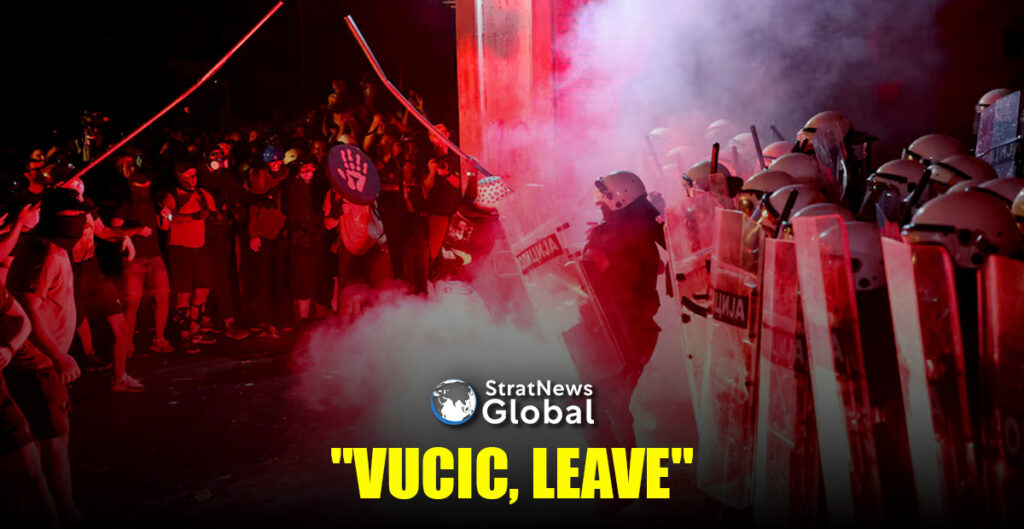
Serbian police on Friday fired teargas and stun grenades to disperse protesters at Novi Sad University, calling for early elections to unseat President Aleksandar Vucic and the ruling SNS.
In an address late in the evening, Vucic said that 11 policemen were injured. There was no information available on the number of protesters who had been injured.
‘Vucic, Leave!’
On Friday evening, thousands gathered at the state university campus. Protesters held banners reading “We don’t want blockades, we want elections,” and “Students have one urgent demand: Call elections”.
The crowd shouted, “Vucic, leave!”
Protesters scuffled with the police in front of the philosophy faculty and threw flares while police used teargas and stun grenades to push the crowd away.
“We are not going to allow destruction of the state institutions,” Vucic told reporters. “Serbia is a strong and responsible state.”
He accused foreign security services of being behind anti-government protesters in Serbia and said his supporters would hold rallies in cities across Serbia on Sunday.
Protests Triggered
Vucic and his SNS party have been rattled by months of protests across Serbia, including blockades of the state universities, sparked by the deaths of 16 people last November killed when the roof on a renovated railway station collapsed.
Protests were mainly peaceful until August 13, when dozens of police officers and civilians were injured in clashes.
Protesters have blamed corruption for the Novi Sad railway station disaster and are demanding early elections in hopes of ousting Vucic and his party.
The ‘Solution’ Is Elections
Students, opposition groups, and anti-corruption watchdogs have accused Vucic and his allies of ties to organised crime, using violence against political rivals, and suppressing media freedoms – allegations they deny.
“The solution is to call elections,” Nebojsa Korac, one of the protesters, said.
“On our side, we want peace and democracy to prevail, and for political institutions to do their job. That means calling elections, and that will be the solution, because the government will change.”
(With inputs from Reuters)
Thailand PM-Elect Vows Stability, Fairness With First Cabinet Picks
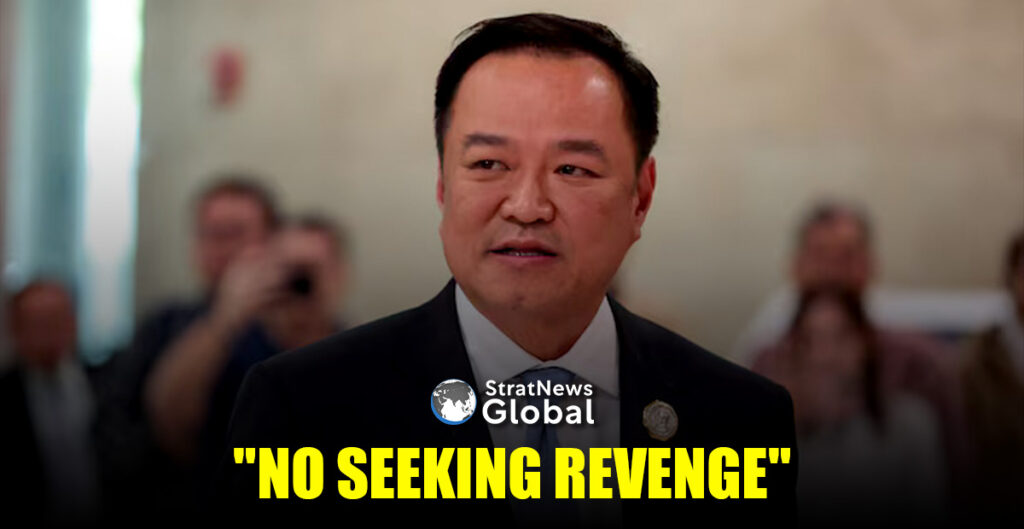
Thailand’s prime minister-elect on Saturday unveiled his initial cabinet picks, naming a former treasury chief, a top oil and gas executive, and a seasoned diplomat to head the finance, energy, and foreign ministries — saying the appointments are aimed at restoring confidence in a country grappling with political and economic turmoil.
Anutin Charnvirakul, a shrewd dealmaker and mainstay of Thai politics throughout years of turmoil, was elected prime minister on Friday, capping off days of drama and a scramble for power during which he outmaneuvered the most successful political party in Thailand’s history.
Who Are The Picks?
He said diplomat Sihasak Phuangketkeow, economist Ekniti Nitithanprapas and energy giant PTT executive Auttapol Rerkpiboon were “top executives in the organisations they will be responsible for”.
Ekniti is a finance ministry official who was once seen as a candidate for central bank governor, while Auttapol helmed the country’s largest company, the state-owned energy firm, PTT Group.
Thailand’s foreign service will see former permanent secretary Sihasak return as minister as a fragile truce with neighbouring Cambodia holds after a border clash flared into a five-day conflict that left at least 43 dead in July.
The appointments, which become official after receiving royal approval, come at a crucial time for Southeast Asia’s second-largest economy, where growth has been lagging regional peers amid months of political instability.
‘No Seeking Revenge’
Anutin’s rout of rival contender Chaikasem Nitisiri on Friday was a humiliation for the ruling Pheu Thai party, the populist juggernaut of influential billionaire Thaksin Shinawatra, who left Thailand late on Thursday for Dubai, where he spent the bulk of his 15 years of self-imposed exile.
The political crisis was triggered in June by Anutin’s withdrawal from Pheu Thai’s alliance, followed by last week’s dismissal by a Thai court of Prime Minister Paetongtarn Shinawatra, Thaksin’s daughter and protege.
Anutin, a conservative with a pull across party lines, won power after forging a pact with the progressive opposition People’s Party, the largest force in parliament, obtaining its support with promises to hold a referendum on amending the constitution and call an election within four months.
He urged unity late on Friday, saying all sides had to work together to “move our country forward in the speed that could compensate the opportunities that were lost” and that the government would “strictly enforce the law”.
“There will be no helping hands to anyone, it will not be used to abuse anyone, and there will be no seeking of revenge on anyone.”
(With inputs from Reuters)
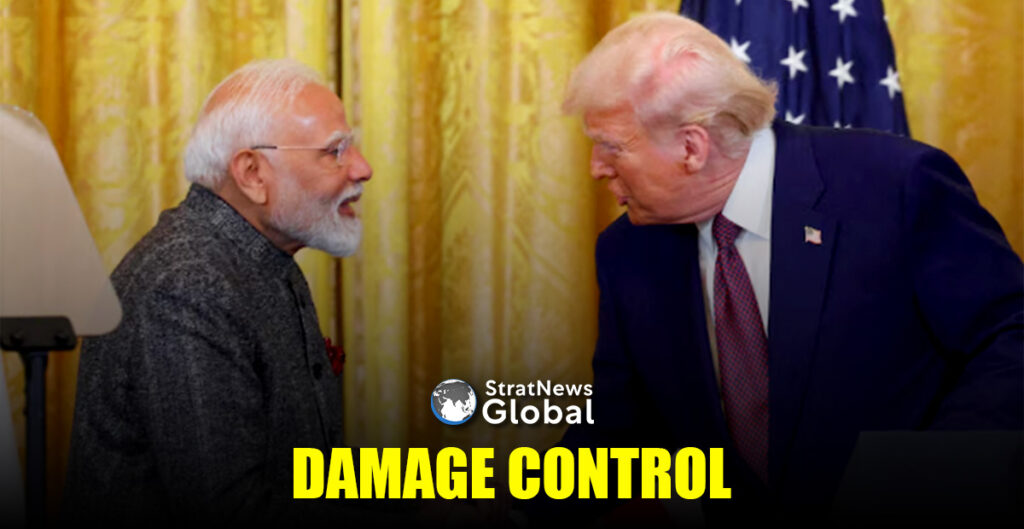
Trump Goes Into Damage Control Mode, Says He’ll ‘Always Be Friends’ With Modi
Just hours after declaring that the United States had “lost” India to China, President Donald Trump appeared to soften his stance, clarifying that America’s relationship with New Delhi remained “special” and that he continued to enjoy a close personal bond with Prime Minister Narendra Modi.
Soon after Trump’s comments, PM Modi responded on X (formerly Twitter), saying he “appreciates and fully reciprocates” the U.S. President’s sentiments and positive assessment of bilateral ties.
When pressed on who he believed was responsible for Washington “losing India” to Beijing, Trump replied, “I don’t think we actually have. What has disappointed me is that India has been buying so much oil, as you know, from Russia. I made my displeasure clear to them. We imposed a very significant tariff on India — a 50% tariff, extremely high.”
Even as he voiced frustration, Trump repeatedly emphasised his personal camaraderie with Prime Minister Modi. “I get along extremely well with Modi, as you know. He’s terrific. He visited just a couple of months ago,” Trump noted.
‘Great Prime Minister’
Reiterating the importance of the bilateral partnership, Trump again described the India-U.S. relationship as “very special,” stressing that despite occasional policy disagreements, his friendship with Prime Minister Modi would endure.
Asked by reporters whether he was prepared to recalibrate relations with India, Trump replied, “Absolutely. I’ll always be friends with Modi. He’s a great Prime Minister. That will never change. I simply don’t agree with what he is doing right now. But the bond between India and the United States is unique. There’s no cause for concern. From time to time, we simply have moments like this.”
The President also sounded upbeat about ongoing trade talks with India as well as other nations, remarking, “They are progressing very well. Other countries are doing well. We are making excellent progress with all of them.”
Trump Posts Modi’s Image With Putin, Xi
Trump’s conciliatory words followed soon after he shared a photograph of Prime Minister Modi alongside Russian President Vladimir Putin and Chinese President Xi Jinping at the Tianjin gathering.
The U.S. President hinted that relations with New Delhi had sunk to their lowest ebb, remarking that America had “lost” India and Russia to what he called “the darkest China.” His comments came only days after Modi, Putin, and Xi were seen together at the Shanghai Cooperation Organisation (SCO) Summit in Tianjin.
The summit, hosted by President Xi, was attended by several world leaders, including PM Modi and President Putin. The public display of camaraderie among the three leaders was described in international circles as “a turning point” and “the emergence of a new world order,” particularly against the backdrop of the trade conflict instigated by Washington.
India, however, refrained from responding directly to Trump’s claim that New Delhi was drifting closer to Moscow and Beijing.
Questioned about the remarks, External Affairs Ministry spokesperson Randhir Jaiswal simply stated, “I have no comments to offer on this post at this moment.”
Meanwhile, India-U.S. ties have been under severe strain, with relations reaching their lowest point in years following Trump’s decision last month to slap punitive tariffs on New Delhi. Washington imposed a total of 50% duties — 25% as a base tariff and another 25% surcharge — in retaliation against India’s continued purchases of Russian crude oil.
(With inputs from IBNS)
US: Trump Signs Executive Order On Tariff Exemptions
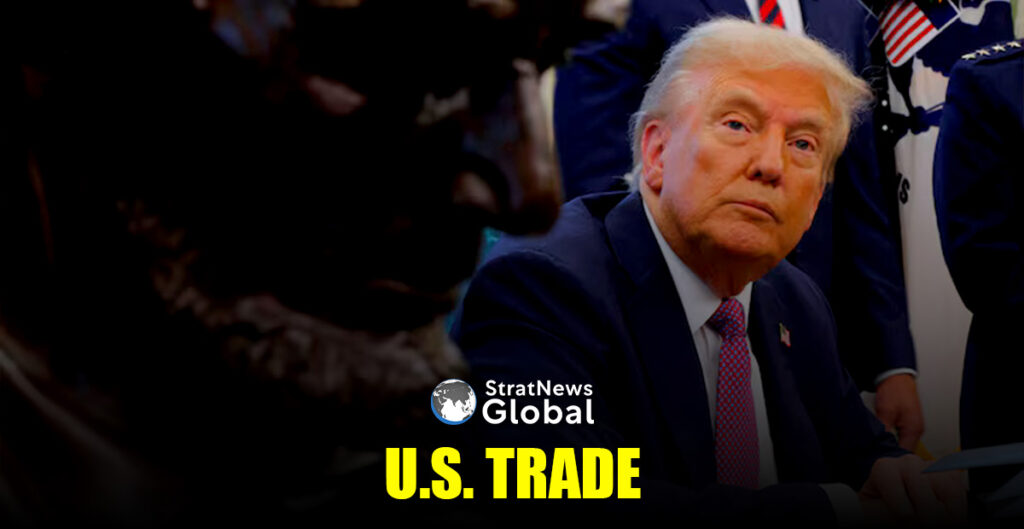
US President Donald Trump has signed an executive order enabling tariff exemptions from Monday for nations finalising trade deals on exports like nickel, gold, chemicals, and pharma compounds.
Trump has spent his first seven months in office building up massive tariff increases to reorder the global trading system, cut US trade deficits and extract concessions from trading partner countries in negotiations.
Aligned Partners
His latest order identifies more than 45 categories for zero import tariffs from “aligned partners” who clinch framework pacts to cut Trump’s “reciprocal” tariffs and duties imposed under the Section 232 national security statute.
Friday’s order brings US tariffs in line with its commitments in existing framework deals, including those with allies such as Japan and the European Union.
The exemptions for countries with US trade deals are set to begin at 12:01 a.m. EDT/0401 GMT on Monday, it said.
In the order, Trump says his willingness to reduce tariffs depends on the “scope and economic value of a trading partner’s commitments to the United States in its agreement on reciprocal trade” and US national interests.
New Carveouts
The cuts cover items that “cannot be grown, mined, or naturally produced in the United States” or produced in sufficient volume to meet domestic demand.
A White House official said it also creates new carveouts for some agricultural products, aircraft and parts, and non-patented articles for use in pharmaceuticals.
In situations where a country has struck a “reciprocal” trade deal with the United States, this will allow the US Trade Representative, the Commerce Department and customs to waive tariffs on covered imports without a new executive order from Trump, the official said.
Tariff Exemption
The zero-tariff items identified in the order include graphite and various forms of nickel, a key ingredient in stainless steel manufacturing and electric vehicle batteries.
Also covered are compounds used in generic pharmaceuticals, including the anesthetic lidocaine and reagents used in medical diagnostic tests.
The order encompasses various types of gold imports, from powders and leaf to bullion, a key import from Switzerland, which is struggling with US tariffs of 39% as it has not yet reached a trade deal.
The order also permits tariffs to be scrapped on natural graphite, neodymium magnets, light-emitting diodes (LEDs) and eliminates previous tariff exemptions on certain plastics and polysilicon, a key component of solar panels.
(With inputs from Reuters)
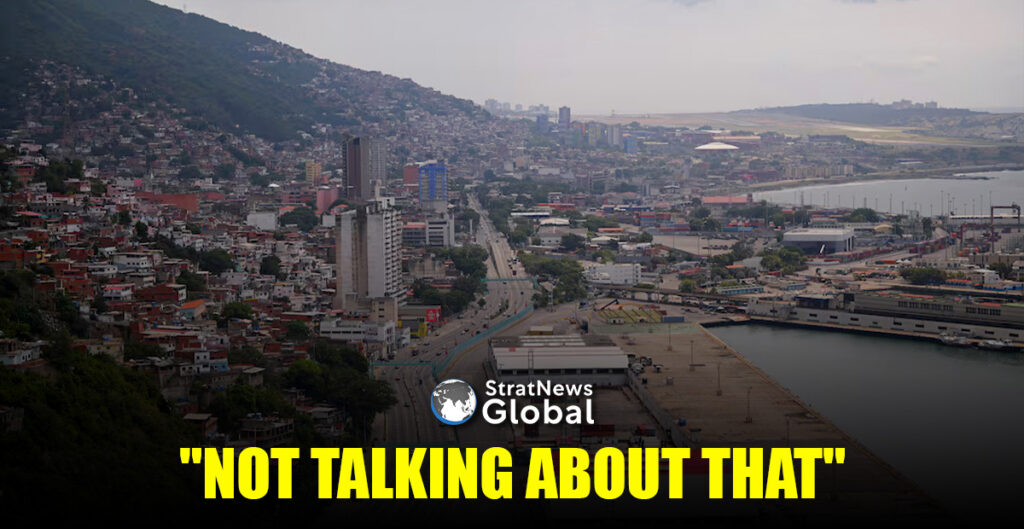
Trump Rules Out Regime Change In Venezuela
Amid a growing military buildup in the Caribbean, US President Donald Trump on Friday clarified that the United States is not pursuing regime change in Venezuela, even as Washington ordered the deployment of 10 additional stealth fighter jets to the region.
“We’re not talking about that, but we are talking about the fact that you had an election which was a very strange election, to put it mildly,” Trump said, referring to the contested 2024 election the Venezuelan government says President Nicolas Maduro won.
Trump had been asked by reporters about a claim Maduro has made this week that the United States was seeking “regime change through military threat”.
Maduro Calls For Peace, Denounces US Threats
“The government of the United States should abandon its plan of violent regime change in Venezuela and in all of Latin America and respect sovereignty, the right to peace, to independence,” Maduro said on state television.
“I respect Trump. None of the differences we’ve had can lead to a military conflict,” Maduro added. “Venezuela has always been willing to converse, to dialogue.”
Trump Defends Strike On Narco Boat
Trump demonstrated his new approach to fighting the drug war with a US military strike on Tuesday that killed 11 people and sank a boat from Venezuela which Trump said was transporting illegal narcotics.
The US president is weighing options for further strikes, including potentially attacking suspected drug cartel targets inside Venezuela, CNN reported on Friday, citing multiple sources briefed on the administration’s plans. Such a strike would mark a major escalation.
The White House, Pentagon and State Department did not immediately respond to Reuters requests for comment on the report.
The Trump administration has ordered the deployment of 10 F-35 fighter jets to a Puerto Rico airfield to conduct operations against drug cartels, sources told Reuters on Friday.
The new deployment comes on top of an already bristling US military presence in the southern Caribbean as Trump carries out a campaign pledge to crack down on groups funneling drugs into the United States.
Venezuelan Jets Buzz US Warship
The disclosure about the F-35s came just hours after the Pentagon accused Venezuela of a “highly provocative” flight on Thursday by fighter jets near a US Navy warship.
Trump warned Venezuela that the US military had authorisation to shoot down the jets if commanders believed they needed to, saying: “If they do put us in a dangerous position, they’ll be shot down.”
At every turn, the Trump administration has sought to tie Maduro’s government to narco trafficking, allegations Caracas denies.
Overdose Deaths
Specifically, Trump has accused Maduro of running the Tren de Aragua gang, which his administration designated a terrorist organization in February. Maduro has denied any connection to Tren de Aragua, which his government says was rendered inactive in Venezuela by a prison raid in 2023.
Trump on Friday compared the deaths of hundreds of thousands of Americans in overdoses to war dead, as he sought to justify the muscular military activity in the Caribbean.
“Think if you’re in a war and you lose 300,000 … We’re not going to allow it to happen,” he said.
Venezuela’s Communications Ministry did not respond to a request for comment about the F-35s or the allegations that Venezuelan fighter jets flew over a US warship.
Targeting Narco-Terrorists
The sources, speaking on condition of anonymity about the latest US deployment, said the 10 fighter jets are being sent to conduct operations against designated narco-terrorist organizations operating in the southern Caribbean. The planes should arrive in the area by late next week, they said.
F-35s are highly advanced stealth fighters and would be effective in combat against Venezuela’s air force, which includes F-16 aircraft.
Amphibious Training In Puerto Rico
A US official, speaking on condition of anonymity, said two Venezuelan F-16s flew over the guided missile destroyer Jason Dunham on Thursday. The Dunham is one of at least seven US warships deployed to the Caribbean, carrying more than 4,500 sailors and Marines.
US Marines and sailors from the 22nd Marine Expeditionary Unit have also been carrying out amphibious training and flight operations in southern Puerto Rico.
The buildup has put pressure on Maduro, whom US Defense Secretary Pete Hegseth has called “effectively a kingpin of a drug narco state.”
Lawless Military Actions
US Representative Ilhan Omar, a Democrat from Minnesota, condemned what she called Trump’s “lawless” actions in the southern Caribbean.
“Congress has not declared war on Venezuela, or Tren de Aragua, and the mere designation of a group as a terrorist organization does not give any President carte blanche to ignore Congress’s clear Constitutional authority on matters of war and peace,” Omar said in a statement.
Unclear Justification
US officials have not clearly explained what legal justification was used for Tuesday’s air strike on the boat or what drugs were on board.
Trump said on Tuesday, without providing evidence, that the US military had identified the crew of the vessel as Tren de Aragua members.
(With inputs from Reuters)
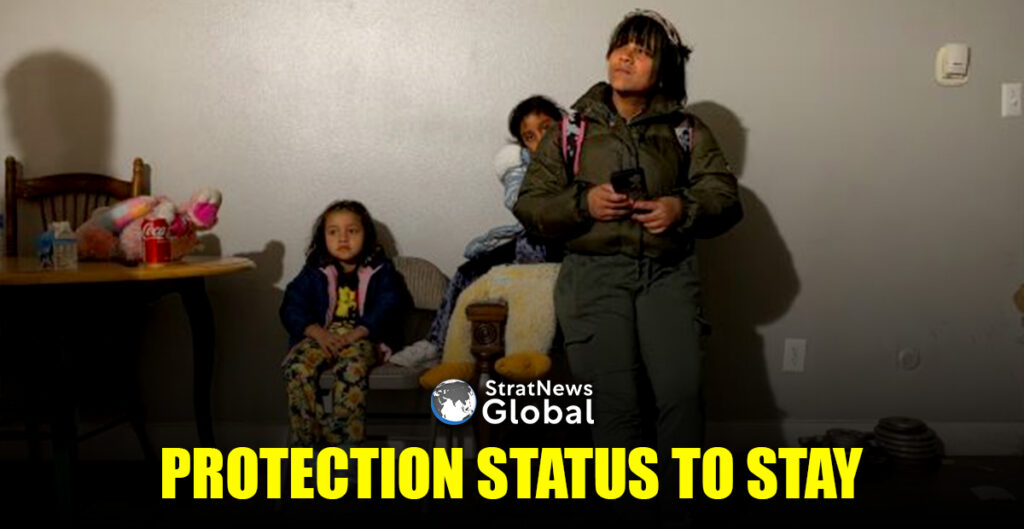
US Judge Rules Against Trump’s Plan To Strip Legal Status Of Venezuelans And Haitians
On Friday, a federal judge in San Francisco said the Trump administration broke the law when it sought to revoke temporary protections that shield over 1 million Venezuelans and Haitians staying in the U.S. from deportation.
U.S. District Judge Edward Chen said that Homeland Security Secretary Kristi Noem lacked the authority to end the programme, known as Temporary Protected Status or TPS, and the decision to do so was motivated by racism against Venezuelan and Haitian people.
“There is no evidence of any reasoned decision making” behind Secretary Noem’s finding that the programme should be canceled, Chen wrote.
Trump, a Republican, has made a crackdown on legal and illegal immigration a central plank of his second White House term. Canceling TPS protections would be a major boost to the administration’s campaign to deport millions of people.
Cancellation Of TPS
Chen in March had temporarily blocked the cancellation of TPS status granted to about 600,000 Venezuelans during the administration of Trump’s Democratic predecessor, President Joe Biden. Haitian TPS recipients later joined the case.
The March ruling was upheld by an appeals court last week, but has been paused by the U.S. Supreme Court.
The administration is likely to appeal Friday’s decision. The U.S. Department of Homeland Security did not immediately respond to a request for comment.
Temporary Protected Status is available to people whose home country has experienced a natural disaster, armed conflict or other extraordinary event. It provides eligible migrants with work authorization and temporary protection from deportation.
The programme was created in 1991 and under Biden was extended to cover about 600,000 Venezuelans and 521,000 Haitians. Noem reversed the extensions in February, saying they were no longer justified.
But Chen on Friday agreed with a group representing TPS recipients that Noem made that decision without first consulting with relevant federal agencies or conducting a comprehensive review of conditions in the two countries.
(With inputs from Reuters)