

Support us by contributing to StratNewsGlobal on the following UPI ID
ultramodern@hdfcbank

Strategic affairs is our game, South Asia and beyond our playground. Put together by an experienced team led by Nitin A. Gokhale. Our focus is on strategic affairs, foreign policy and international relations, with higher quality reportage, analysis and commentary with new tie-ups across the South Asian region.
You can support our endeavours. Visit us at www.stratnewsglobal.com and follow us on YouTube, Twitter, Facebook and Instagram.
र 500 per month
र 1000 per month
र 5000 per year
र 10000 per year
Donate an amount of your choice
र 500 per month
Donate र 500 per month

र 1000 per month
Donate र 1000 per month
र 5000 per year
Donate र 5,000 per year
र 10000 per year
Donate र 10,000 per year
Donate an amount of your choice
Donate an amount of your choice
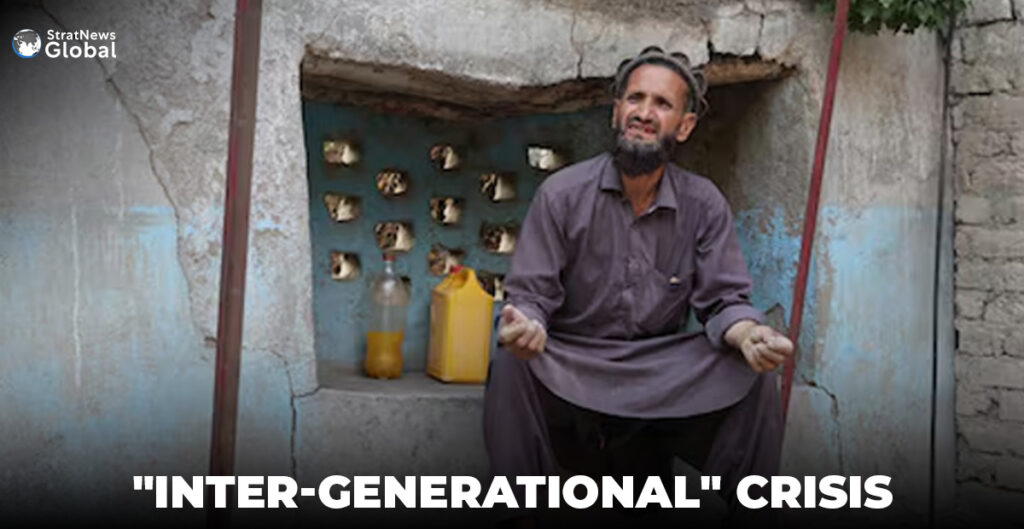





Afghanistan Earthquakes Trigger ‘Inter-Generational’ Crisis Amid Scarce Aid
This month’s earthquakes in eastern Afghanistan levelled villages, wiping out homes and livestock—the sole assets for many families—leaving survivors destitute as aid dwindles.
At least 2,200 people were killed and more than half a million were affected when a powerful earthquake struck the region on the night of August 31, followed by a series of strong aftershocks. The quakes have left tens of thousands of people homeless, with some fearing further landslides.
Abdul Ghafar, 52, has been living with his family of 10 under a tarpaulin sheet in Bamba Kot, a village in Afghanistan’s eastern Nangarhar province, since the quakes struck. The walls of his stone house are cracked, the ceilings have collapsed, and rubble covers the floor, forcing the family to sleep outside.
“We only need one tent,” he said, adding that officials refused to register his damaged house as uninhabitable.
For many families in rural Afghanistan, homes, land, and livestock are all they can call their own.
“In Afghanistan, households store wealth in homes, land and livestock, so when earthquakes destroy these assets, entire balance sheets collapse overnight,” said Jennifer Brick Murtazashvili, a professor at the University of Pittsburgh who specialises in governance in fragile states.
Stephen Rodriques, UNDP’s Resident Representative in Afghanistan, said more than 1.3 million animals were affected in the worst-hit Nangarhar and Kunar provinces, with grain stores and irrigation systems destroyed, threatening food supplies and the next planting season.
More than 7,000 livestock were killed and seven irrigation systems destroyed, with others damaged, according to the Norwegian Refugee Council.
“When those inputs vanish, you see less production, higher food prices and long-term harm to nutrition and health, especially for the poorest households,” said Ilan Noy, chair in the Economics of Disasters and Climate Change at Victoria University in Wellington.
“Without financing, the recovery will take much longer, and will create long-term cascades of consequences from this event that can continue for a very long time, possibly inter-generationally,” he said.
Strain Upon Strain
Taliban authorities say more than 6,700 homes were destroyed. Families remain in tents as aftershocks persist.
Thomas Barfield, author and president of the American Institute of Afghanistan Studies, said the coming winter would worsen the crisis and that decades of war and migration mean fewer relatives remain to help rebuild.
The quakes add gloom to an economy battered by sanctions, frozen assets and aid cuts since the Taliban takeover in 2021, while over 2 million deportations from Pakistan and Iran this year have further strained food and housing.
“Construction was a huge employer that disappeared after the Taliban takeover, the NGO sector is shrinking with aid cuts, and even the public sector is under strain,” said Ibraheem Bahiss of the International Crisis Group.
“Every year brings droughts and floods, and now earthquakes on top of that, compounding the tragedy Afghans face.”
The United Nations has appealed for $140 million in aid, but pledges lag as donors focus on Gaza and Ukraine and resist funding the Taliban because of its curbs on women aid workers.
Some aid has trickled in following the earthquake, from tents to food supplies, but it is not nearly enough, analysts said.
“Emergency aid is a wet towel in a forest fire; it won’t bridge the gap,” said Obaidullah Baheer, an adjunct lecturer at the American University of Afghanistan in Kabul. He warned that aid flows have already dropped steeply in a country reliant on them for two decades, and that “the real impact will only start to show next year.”
(With inputs from Reuters)
Palestinians In Gaza’s Nasser Area Face New Dilemma As Israeli Forces Advance
Palestinians in Gaza City’s relatively unscathed Nasser area faced the difficult choice of staying or fleeing after the Israeli military on Thursday distributed leaflets warning that troops would seize control of the western neighbourhood.
Israel has ordered the hundreds of thousands of people living in Gaza City to leave as it intensifies its all-out war on the Palestinian militant group Hamas, but with little safety, space and food in the rest of Gaza, people face dire choices.
“It has been almost two years, with no rest, no settling down, not even sleep,” said Abu Ahmed, a father, as he and his family prepared to flee the city in a truck pulled by a motorcycle, laden with some of their belongings.
“We can’t sit with our children just to sit with them. Our life revolves around war,” he said. “We have to go from this area to that area. We can’t take it anymore, we are tired.”
Fatal Search For Food
Israeli forces killed 18 people across the territory on Thursday, according to medics and local health authorities, including 11 in strikes on various parts of Gaza City, five in a strike on a single location in Beach refugee camp, and two who were searching for food near Rafah in the south.
Israeli ground troops had operated in parts of the Nasser area at the start of the war in October 2023, and the leaflets dropped late on Wednesday left residents fearful that tanks would soon advance to occupy the entire neighbourhood.
In the past week, Israeli forces have been operating in three Gaza City neighbourhoods further east – Shejaia, Zeitoun, and Tuffah – and sent tanks briefly into Sheikh Radwan, which is adjacent to Nasser. It said last Thursday it controlled 40% of the city.
On Wednesday, the Israeli military said it struck 360 targets in Gaza in what it said was an escalation of strikes that targeted “terrorist infrastructure, cameras, reconnaissance operations rooms, sniper positions, anti-tank missile launch sites, and command and control complexes”.
It added that in the coming days, it would intensify attacks in a focused manner to strike Hamas infrastructure, “disrupting its operational readiness, and reducing the threat to our forces in preparation for the next phases of the operation”.
Gaza City families continued to stream out of their homes in areas targeted by Israeli aerial and ground operations, heading either westward towards the centre of the city and along the coast, or south towards other parts of the strip.
But some were either unwilling or unable to leave.
“We don’t have enough money, enough to flee. We don’t have any means to go south like they say,” said Ahmed Al-Dayeh, who was attending the funeral of one of the people killed in Thursday’s strikes, who was his friend.
Deadly War
The war was triggered by Hamas-led attacks launched from Gaza on southern Israel on October 7, 2023, in which 1,200 people, mostly civilians, were killed, and 251 taken hostage, according to Israel.
Israel’s military assault on Gaza has killed over 64,000 people, mostly civilians, according to local health authorities, caused a hunger crisis and wider humanitarian disaster, and reduced much of the enclave to rubble.
Seven more Palestinians, including a child, have died of malnutrition and starvation in Gaza in the past 24 hours, the territory’s health ministry said on Thursday, raising the number of deaths from such causes to at least 411, including 142 children.
Israel says it is taking steps to prevent food shortages in Gaza, letting hundreds of trucks of supplies into the enclave, though international agencies say far more is needed.
The status of negotiations towards a ceasefire in Gaza that were being hosted and co-mediated by Qatar has been uncertain since Israel attempted to kill the political leaders of Hamas in an airstrike on the Qatari capital Doha on Tuesday.
The airstrike took place shortly after Hamas claimed responsibility for a shooting on Monday that killed six people at a bus stop on the outskirts of Jerusalem.
(With inputs from Reuters)
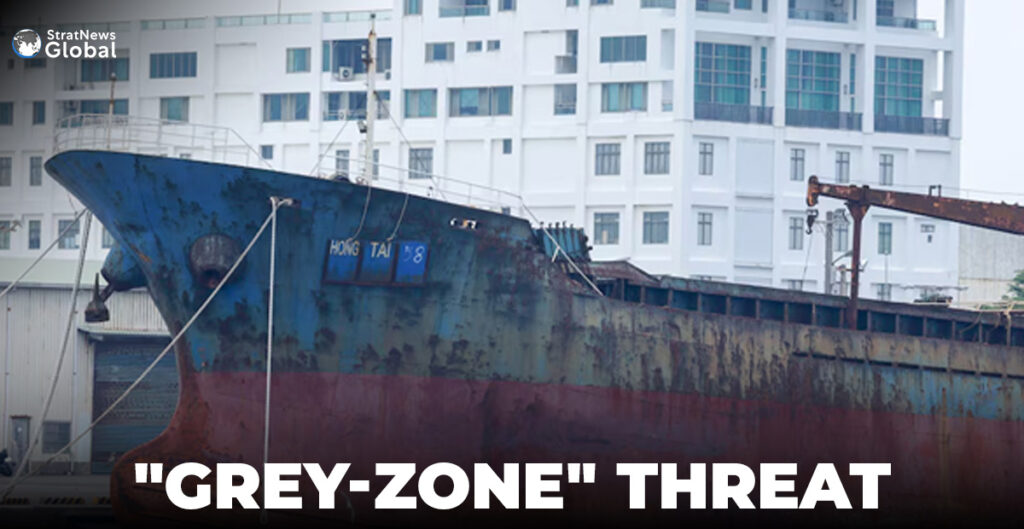
Taiwan Ramps Up Sea Cable Patrols Amid Rising Chinese ‘Grey-Zone’ Threat
Coast guard captain Juan Chung-ching steers his patrol vessel through the Taiwan Strait, monitoring for threats to undersea cables that Taipei warns are China’s latest grey-zone warfare target, crucial to the island’s communications.
Juan steered his 100-ton vessel, armed with water cannons and an autocannon, toward TP3, the undersea cable that made international headlines when a Chinese captain was found guilty of deliberately severing it this year.
TP3 is one of 24 undersea cables connecting Taiwan to the domestic or global internet.
Juan said such missions have become a top priority to combat China’s grey-zone warfare, a tactic meant to drain Taiwan’s resources while falling short of an act of war. On August 28, Reuters became the first media outlet to join one of these patrols.
“Their incursions have severely undermined the peace and stability of Taiwanese society,” said Juan, whose boat escorted the Chinese-crewed Hong Tai 58 for investigation hours after TP3 went offline in February.
“We are stepping up patrols in this area, monitoring for any vessels engaging in disruptive or destructive activities.”
Taiwanese authorities have connected two incidents of suspected underwater sabotage with China-linked boats this year, including one in Taiwan’s north.
China’s Taiwan Affairs Office did not respond to a request for comment. It has previously been said that Taiwan was “manipulating” possible Chinese involvement in the severing of undersea cables and making up accusations before the facts were clear.
Beijing views Taiwan as its own territory and claims the strategic waterway. Taipei rejects China’s territorial claims.
24-Hour Patrol
Taiwan’s stepped-up response comes with the Baltic Sea region on high alert after a string of suspected underwater sabotage incidents since Russia invaded Ukraine in 2022.
In the waters near TP3, coast guard vessels are now conducting 24-hour patrols.
An alert system detects vessels that come within a one-kilometre range off TP3 at slow speed, while dozens of operators at radar stations work to identify suspicious ships, the coast guard said.
Radio warnings are issued to those boats before coast guard vessels are dispatched to warn them away.
“Taiwan ranks among the top countries facing this issue,” Lin Fei-fan, Deputy Secretary-General of Taiwan’s National Security Council, told Reuters.
“We are indeed very close to China, and many densely populated submarine cable areas are highly vulnerable to damage.”
The task has stretched coast guard resources. Their eight boats and nearly 500 officers in the area are also responsible for life-saving missions and enforcing maritime law.
High on their watch list are 96 China-linked boats blacklisted by Taiwan. Many carry flags of convenience registered to third countries to avoid taxes and regulations.
Taiwan is also monitoring nearly 400 other China-linked boats, including cargo ships that could be converted into war vehicles, said a senior Taiwan security official briefed on the matter.
Taipei and other “like-minded” capitals are sharing intelligence on the real-time locations of these boats, the official said, requesting anonymity due to the sensitivity of the matter.
“Those ships are like cannon fodder, piles of scrap metal,” said Jenson Chien, commander of a coast guard flotilla near TP3, pointing to several dilapidated Chinese boats.
“They employ minimal resources to disrupt and sever our connections, sowing unrest throughout Taiwanese society.”
(With inputs from Reuters)
Can India Thrive in The New World Order?
Fluid geopolitics, fracturing globalisation, rising protectionism, weaponisation of finance and trade are generating unprecedented headwinds to global economic growth.
The obvious question is whether India can survive and more importantly, thrive in such a world? What will it take?
Especially since India has set itself an audacious ambition to become a developed economy by 2047.
To grow its per capita income nearly seven-fold to $18,000 in the next 22 years.
To answer all this and more, StratNewsGlobal.Tech spoke to Montek Singh Ahluwalia on Capital Calculus. He is an economist and someone who has served in various capacities in government, including as finance secretary and deputy chairman of the erstwhile Planning Commission and one of the key architects of India’s economic reforms.
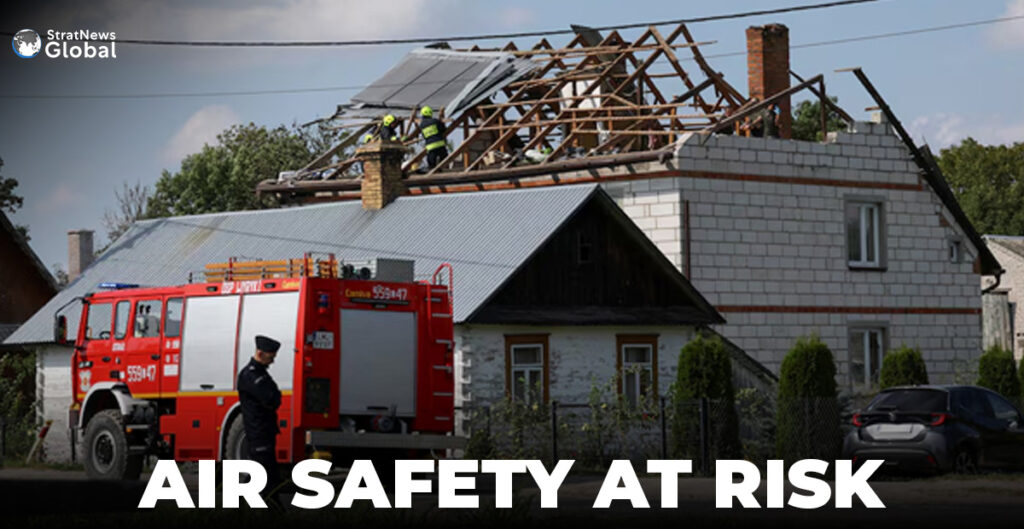
Russian Drone Incursion In Poland Renews Fears Over Europe’s Civil Aviation Safety
Aviation and insurance experts said Russian drone incursions into Poland have renewed concerns about the vulnerability of Europe’s civil air transport, marking the latest challenge for airlines amid escalating global conflict.
Early on Wednesday, Poland shot down drones in its airspace with the backing of military aircraft from its NATO allies, the first time a member of the Western military alliance is known to have fired shots during Russia’s war in Ukraine.
Warsaw Chopin and Modlin airports, as well as Rzeszow and Lublin airports in the country’s east, temporarily closed before resuming operations.
Countries bordering on Ukraine have reported occasional Russian missiles or drones entering their airspace since Russia’s 2022 invasion, but not on such a large scale, and they are not known to have shot them down.
Airlines Left With Fewer Options, Higher Costs
Proliferating conflict zones around the world have increased the burden on airline operations and profitability, adding to safety concerns and disrupting travel.
With airspace closures around Russia and Ukraine, throughout the Middle East, between India and Pakistan, and in parts of Africa, airlines are left with fewer route options.
Detours add to airlines’ fuel costs and lengthen journey times. Eurocontrol, a 41-nation coordination agency, has said Ukraine’s closed airspace has added to congestion in the region’s skies.
Since October 2023, many international carriers have suspended flights to the region due to fears of missile and drone interference.
Wednesday’s drone incident followed Israel’s attempt on Tuesday to kill the political leaders of Hamas in the Qatari capital Doha.
Worries about further disruption for the travel industry pressured airline stocks. Shares in British Airways owner IAG were down 4.1%, easyJet fell 2.2% to its weakest since April, while Lufthansa and Ryanair were both also 2.2% lower at the close of trade.
Flight disruptions were relatively limited because the drone incursion happened early in the morning, before many airlines had started flying.
Polish airline LOT redirected some flights to western Poland and said it expected cancellations and delays.
A spokesperson for budget airline Wizz Air, which operates in central and eastern Europe, said its security teams “closely monitored” the situation and adjusted flight schedules after airports closed.
The European Union Aviation Safety Agency said no advisory was needed for the drone incursion due to its temporary nature, adding that Poland’s aviation authorities were able to sufficiently handle the incident.
Airlines, Insurers Eye Risks
Aviation analysts say airlines are increasingly wary of the risks posed by incursions into civilian flight zones.
“This is a wake-up call, I think, for everyone in Europe who can expect this more often,” said Eric Schouten, head of security consultancy Dyami.
Two senior aviation insurance market sources said the market was watching events in Poland and Qatar closely.
If the market got a sense either that Russian drone incursions into Polish airspace were becoming consistent and deliberate, or that Israeli airstrikes in the Middle East were likely to continue, it would pose serious questions for insurers, one source added.
LOT, Lufthansa, Ryanair, and airBaltic did not immediately respond to requests for comment.
Poland’s civil aviation authority and air navigation service did not respond to a request for comment on additional measures taken to ensure airspace safety.
Worst-Case Scenario
Following the drone incident, airlines may review their risk assessments in Poland, said Matthew Borie, chief intelligence officer at aviation risk consultancy Osprey Flight Solutions.
They may consider flying further west in Poland away from the Russian, Ukrainian, and Belarusian borders, operating during daylight hours and carrying extra fuel to cope with potential diversions, he said, similar to steps taken in the Middle East.
The worst-case scenario for airlines flying near a conflict zone is a plane being struck — either accidentally or deliberately — by weaponry.
Since 2001, six commercial planes have been unintentionally shot down, with three additional close calls, according to Osprey.
In one such incident, in December, an Azerbaijan Airlines flight crashed in Kazakhstan, killing 38 people. The plane was accidentally shot down by Russian air defences, according to Azerbaijan’s president and Reuters sources.
In 2020, a Ukrainian passenger plane was mistakenly targeted and destroyed by Iranian air defence operators.
“If this happens more often, you really have to understand what’s happening … What might go wrong? I’m always saying, misidentification is your biggest risk,” Schouten added.
(With inputs from Reuters)
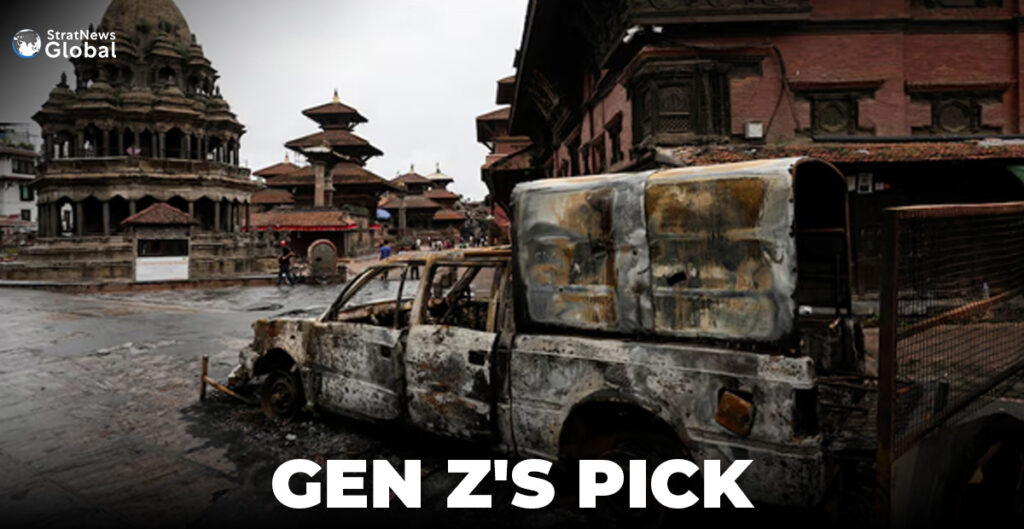
Nepal’s Gen Z Protesters Back Country’s First Female Chief Justice As Interim Leader
Nepal’s “Gen Z” protesters endorsed the nation’s first female chief justice to serve as interim leader and demanded the dissolution of parliament on Thursday, just two days after violent demonstrations claimed 34 lives and prompted the prime minister’s resignation.
Sushila Karki, 73, who was the first woman to be appointed Nepal’s chief justice in 2016 and is now retired, has been the frontrunner to become interim leader of the impoverished Himalayan country, which is wedged between India and China.
Her name had been proposed to the president and the army by those leading the protest, a representative of the protesters, Ojaswi Raj Thapa, told reporters.
“We will dissolve the parliament. We are not trying to dissolve the constitution,” Thapa said. “We may need some changes to the constitution, but we don’t want to dissolve the constitution.”
‘Gen Z’ Protests
The demonstrations, popularly referred to as the “Gen Z” protests, as most participants are in their teens or early 20s, triggered Nepal’s worst upheaval in years, forcing K.P. Sharma Oli to resign as prime minister on Tuesday, a day after 19 protesters were killed in violence.
The death toll has since risen to 34, and more than 1,300 were injured, Nepal’s health ministry said.
Soldiers continued patrolling the quiet streets of Kathmandu on Thursday, and shops, schools and colleges remained shut. Some essential services in the city had resumed.
Karki has agreed to become interim leader, but efforts are being made to find a constitutional route to appoint her, a source familiar with the matter told Reuters, speaking on condition of anonymity.
Local media reported that Karki was in talks with President Ramchandra Paudel and army chief Ashok Raj Sigdel.
‘Fearless’ Leader
“We see Sushila Karki for who she truly is — honest, fearless, and unshaken,” said Sujit Kumar Jha, a 34-year-old company secretary.
However, another source who declined to be named said protesters were still seeking to reach a unanimous decision and that not everybody backed Karki’s candidacy.
Karki did not respond to telephone calls from Reuters to seek comment. An army spokesperson did not immediately respond to a request for comment.
Earlier on Thursday, the spokesperson, Raja Ram Basnet, had told Reuters, “Initial talks are on and will continue today,” referring to the discussions on an interim leader. “We are trying to normalise the situation slowly.”
Prohibitory Orders In Force
Prohibitory orders will stay in Kathmandu and surrounding areas for most of the day, the army said in a statement, while an airport spokesman said international flights were operating.
The demonstrations, triggered by a social media ban that was later revoked, were also viewed as young people voicing frustration at the government’s perceived failure to fight corruption and boost economic opportunities.
Government buildings, from the Supreme Court to ministers’ homes, including Oli’s private residence, were set ablaze in the protests, which only subsided after the prime minister resigned.
Business establishments set on fire included several hotels in the tourist town of Pokhara and the Hilton in Kathmandu.
(With inputs from Reuters)
Amid U.S. Tariffs, India-EU Trade Talks Enter Critical Phase
India and the European Union are stepping up negotiations for a long-awaited Free Trade Agreement (FTA). An EU delegation led by Trade Commissioner Maroš Šefčovič and Agriculture Commissioner Christophe Hansen arrives in Delhi today for talks with Commerce and Industry Minister Piyush Goyal.
The visit comes amid the 13th round of negotiations, seen as pivotal to finalising the framework of a trade pact that has been in the making for over a decade. This week’s meetings carry renewed urgency as India recalibrates its external trade relationships in response to U.S. tariffs.
“The tariff escalation from the U.S. has made it clear that India needs to expand and stabilise its trade portfolio,” said a senior trade official. “The EU deal offers not just market access but long-term predictability.”
What’s On The Agenda
Negotiators have closed roughly two-thirds of the FTA’s chapters, including those related to digital trade, customs facilitation, dispute settlement and support for small and medium enterprises. However, several contentious areas remain, such as:
- Rules of origin
- Tariff concessions on dairy, wine, automobiles and medical devices
- Carbon Border Adjustment Mechanism (CBAM) compliance
- Intellectual property and investment protection standards
Officials hope for a resolution before the next round of talks in Brussels, slated for early October.
European Commission President Ursula von der Leyen, in her State of the Union address recently, said the EU was committed to concluding a “historic trade deal” with India before the year-end.
Prime Minister Narendra Modi has also been actively engaging with European leaders. In a phone conversation with Italian Prime Minister Giorgia Meloni, the two leaders have reaffirmed support for fast-tracking the FTA.
Germany has echoed similar support, with senior officials backing India’s concerns on regulatory standards and pressing for internal EU consensus on key aspects of the deal.
Beyond Trade
On September 17, the EU is expected to unveil a new strategic vision document outlining its long-term engagement with India across trade, climate, technology, defence and foreign policy. Multiple exchanges are scheduled in the coming months, including:
- Visit of the EU’s Political and Security Committee to New Delhi (October)
- India-EU Trade and Technology Council (TTC) meeting (November)
- Indo-Pacific Ministerial Forum in Delhi (November 20–21)
- Visit by EU High Representative for Foreign Affairs Kaja Kallas (expected in December or next year)
Why This Deal Matters
In 2024-25, India’s trade in goods with the EU stood at $136.5 billion, with another $51.4 billion in services. The EU accounts for about 17% of India’s total exports, making it India’s largest trading partner.
For the EU, the deal offers a pathway to a large, fast-growing market as it seeks to reduce overdependence on other regions. For India, it’s a strategic hedge amid trade friction with the U.S., and an opportunity to lock in access to advanced markets under predictable terms.
Mauritius Is ‘Family’: India Announces $680 Mn To Bolster IOR Footprint
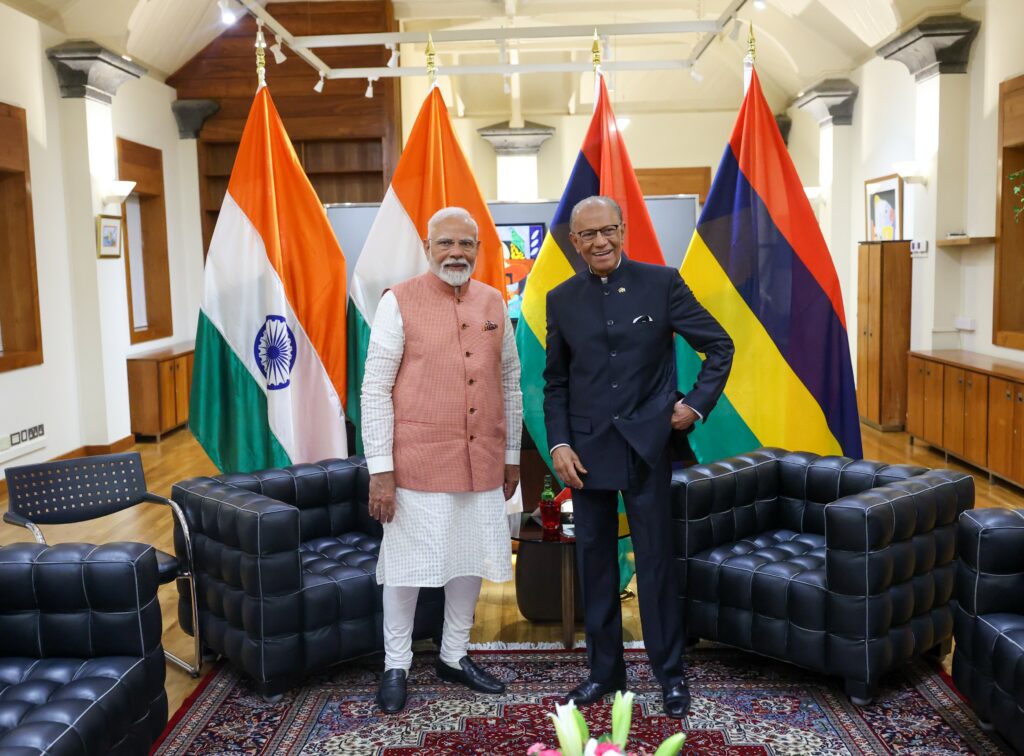
The temple town of Varanasi witnessed two secular announcements on Thursday: With Mauritius visiting Prime Minister Navinchandra Ramgoolam looking on, his Indian counterpart Narendra Modi declared a $680 million Special Economic Package to support the island’s development across infrastructure, healthcare, employment generation and maritime security.
Modi also announced Mahasagar, Mutual & Holistic Advancement for Security & Growth Across Regions, a policy that at its core seeks to challenge China’s attempts to expand its influence in the Indian Ocean.
The economic package will fund the 500-bed Sir Seewoosagur Ramgoolam National Hospital to enhance public healthcare, an AYUSH Centre of Excellence, marking the international expansion of India’s traditional wellness systems, a Veterinary School and Animal Hospital and helicopter provisions to strengthen emergency response and maritime surveillance.
“Today’s package is not assistance, it’s an investment in our shared future,” said Modi during the joint press address. He also congratulated Mauritius on the conclusion of the Chagos Agreement, calling it a “historic victory” for Mauritian sovereignty. “India has always championed the cause of decolonization and supported Mauritius in its rightful claims.”
Other projects up for completion include an Air Traffic Control tower at Port Louis International Airport, development of key transport infrastructure including the Motorway M4 and Ring Road Phase II and acquisition of advanced port equipment to boost maritime trade capacity.
India has agreed in principle to assist in the redevelopment of Mauritius’ port infrastructure and support marine surveillance and conservation efforts around the Chagos Marine Protected Area.
India has committed $ 25 million in budgetary assistance for the current fiscal year. Both sides will work towards enabling trade in local currencies, building on the digital payment frameworks such as UPI and RuPay, which were introduced in Mauritius last year.
“This will not only reduce transaction costs but also enhance the resilience of our bilateral trade,” Modi underscored.
Several MoUs were signed covering science, oceanography, energy, hydrography, community development, and capacity building. IIT Madras and the Indian Institute of Plantation Management signed agreements with the University of Mauritius, setting the stage for collaborative research and innovation.
PM Ramgoolam participated in the Ganga Aarti and visited the Kashi Vishwanath Temple, highlighting the spiritual and civilizational ties that have bound India and Mauritius for centuries.
Manhunt Launched For Sniper Suspected Of Killing Charlie Kirk In Utah
Police and federal agents have launched a massive manhunt for the sniper suspected of firing the fatal shot that killed conservative activist Charlie Kirk on Thursday, while he was addressing questions on gun violence during a university event.
Kirk, 31, a podcast-radio commentator and an influential ally of Donald Trump, is credited with helping build the Republican president’s base among younger voters. He was gunned down on Wednesday in what Utah Governor Spencer Cox called a political assassination.
The slaying, captured in graphic detail in video clips that rapidly spread around the internet, occurred during a midday event attended by 3,000 people at Utah Valley University in Orem, Utah, about 40 miles (65 km) south of Salt Lake City.
In one clip, blood could be seen gushing from Kirk’s neck immediately after a shot rang out, and he slumped in his chair.
Kirk, co-founder and president of the conservative student group Turning Point USA, was pronounced dead at a local hospital hours later. His murder stirred immediate expressions of outrage and denunciations of political violence from Democrats and Republicans alike.
Cox said Kirk’s events on college campuses were part of a tradition of open political debate that was “foundational to the formation of our country, to our most basic constitutional rights”.
“When someone takes the life of a person because of their ideas or their ideals, then that very constitutional foundation is threatened,” Cox said.
Era Of Political Violence
The shooting punctuated the most sustained period of U.S. political violence since the 1970s. Reuters has documented more than 300 cases of politically motivated violent acts across the ideological spectrum since supporters of Trump attacked the U.S. Capitol on January 6, 2021.
Trump himself has survived two attempts on his life, one that left him with a grazed ear during a campaign event in July 2024 and another two months later, foiled by federal agents.
The lone perpetrator suspected of firing the single gunshot that struck Kirk in the neck, apparently from a rooftop sniper’s nest on campus, remained “at large,” said Beau Mason, commissioner of the Utah Department of Public Safety, at a news conference four hours later.
Security camera footage showed a person believed to be the assailant dressed in all-dark clothing, Mason told reporters. But some eight hours after the killing, authorities said they still had no suspect in custody.
State police issued a statement on Wednesday night saying that two men had been detained, and one was interrogated by law enforcement, but both were released.
“There are no current ties to the shooting with either of these individuals,” the statement said. “There is an ongoing investigation and manhunt for the shooter.”
No Suspects In Custody, Multiple ‘Crime Scenes’
One of the two detainees, an older man seen in photos that circulated online shortly after the killing, was familiar to locals as a political “gadfly,” according to the Salt Lake Tribune. Officials said he had been charged with obstruction by university police.
The other man had been initially described by the governor as a “person of interest” in the investigation.
Police said late on Wednesday that investigators were seeking clues at “multiple active crime scenes,” pinpointed on the basis of where Kirk was shot and “locations where the suspect and the victim travelled.”
Kirk, who was married and the father of two young children, had just returned to the United States from an overseas speaking tour in South Korea and Japan.
His appearance on Wednesday was the first in a planned 15-event “American Comeback Tour” of U.S. college campuses.
Known for his often-provocative discourse on topics ranging from race and gender to immigration and firearms regulation, Kirk often used such events to invite members of the crowd to debate him live.
At the moment he was shot, Kirk, a staunch advocate of the Constitution’s Second Amendment right to bear arms, was being questioned by an audience member about gun violence, according to multiple videos of the event posted online.
‘Radical Left Lunatics’
In a video message taped in the Oval Office and posted to Trump’s Truth Social online platform, the president vowed that his administration would track down those responsible for Kirk’s killing.
Trump, who routinely describes political rivals, judges and others who stand in his way as “radical left lunatics” and warns that they pose an existential threat to the nation, also decried violent political rhetoric, while casting it as a phenomenon of the political left.
“For years, those on the radical left have compared wonderful Americans like Charlie to Nazis and the world’s worst mass murderers and criminals,” Trump said in the video, recorded in the Oval Office. “This kind of rhetoric is directly responsible for the terrorism that we’re seeing in our country today, and it must stop right now.”
(With inputs from Reuters)
Islamist Student Bloc Sweeps Dhaka University Polls, Building Up To 2026 Election
In a stunning comeback, the student wing of Bangladesh’s Islamist political party Jamaat-e-Islami has clinched a landslide victory in the Dhaka University Central Students’ Union (DUCSU) elections.
The results, seen as politically significant, come just months ahead of the February 2026 national polls, media reports said.
First Polls Since Hasina’s Ouster
The Islami Chhatra Shibir (ICS)-backed panel secured 23 of 28 seats, defeating the student wing of former Prime Minister Khaleda Zia’s Bangladesh Nationalist Party (BNP).
Key winners include Shadik Kayem and SM Farhad, elected Vice-President and General Secretary respectively, while Muhammad Mohiuddin Khan was elected Assistant General Secretary. Under DUCSU rules, the Vice-President automatically assumes the role of President.
A total of 471 candidates contested for the 28 posts, with ICS running a full panel.
This was the first DUCSU election under the interim government and notably the first without participation from the Bangladesh Chhatra League (the Awami League’s student wing), which was banned earlier.
Back To ‘Hijab’ Era
Reacting to ICS’ victory, exiled author Taslima Nasreen shared a video on Facebook, warning that some of the student wing members were already calling for hijab enforcement.
In the video caption, she wrote: “In the DUCSU election, these jihadis who won are shouting ‘Hijab, hijab’. Surely, the female students who do not wear hijab will be harassed by these …….. in many ways. After forcing women into hijab, they will start shouting ‘Burqa, burqa’. Then women will have to go to university wearing the burqa. After that, they will, in Taliban style, start saying that women should not study at university. ”
“They will shout ‘No female students, no female students.’ Next, they will oppose women studying in schools and colleges. They will demand that women should not be seen in workplaces, shouting ‘No women, no women’. Then they will demand that women should not go outside the home at all. The country is falling into the hands of rapists and misogynists, ignorant, violent men and extremists,” she wrote.
Implications
For the first time in decades, DUCSU will be dominated by Shibir, which had been sidelined for years. This could reshape the nature of protests and policy debates at the university.
In national politics, Jamaat-e-Islami may regain political influence through its student front, while BNP’s weak showing underscores its struggle to fully capture youth support.
The result signals growing student disillusionment with both the Awami League and BNP, potentially forcing larger parties to recalibrate their youth engagement strategies.
Secular student groups have warned that Shibir’s control could accelerate campus radicalisation. International observers, meanwhile, are watching closely, given how student politics in Bangladesh often reflect broader national trends.
(With inputs from IBNS)