

Support us by contributing to StratNewsGlobal on the following UPI ID
ultramodern@hdfcbank

Strategic affairs is our game, South Asia and beyond our playground. Put together by an experienced team led by Nitin A. Gokhale. Our focus is on strategic affairs, foreign policy and international relations, with higher quality reportage, analysis and commentary with new tie-ups across the South Asian region.
You can support our endeavours. Visit us at www.stratnewsglobal.com and follow us on YouTube, Twitter, Facebook and Instagram.
र 500 per month
र 1000 per month
र 5000 per year
र 10000 per year
Donate an amount of your choice
र 500 per month
Donate र 500 per month

र 1000 per month
Donate र 1000 per month
र 5000 per year
Donate र 5,000 per year
र 10000 per year
Donate र 10,000 per year
Donate an amount of your choice
Donate an amount of your choice
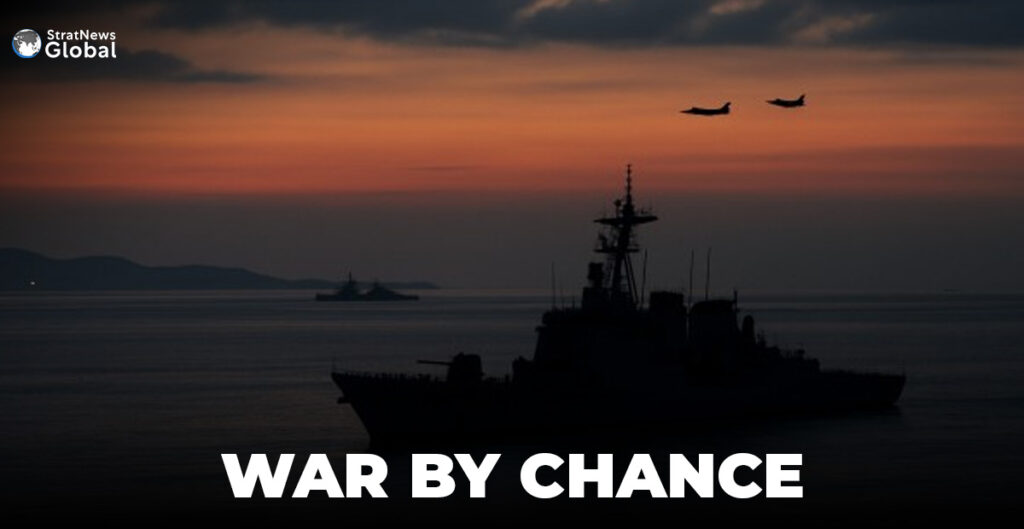


The Greatest Danger in the Taiwan Strait: A War of Chance
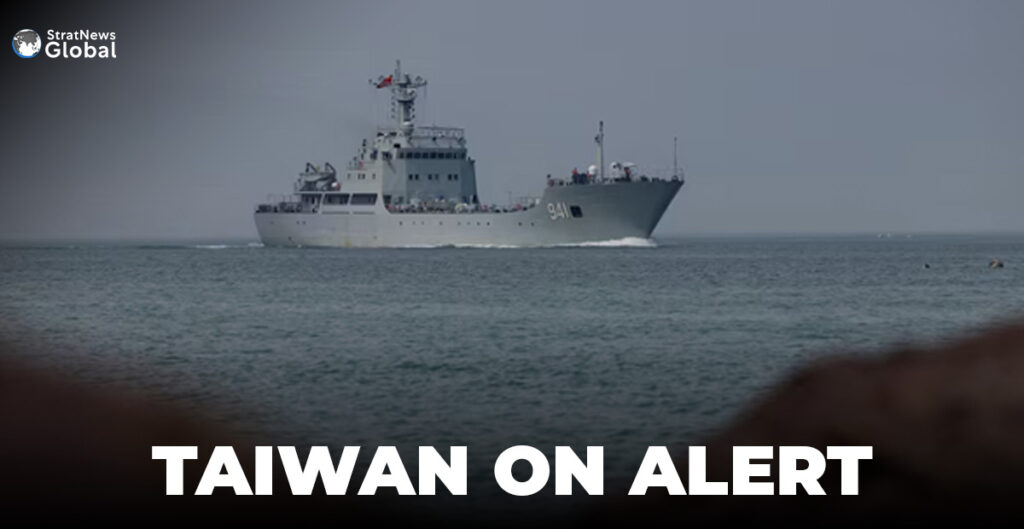
Tensions across the Taiwan Strait are once again raising fears that Beijing and Taipei could stumble into conflict. While much of the debate focuses on a deliberate war of choice by China or a war of necessity triggered by Taiwan’s declaration of independence, experts warn of a third, more unpredictable path: a war of chance.
In an article published in Foreign Affairs, Joel Wuthnow, a Senior Research Fellow at the Institute for National Strategic Studies at the U.S. National Defense University, argues that an accidental conflict sparked by miscalculation is the most likely danger confronting China, Taiwan, and the United States. Wuthnow, co-author of China’s Quest for Military Supremacy, stresses that although wars of choice or necessity can be deterred through policy, the risk of a war of chance remains inherent and far harder to eliminate.
Unlike a calculated invasion or a redline-driven confrontation, a war of chance could erupt suddenly. Wuthnow describes a plausible scenario: a Chinese fighter jet flying too close to Taiwan ignores repeated warnings and is shot down. Beijing retaliates against Taiwan’s air defences, leading to casualties. The United States, uncertain of Beijing’s intent, mobilises forces in the region. China responds in kind. With each side interpreting the other’s actions as aggression, escalation could quickly spiral beyond control.
History is full of such examples. The assassination of Archduke Franz Ferdinand in 1914, which ignited World War I, is cited by Wuthnow as a textbook case of how accidents can cascade into global conflict. Similarly, the American Revolution began when a British soldier fired the “shot heard ’round the world” in Concord, Massachusetts—an act against orders that nonetheless sparked war. Other cases include the Peloponnesian War, which grew from a local dispute, and the Second Opium War, triggered in 1856 by the arrest of a ship’s crew in Canton.
Three factors, Wuthnow explains, make such accidents especially dangerous: frequent contact between rival militaries, political pressures that make backing down costly, and the mobilisation of allies that magnify small disputes into major confrontations. All three, he warns, are present in the Taiwan Strait today.
Chinese military activity around Taiwan has sharply increased. In January 2025, Chinese jets crossed the Strait’s centerline 248 times, more than triple the number from the same month a year earlier. In April, a Chinese fighter approached within 40 miles of Taipei, and Chinese navy ships entered Taiwan’s contiguous zone for the first time during the “Strait Thunder” exercise. The Chinese Coast Guard has also taken provocative actions, such as detaining the crew of a Taiwan-flagged vessel near Kinmen in 2024. These manoeuvres, Wuthnow notes, carry exactly the kind of risks that could spark a war of chance.
Political dynamics further complicate de-escalation. Beijing, having long portrayed Taiwan as a breakaway province, cannot afford to appear weak, especially if the United States or its allies intervene. Taiwan’s leaders, meanwhile, must contend with strong public sentiment for autonomy. Roughly a quarter of Taiwanese favour independence now or in the future, making concessions politically costly. Protests or nationalist outrage on either side could lock leaders into escalation.
The possibility of U.S. involvement adds another layer of danger. Washington could misinterpret an accident as the prelude to an invasion and respond with force. Domestic political pressure might push the White House toward intervention, while Beijing, fearing a U.S. attack, could launch preemptive strikes.
Reckless actions by individual Chinese pilots or sailors are another concern. Wuthnow recalls the 2001 collision between a Chinese J-8 fighter and a U.S. reconnaissance plane, which led to the death of the Chinese pilot and the detention of the American crew. More recent incidents include a near-collision between a Chinese J-11 and a U.S. B-52 in 2023, clashes with Philippine forces in the South China Sea, and even a collision between two Chinese vessels in pursuit of a Philippine ship. None of these sparked war, but in the volatile Taiwan Strait, similar accidents could prove catastrophic.
To reduce risks, Wuthnow calls for greater restraint and communication. The PLA should avoid provocative manoeuvres close to Taiwan’s air and sea boundaries. Taiwan’s military, in turn, should act cautiously in enforcing its defences. Leaders on both sides must also rein in rogue operators and establish mechanisms to flag dangerous incidents.
Dialogue, even indirect, is essential. Although Beijing refuses direct talks with Taiwan’s President William Lai, Wuthnow suggests backchannel communication through research institutes or unofficial intermediaries could provide off-ramps during crises. The United States, meanwhile, should maintain its policy of strategic ambiguity toward Taiwan. Shifting to strategic clarity, Wuthnow warns, would force Washington into immediate military action during a crisis, raising the risk of escalation.
Ultimately, prevention can only go so far. The United States and Taiwan must also prepare credible plans for managing accidental incidents. Most wargames today focus on deliberate Chinese aggression, Wuthnow notes, leaving policymakers ill-prepared for a crisis sparked by miscalculation. In the Taiwan Strait, where history, geography, and politics collide, improvisation in such a scenario could prove disastrous.
Wars of chance, Wuthnow concludes, are sudden, unpredictable, and often devastating. Careful statesmanship and prudent crisis management may be the only tools available to prevent an accident from becoming a world-altering conflict.
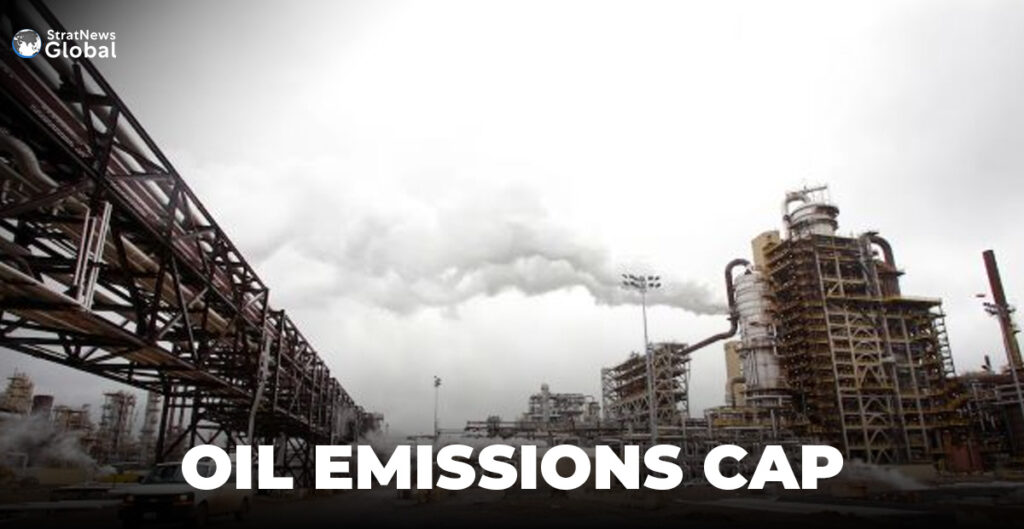
Canada Weighs Scrapping Oil Emissions Cap Under New Climate Strategy
The Canada government is negotiating with Alberta officials and energy companies over the possibility of removing the federal cap on emissions from the oil and gas industry, provided the sector and province commit to cutting their carbon output through alternative measures, according to three people familiar with the talks.
The sources, who were not authorized to speak publicly about the discussions, said Prime Minister Mark Carney‘s government has discussed removing the cap with oil companies and Canada’s top oil-producing province if they make other environmental concessions.
Canada’s emissions cap has not yet been implemented through legislation. But the prospect of it has been broadly condemned by Canadian oil and gas companies who have said it will force them to cut production.
Carney Wants To Keep Emission Caps
Carney, who won an election in April promising to protect Canada’s economy from U.S. tariffs, has faced some criticism for stepping away from his Liberal Party’s previous emphasis on the environment.
His government’s tone has changed significantly from a few weeks ago, sources said, adding officials had until recently suggested the emissions cap would stay in place.
Carney said during an election campaign he would keep the emissions cap, which is not scheduled to take effect until 2030. His predecessor Justin Trudeau published draft regulations for the cap last November.
The sources said the current talks could lead to the emissions cap being scrapped as part of a broader new “climate competitiveness strategy,” which the federal government aims to unveil later this autumn.
Carney’s federal environment department said the government is reviewing feedback on the emissions cap.
While mechanisms like caps can play a role in building a future that reduces emissions, “we are not going to get there through regulation alone,” an environment department spokesperson said in a statement.
“Canada’s new government is committed to climate policy that is unifying, credible, and predictable; that reduces emissions, drives investment, and builds the economy of the future,” the statement said.
Canada’s Natural Resources Minister Tim Hodgson declined to discuss details of the negotiations, but said in an interview on Thursday the federal government is committed to delivering clean and conventional energy in an environmentally responsible way.
“What I can tell you is that our government is focused on results, not how we get there,” Hodgson said.
New Climate Strategy
Any move to eliminate the cap would be contingent on Alberta and the oil sector making renewed, serious commitments to emissions reduction including, but not limited to moving ahead with the Pathways carbon capture and storage project, two of the sources said.
Canada’s new climate competitiveness strategy will focus on “results over objectives and investments over prohibition,” Carney said this week at a meeting of the ruling Liberal party in Edmonton.
Oil and gas is Canada’s highest-polluting industry and its emissions continue to rise due to rising production in the country’s oil sands region.
Ottawa will likely fall short of its international climate commitment to reduce greenhouse emissions by 40-45% from 2005 levels by 2030 unless the oil and gas sector intensifies efforts to decarbonize.
Under the terms of the cap, the federal government would require its oil and gas sector to cut emissions to 137 million metric tons, 37% below 2022 levels, by 2030.
Carney promised to make Canada the “world’s leading energy superpower,” forging ahead with clean energy development while making the conventional oil and gas sector more competitive.
He has also sought to mend federal relations with Alberta, which under Trudeau had become increasingly rocky due to that government’s heavy focus on environmental issues.
(With inputs from Reuters)
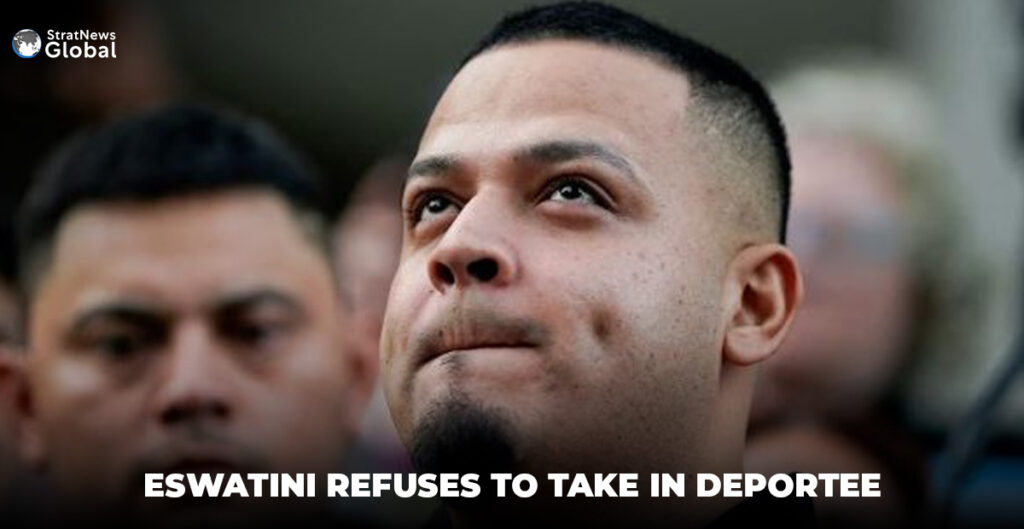
Eswatini Denies U.S. Request To Accept Kilmar Abrego As Deportee
The Eswatini government said on Thursday it had no agreement with the United States to accept Kilmar Abrego, rejecting a claim by President Donald Trump’s administration last week that he could be deported to the small African country.
“The Government of Eswatini has not received any communication regarding this person,” government spokesperson Thabile Mdluli said.
“Any proposal to send more deportees to Eswatini will be discussed between the governments of Eswatini and the United States of America prior to initiating processes, and the country will be properly informed,” Mdluli added in a text message.
The Trump administration has sought to deport more migrants to so-called “third countries,” saying the step is necessary if their home countries will not accept them. Critics have questioned that rationale.
Eswatini accepted five third-country deportees from the United States in July, for which it is facing a court challenge by local human rights activists who have called their government’s secretive deal with the Trump administration illegal.
Abrego, whose arrest in March and subsequent fight to stay in the United States have become a flashpoint in Trump’s immigration crackdown, is originally from El Salvador and is currently being held in an immigration detention centre in Virginia.
Abrego’s Deportation
A sheet metal worker who entered the United States illegally, Abrego had been living in Maryland with his wife, their child and two of her children – all of whom are American citizens – until he was arrested, accused of being a gang member and sent to a prison in El Salvador despite a U.S. judge’s ordering prohibiting his deportation to his native country.
A September 5 email from a U.S. Department of Homeland Security official to Abrego’s lawyers said: “We hereby notify you that your new country of removal is Eswatini.” The official said the change was made because Abrego, 30, had stated that he feared persecution or torture in Uganda, previously designated for his deportation. Abrego has no ties to Eswatini.
In response to a request for comment, a senior Trump administration official referenced U.S. government allegations against Abrego, including criminal charges related to migrant smuggling, and said he would be deported, even if it was to another nation.
“We are not going to allow this public safety threat to remain in our country,” the official said.
Kilmar Abrego has pleaded not guilty.
(With inputs from Reuters)
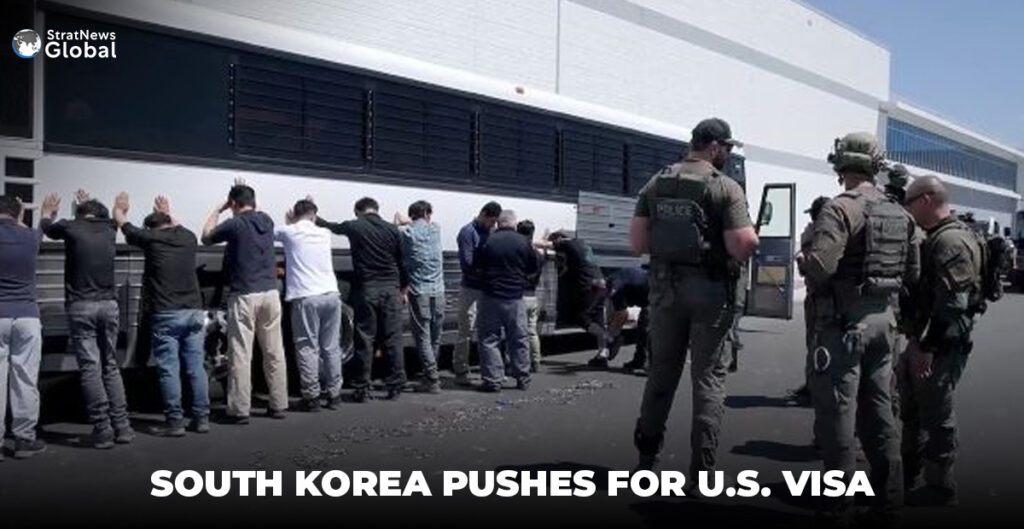
Detained South Korean Workers Return Home As Seoul Pushes For U.S. Visa Backing
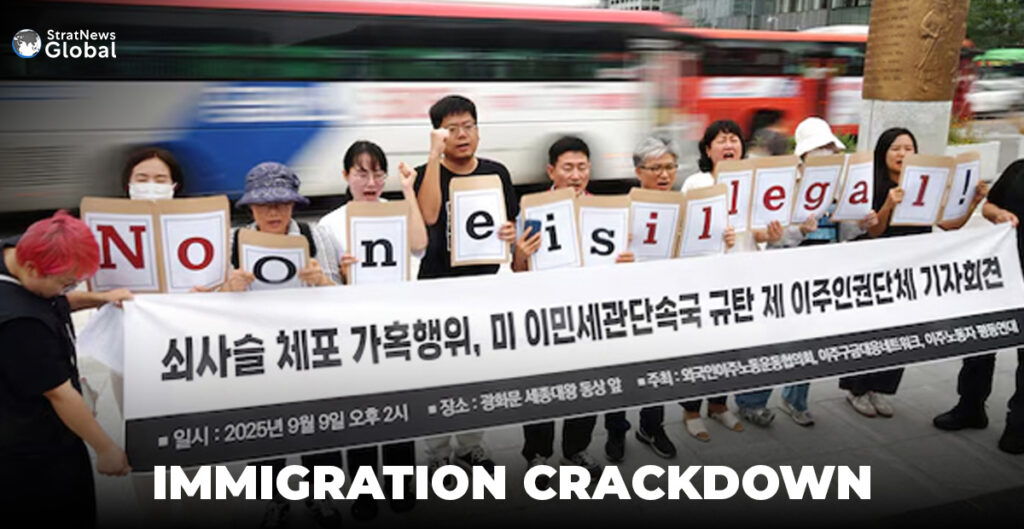
South Korea’s Foreign Minister Cho Hyun called on the U.S. Congress to back a new visa programme for Korean businesses. His appeal came as hundreds of mostly South Korean workers, arrested in a large U.S. immigration sweep last week, prepare to return home on Friday.
During his meetings with U.S. senators in Washington, Cho reiterated concerns among South Koreans over the detention of Korean professionals participating in investment projects in the United States, his ministry said in a statement.
A plane carrying more than 300 Korean workers who were detained during the raid at a Hyundai Motor and LG Energy Solution battery joint venture in the state of Georgia has left the United States, bound for South Korea.
The plane is expected to touch down in South Korea at around 2 p.m. (0500 GMT), according to LG Energy Solution, whose workers and subcontractors were among the detainees.
After being held for a week by U.S. Immigration and Customs Enforcement, the South Korean workers have been released and flown from Atlanta.
The raid that sent shockwaves across South Korea has threatened to destabilise ties, at a time when both countries are seeking to finalise a trade deal, and to scare off South Korean investment in the United States that U.S. President Donald Trump has been keen to secure.
Following the raid, the battery plant is facing a minimum startup delay of two to three months, Hyundai CEO Jose Munoz said on Thursday.
‘Wrong Visas’
In the wake of the raid, Washington and Seoul have agreed to discuss establishing a new visa category for South Koreans, Cho has said.
U.S. Commerce Secretary Howard Lutnick said on Thursday that hundreds of South Korean workers arrested during the immigration raid had the wrong visas.
“I called up the Koreans, I said, oh, give me a break. Get the right visa and if you’re having problems getting the right visa, call me,” Lutnick said in an interview with Axios.
Asked if the raid had created tensions between the countries, Lutnick told CNBC Trump would “go and address that.”
“So I think he’s going to make a deal with different countries that when they want to build big here, he’ll find a way to get their workers proper work visas, meaning short-term work visas, train Americans and then head home,” he said.
South Korean companies have complained for years that they have struggled to obtain short-term work visas for specialists needed at their high-tech U.S. plants, and had come to rely on a grey zone of looser interpretation of visa rules under previous U.S. administrations.
“Minister Cho emphasized that fundamental preventative measures are essential to ensure that our workforce is not subjected to unfair treatment in order to fulfil our companies’ investment commitments to the United States,” the ministry said in a statement.
(With inputs from Reuters)
FBI Director Patel Faces Heat After False Claim In Kirk Probe
FBI Director Kash Patel is facing sharp criticism after wrongly claiming a suspect was caught in the fatal shooting of conservative activist Charlie Kirk, a close ally of US President Donald Trump.
Moments before officials on the scene of the shooting in Orem, Utah, briefed the press on Wednesday, Patel announced on social media that the person responsible for the shooting was in custody. That claim was quickly contradicted by local officials, leading to hours of confusion before the FBI clarified that two people had been questioned and then released following the incident.
Current and former US officials called Patel’s announcement counterproductive.
Social Media Gimmick?
“At the outset of an investigation, much of the initial intelligence is typically wrong or slightly off. That’s why what he did yesterday has never been done by any FBI director before him, or any division leadership before,” said retired FBI agent Dan Brunner. “The investigators need to sort through all the initial intelligence before putting out factual evidence … FBI does not run investigations on social media.”
A White House source, granted anonymity to discuss internal discussions, called Patel’s announcement unprofessional and said “his performance is really not acceptable to the White House or the American public” and will be addressed.
Former Homeland Security Department official John Cohen likewise said Patel’s announcement “is unorthodox and could be confusing in that details change quickly”.
White House Backing
The White House said Patel had Trump’s backing and described Reuters’ reporting as despicable “when there’s a crazed killer still on the loose”.
“This is a despicable story from anonymous sources clearly trying to sow distrust amongst the President’s team during a time of utmost unity,” White House spokeswoman Karoline Leavitt told Reuters. “Kash Patel is leading the manhunt to catch the killer of our friend, and everyone is supporting him and trying to be as helpful as possible during this effort, including the President of the United States.”
The FBI did not respond to a request for comment.
The killing of Kirk, a prominent Trump ally, at a Utah college in front of 3,000 people, is the latest incident of political violence in the United States this year.
Patel’s First Big Test
It amounts to the first big test for the FBI director, a Trump loyalist who has pushed to transform the most prominent US law enforcement agency into an instrument of Trump’s America First agenda.
Multiple current and former agents said they were concerned that Patel’s lack of law enforcement experience could impede the progress of the investigation.
Under Patel’s leadership, FBI agents, who typically pursue complex investigations ranging from corruption to national security, have been drafted to investigate political rivals of the president and pursue street crimes in Washington.
Patel has pushed out dozens of FBI employees at the traditionally independent agency who were seen as insufficiently loyal to Trump. Three former FBI officials alleged in a lawsuit filed on Wednesday hours before the shooting that Patel told them he had been ordered to fire anyone who worked on a criminal investigation against Trump after his first White House term.
Among those dismissed: the former top official in the FBI’s Salt Lake City field office, which is now taking the lead on the investigation into Kirk’s death.
FBI Special Agent in Charge Robert Bohls, who now heads that office, told reporters on Thursday morning that investigators have found several clues, including the rifle used in the incident, but still had not captured a suspect.
‘Slap In The Face’
The FBI on Thursday released two photos of a person they were seeking in the probe.
The agency also announced a $100,000 reward for information leading to an arrest – an amount that was dismissed as inadequate by conservative activist Laura Loomer. “This is honestly embarrassing for the FBI and our country. What a slap in the face to Charlie Kirk,” she said on social media.
Before taking the FBI’s top job, Patel was a prominent critic of the agency, alleging that a “deep state” within the government had persecuted Trump. As a congressional staffer, he helped lead an investigation into the FBI’s 2016 probe of the Trump campaign’s contacts with Russia.
As FBI director, Patel has been a vocal advocate for Trump’s agenda and has appeared with Trump at social events – a contrast to prior FBI leaders, who have traditionally presented themselves as nonpartisan professionals independent of the White House’s whims.
He has occasionally gotten crosswise with the administration. In May, he told lawmakers that Trump’s proposed budget did not provide enough money for the FBI, then said the following day that he supported the planned cuts.
Patel was removed earlier this year from his other role serving as the acting director for the Bureau of Alcohol, Tobacco, Firearms and Explosives. It was never made clear why he was removed, and replaced with Army Secretary Daniel Driscoll.
(With inputs from Reuters)
China’s Fujian Carrier Nears Taiwan In ‘Routine’ Trials
China’s most advanced aircraft carrier, the Fujian, recently passed through the sensitive Taiwan Strait into the South China Sea during its sea trials.
The Chinese navy said in a statement on Friday that the journey was made to conduct scientific research trials and training missions. First unveiled in 2022, the country’s third aircraft carrier began sea trials last year and has yet to formally enter service.
‘Routine Arrangement’
“This cross-regional trial and training exercise for the Fujian is a routine arrangement in the carrier’s construction process and is not directed at any specific target,” it added.
The sailing comes as US Marines and Japanese counterparts stage a fortnight of exercises on the nearby island of Okinawa with the Typhon missile system and other advanced anti-ship weapons. The exercises are due to run until September 25.
Japan’s defence ministry said late on Thursday that the Fujian had entered the East China Sea, sailing southwest toward Taiwan, accompanied by two Chinese missile destroyers.
Taiwan Monitoring Situation
Taiwan’s defence ministry said it has been monitoring the situation with joint intelligence surveillance and has taken appropriate measures.
China has, over the past five years or so, stepped up its military presence around Taiwan, including staging war games, to assert its sovereignty claims.
Taiwan’s government rejects Beijing’s sovereignty, saying only the island’s people can decide their future.
Dispute
China considers the Taiwan Strait to be its territorial waters. Taiwan, the United States and many of its allies say it is an international waterway.
The South China Sea has been another site of increased Chinese military activity. China claims most of the sea – claims that are contested by many countries, including the Philippines and Vietnam.
The Fujian, designed and built domestically, is larger and more advanced than the Shandong, commissioned in late 2019, and the Liaoning, which China bought second-hand from Ukraine in 1998.
With a flat deck and electro-magnetic catapults to launch aircraft, the Fujian is expected to host a larger and wider range of planes than the other two carriers – including early-warning aircraft and, eventually, China’s first carrier-capable stealth jet fighters.
Regional security analysts and military attaches are watching the Fujian’s trials closely, in part to see how effectively China’s navy can co-ordinate full-blown carrier operations with escort ships and submarines.
(With inputs from Reuters)
Can Trump’s Tariffs Revive South Asian Trade?
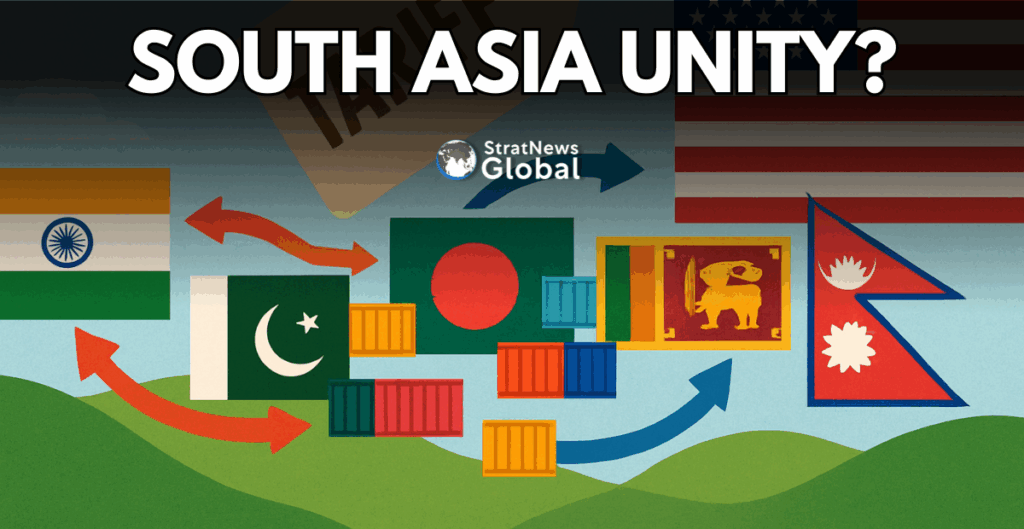
Trade experts in South Asia have called for greater regional cooperation and revival of agreements such as the South Asian Free Trade Agreement (SAFTA) to mitigate the impact of new U.S. tariffs announced by President Donald Trump.
At a seminar organised by the Centre for Social and Economic Progress (CSEP), panellists noted that Trump’s tariffs have shaken export-dependent economies across South Asia, and the World Uncertainty Index has spiked in response.
India was hit the hardest, facing a 50% tariff rate, including an additional 25% penalty for continuing oil purchases from Russia. Bangladesh and Sri Lanka face 20% tariffs, while Pakistan was subjected to 19%. Nepal, however, emerged comparatively better off, with a 10% tariff that panellists said gives it an advantage over its neighbours.
Despite this uneven impact, speakers emphasised the need for diversification and cooperation. Vaqar Ahmed, a Pakistani economist, pointed to earlier phases of SAARC cooperation, noting that even minimal intra-regional trade had delivered substantial gains. Pakistan is pursuing tariff reforms through a new national policy aimed at reducing maximum customs duties and enhancing competitiveness, Ahmed added.
Sanjay Kathuria, Visiting Fellow at CSEP, who moderated the discussion, cited India-China trade as an example. observing that despite political strains, economic engagement had thrived, he asked: “Why can’t the rest of South Asia follow that same example?”
Bangladesh’s Mustafizur Rehman, Distinguished Fellow at the Centre for Policy Dialogue, stressed the importance of regional supply chains, marketing integration, and mutual recognition agreements. Subhashini Abeysinghe, Research Director at Verité Research in Sri Lanka, urged diversification beyond traditional sectors like textiles and beyond reliance on the U.S. market.
From Nepal, Paras Kharel, Executive Director at South Asia Watch on Trade, Economics and Environment, warned that while low tariffs provide short-term advantages, over-reliance on a narrow export basket could increase vulnerability in the future.
For India, TG Srinivasan, Visiting Fellow at CSEP, recommended negotiating deeper free trade agreements and liberalising the domestic market, rather than relying solely on simple FTAs.
Other suggestions from the panel included diversifying export products and reinforcing multilateral trade systems such as the World Trade Organization (WTO).
The discussion highlighted that while South Asian countries grapple with U.S. tariff pressures, analysts see regional economic cooperation as a potential buffer against global trade uncertainty.
North Korea’s Leader Elevating Daughter As Successor, Seoul Intelligence Says
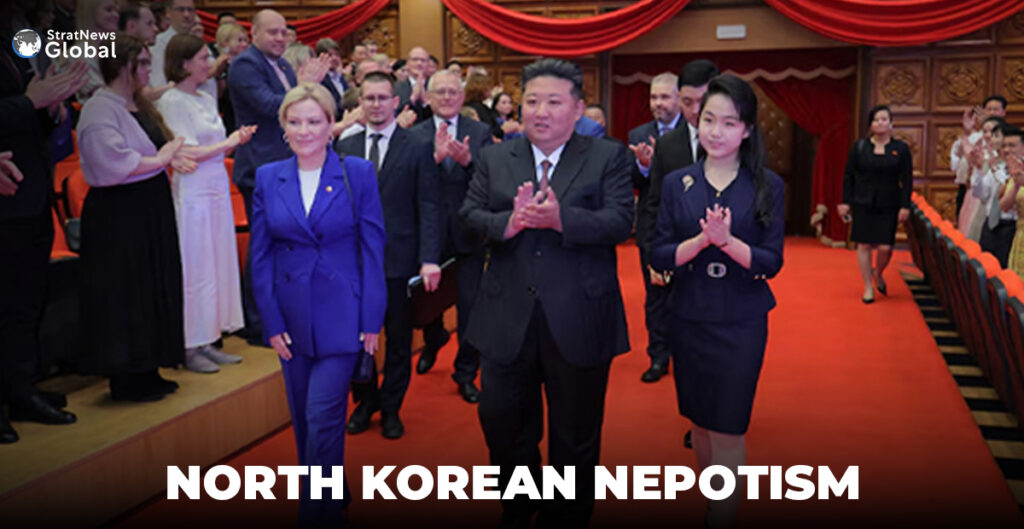
North Korean leader Kim Jong Un seems to have further cemented the status of his daughter, Kim Ju Ae, as his probable successor after she joined him during a visit to China, South Korean lawmakers stated on Thursday, quoting information provided by the nation’s intelligence agency.
Ju Ae stayed at the North Korean embassy and avoided the public spotlight during the Beijing visit, but just being on the overseas trip with her father was “enough to build a narrative” as the regime’s likely successor, said Lee Seong-kweun, a lawmaker on South Korea’s parliamentary intelligence committee.
“It was suggested that Kim Ju Ae’s status was solidified as a likely successor by showing her occasionally, while enabling her to build overseas experience but not to appear at public events,” said Park Sun-won, another lawmaker on the committee.
Also, North Korean officials were spotted wiping out traces in order not to expose the biological information of Kim and his daughter during the China trip. This included using a special plane to transport garbage and the pair staying at the North Korean embassy, South Korea’s spy agency told the lawmakers.
Earlier this month, Kim made an unprecedented trip to Beijing for a large-scale multilateral gathering, watching a military parade standing shoulder-to-shoulder with Chinese President Xi Jinping and Russian President Vladimir Putin.
Kim also held bilateral meetings with Xi and Putin on the sidelines in a bid to portray an image that North Korea was no longer an isolated country and was trying to restore relations with China, the South Korean lawmakers said.
The South Korean intelligence agency believed that economic ties between Beijing and Pyongyang would inevitably expand following the meeting between Xi and Kim, most likely through unofficial trade, according to the lawmakers.
Kim Ju Ae
Kim Ju Ae, the North Korean leader’s daughter, has emerged as a significant figure in the country’s tightly controlled political landscape.
Although details about her remain scarce due to Pyongyang’s secrecy, she has increasingly appeared in public alongside her father, fueling speculation that she is being groomed as his successor.
Believed to have been born around 2013, Kim Ju Ae is the second child of Kim Jong Un and his wife, Ri Sol Ju.
Her existence was first publicly acknowledged in 2013 when former U.S. basketball star Dennis Rodman visited North Korea and revealed meeting her.
However, she only came into the public eye in November 2022, when state media published images of her attending a missile launch with her father.
Since then, Kim Ju Ae has been a regular presence at high-profile events, including military parades and weapons inspections, often portrayed in state media as a central figure near her father.
(With inputs from Reuters)
US Sues Uber For Discrimination Against Disabled Riders
The US government on Thursday filed a lawsuit against Uber Technologies, alleging that the ride-hailing giant violated federal law by discriminating against passengers with disabilities.
In a complaint filed in San Francisco federal court, the US Department of Justice said Uber drivers routinely refuse to serve riders with disabilities, including people who travel with service animals or stowable wheelchairs.
The department also said Uber and its drivers illegally charge cleaning fees for service animals, and cancellation fees to riders who are denied service.
Some drivers also allegedly insult and demean people with disabilities, or refuse reasonable requests such as letting mobility-impaired passengers sit in the front seat.
“Uber’s discriminatory conduct has caused significant economic, emotional, and physical harm to individuals with disabilities,” and violates the Americans with Disabilities Act, the Justice Department said.
Uber Disagrees
Uber said in a statement that it disagreed with all of the allegations, and was committed to expanding access and improving the experience of riders with disabilities.
Uber also said riders who use guide dogs or require other assistance “deserve a safe, respectful, and welcoming experience on Uber -full stop. We have a clear zero-tolerance policy for confirmed service denials.”
Injunction, Fine Sought
The complaint describes Uber’s alleged mistreatment of 17 individuals.
They include J.E., a 7-year-old amputee from the Bronx, New York, who was allegedly denied a ride home from his brother’s birthday party in Pelham Bay Park after an Uber driver looked at his wheelchair and asked, “Is that coming?”
Another passenger, Jason Ludwig, a Gulf War veteran with a service dog, was reportedly refused a ride to the Norfolk airport from Newport News. As a result, he missed his flight and had to drive 16 hours home to Yarmouth Port, Massachusetts, with his wife.
A third rider, Jeff Clark of Mount Laurel, New Jersey, allegedly had four drivers in Philadelphia cancel rides in a 17-minute period after he told them he was blind and used a guide dog.
The lawsuit seeks an injunction barring further ADA violations. It also seeks upgrades to Uber’s practices and training, monetary damages and a civil fine.
A Justice Department spokesman had no immediate additional comment.
Uber shares were up 0.7% in late afternoon trading.
The case is US v. Uber Technologies Inc, US District Court, Northern District of California, No. 25-07731.
(With inputs from Reuters)
Trump Offers Detained Korean Workers To Stay In US, But Only One Accepts
U.S. President Donald Trump offered hundreds of South Korean workers detained in an immigration raid the option to remain in the United States, but South Korean officials said on Thursday that only one chose to stay.
Trump’s overture sought to encourage the workers to stay and train Americans, according to the officials. It resulted in a one-day delay to the departure of a chartered plane to bring the workers home.
The plane is now scheduled to leave the U.S. later in the day. TV footage showed the workers boarding buses outside the barbed-wire clad fences of a detention centre at around 2 a.m. on Thursday to go to Atlanta airport.
Unlike other U.S. deportations, they were not handcuffed – satisfying a key demand from South Korea, which has been horrified by the raid, particularly by the use of armoured vehicles and shackles.
Over 300 Detained
Some 300 South Koreans were arrested last week, along with more than 150 others at the Georgia construction site of a $4.3 billion Hyundai Motor and LG Energy Solution project to build batteries for electric cars.
While the raid has been trumpeted by U.S. immigration authorities, it has threatened to destabilise ties at a time when both countries are seeking to finalise a trade deal, and to scare off South Korean investment in the United States, which Trump has been so keen to secure.
“Our businesses that have entered the United States are likely in a state of serious confusion,” President Lee Jae Myung told a news conference on Thursday to mark his first 100 days in office.
Lawmakers in Seoul have acknowledged that there may have been some overstepping of the boundaries of a 90-day visa waiver programme or a B-1 temporary business visa.
But South Korean companies have also complained for years that they have struggled to obtain short-term work visas for specialists needed at their high-tech U.S. plants, and had come to rely on a grey zone of looser interpretation of visa rules under previous American administrations.
New Visa Category
In the wake of the raid, Washington and Seoul have agreed to discuss establishing a new visa category for Koreans, South Korean Foreign Minister Cho Hyun has said.
But current difficulties about sending staff to the U.S. could affect direct investment. “Our businesses that are investing in the United States will no doubt be very hesitant,” Lee said.
Seoul has also asked that the detained workers not be disadvantaged should they seek to re-enter the United States again.
The White House, the U.S. Department of State, and the Department of Homeland Security did not immediately respond to requests for comment.
While the broader impact on South Korean investment in the U.S. has yet to become fully clear, some South Korean workers are decamping in droves from more of LG Energy Solution’s U.S. production sites because of visa concerns, people familiar with the situation said.
LG Energy Solution has also asked its subcontractors to prepare contingency plans and hire local workers, one of the people said.
Many of the detained workers are employees of subcontractors involved in the project. South Korean media also said a smaller number of Japanese and Chinese nationals had been arrested during the raid.
China’s foreign ministry said its embassy in the United States was working to gain a detailed understanding of the situation and provide necessary assistance to its citizens.
“We urge the U.S. to enforce laws impartially and to ensure the legitimate rights and interests of the involved Chinese citizens,” it said in a statement to Reuters.
Japan has said three of its nationals were affected by the raid, and it will take appropriate steps to protect them.
(With inputs from Reuters)