

Support us by contributing to StratNewsGlobal on the following UPI ID
ultramodern@hdfcbank

Strategic affairs is our game, South Asia and beyond our playground. Put together by an experienced team led by Nitin A. Gokhale. Our focus is on strategic affairs, foreign policy and international relations, with higher quality reportage, analysis and commentary with new tie-ups across the South Asian region.
You can support our endeavours. Visit us at www.stratnewsglobal.com and follow us on YouTube, Twitter, Facebook and Instagram.
र 500 per month
र 1000 per month
र 5000 per year
र 10000 per year
Donate an amount of your choice
र 500 per month
Donate र 500 per month

र 1000 per month
Donate र 1000 per month
र 5000 per year
Donate र 5,000 per year
र 10000 per year
Donate र 10,000 per year
Donate an amount of your choice
Donate an amount of your choice
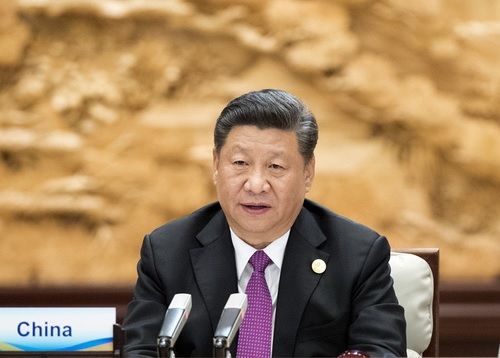
Chinese Footprints In South Asia: The Debt Trap Strategy
Common sense tells us that while China’s Belt & Road Initiative (BRI) has great potential for trade, business and investment and could be a lifeline for South Asian states hungry for no-strings-attached funding, there are other implications. The pushback against BRI in parts of Southeast Asia and Africa along with the demand that BRI agreements be re-negotiated, suggests resentment over terms weighted heavily in Beijing’s favour.
Estimated to cost around $1 trillion of which about $200 billion has been spent since it was launched in 2013, the BRI primarily comprises infrastructure projects with Beijing forking up the money through grants and loans. A common complaint heard is that funding tends to go for projects where Beijing has a particular interest, rates of interest are on the higher side, Chinese suppliers are preferred as is Chinese labour.
M.V. Rappai, who studies and analyses Asian strategic and security issues at the Institute of Chinese Studies in Delhi, says that “China is essentially driven by the mercantilist instinct, seeking to maximise gains through trade and investment for which every instrument of national power is harnessed. This is visible in their strategy for South Asia where Chinese money and business is driving political influence”.
Myanmar
A case in point is Myanmar. Late in the old year, there were media reports of plans for a railway line linking up Kunming in southern China with three ports in Myanmar—Muse, Mandalay, Kyaukphyu. The ports will give China access to the Bay of Bengal but the larger question is viability: will Myanmar be saddled with a Hambantota-like project, where Sri Lanka had to hand over the port to China on a 99-year lease because it didn’t have the money to pay off the Chinese builders.
Thailand-based journalist Bertil Lintner, who has travelled and written extensively on Myanmar, warned in an article in the Asia Times earlier last year that $4 billion, of a total national debt of $10 billion, was owed to China. The article said ruling party MPs were ringing alarm bells over “sovereignty eroding debt trap”, given the 4.5 per cent interest Beijing charged on loans, believed to be the highest ever. It’s not clear if China is willing to accept repayment in kind such as in rice.
Nepal
A report in the Kathmandu Post dated October 11, 2018 listed no less than 24 BRI projects. The most ambitious being a railway line stretching nearly 300 km from Kyirong in Tibet (on the border with Nepal), to Kathmandu, Pokhara and the Buddhist holy city of Lumbini. The project will cost around $8 billion, which is close to one-third of Nepal’s GDP and while loans from China may not be an issue, its viability is in serious doubt.
Bangladesh
BRI projects were estimated at around $10 billion, according to an analysis in the Interpreter (May 30, 2019) published by Australia’s respected Lowy Institute. These include a 6.5 km road-rail bridge over the Padma River which will establish connectivity between the eastern and western halves of Bangladesh, an industrial park in the port city of Chittagong, a road tunnel in the south-east and a deep-sea port in Payra in southern Bangladesh on the Bay of Bengal.
Sri Lanka
The Chinese have leased Hambantota deep-sea port for 99 years because Colombo cannot pay the reported $1.12 billion spent on building it. But the Sri Lankan navy will handle all security issues thereby meeting a key concern of India. China is also investing in the massive Colombo Port City Project, seen as that country’s desire to emerge as a commercial and services hub between Dubai and Singapore.
The Sri Lankan finance ministry says the debt to China is not unsustainable and the country is not caught in a debt trap. Nevertheless, the public outcry against the acquisition of land for Chinese companies may compel the new government of Gotabaya Rajapaksa to go slow on Chinese help. But as the president underscored, other countries must step in to fill the gap since his country needs money to build infrastructure.
Pakistan
The most often cited case of a country deep in hock to the Chinese due in part to the China Pakistan Economic Corridor (CPEC). But that doesn’t appear to have discouraged Islamabad, witness Foreign Minister Shah Mahmood Qureshi declaring late last year that the $62 billion CPEC was “top priority”. The project is now apparently moving into its “second phase”, with the focus on industrialization, agriculture and the creation of special economic zones.
The reputed Dawn newspaper carried an extensive report on CPEC in June 2017, including its now unfolding second phase. The report titled ‘CPEC Master Plan Revealed’ began with words that can only be described as grim and pregnant with meaning: “The floodgates are about to open”, it said and went on to note, “The plan lays out in detail what Chinese intentions are in Pakistan for the next decade and a half, details that have not been discussed in public so far.”
These range from a nationwide surveillance network to the penetration of most sectors of the Pakistan economy by Chinese enterprises and culture. Whether Prime Minister Imran Khan can block the Chinese is not clear given his government’s other problems with the Financial Action Task Force pressing him on curbing funding to terror groups, the IMF’s own demands and his inability to deliver on governance.
The overall picture this presents is of China using its fat pocketbook to distribute money liberally in a region hungry for development and hungrier for “no-strings-attached” funding. It underscores the point made earlier, of China building political influence through trade, business and investment. There’s nothing wrong with that except it pinches India which is accustomed to not being challenged in the region (Pakistan is the exception in that respect).
The concern in Delhi’s South Block is that China is using its economic clout to contain and gradually undermine India’s influence in its backyard, get access to the Indian Ocean through which its energy supplies transit and expand its naval presence to ensure their security. This is exactly how it seems to be playing out.
China today has access to three deep-sea ports in the Indian Ocean: Gwadar in Pakistan, Hambantota in Sri Lanka and in Djibouti on the Horn of Africa. Reports suggest Beijing could have two more ports at its disposal in the years ahead, in Madagascar and Tanzania, both in Africa.
Not directly related here but helpful to China’s Indian Ocean strategy are more recent reports of Beijing obtaining a 30-year lease on a Cambodian port in the Gulf of Thailand. Cambodian has apparently allowed China permission to station troops in the Siem Reap naval base and an airfield long enough to accommodate military aircraft is being hacked out through the Cambodian jungle.
Cambodia, which is deeply in debt to China, is the first country in Southeast Asia to allow Chinese troops on its territory. It strengthens Beijing’s hold over disputed waters in the South China Sea and could be the beginning of a new period of unprecedented Chinese hegemony over the region. As Charles Edel, a former U.S. State Department official now at the University of Sydney in Australia, warned: “You have all of a sudden mainland Southeast Asia potentially sitting behind a defensive Chinese military perimeter. This is by far the biggest implication and one that would likely have political effects.”
Not that India is sitting on its haunches; the pushback has been evident for some time with Indonesia giving India port facilities on Sabang in the province of Aceh. It is 700 km southeast of India’s Andaman Islands and 500 km from the Malacca Straits, seen as a choke point since 80 per cent of China’s energy supplies have to negotiate the straits to reach home ports.
India and France have tied up in a “three-pronged” security partnership that will include joint surveillance and joint patrols beginning in 2020. France has four island territories in the Indian Ocean including Reunion and Mayotte and China’s rising naval profile is worrying Paris. Add to that the Quad (Australia, India, Japan, USA). Prime Minister Modi’s recent Indian Ocean Initiative, which is still being fleshed out, will be another instrument in India’s plans to secure the Indian Ocean.
But this is not so much about India as about China and the purpose behind the dragon’s manoeuvres in our neighbourhood. We will bring you a detailed country by country analysis of China’s strategy in South Asia.
Afghan Polls, Peace: Looking For A Road To Even The Highest Mountain
There is a path to the top of even the highest mountain, says a Dari proverb. In Afghanistan, though, the road to the top of that mountain is never over till it’s finally over. The Independent Election Commission (IEC) has declared the preliminary results of the September 29 Presidential vote. President Ashraf Ghani has got over the needed 50 per cent and one vote needed to retain power for a second term. But these are preliminary results and if he or his Chief Executive Dr Abdullah Abdullah doesn’t win at least that number when the final results are declared, the process is to have a run-off between the top two. When will the final results be announced? The Independent Election Complaints Commission (IECC) now steps in. All candidates have three days to register their objections. Chairperson Zuhra Shinwari says addressing all complaints will take between 37 and 39 working days after that. So, no final result before February 2020. And if no one crosses the needed magic mark, a run-off is needed, which because of winter, logistics and finances is impossible to hold before the snow melts in Spring 2020. There’s of course American arm-twisting that can happen like it did with the same two top contenders being forced to form a National Unity Government (NUG) in 2014. But both have refused to follow that path this time.
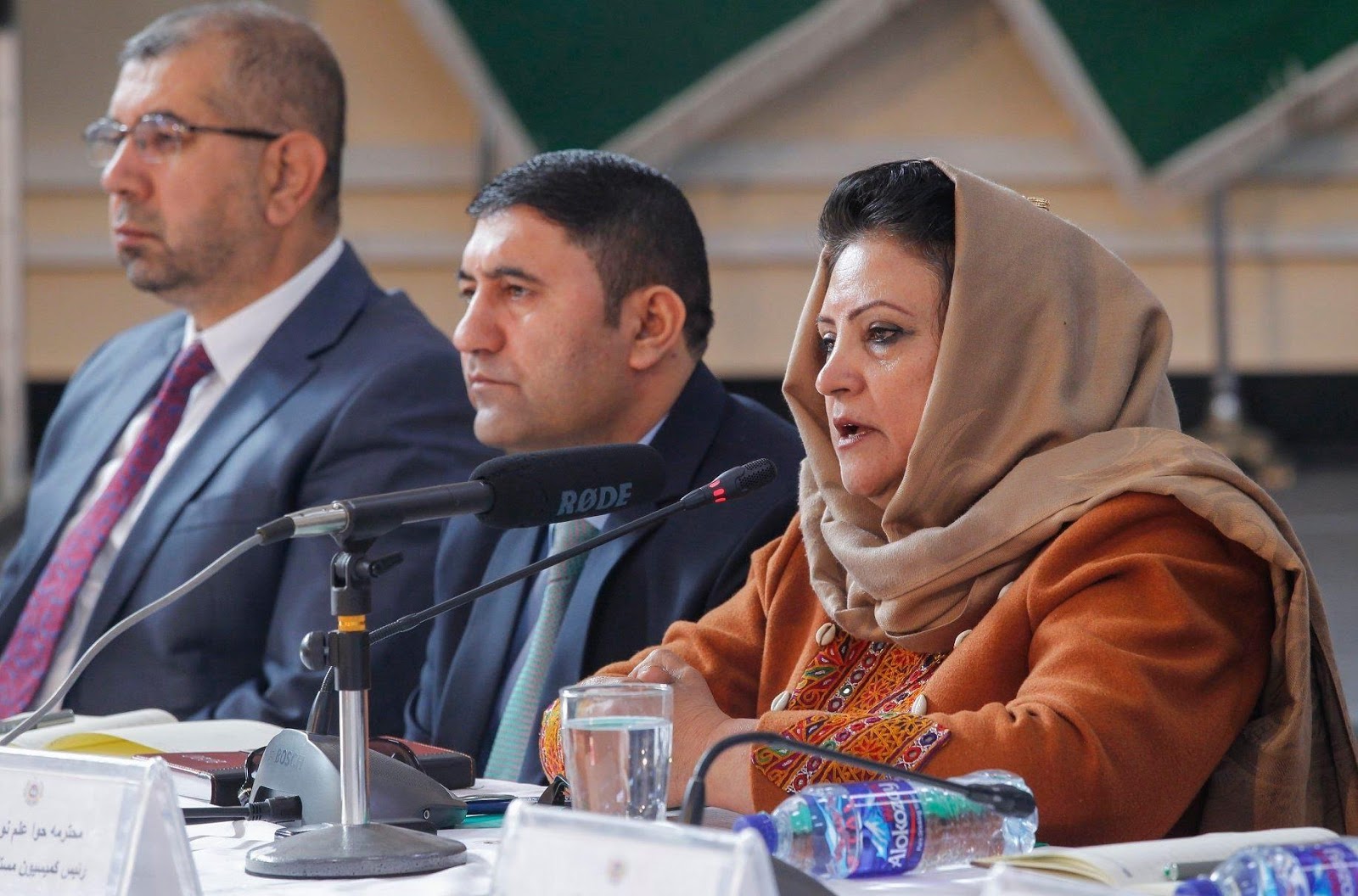
Hawa Alam Nuristani, the Chairperson of the IEC, announced the initial results nearly three months after the polls and more than two months after the commission’s October 19 timeline to declare them. The timeline also had November 23 as the probable date for any second round if needed. Now that timeline moves to Spring unless President Ghani or Dr Abdullah gets the required final numbers. The IEC says the President won 923,868 or 50.64 per cent of the valid vote followed by Dr Abdullah with 720,990 or 39.52 per cent of the vote. Turnout was the lowest since the Taliban were ousted in 2001, with just 1.82 million valid votes counted. Afghanistan’s total population is about 37 million, with 9.6 million of them registered voters. Nearly one million votes were excluded due to irregularities. So, in the end, a President could win with a single digit percentage of the total possible voters.
Abdullah Abdullah’s team immediately rejected the initial result announcement. “We would like to make it clear once again… that our team will not accept the result of this fraudulent vote unless our legitimate demands are addressed.”
He has been questioning the validity of around 300,000 ballots and demands their rejection. The Chief Executive has also accused the IEC of trying to rig the election outcome in favour of the incumbent, a charge Chairperson Nuristani has repeatedly rejected. After all the previous fraud-marred and controversial elections, the IEC for the first time used biometric machines to weed out people from voting more than once. But, it had to still reject nearly one million of the initial 2.7 million votes polled.
The highest mountain seems still a way off till this result is decided and accepted. Protests have been taking place by both Dr Abdullah supporters and some of the other Presidential candidates’ parties. Whether that will further fracture the country along ethnic lines depends on how the leaders and their teams now react.
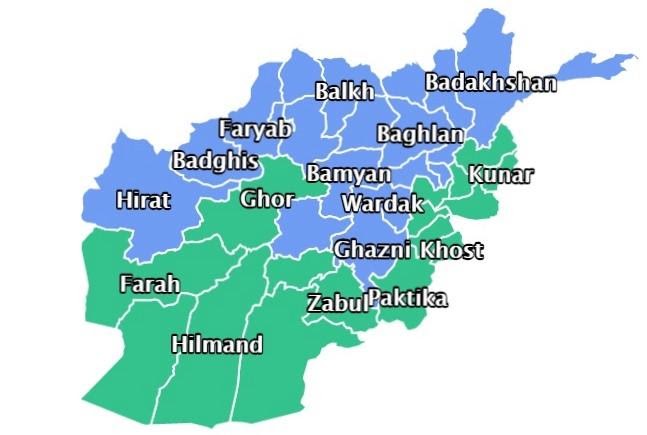
President Ghani won majorities in the ethnically dominant Pashtun South and East, while Dr Abdullah has majorities in central, western and northern areas dominated by other ethnic groups including Tajiks, Uzbeks and Hazaras among others, according to a map released by the IEC.
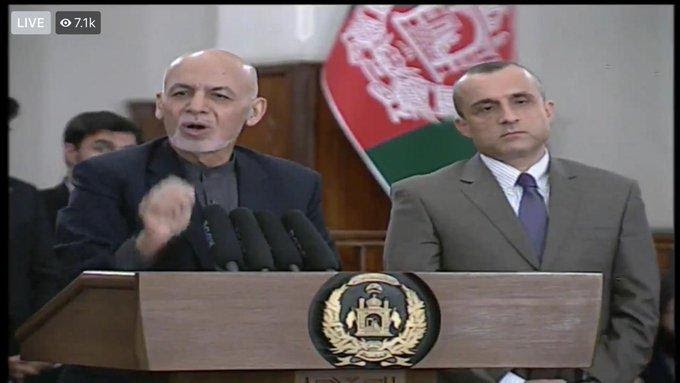
Flanked by his running mates and supporters, President Ghani in a nationally televised address said they are “celebrating the country’s victory… a victory for the Republic and a clear rejection of those pushing alternative formulas”. “Our embrace is wide open, our patience like the Hindukush… We are moving towards trust and national unity,” he said.
That remains to be seen. The U.S. reacted cautiously. Ambassador John Bass tweeted: “It’s important for all Afghans to remember: these results are preliminary. Many steps remain before final election results are certified, to ensure the Afghan people have confidence in the results.”
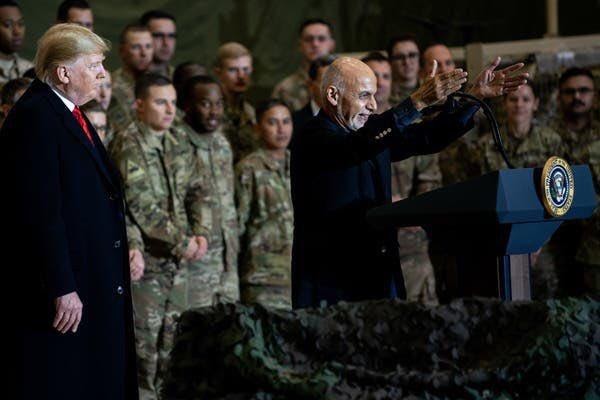
Many steps also remain before an agreement with the Taliban is reached. U.S. talks officially resumed in December almost two months from the day President Donald Trump tweeted they were dead. The U.S. President resuscitated talks in his first visit in office to the country to Bagram Air Force Base on Thanksgiving when he also met President Ghani. The Taliban has repeatedly insisted America has to first reach a deal with them on withdrawal of foreign troops and counter-terrorism guarantees. Taliban statements say only after that intra-Afghan talks (with among others the Kabul government) can begin as well as negotiations for a larger ceasefire with Afghan forces. After a recent pause in talks, U.S. Special Representative Zalmay Khalilzad berated the Taliban saying, “They must show they are willing and able to respond to the Afghan desire for peace.” Sources suggest the Taliban could announce a short-term ceasefire after a troop withdrawal and reduction of violence agreement is signed between them and the U.S. soon.
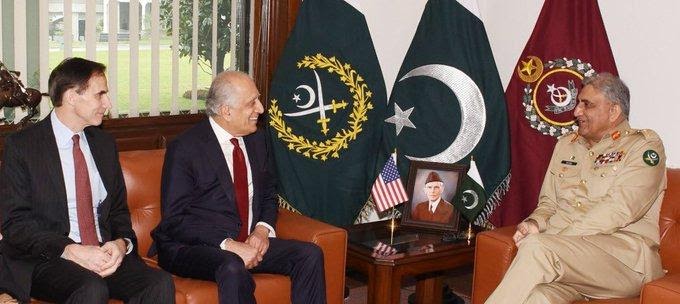
Ambassador Khalilzad also had meetings with Pakistan’s Foreign Minister Shah Mahmood Qureshi and Army Chief General Qamar Bajwa on December 13 and “Welcomed Pakistan’s help to facilitate a reduction of violence & ceasefire in Afghanistan so we can pivot to intra-Afghan negotiations.” More than 150,000 people are estimated to have been killed in the last 18 years of war. So, that again is a high mountain to climb though the search for a path to the top continues.
Trump, Taliban, Talks, Troops, Thanksgiving
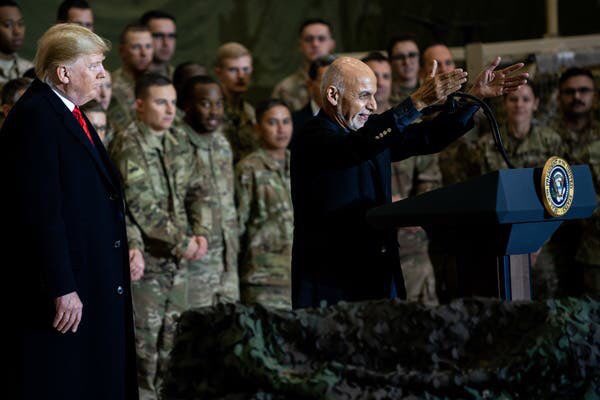
NEW DELHI: It wasn’t a tweet but a trip that rekindles talks with the Taliban. U.S. President Donald Trump, on his first visit to Afghanistan-where America is fighting and many say losing its longest war ever-has announced peace talks with the Taliban, that he called off, have restarted. In an unannounced trip, President Trump flew in for a surprise Thanksgiving visit to troops at Bagram Air Force Base and met President Ashraf Ghani. The U.S. President, who called off a Taliban deal at the last minute in September, told troops that “the Taliban wants to make a deal. We’ll see if they want to make a deal. It’s got to be a real deal, but we’ll see. But they want to make a deal.”
President Ghani issued an early morning statement saying, “In our bilateral meeting, we discussed the important progress we have jointly made in our military efforts in the battlefield, including crushing the Daesh in eastern Afghanistan. President Trump appreciated the tireless efforts of the Afghan security forces in this fight. Both sides underscored that if the Taliban are sincere in their commitment to reaching a peace deal, they must accept a ceasefire. We also emphasized that for any peace to last, terrorist safe havens outside Afghanistan must be dismantled. After our meeting, President Trump and I joined the U.S. troops and delivered our Thanksgiving greetings. We thanked them and their Afghan counterparts for their continued efforts and sacrifices in combating terrorism.”
The war in Afghanistan is the longest in U.S. history, killing 147,000 people since 2001, including 40,000 civilians, 60,000 Afghan security forces and 3,500 coalition troops- about 2,400 of them Americans, according to a study by Brown University.
A ceasefire or an agreement on a reduction of violence is crucial to restarting talks. As is how the Afghan government and other sections of society can start talks with the Taliban. A meeting is planned in China. The Taliban meanwhile have been talking in Iran and Qatar. The head of the political office, founding deputy, Mullah Baradar met Iran’s Foreign Minister Javad Zarif in Tehran on November 26. The Vice President of the Taliban’s Qatar office Abbas Stanekzai has also met the EU’s Special Representative Roland Kobia and Germany’s Special Representative Markus Potzel in Doha as the process to kick-start the stalled talks gathers momentum.
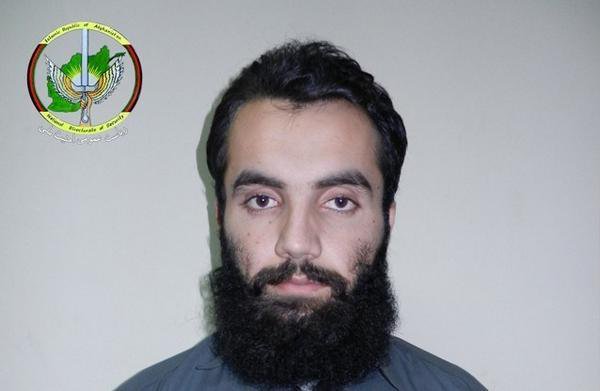
All this activity follows the swap of two western academics held hostage by the Taliban since 2016 for three imprisoned senior Taliban members-including Anas Haqqani, the brother of the deputy head of the Taliban and military commander Sirajuddin Haqqani.
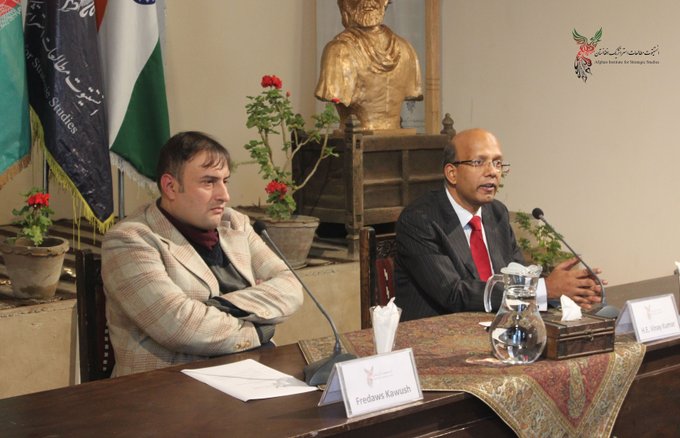
Coincidentally, New Delhi’s Ambassador in Afghanistan Vinay Kumar spoke about the Indian perspective on the Afghan Peace Process hours before the visit by the U.S. President. At an event organised by the Afghan Institute for Strategic Studies he is quoted on the AISS twitter handle as having said, “India has a serious dialogue with the U.S. regarding peace in Afghanistan and that India supports these efforts.” Adding, “India supports an inclusive peace process in which Afghans have full control, leadership & ownership.’ He was further quoted as saying, “India advocates and works for cessation of terrorism and termination of terror infrastructure in Afghanistan.”
If all these developments weren’t enough for a few hours, the Chief Executive Abdullah Abdullah’s team called for non-violent country-wide protests. They want the Independent Election Commission to invalidate what they say are 300,000 fraudulent votes in the Presidential elections by Saturday.
Afghans voted on September 28, but preliminary results, due for 19 October have been continuously postponed. The process could go into a second round if no candidate wins 50 % + 1 vote.