

Support us by contributing to StratNewsGlobal on the following UPI ID
ultramodern@hdfcbank

Strategic affairs is our game, South Asia and beyond our playground. Put together by an experienced team led by Nitin A. Gokhale. Our focus is on strategic affairs, foreign policy and international relations, with higher quality reportage, analysis and commentary with new tie-ups across the South Asian region.
You can support our endeavours. Visit us at www.stratnewsglobal.com and follow us on YouTube, Twitter, Facebook and Instagram.
र 500 per month
र 1000 per month
र 5000 per year
र 10000 per year
Donate an amount of your choice
र 500 per month
Donate र 500 per month

र 1000 per month
Donate र 1000 per month
र 5000 per year
Donate र 5,000 per year
र 10000 per year
Donate र 10,000 per year
Donate an amount of your choice
Donate an amount of your choice

Hungary Back In US Visa Waiver Programme
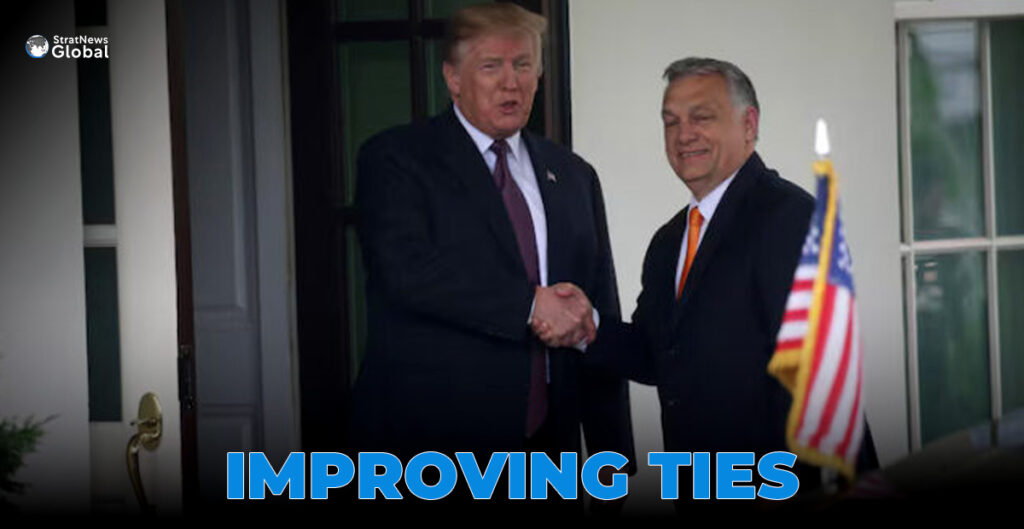
In a move signalling improved bilateral ties, the United States on Tuesday fully restored Hungary’s status in its visa waiver programme, after the Hungarian government acted to address security concerns, the Trump administration announced.
The decision is one of the first tangible signs of improved relations between the US and Hungarian governments under President Donald Trump’s administration. Hungarian Prime Minister Viktor Orban has long been a Trump ally.
The Visa Waiver Programme permits citizens from about 40 countries to travel to the United States for stays of up to 90 days without a visa.
Reversing Biden Era Rules
In 2021, the US Homeland Security Department revoked already-issued electronic approvals of all Hungarian passport holders born outside of Hungary and continued to deny new applications to Hungarian applicants born outside of Hungary.
In August 2023, the Biden Administration reduced the validity period for Hungarian travelers from two years to one year, while also limiting electronic approvals to a single use.
“Now that the government of Hungary has taken action requested by the US government to address security vulnerabilities, the restrictions imposed by the previous administration have been lifted,” DHS said on Tuesday.
Looking For A Wide-Ranging Economic Agreement
While Orban and Trump have established a strong personal rapport, relations between the two countries are not without their frictions.
Orban, whose country is a European Union member, had hoped for a wide-ranging economic agreement to be signed with the Trump administration, but it has not yet materialized.
The US and the EU struck a framework trade agreement on July 27 that imposed a 15% import tariff on most EU goods, averting a bigger trade war. However, the deal hurts Hungary because of its auto exports, which had previously incurred a tariff of just 2.5%.
Hungary also remains heavily reliant on Russian gas and crude supplies, while Trump is pressuring the EU to speed up its efforts to end all energy imports from Russia.
At the same time, the Orban government’s anti-immigration policies have earned admiration in MAGA circles in the United States. Orban also welcomed Trump’s decision earlier this year to shut down USAID, the main US foreign aid agency.
(With inputs from Reuters)
US Launches Major Maritime Mission To Challenge China’s Global Port Influence
U.S. President Donald Trump’s administration is pursuing a mission to diminish China’s global port network and place more strategic terminals under Western control, according to three sources familiar with the plan.
The drive is part of the most ambitious effort to expand U.S. maritime influence since the 1970s and is designed to address growing fears in Washington that it would be at a disadvantage to China in the event of a conflict.
Trump administration officials believe the U.S. commercial shipping fleet is ill-equipped to provide logistical support for the military in time of war, and Washington’s dependence on foreign ships and ports is excessive, the people said.
Options the White House is considering include supporting private U.S. or Western firms to buy Chinese stakes in ports, the three people said. They did not mention any specific firms other than to cite BlackRock’s proposed deal to buy the port assets of Hong Kong’s CK Hutchison in 23 countries, including the Panama Canal, as a good example.
The sources asked not to be named because they are not authorised to discuss the matter publicly.
The White House and U.S. Treasury did not respond to requests for comment.
Besides Panama, U.S. officials and lawmakers are concerned about Chinese maritime infrastructure holdings in places including Greece and Spain, the Caribbean, and U.S. West Coast ports, according to the sources.
China conducts normal co-operation with other countries within the framework of international law, a spokesperson with China’s diplomatic mission in Washington said.
“China has always been firmly opposed to illegal and unjustifiable unilateral sanctions and so-called long-arm jurisdiction and moves that infringe on and undermine other countries’ legitimate rights and interests through economic coercion, hegemonism and bullying,” the spokesperson said.
Officials in Beijing did not respond to a request for comment.
“The U.S. government sees Chinese investments in global ports as a huge threat to its national security,” said Stuart Poole-Robb, founder of risk and intelligence advisers KCS Group.
“The concern is that China could leverage its control over these assets for espionage, military advantage, or to disrupt supply chains during geopolitical crises,” he said, citing conversations with U.S. security counterparts.
Greek Port In Focus
The U.S. intends to look at Chinese interests in the Greek port of Piraeus, the three sources said. Situated in Athens, in the eastern Mediterranean, Piraeus is a pivotal hub on the trade route linking Europe, Africa and Asia.
COSCO, one of China’s biggest port and shipping groups, holds a 67% stake in the Piraeus Port Authority company.
Some Chinese investors are concerned Washington may want to target COSCO’s operations in Greece, a source close to Chinese investors involved in Greek shipping said.
COSCO and the Greek government did not respond to requests for comment. Greek officials have told Reuters previously that they have not been informed about any plans to change control of Piraeus.
Washington already has COSCO in its sights.
The Department of Defence added state-owned COSCO to its blacklist of companies with links to the Chinese military in January.
While the designation does not involve immediate bans on U.S. companies doing business with those listed, it can act as a signal that further action is being considered.
“The United States intends to attack China’s international influence by exaggerating the ‘China threat theory’ and use this as an excuse to force allies to take sides in supply chain arrangements,” the Development Research Centre of the State Council, an official think-tank of China’s governing cabinet, said in a paper published last month.
The U.S. administration has unveiled measures to increase America’s thin commercial maritime presence around the world, including by encouraging domestic shipbuilding, is looking to expand access to U.S.-controlled shipping registries, and is also reviewing global maritime chokepoints for shipping risks.
China owns or leases an extensive network of ports through companies, including COSCO and other state-controlled enterprises such as China Merchants and SIPG in Shanghai.
According to a report published last year by the Council of Foreign Relations, a U.S. think-tank, China had investments in 129 port projects worldwide through various companies as of August 2024.
China’s shipbuilding industry is also estimated to be 230 times larger than U.S. shipyard capacity, meaning it could take decades to catch up, according to U.S. Navy estimates.
The U.S. maritime push has contributed to tensions with Beijing, which sees port and shipping assets as integral to its Belt and Road initiative, at a time when the two superpowers are already at loggerheads over trade and tariffs.
(With inputs from Reuters)
India, US Hold ‘Positive And Forward-Looking’ Trade Talks Amid Tariff Row
Talks between India and the United States on a bilateral trade pact — the first since Donald Trump imposed 50% tariffs — were described as “positive” by both governments.
“Assistant U.S. Trade Representative Brendan Lynch held a constructive meeting in New Delhi with his counterpart, Ministry of Commerce and Industry Special Secretary Rajesh Agrawal, on September 16 to discuss the way forward on bilateral trade negotiations,” a U.S. Embassy spokesperson said following Tuesday’s discussions.
India, US Pledge Progress
The Ministry of Commerce and Industry issued a similar statement, noting that both nations had resolved to intensify their work toward securing a trade deal.
“Recognising the enduring significance of U.S.-India trade ties, the dialogue was positive and forward-looking, addressing multiple aspects of the prospective deal. Both sides agreed to accelerate efforts aimed at achieving an early, mutually beneficial agreement,” the ministry said.
Lynch and his team arrived in India late Monday for the talks, which sources in the Indian government described not as the formal sixth round of trade negotiations but rather a “precursor” to them.
Relations between Washington and New Delhi had deteriorated sharply after a 25% penalty on India’s purchase of Russian oil was announced on July 30, in addition to the 25% tariffs, and implemented on August 27.
India, which has labelled the tariffs as unjustified, expressed confusion over the rationale, pointing out that China remains the largest buyer of Russian crude and the European Union continues to import the highest share of Russian LNG.
Critical remarks by U.S. President Donald Trump, who labelled India’s economy “dead,” and by advisers such as Peter Navarro, who branded New Delhi’s oil purchases from Russia as “blood money,” had further worsened tensions.
Restoring Ties
A shift in tone emerged last week when Trump publicly stated that negotiations were progressing and voiced optimism about a successful outcome.
“I am pleased to announce that the United States of America and India are continuing discussions to address trade barriers between our two nations. I look forward to speaking soon with my very good friend, Prime Minister Modi. I am confident that reaching a mutually satisfactory conclusion will be straightforward for both of our great countries!” Trump posted on Truth Social.
Indian Prime Minister Narendra Modi echoed this sentiment on X, stressing the natural partnership between the two nations.
“India and the U.S. are close friends and natural partners. I am confident our trade discussions will unlock the immense potential of the India-U.S. partnership. Our teams are working diligently to conclude these talks swiftly. I also look forward to speaking with President Trump, as together we will ensure a brighter, more prosperous future for our peoples,” Modi wrote.
Ongoing Negotiations
Negotiations launched in February had raised expectations that the initial phase of the bilateral trade agreement could be finalised by the fall of this year.
Five rounds were already completed, but the sixth — originally planned between August 25 and 29 — was postponed.
(With inputs from IBNS)
Suspect In Charlie Kirk Killing Appears In Utah Court For First Hearing
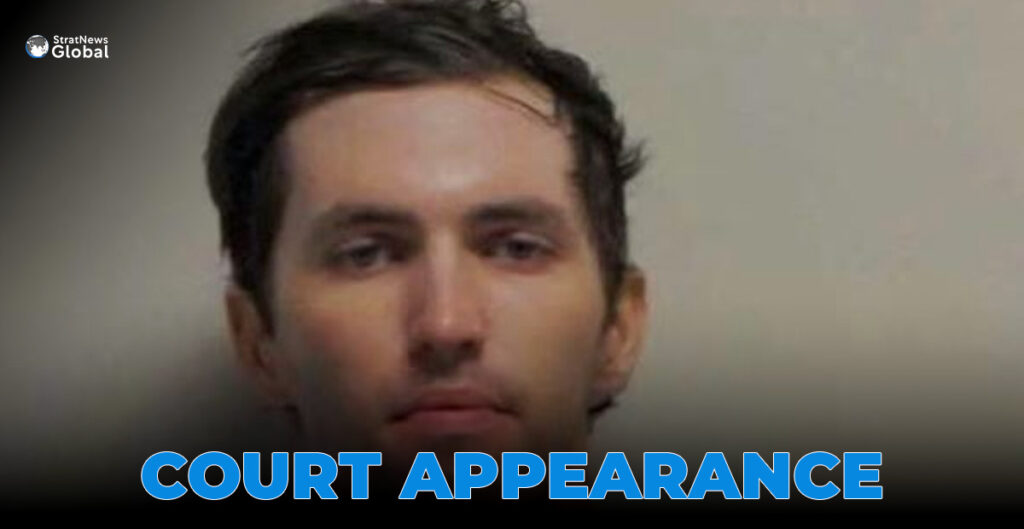
A trade school student accused of killing right-wing activist Charlie Kirk during a university event in Utah appeared in court on Tuesday via video link from jail. It was his first public appearance since the shooting, during which prosecutors formally presented the charges against him.
Tyler Robinson, 22, is accused of firing the single rifle shot from a rooftop sniper’s nest that pierced Kirk’s neck last Wednesday on the campus of Utah Valley University in Orem, about 40 miles (65 km) south of Salt Lake City.
The killing, captured in graphic video clips that went viral on the internet, sparked denunciations of political violence across the ideological spectrum but also unleashed a wave of partisan blame-casting and concerns that Kirk’s murder might beget more bloodshed.
Charlie Kirk, A ‘Martyr’?
Authorities have offered no possible motive for the killing, though Kirk’s wife and other supporters were quick to cast him as a martyr for their cause.
Charlie Kirk, co-founder and head of the conservative student movement Turning Point USA and a key ally of President Donald Trump, was speaking at an event attended by 3,000 people when he was gunned down. He died later at a hospital. He was 31.
The suspect, a third-year student of an electrical apprenticeship at a state technical college, initially escaped in the pandemonium following the shooting.
He was arrested on Thursday night at his parents’ house, some 260 miles (420 km) southwest of the crime scene, after relatives and a family friend alerted authorities that Robinson had implicated himself in the shooting, according to Governor Spencer Cox.
Robinson was booked into Utah County Jail on suspicion of aggravated murder, a felony weapons offense, and obstruction of justice, according to an affidavit filed by investigators.
Cox said the state would be inclined to seek the death penalty should Robinson be convicted, but that prosecutors would consider the wishes of Kirk’s family before making that decision.
The killing has unnerved Americans who have seen a spike in political violence in recent years, including two attempted assassinations of Trump last year and the assassination of a Democratic state lawmaker in Minnesota this summer, among many other high-profile examples.
Roughly two out of three Americans believe that harsh rhetoric common in politics is encouraging violence, according to a Reuters/Ipsos poll conducted in the days following Kirk’s murder.
First New Glimpse Of Suspect
Robinson was scheduled to appear via video feed from jail on Tuesday afternoon in Utah County Justice Court in Provo.
The Utah County district attorney planned to hold a news briefing to explain the charges a few hours before the hearing. Newly filed court documents accompanying the charges may contain additional information about evidence in the investigation.
U.S. Attorney General Pam Bondi said the Department of Justice would review the case separately to determine whether federal charges should be pursued.
“And of course, if we do, we will also indict and work hand-in-hand with the state to ensure that this horrible human being faces the maximum extent of the law,” Bondi told Fox News on Monday.
The governor said on Friday that in addition to the role played by Robinson’s own family in turning him in, investigators had linked the suspect to the crime through security camera footage and evidence gathered from his social media profile.
Plan To Kill
On Monday, FBI Director Kash Patel went further in a Fox News interview, saying investigators had uncovered a text message posted by Robinson before last Wednesday’s shooting saying he planned to kill Kirk.
Separately, the Washington Post reported on Monday that Robinson had sent a message via the online platform Discord to friends apparently confessing to the crime on Thursday night, shortly before he was arrested.
Patel said Robinson also is believed to have written a physical note saying he had the “opportunity to take out Charlie Kirk” and would do so. Although that note was destroyed, investigators have collected forensic evidence that it existed and confirmed its contents through interviews, Patel said.
Patel did not say who had received the text message or whether anyone had seen the written note before the attack.
Investigators have spoken to Robinson’s roommate, who was also a romantic partner, officials have said. Cox described the roommate as “a male transitioning to female,” and said the roommate has been “incredibly cooperative.”
Law enforcement authorities have said they believe Robinson acted alone but are looking into whether anyone else had a hand in plotting the killing or knew in advance of Robinson’s intentions.
Patel told Fox News that DNA matching the suspect’s was found on a towel that was wrapped around the bolt-action rifle believed to be the murder weapon and on a screwdriver found on the rooftop used by the shooter as a sniper perch.
(With inputs from Reuters)
‘Gaza Is Burning’: Israel Launches Massive Ground Offensive
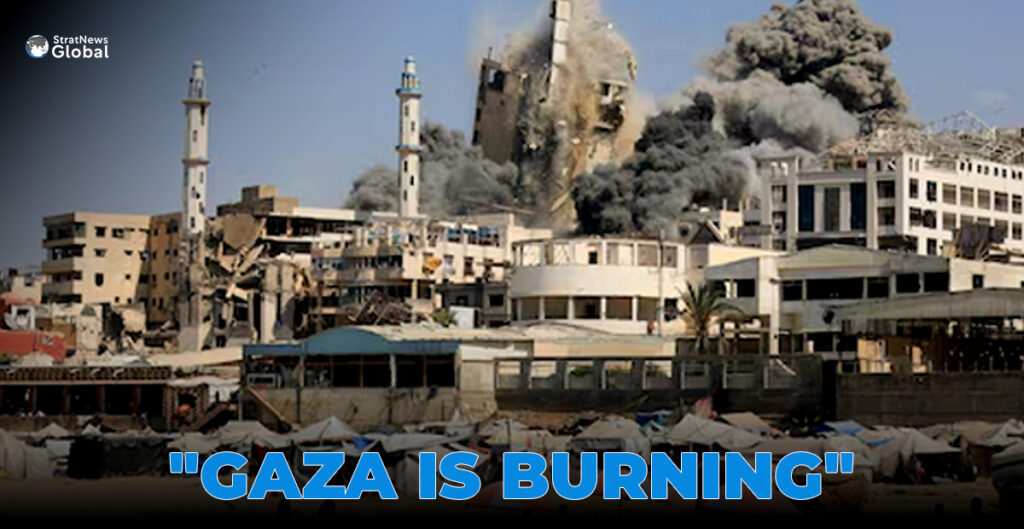
Israel on Tuesday launched a long-anticipated ground assault on Gaza City, declaring “Gaza is burning,” while Palestinians described the heaviest bombardment they have endured in two years of conflict.
An Israel Defence Forces official said ground troops were moving deeper into the enclave’s main city, and that the number of soldiers would rise in the coming days to confront up to 3,000 Hamas combatants the IDF believes are still in the city.
“Gaza is burning,” Defence Minister Israel Katz posted on X. “The IDF strikes with an iron fist at the terrorist infrastructure, and IDF soldiers are fighting bravely to create the conditions for the release of the hostages and the defeat of Hamas.”
In launching the assault, Israel’s government defied European leaders, threatening sanctions and warnings from even some of Israel’s own military commanders that it could be a costly mistake.
But Washington offered its apparent blessing, conveyed by Secretary of State Marco Rubio.
In the latest expression of international alarm, a United Nations Commission of Inquiry concluded that Israel had committed genocide in Gaza, incited by top officials, including Prime Minister Benjamin Netanyahu. Israel called the assessment “scandalous” and “fake”.
Bodies Trapped Under Rubble
Gaza health officials reported at least 40 people killed, most in Gaza City, in the assault’s early hours on Tuesday, as air strikes swept across the city and tanks advanced.
Where a missile had destroyed two multi-storey residential buildings in the middle of the night, people clambered over an immense mound of dislocated concrete to pry out victims, footage obtained by Reuters showed. A woman cried as a small child’s body was pulled from the wreckage, hastily wrapped in a green blanket and carried away.
Abu Mohammed Hamed said several of his relatives had been injured or killed, including a cousin whose body was trapped by a concrete block: “We don’t know how to take her out. We have been working on it since 3 a.m.”
Israel renewed its calls on civilians to leave, and long columns of Palestinians streamed towards the south and west in donkey carts, rickshaws, heavily laden vehicles or on foot.
“They are destroying residential towers, the pillars of the city, mosques, schools and roads,” Abu Tamer, a 70-year-old man making the gruelling journey south with his family, told Reuters in a text message.
“They are wiping out our memories.”
US Offers Support, EU Plans Sanctions
Hours before the escalation, Rubio offered U.S. backing at a press conference alongside Netanyahu. While the United States wished for a diplomatic end to the war, “we have to be prepared for the possibility that’s not going to happen”, he said.
But other longstanding allies have recoiled at what they see as disproportionate harm to civilians. In Brussels, a spokesperson for the EU executive said it would agree on Wednesday to impose new sanctions on Israel, including suspending certain trade provisions.
British Foreign Secretary Yvette Cooper called the assault “reckless and appalling” and called for an immediate ceasefire. Britain and France are expected this month to become the first major Western powers to recognise Palestinian independence.
The area of Tel Al-Hawa, in the southwest of Gaza City, was being pounded by strikes from air, ground and sea, according to witnesses reached by Reuters via text message.
They said the IDF was using robots loaded with explosives, and that powerful blasts were sending debris and shrapnel hundreds of metres from impact sites.
‘Escaping Towards Death’
Some residents were staying put, too poor to secure a tent and transport or because there was nowhere safe to go.
“It is like escaping from death towards death, so we are not leaving,” said Um Mohammad, a woman living in the suburb of Sabra, under aerial and ground fire for days.
Both Hamas and the IDF estimate around 350,000 people have fled Gaza City so far, with close to twice as many still left behind.
Much of Gaza City was laid to waste in the early weeks of the war in 2023, but around 1 million Palestinians had returned there to homes among the ruins. Forcing them out means nearly the entire population of Gaza will now be confined to encampments along the coast, further south.
The UN, aid groups and numerous foreign countries have denounced Israel’s tactics as a mass forced displacement, without adequate food, medical care, space and basic hygiene.
Three more Palestinians died of malnutrition and starvation in the past 24 hours, Gaza’s health ministry said on Tuesday, raising total hunger deaths to at least 428, most in the last two months, in what a global monitor calls a man-made famine. Israel says the extent of hunger has been exaggerated.
Some Israeli military commanders have expressed concern that the Gaza City assault could endanger remaining hostages held by Hamas or be a “death trap” for troops.
Chief of Staff Eyal Zamir, at a meeting Netanyahu convened late on Sunday with security chiefs, urged the prime minister to pursue a ceasefire deal, according to three Israeli officials, two of whom were in the meeting and one of whom was briefed on its details.
Families of hostages, who have led calls for a ceasefire, gathered outside Netanyahu’s home in Jerusalem late on Monday as news of the offensive streamed in.
“Our loved ones in Gaza are being bombarded by the IDF under the orders of the prime minister,” said Anat Angrest, whose son Matan is among the 20 hostages believed to still be alive.
Hamas attacked Israel in October 2023, killing about 1,200 people and taking 251 hostages, Israeli tallies show. Israel’s military assault against Hamas has killed over 64,000 Palestinians, Gaza’s health ministry says.
(With inputs from Reuters)
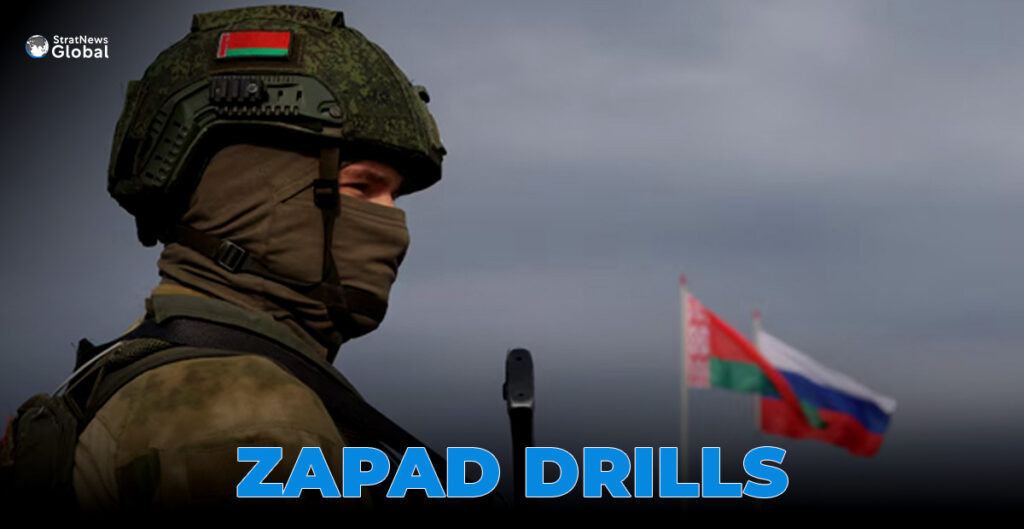
Moscow, Minsk Conduct Nuclear Weapons Launch Drill In Belarus: Lukashenko
Belarusian leader Alexander Lukashenko said on Tuesday that Russia and Belarus are conducting joint war games, including rehearsals for the launch of Russian tactical nuclear weapons.
State media quoted the Belarusian chief of staff as saying that the exercises also featured Russia’s Oreshnik hypersonic missile, which it test-fired last year in the war with Ukraine.
Zapad Military Drills
Russia and Belarus are wrapping up five days of war games, codenamed Zapad (West), in a show of force they say is designed to test their combat readiness, but which has unnerved some surrounding countries, given the ongoing war.
The war games, which Western military analysts say are designed to intimidate Europe, come just days after Polish and NATO forces say they shot down Russian drones that entered Polish airspace. Warsaw has temporarily closed its border with Belarus as a precaution.
Tactical Nuclear Weapons
Belarus, a close Russian ally which borders Ukraine and Russia, as well as NATO members Poland, Lithuania and Latvia, hosts Russian tactical nuclear weapons which Moscow retains command and control of. Minsk has been working to reopen and renovate its Soviet-era nuclear storage facilities.
Lukashenko was cited by the Belarusian state news agency Belta as saying that it was only natural that the Russian tactical nuclear weapons were part of the Zapad drills.
“We are practising everything there. They (the West) know this too; we are not hiding it. From firing conventional small arms to nuclear warheads. Again, we must be able to do all this. Otherwise, why would they be on Belarusian territory?” he was quoted as saying.
“But we are absolutely not planning to threaten anyone with this,” he added.
The Belarusian Defence Ministry confirmed in a statement that the use of tactical nuclear weapons had been rehearsed along with the deployment of Russia’s intermediate-range Oreshnik ballistic missile that Moscow fired at Ukraine for the first time on November 21 last year.
Russian President Vladimir Putin said late last year that Russia could deploy Oreshniks, which he has claimed are impossible to intercept, on the territory of Belarus in the second half of 2025.
Lukashenko, who holds regular talks with Putin, allowed Moscow to use his territory to enter Ukraine in February 2022, but has not committed his own troops to the fighting.
U.S. President Donald Trump has begun cultivating closer ties with Lukashenko, long treated as a pariah by the West, and relaxed some sanctions on Belarus last week in return for the release of 52 prisoners, including political opponents of the veteran leader.
In a sign of the warming in relations, U.S. military officers observed part of the Zapad exercise in Belarus on Monday.
What Else Do The Zapad Exercises Involve?
Russia’s Defence Ministry said on Tuesday that nuclear-capable Russian Tu-160 strategic bombers had rehearsed launching cruise missiles over the Barents Sea north of the Nordic countries.
The bombers had flown over the Barents Sea’s neutral waters for about four hours, escorted by MiG-31 fighter jets, it said.
Separately, it said Marines belonging to Russia’s Northern Fleet practised repelling an amphibious landing by an enemy force on a peninsula in Russia’s Murmansk region.
Video showed troops – backed by attack helicopters and fighter jets – using armoured personnel carriers, drones, rocket-propelled grenade launchers and automatic weapons – seeing off an imaginary enemy.
Ships from Russia’s Baltic Fleet – backed by fighter jets – test-fired cruise missiles at notional enemy ships, as did the fleet’s land-based mobile missile launchers.
In Russia’s Kaliningrad exclave, troops practised using a Torn-MDM radio reconnaissance complex to detect the location of enemy forces so that their coordinates could be passed on to drone and artillery units.
(With inputs from Reuters)
Syria, Israel Move Closer To Security Pact Amid U.S. Pressure
Syria has stepped up negotiations with Israel under U.S. pressure, aiming for a security agreement that could roll back Israel’s recent territorial gains. The proposed deal, however, would stop well short of establishing a full peace treaty, according to sources familiar with the discussions.
Washington is pushing for enough progress to be made by the time world leaders gather in New York for the U.N. General Assembly at the end of this month to allow President Donald Trump to announce a breakthrough, four of the sources said.
Even a modest agreement would be a feat, the sources said, pointing to Israel’s tough stance during months of talks and Syria’s weakened position after sectarian bloodshed in its south inflamed calls for partition.
According to sources, Syria’s proposal aims to secure the withdrawal of Israeli troops from territory seized in recent months, to reinstate a demilitarized buffer zone agreed in a 1974 truce, and to halt Israeli air strikes and ground incursions into Syria.
The sources said talks had not addressed the status of the Golan Heights, which Israel seized in a 1967 war. A Syrian source familiar with Damascus’s position said it would be left “for the future.”
The two countries have technically been at war since the creation of Israel in 1948, despite periodic armistices. Syria does not recognize the state of Israel.
After months of encroaching into the demilitarized zone, Israel abandoned the 1974 truce on December 8, the day a rebel offensive ousted Syria’s then-president Bashar al-Assad. It struck Syrian military assets and sent troops to within 20 kilometres (12 miles) of Damascus.
Israel has shown reluctance during the closed-door talks to relinquish those gains, the sources said.
“The U.S. is pressuring Syria to accelerate a security deal – this is personal for Trump,” said an Israeli security source, who said the U.S. leader wanted to present himself as the architect of a major success in Middle Eastern diplomacy.
But, the source said, “Israel is not offering much.”
A State Department official said Washington “continues to support any efforts that will bring lasting stability and peace between Israel, Syria and its neighbours.” The official did not answer questions on whether the U.S. wanted to announce a breakthrough during the General Assembly.
Trust Deficit At Talks
Israel has voiced hostility to Syria’s Islamist-led government, pointing to President Ahmed al-Sharaa’s former jihadist links, and has lobbied Washington to keep the country weak and decentralised.
But the U.S. has encouraged talks – keen to expand the countries that signed peace deals with Israel under the Abraham Accords during Trump’s first administration.
Exploratory contacts began in Abu Dhabi following Sharaa’s April visit to the Emirates, which have ties with Israel. The two sides then met in the Azerbaijani capital Baku in July.
Days later, discussions were plunged into disarray when Syrian troops deployed to the southwestern Sweida region to quell sectarian violence between Bedouin and Druze militias. Israel said the deployment violated its enforcement of a “demilitarized zone” and bombed the defence ministry in Damascus. Sharaa accused it of seeking pretexts to interfere in Syria’s south.
A U.S.-brokered ceasefire ended the violence and, a month later, bilateral negotiations resumed in Paris – marking the first time Syria publicly acknowledged holding direct talks with its longtime foe.
However, the atmosphere in the room was tense, with a lack of trust between the two sides, according to two Syrian sources and a Western diplomat.
Negotiators are following a phased process modelled on deals Israel reached with Egypt that paved the way for a landmark normalization of relations in 1980. That involved the return to Egypt of the Sinai peninsula, seized by Israel in the 1967 war.
Six sources briefed on the talks said Israel would be unwilling even in the longterm to return the Golan, which Trump unilaterally recognised as Israeli in his first term.
Instead, Israel floated a proposal to the U.S. special envoy for Syria, Thomas Barrack, that it could withdraw from southern Syria in return for Sharaa relinquishing the Golan, the Israeli official said.
“Our feelers via the Americans suggest this is a non-starter,” the official said. Netanyahu’s office, Dermer’s office and the U.S. State Department did not respond to questions on the swap proposal.
A Syrian official said that Sharaa understood that “any compromise on the Golan would mean the end of his rule” and had told Barrack the security pact must be anchored in the 1974 lines.
While Sharaa is willing to accelerate talks with Israel to please Washington, he remains wary, according to a Western intelligence officer, the Israeli official and Syrian source.
He has told Barrack that conditions are not yet ripe for a broad peace agreement. “The basic elements of trust are simply not there,” said the Syrian official.
A senior U.S. administration official reported that Trump was clear when he met Sharaa in May in Riyadh that “he expected Syria to work towards peace and normalization with Israel and its neighbours.”
“The Administration has actively supported this position since then,” the official said. “The President wants peace throughout the Middle East.”
Narrow Path For Sharaa
Realities on the ground have limited the Syrian leader’s options.
On the one hand, Israel’s incursions and support for the Druze have hardened Syrian public opinion against any deal, a factor weighing on Sharaa, officials say.
On the other, Israel’s land grabs in Syria pose a threat to Damascus, making a de-escalatory pact all the more important for Sharaa.
A Syrian military officer based near the border with Israel, who asked not to be identified, said Syrian army patrols in the south avoid confronting Israeli troops, who regularly raid villages and go door-to-door collecting household data and searching for arms.
The Israeli military said its operations had discovered “numerous weapons”, thwarted smuggling attempts and apprehended “dozens of suspects involved in advancing terrorist activity”, without providing further details.
The Israeli military was operating in southern Syria to protect Israel and its citizens, the statement said. Israel has threatened air strikes on any significant Syrian military or intelligence presence near the border without its consent.
Israel uses its new post at Mount Hermon, which it seized after Assad’s fall, to surveil the region. Defence Minister Israel Katz said last month Israel would not cede the location.
Israel’s military has imposed buffer zones in some neighbouring countries following the Oct. 7, 2023 attack on Israel by Hamas, in which some 1,200 people were killed. Israel’s nearly two-year campaign against Hamas has killed more than 64,000 people in Gaza, according to local authorities.
“As in northern Gaza and southern Lebanon, Israel is now enforcing a wider demilitarised zone in southern Syria,” Syrian security analyst Wael Alwan said.
Druze Developments Bolstered Israel
Israel’s position has been strengthened by developments in Sweida, where Syrian forces stand accused of execution-style killings of Druze civilians. Druze leaders are calling for independence and a humanitarian corridor from Golan to Sweida – a challenge to Sharaa’s vow to centralise control of Syrian territory.
Two senior Druze figures, who requested anonymity due to the sensitivity of the matter, said that since the Sweida fighting, Israel was helping unify splintered Druze factions and had delivered military supplies including guns and ammunition to them.
The two Druze commanders and a Western intelligence source said that Israel was also paying salaries for many of the roughly 3,000 Druze militia fighters.
Syrian Foreign Minister Asaad al-Shibani dismissed the possibility of a humanitarian corridor at the Paris talks, saying it would infringe on Syria’s sovereignty, according to a Syrian official familiar with the discussions.
Both sides agreed that stability in Syria’s south was key to preventing a resurgence of covert agents linked to Iran, Lebanese armed group Hezbollah or Palestinian terrorist groups – common enemies of Israel and Syria’s new leaders. Israel agreed to allow interior ministry forces to deploy checkpoints in Sweida.
“Both parties are probing areas of common ground,” said the Syrian official.
Sharaa is keen not to provoke his southern neighbour, aware of how much damage its military can inflict, one close aide said on condition of anonymity: “Avoiding confrontation is central to his plan to rebuild and govern.”
Erdem Ozan, a former Turkish diplomat and expert on Syria, said Sharaa could accelerate talks to secure economic aid and reconstruction support from investors, Gulf benefactors and Washington.
“Sharaa’s focus on economic delivery could push him toward pragmatic concessions, but he’ll need to balance this with maintaining legitimacy among his supporters,” Ozan said.
Concessions could include handing greater autonomy to regional groups, including the Kurds and Druze, Ozan said, as well as demilitarization near Syria’s borders with Israeli and Jordan.
(With inputs from Reuters)
Trump Announces TikTok Deal With US Ownership
In a potential end to a months-long saga, President Donald Trump on Tuesday said the US and China had reached a deal to keep TikTok operating in the United States, with its American assets set to be transferred from China’s ByteDance to US ownership.
A deal on the popular social media app, which counts 170 million US users, stands as a breakthrough in months-long talks between the world’s No. 1 and No. 2 economies that have sought to defuse a wide-ranging trade war that has unnerved global markets.
‘Kids Want It So Badly’
“We have a deal on TikTok … We have a group of very big companies that want to buy it,” Trump said, without providing further details.
He lauded the trade deal reached with China, calling it an upgrade for both countries, and said it would preserve tens of billions of dollars of value.
“The kids want it so badly, I have parents calling me up. They don’t want it for themselves. They want it for their kids,” Trump said.
Multiple Extensions
Any agreement could require approval by the Republican-controlled Congress, which passed a law in 2024 during the Biden Administration that required divestiture due to fears that TikTok’s US user data could be accessed by the Chinese government, allowing Beijing to spy on Americans or conduct influence operations through the app.
The Trump administration has repeatedly declined to enforce a law requiring the app to shut down due to worries it would anger users and disrupt political communications, instead extending the divestiture deadline on three separate occasions.
Trump has credited the app with helping him win re-election last year, and his personal account has 15 million followers. The White House launched an official TikTok account last month.
CNBC reported Tuesday that the deal is expected to be closed within the next 30 to 45 days, and that the agreement will include existing investors in TikTok’s China-based parent ByteDance and new investors.
Reuters has not independently verified CNBC’s report. However, the details are in line with Reuters’ reporting in April that the deal would spin off TikTok’s US operations into a new company based in the US and majority-owned and operated by US investors.
Tariffs And TikTok
A deal for TikTok had been in the works in the spring, but was put on hold after China indicated it would not approve it following Trump’s announcements of steep tariffs on Chinese goods.
Washington has maintained that TikTok’s ownership by ByteDance makes it beholden to the Chinese government and Beijing could use the app to collect data on Americans.
The company has said US officials have misstated its ties to China, arguing its content recommendation engine and user data are stored in the US on cloud servers operated by Oracle while content moderation decisions that affect American users are also made in the US.
Potential Buyers
CNBC also reported on Tuesday that Oracle will keep its cloud deal with TikTok as part of the agreement. Reuters reported earlier this year that the White House was working on a plan to tap Oracle along with a group of outside investors to take control of the app’s operations.
As part of the plan, Oracle would have been responsible for addressing national security issues, Reuters had then reported.
Shares of Oracle pared some gains on Tuesday following the news on TikTok and were last up nearly 3%.
A framework agreement was reached by officials from both countries on Monday, marking a breakthrough after months of intense talks. The White House has been involved to an unprecedented level in the closely watched deal talks.
Amid escalating trade tensions, US and China delegations discussed the divestment as part of broader disputes over tariffs and tech export control regulations.
A final confirmation on the deal is expected on Friday in a call between Trump and President Xi Jinping.
Several suitors including former Los Angeles Dodgers owner Frank McCourt, a startup run by OnlyFans founder and Amazon had expressed interest in the fast-growing business that analysts estimate could be worth as much as $50 billion.
(With inputs from Reuters)
UK: King Charles Attends Catholic Funeral, Breaks Royal Tradition
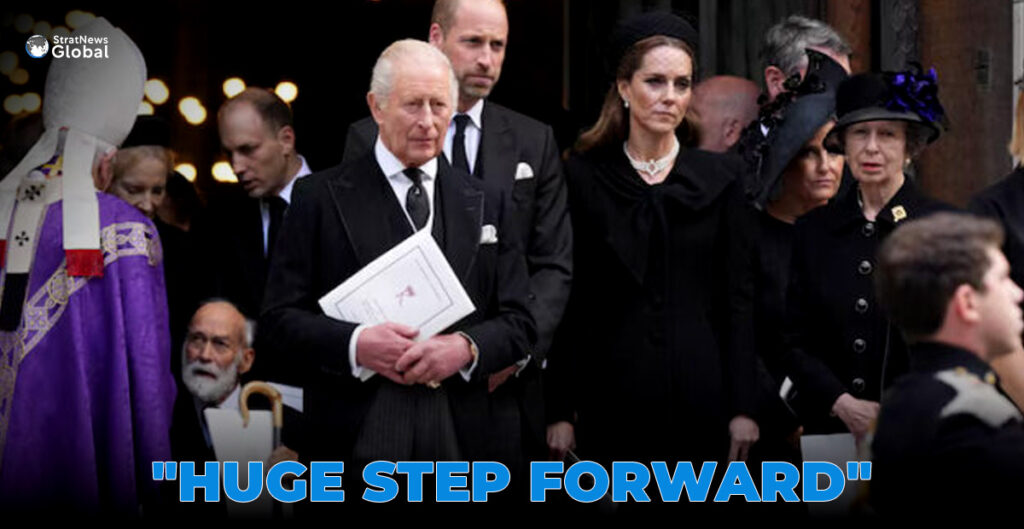
In a historic gesture, King Charles on Tuesday became the first British monarch in nearly 400 years to attend a Roman Catholic funeral, joining family members at the requiem mass for the Duchess of Kent, wife of a cousin of the late Queen Elizabeth.
The duchess, Katharine Worsley, who joined the royal family when she married Prince Edward, the Duke of Kent, in 1961, died on September 4, aged 92.
Best remembered for her close association with the Wimbledon tennis tournament, where from 1969 she helped to hand out the trophies, she was also known for converting to Roman Catholicism in 1994, becoming the first British royal to do so since King Charles II, who turned to the faith on his deathbed in 1685.
Charles Breaks With Royal Tradition
Thus, it was a break in tradition for Charles, the Supreme Governor of the Protestant Church of England, to attend the funeral for the duchess at London’s Westminster Cathedral, where the service was conducted by Cardinal Vincent Nichols, the leader of Catholics in England and Wales.
Also present were the king’s son and heir Prince William and his wife Kate, although Charles’ wife Queen Camilla had to pull out as she was recovering from acute sinusitis.
‘Huge Step Forward’
“The funeral will be of great historical significance,” Catherine Pepinster, former editor of the Catholic weekly review, The Tablet, told the Sunday Times. “This is a huge step forward in ecumenical relations.”
Following the funeral, the duchess’ coffin was to be taken to a burial ground at Frogmore on the royal estate surrounding Windsor Castle, which is preparing to host US President Donald Trump for a state visit from Wednesday.
Charles has for many years stated that he wishes to protect all faiths, and he and his wife Camilla were among the last official visitors to see Pope Francis before his death in April.
Pope Leo XIV said he was saddened to learn of the duchess’ death in a message to the king which was read out at the service.
(With inputs from Reuters)
EU Delays 19th Russia Sanctions Package Amid Trump Pressure
EU officials said on Tuesday that the European Commission will postpone unveiling its next Russia sanctions package as the bloc navigates the Trump administration’s call for a stronger role in curbing Russia’s energy revenues.
The Commission had been expected to present a 19th round of sanctions to envoys of the 27 EU member states on Wednesday, which diplomats said was likely to include Russian banks, Moscow’s sanctions-evading “shadow fleet” of oil tankers and listings to deter other countries from circumventing EU and US sanctions.
Two EU officials confirmed the delay, first reported by Politico, but did not say why the timeline had slipped. No new date has been set for the package to be presented.
Andriy Yermak, chief of staff to Ukrainian President Volodymyr Zelenskyy, pressed the EU to act swiftly.
“The 19th EU sanctions package must be adopted without delay – and all strong measures must remain intact,” he wrote on X.
Trump Pressures EU On Russian Energy Imports
The U.S. has stepped up pressure on Europe to play a more robust role in helping to end Russia’s war in Ukraine, with a peace deal seemingly elusive despite repeated threats of harsher penalties on Moscow and partners.
U.S. President Donald Trump has told the EU it should impose harsh tariffs on India and China, the biggest buyers of Russian oil, and stop importing Russian energy itself, as part of a strategy to put pressure on Russia’s war economy.
A European Commission spokesperson told reporters, “discussions are ongoing in order to have a solid (sanctions) package”.
The EU already intends to end purchases of Russian oil and gas by January 1, 2028 – a goal it says is ambitious and would ensure that EU countries do not face energy price spikes or supply shortages in the meantime.
But Washington wants the bloc to move faster.
Additional Levies
On tariffs, U.S. Treasury Secretary Scott Bessent said the Trump administration would not impose additional levies on Chinese goods to halt China’s purchases of Russian oil unless EU nations first hit China and India with punitive duties of their own.
European officials have said the bloc is highly unlikely to do so. The EU treats tariffs differently from sanctions and only imposes them after a probe to establish a legal justification within the bloc’s trade laws.
“It’s a challenging proposition (from Trump),” one EU diplomat told Reuters. “Even if his requests are deliberately excessive, it still forces us to come to terms with them in some way in order to avoid him shifting the blame onto the EU.”
Finance ministers from the Group of Seven nations discussed further Russia sanctions last Friday. Earlier that day, Trump said his patience with Russia’s President Vladimir Putin was running out, but he stopped short of threatening new sanctions.
Ukraine’s Foreign Minister Andrii Sybiha said Kyiv supported all efforts to starve the Russian war machine of resources.
“They can and should be coordinated steps from both sides of the Atlantic,” he said on X.
(With inputs from Reuters)