

Support us by contributing to StratNewsGlobal on the following UPI ID
ultramodern@hdfcbank

Strategic affairs is our game, South Asia and beyond our playground. Put together by an experienced team led by Nitin A. Gokhale. Our focus is on strategic affairs, foreign policy and international relations, with higher quality reportage, analysis and commentary with new tie-ups across the South Asian region.
You can support our endeavours. Visit us at www.stratnewsglobal.com and follow us on YouTube, Twitter, Facebook and Instagram.
र 500 per month
र 1000 per month
र 5000 per year
र 10000 per year
Donate an amount of your choice
र 500 per month
Donate र 500 per month

र 1000 per month
Donate र 1000 per month
र 5000 per year
Donate र 5,000 per year
र 10000 per year
Donate र 10,000 per year
Donate an amount of your choice
Donate an amount of your choice








TikTok’s U.S. Future: China Stands Ground Despite Trump’s Claim Of Advancing Deal
China reaffirmed its position on the future of TikTok in the United States on Saturday, a day after U.S. President Donald Trump claimed that negotiations to shift the video-sharing platform into American-controlled ownership were advancing.
“China‘s position on TikTok is clear: The Chinese government respects the wishes of the enterprise, and welcomes it to carry out commercial negotiations in accordance with market rules to reach a solution compliant with China’s laws and regulations, and strikes a balance of interests,” China’s Commerce Ministry said in a statement, reiterating a position it has maintained over the past week.
Key questions remain about the potential U.S./China deal after Trump and Chinese President Xi Jinping held a call on Friday.
They include the precise ownership structure of TikTok, how much control China will retain over the app’s inner workings, and what Beijing gets from backing down and letting the U.S. muscle in on one of China’s most successful companies.
Future Of TikTok
Progress over the future of the social media app – which has 170 million U.S. users – is seen key to unlocking concessions in other areas – from airplanes to soybeans – as the world’s two largest economies chart a path beyond their current tariff truce.
“It is hoped that the U.S. side will work towards the same goal as China, earnestly fulfil its corresponding commitments, and provide an open, fair, equitable and non-discriminatory business environment for the continued operation of Chinese enterprises in the U.S., including TikTok,” the Commerce Ministry statement added.
Since a framework deal was struck in Madrid earlier this week, Chinese officials and state media have called it a “win-win”, promising to review TikTok’s technology exports and intellectual property licensing.
The framework deal was one hurdle Trump needed to clear to keep TikTok open. U.S. Congress had originally ordered the app to be shut down for U.S. users by January 2025 if its U.S. assets were not sold by Chinese owner ByteDance.
He Yadong, a spokesperson for China’s Commerce Ministry, reiterated China’s hope that the U.S. reduce the barriers to trade facing Chinese firms, when asked what Beijing had got out of the Madrid deal during a news conference on Thursday.
(With inputs from Reuters)
UK Couple Released By Taliban Lands In Qatar
After eight months in Taliban captivity, a couple from the UK, 76-year-old Barbie Reynolds and her husband Peter, 80, reunited with their daughter in Qatar on Friday, following their release from Afghanistan.
Family members said they had been concerned for the health of the couple, who ran a charity in Afghanistan where they had lived for 18 years, staying on after the Taliban returned to power in 2021.
They were detained in February and freed after what an official with knowledge of the matter described as months of negotiations with the Taliban by Qatar in coordination with Britain.
As they stepped off the plane in Doha, the couple waved to waiting relatives. Their daughter, Sarah Entwistle, ran toward her mother in tears, embracing her tightly.
Could Would Return To Afghanistan ‘If We Can’
Before boarding the plane at Kabul airport, Barbie Reynolds said she and her husband would return “if we can”, adding that they were Afghan citizens.
Speaking to reporters before being reunited with her parents, Entwistle said the family was “forever grateful to the Qatari and British governments for standing with us during this difficult time”.
“Thank you for giving us our family back.”
Their son, Jonathan Reynolds, who is in the United States, told Sky News the urgency of their release was critical: “Any longer would have been very detrimental to their health.”
The official with knowledge of the matter said the two were held separately throughout their detention. The Qatari embassy provided them with “critical support, including access to their doctor, delivery of medication and regular communication with their family”, the official said.
Qatar has worked for the release of foreigners detained in Afghanistan, including helping to free at least three Americans this year.
Taliban Says Couple Violated Afghan Laws
Afghanistan’s foreign ministry posted on X that the couple had violated Afghan laws, without giving details. It said Afghanistan “does not view issues related to citizens from a political or transactional perspective”.
Richard Lindsay, Britain’s special envoy to Afghanistan, said it was “obviously up to the authorities here to determine why they were detained, but we are very grateful that at least, today is a very great humanitarian day, that they will be reunited with their family”.
British media have reported that the couple ran projects in schools, staying on with the permission of Afghanistan’s Taliban rulers after the militant group returned to power in 2021 following 20 years of US-led Western military intervention.
An American, Faye Hall, who was arrested with them, was released in March.
Western countries including Britain and the United States shut their embassies and withdrew their diplomats as the Taliban took over. Britain now advises its nationals against travelling to Afghanistan because of the risk of detention.
(With inputs from Reuters)
US Discusses Post-War Gaza Administration With Gulf States, Envoy Says
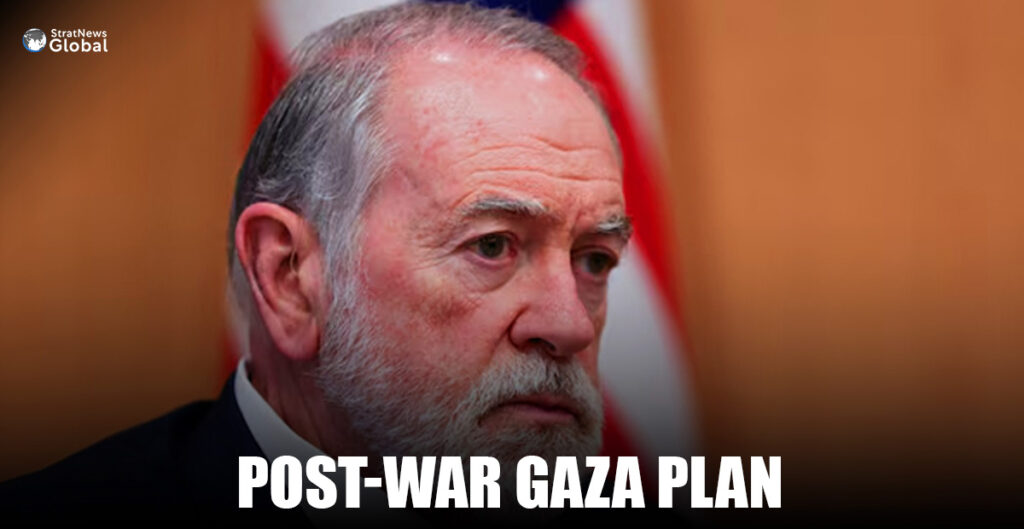
U.S. Ambassador Mike Huckabee said on Friday that the United States has discussed with Gulf Arab states about the post-war Gaza administration.
Huckabee said there had been conversations around an interim governing structure involving Gulf Arab states, potentially with the U.S. taking on a supervisory role, with a decision on a permanent arrangement to be made later.
“It’s a discussion. It’s not something that has been accepted by the administration, by Israel, by anyone. I’m not familiar with anything that is ready for signature,” he said.
After nearly two years of war, Israel has not clearly outlined how it wants Gaza to be governed, although there is a broad international consensus that the militant group Hamas, heavily diminished by Israel’s siege, cannot remain in charge.
Gaza’s Future Governance Unclear
Huckabee did not say when the talks took place or which Gulf states had been involved. The Gulf states did not immediately respond to requests for comment outside normal business hours.
Reuters reported in January that the UAE had discussed with the U.S. and Israel participating in an interim post-war Gaza administration that included the Palestinian Authority. In May, it reported the U.S. had separately discussed the possibility of itself leading a temporary post-war administration.
The PA, which exercises limited civic rule in the Israeli-occupied West Bank and was forced out of Gaza by Hamas in 2007, has said it is ready to govern Gaza with international support.
But Israeli Prime Minister Benjamin Netanyahu opposes PA involvement and has said there will never be a Palestinian state. The creation of such a state is one of the conditions the UAE has set for taking part in a post-war Gaza plan.
Netanyahu has also declared that Israel must retain overall security control alongside an Arab-led civilian administration. Others in his right-wing coalition, however, want to annex Gaza.
Huckabee said the U.S. would not join any plan with the PA if it continued to make payments to individuals and families involved in what the U.S. calls acts of terrorism.
“Why would we push something that violates our own law? We’re never going to do that,” he said in an interview.
Israeli Finance Minister Bezalel Smotrich, who wants to annex Gaza, said this week that he was negotiating with the U.S. on how to divide Gaza once the war ends. Huckabee said he was not aware of such talks.
Hamas Refuses To Discuss Disarmament
Hamas has acknowledged it will no longer govern after the war but has refused to discuss disarmament.
“They have to give up. They can’t continue to think that they have a future,” Huckabee said at the U.S. Embassy in Jerusalem.
Israel’s military this week launched a ground offensive on Gaza City, where hundreds of thousands of Palestinians are sheltering.
The military says thousands of militants are in the city and has ordered the population to leave, anticipating intense fighting.
Amid growing international outrage, U.N. Secretary-General Antonio Guterres on Tuesday called the events “horrendous” and said the war was morally, politically and legally intolerable.
Huckabee also said former British Prime Minister Tony Blair was working on a plan for post-war Gaza, though he was not aware of the details. Blair met with President Donald Trump last month. The Tony Blair Institute declined to comment.
Asked what message Secretary of State Marco Rubio delivered on the Gaza City operation during his visit to Israel this week, Huckabee said that the U.S. recognised that “Israel has to do what it has to do to get its hostages back and end the war”.
Israel says around 20 hostages are still alive in Gaza after being captured in the Hamas attack in October 2023 that triggered the war. Militants are also believed to be holding the bodies of 28 dead hostages.
Hundreds of thousands of Palestinians have fled Gaza City since Netanyahu ordered the military on August 8 to take control there, but a greater number have stayed put, either in battered homes among the ruins or in makeshift tent camps.
(With inputs from Reuters)
Ukraine: Russian Drone And Missile Strikes Leave Three Dead, Dozens Wounded
Russia carried out a large-scale overnight assault on Ukraine using drones and missiles, leaving three people dead, dozens injured, and causing damage to homes and infrastructure, President Volodymyr Zelenskyy said on Saturday.
Despite diplomatic efforts to find ways to end the war that began when Russia invaded in February 2022, the fighting has intensified in recent months.
In a statement on the Telegram app, Zelenskyy said Russia had launched around 580 drones and 40 missiles targeting infrastructure, civilian manufacturing companies and residential areas in different parts of the country.
Air defences shot down 552 of the drones and 31 missiles, Ukraine’s air force said.
Russia Is ‘Terrorising’ Civilians, Says Zelenskyy
“All night, Ukraine was under a massive attack by Russia,” Zelenskyy said. “Every such strike is not a military necessity but a deliberate strategy by Russia to terrorise civilians and destroy our infrastructure.”
Russia denies targeting Ukrainian civilians.
In the central city of Dnipro, a missile with a cluster munition hit a residential apartment building, Zelenskyy said.
One person was killed, and at least 26 people were injured in Dnipro, regional officials said.
Two people were also killed in the Chernihiv region in the north and the Khmelnytskyi region in the west of the country, regional officials said.
“I could hear the ‘Shahed’ (drone) getting closer and closer. I understood it was flying towards us. My child and I were very frightened,” Yulia Chystokletova, a resident of Kyiv, said.
“It should not be happening in the 21st century. We are all people. Agree… sit down at the negotiating table.”
Kyiv faces increasing pressure in eastern Ukraine, where Russian troops are keeping up their grinding advance, devastating villages and towns and claiming new territory.
Both Sides Stepping Up Drone Attacks
To hit Ukrainian cities far from the frontline, Russia appears to have changed its tactics and now launches swarms of hundreds of drones in one strike, compared with dozens early in the war.
Ukraine typically responds with drone strikes of its own, aiming to reach deeper into the Russian territory, hitting refineries, fuel depots, and logistics hubs.
Ukraine hit two Russian oil refineries in the Saratov and Samara regions in attacks overnight, causing explosions and fires, the Ukrainian General Staff said.
“Regarding refineries: we have drones, we know how to produce them. It all depends on the number of drones we use per day,” Zelenskyy told reporters.
“As soon as the number of drones is comparable to that of the Russians, they will feel it in terms of fuel shortages and the number of queues at petrol stations.”
Russia’s Defence Ministry said its forces had successfully carried out strikes with high-precision weapons on Ukrainian military-industrial facilities overnight.
Polish and allied aircraft were also deployed early on Saturday to ensure the safety of Polish airspace after some of Russia’s airstrikes targeted western Ukraine near the border with NATO member Poland, the Polish military command said.
(With inputs from Reuters)
South Africa: DA Fields Zille To Reclaim Johannesburg
South Africa’s Democratic Alliance (DA) on Saturday named former party leader Helen Zille as its candidate for Johannesburg mayor, as it gears up to regain control of the country’s largest city in next year’s local body elections.
The 74-year-old was widely regarded as the main architect of the party’s political strategy in last year’s national election, in which the ruling African National Congress lost its majority for the first time, forcing it to share power with second-placed DA and a host of smaller parties.
‘Choice Between Decay And Renewal’
With Zille, the DA has chosen a political heavyweight to try to win back South Africa’s commercial capital after a series of mayors in the past decade or so either quit, were forced out or – in the case of three of them – died while holding the post.
By nominating a seasoned political figure, the party aims to project stability and competence, and to replicate the success it has had in governing Cape Town, Johannesburg’s economic rival, often praised for its better service delivery.
“The next local government election is not DA vs ANC. It is a choice between decay and renewal,” DA leader John Steenhuisen told supporters in Soweto township. “Where the DA governs outright, we deliver.”
‘I Share Your Despair’
In her nomination acceptance speech, Zille promised better delivery of water, electricity, road repair and refuse services.
“We will not let Joburg’s taps stay dry. We won’t accept brokenness as the new normal,” she said. “We will wrestle our city back from a criminal mafia. When you drive through those potholed roads, in the darkness, where every broken streetlight represents a failed promise, I share your despair.”
Johannesburg has been governed by a variety of coalitions in recent years as no party holds a majority in the city council. The DA last held the mayoral role in the city in 2022.
(With inputs from Reuters)
Trump’s New H-1B Visa Fee May Impact Indian IT Operations, Industry Body Warns
India’s IT industry body Nasscom said on Saturday that imposing a new $100,000 annual fee on H-1B visa applications could disrupt the global operations of Indian technology services companies that send skilled professionals to the United States.
The White House announced the new fee on Friday, prompting some major U.S. tech firms to advise visa holders to either remain in the country or return there quickly. The new fee marks Washington’s most high-profile attempt to overhaul the country’s temporary employment visa system.
Nasscom, representing India’s $283 billion IT and business process outsourcing industry, said the abrupt rollout of the policy would impact Indian nationals and disrupt continuity of ongoing onshore projects for the country’s technology services firms.
The industry body said the one-day deadline for the new policy created “considerable uncertainty for businesses, professionals, and students across the world.”
It also said the new policy could have “ripple effects” on the U.S. innovation ecosystem and on global job markets, pointing out that for companies, “additional cost will require adjustments”.
Microsoft, JPMorgan and Amazon responded to the announcement by advising employees holding H-1B visas to remain in the United States, according to internal emails reviewed by Reuters.
Since taking office in January, President Donald Trump has launched a broad crackdown on immigration, including efforts to limit certain forms of legal immigration.
‘Stop Bringing In People’
“If you’re going to train somebody, you’re going to train one of the recent graduates from one of the great universities across our land. Train Americans. Stop bringing in people to take our jobs,” US Commerce Secretary Howard Lutnick said.
Trump’s threat to crack down on H-1B visas has become a major flashpoint with the tech industry, which contributed millions of dollars to his presidential campaign.
Critics of the programme, including many US technology workers, argue that it allows firms to suppress wages and sideline Americans who could do the jobs. Supporters, including Tesla CEO and former Trump ally Elon Musk, say it brings in highly skilled workers essential to filling talent gaps and keeping firms competitive. Musk, himself a naturalised US citizen born in South Africa, has held an H-1B visa.
Some employers have exploited the program to hold down wages, disadvantaging US workers, according to the executive order Trump signed on Friday.
The number of foreign science, technology, engineering and mathematics (STEM) workers in the US more than doubled between 2000 and 2019 to nearly 2.5 million, even as overall STEM employment only increased 44.5% during that time, it said.
(With inputs from Reuters)
Trump Administration Targets Harvard With New Financial Restrictions
U.S. President Donald Trump’s administration on Friday intensified its actions against Harvard University by imposing new restrictions on the Ivy League institution’s access to federal student aid funds, citing concerns regarding the “financial position” of the oldest and wealthiest university in the United States.
The Department of Education said it had placed Cambridge, Massachusetts-based Harvard on “heightened cash monitoring” status, a shift from the typical practice that will force it to use its own funds to disburse federal student aid before drawing down funds from the department.
Trump has cracked down on universities and threatened to cut federal funding over a range of issues like pro-Palestinian protests against U.S. ally Israel’s assault on Gaza, transgender policies, climate initiatives and diversity, equity and inclusion programs.
The Education Department is also seeking to have Harvard post a letter of credit for $36 million to ensure its financial obligations are met. In a letter, it said recent events raised concerns about Harvard’s finances, citing its decision to issue bonds and conduct layoffs amid its conflict with the White House.
The Education Department said Harvard was at risk of losing access to all federal student aid funding by not complying with requests for records from its Office of Civil Rights, which, a separate letter warned, may pursue an enforcement action.
That office has been reviewing whether Harvard still considers race in its undergraduate admissions process, even after the U.S. Supreme Court in 2023 ruled that affirmative action practices that schools relied on to boost enrollment of racial minorities were unlawful.
Harvard did not respond to requests for comment.
The government in July settled its federal investigations with Columbia University, which agreed to pay more than $220 million to the government, and Brown University, which said it will pay $50 million to support local workforce development. Both accepted certain government demands.
The Trump administration has been seeking a settlement with Harvard. Trump has said Harvard should pay “nothing less than $500 million.”
The government had separately proposed settling its probe into the University of California, Los Angeles through a $1 billion payment from the university. California Governor Gavin Newsom called that offer an extortion attempt. The government froze nearly $600 million in funding for UCLA, the university said in August.
Protest Rules At UCLA Amid Trump Crackdown
UCLA unveiled new protest rules on Friday that formalised interim policies put in place in September 2024. UCLA experienced large demonstrations last year and a violent attack by a pro-Israeli mob on a pro-Palestinian encampment.
The policies unveiled on Friday at UCLA include measures that restrict unauthorised encampments, ban masks or face coverings for those who violate rules and make outdoor spaces off-limits for demonstrations that are not pre-approved.
UCLA says it will allow pre-approved overnight events and outlined some designated areas for public expression for which prior approval was not needed. Policy violations could lead to disciplinary action or even arrest, UCLA said.
The University of California system, of which UCLA is a part, has called this period one of the gravest threats in the institution’s history.
Harvard, which has a $53 billion endowment, has not suggested it was on the verge of financial catastrophe, but it has cut spending after Trump’s administration launched a campaign to leverage federal funding to force change at it and other universities, which the president says are gripped by “radical left” ideologies.
In particular, Trump has alleged that universities allowed antisemitism during last year’s campus protests. Protesters, including some Jewish groups, say the government wrongly equates their criticism of Israel’s assault on Gaza and its occupation of Palestinian territories with antisemitism and their advocacy for Palestinian rights with support for extremism.
Harvard in July said the combined impact of recent federal actions on its budget could approach $1 billion annually. It has sued over some of those actions, leading a judge this month to rule the administration had unlawfully terminated more than $2 billion in research grants awarded to Harvard.
(With inputs from Reuters)
Russia Says Its Fighter Jets Did Not Violate Estonian Airspace
The Russian Defence Ministry said early on Saturday that Russian fighter jets did not breach Estonian airspace and instead flew over neutral Baltic Sea waters while travelling from northwest Russia to the Russian Baltic exclave of Kaliningrad.
The government of NATO member Estonia said three Russian military jets violated its airspace for 12 minutes in an “unprecedentedly brazen” incursion. The incident occurred just over a week after more than 20 Russian drones entered Polish airspace, some downed by NATO jets.
“The flight was carried out in strict conformity with international rules governing airspace with no violation of the borders of other states, as is confirmed by independent checks,” the Russian Defence Ministry said of the three MiG-31 fighters in a post on Telegram.
“During the flight, the Russian aircraft did not deviate from the agreed flight path and did not violate Estonian airspace.”
The statement said the route taken by the fighters from the northwestern Russian region of Karelia “was over neutral waters of the Baltic Sea at a distance of more than 3 km from the island of Vaindloo,” which lies off the Estonian coast.
Airspace Violation After Zapad Drills
The airspace violation comes three days after Russian and Belarusian military forces ended joint military exercises, called Zapad 2025.
Tallinn said on Friday that the three MiG-31 fighter jets entered Estonian airspace without permission and stayed there for a total of 12 minutes.
“Russia has violated Estonian airspace four times already this year, which is unacceptable in itself, but today’s violation, during which three fighter jets entered our airspace, is unprecedentedly brazen,” said Estonian Foreign Minister Margus Tsahkna.
“Russia’s ever-increasing testing of borders and aggressiveness must be responded to by rapidly strengthening political and economic pressure.”
The Russian Defence Ministry did not immediately respond to a request for comment.
Estonia said it had summoned the top Russian diplomat in the country to lodge a protest and deliver a note.
(With inputs from Reuters)
US Government Shutdown Looms After Senate Rejects Stopgap Bill
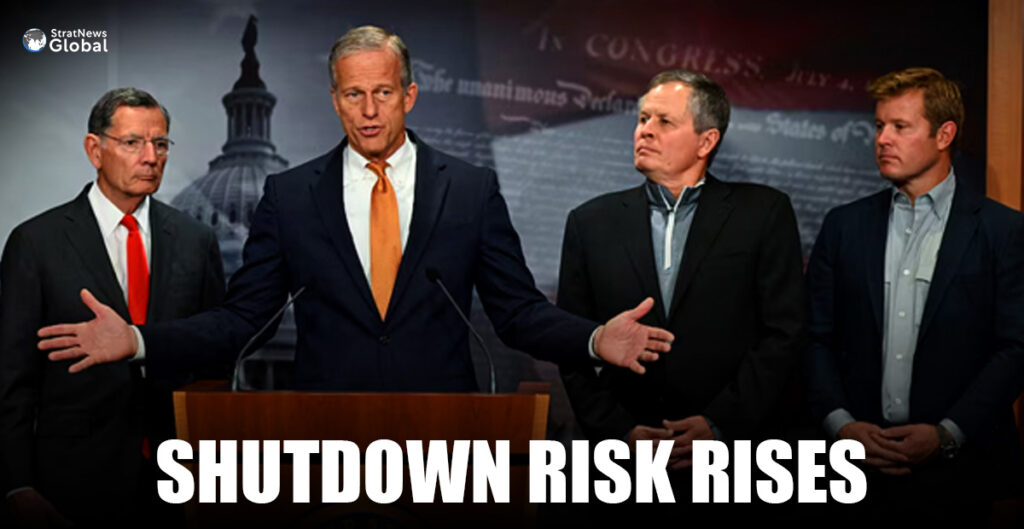
The risk of a U.S. government shutdown spiked on Friday after the Senate rejected a short-term funding bill to maintain federal operations beyond September 30 and adjourned for a week-long recess.
The lawmakers voted 44-48 to defeat a stopgap spending bill that would have kept federal agencies operating at current funding levels through November 21. The measure faced near universal opposition from Democrats, who demanded increased healthcare funding.
Republicans said they could vote again on September 29, just a day before funding is due to expire, when senators return from a break.
Senate Majority Leader John Thune blamed Democrats for increasing the chances of a shutdown. “Eventually, it’s going to be an up or down vote on whether they want to keep the government open,” he said.
Additional Funding Demands
Democrats had demanded additional funding for healthcare subsidies under the Affordable Care Act and the restoration of funding cut from the Medicaid healthcare programme for lower-income Americans. But that effort failed 47-45.
Congress has struggled to pass spending legislation in recent years due to rising partisan tensions, repeatedly raising the threat of a shutdown that would leave government workers unpaid and a wide range of services disrupted.
The temporary spending bill included $88 million to protect lawmakers, executive branch officials and the Supreme Court in the aftermath of conservative activist Charlie Kirk’s assassination.
Only 43 Republicans and one Democrat, Senator John Fetterman, voted for it, far short of the 60 votes needed to pass the Senate. Two Republicans, Senators Lisa Murkowski and Rand Paul, joined other Democrats and independents in opposition. Republicans were also plagued by absences, with eight members not voting.
The annual funding debate covers only about one-quarter of the federal government’s $7 trillion budget, which also includes mandatory programs such as Social Security and Medicare, as well as payments on the nation’s $37.5 trillion debt.
The same stopgap bill passed the Republican-controlled U.S. House of Representatives by a vote of 217-212. In a move to pressure Senate Democrats, House Republican leaders said they would not return until after Oct. 1.
“If there was ever a sign that the Republicans wanted a shutdown, that’s it,” Senate Democratic leader Chuck Schumer said.
(With inputs from Reuters)
Heathrow, Brussels Among European Airports Hit By Cyberattack
Operations at several major European airports, including London’s Heathrow—Europe’s busiest—were disrupted on Saturday by a cyberattack targeting a provider of check-in and boarding systems, resulting in widespread flight delays and cancellations.
Collins Aerospace, which provides systems for several airlines at airports globally, is experiencing a technical issue that may cause delays for departing passengers, Heathrow Airport said, having warned of delays.
Brussels Airport and Berlin Airport were also affected by the attack, they said in separate statements.
RTX Corporation, Collins Aerospace’s parent company, said it had become aware of a “cyber-related disruption” to its software at selected airports, without naming them.
Electronic Check-In Affected
“The impact is limited to electronic customer check-in and baggage drop and can be mitigated with manual check-in operations,” RTX said in an e-mailed statement, adding that it was working to fix the issue as quickly as possible.
The attack has rendered automated systems inoperable, allowing only manual check-in and boarding procedures, Brussels Airport said on its website, adding the incident had occurred on Friday night.
“This has a large impact on the flight schedule and will, unfortunately, cause delays and cancellations of flights…The service provider is actively working on the issue and trying to resolve the problem as quickly as possible.”
Passengers with a flight scheduled for Saturday were advised by the affected airports to confirm their travel with airlines before heading to the airport.
Frankfurt Airport Not Impacted
“Due to a technical issue at a system provider…there are longer waiting times at check-in. We are working on a quick solution,” Berlin Airport said in a banner on its website.
Frankfurt Airport, Germany’s largest, was not affected, a spokesperson said. An official from the operations control centre at Zurich Airport also said it had not been impacted.
EasyJet, among Europe’s biggest airlines, said it was currently operating as normal and did not expect the issue to impact its flights for the rest of the day.
Other major airlines, including Ryanair and British Airways’ owner, IAG, did not immediately respond to Reuters’ requests for comment.
There were no indications of threats to Polish airports, Deputy Prime Minister and Minister of Digital Affairs Krzysztof Gawkowski said.
(With inputs from Reuters)