

Support us by contributing to StratNewsGlobal on the following UPI ID
ultramodern@hdfcbank

Strategic affairs is our game, South Asia and beyond our playground. Put together by an experienced team led by Nitin A. Gokhale. Our focus is on strategic affairs, foreign policy and international relations, with higher quality reportage, analysis and commentary with new tie-ups across the South Asian region.
You can support our endeavours. Visit us at www.stratnewsglobal.com and follow us on YouTube, Twitter, Facebook and Instagram.
र 500 per month
र 1000 per month
र 5000 per year
र 10000 per year
Donate an amount of your choice
र 500 per month
Donate र 500 per month

र 1000 per month
Donate र 1000 per month
र 5000 per year
Donate र 5,000 per year
र 10000 per year
Donate र 10,000 per year
Donate an amount of your choice
Donate an amount of your choice



CoE May Break Tradition With First Woman Archbishop Of Canterbury
The Church of England is likely to name its next Archbishop of Canterbury on Friday, with two women among the frontrunners for the top post, which also serves as the spiritual head of 85 million Anglicans across the globe.
The 106th Archbishop will replace Justin Welby, who resigned last November over a child abuse coverup scandal, and will inherit an institution that has long grappled with theological schisms over the approach to gay Christian couples and the role of women in the church.
According to the bookmakers, the CoE could get its first woman Archbishop of Canterbury, a decade after it began consecrating women as bishops.
Conservative Anglicans Oppose Women Bishops
Leading contenders include Bishop Rachel Treweek, the CoE’s first-ever female diocesan bishop, and Iranian-born Bishop Guli Francis-Dehqani, who came to Britain as a refugee with her parents following the 1979 Islamic Revolution.
Balancing expectations between conservative Christians in African countries – where homosexuality is outlawed in some nations – and their generally more liberal counterparts in the West has proven a difficult task for previous office-holders.
Appointing a woman archbishop could compound that. The conservative Global Anglican Future Conference, which says it represents the majority of Anglicans worldwide and had rejected Welby’s approach to homosexuality, believes only men should be consecrated as bishops.
Another frontrunner for next archbishop is Bishop Martyn Snow, who stepped away from leading the CoE’s process to bless same-sex couples, saying he could not unite the Church, while media reports have also named Pete Wilcox, Bishop of Sheffield.
Lengthy Vetting Process
Unlike the Catholic Church, which elected Pope Leo just 17 days after Francis’ death, the CoE has taken nearly a year to make its decision due to a complex vetting process, led by a former spy and involving senior bishops and global representatives.
Appointing a woman to the Archbishopric would mark a historic shift for global religious institutions.
While the Catholic Church, the world’s largest Christian denomination with 1.4 billion members, does not ordain women as priests, the CoE under Welby embraced female leadership, with women now making up close to a third of all bishops in England.
Jonathan Evans, a former head of the MI5 spy agency who was chosen by the government to lead the 20-strong selection commission, said in July he wanted to avoid a list of candidates where all were “white, Oxbridge, male and come from the southeast of England”.
The commission comprised 17 voting members, including five representatives from the global Anglican Communion, three from Canterbury, and six from the CoE’s governing body.
Under the rules, the commission makes a recommendation to the prime minister, who puts it forward to King Charles for consent. In Britain, the monarch has been supreme governor of the CoE since it broke from the Catholic Church under Henry VIII in the 16th century.
Predictions have been incorrect in the past, with Welby – a former oil executive – being a surprise pick when he was appointed to replace Rowan Williams in 2013.
(With inputs from Reuters)
174 Years’ Jail For 7 Grooming Gang Members In UK
In the latest verdict linked to the long-running “grooming gangs” scandal in the UK, seven men were sentenced on Wednesday to a combined 174 years in jail for sexually exploiting two vulnerable girls.
The men were convicted in June after a trial involving a total of 50 offences, including 30 counts of rape, which occurred between 2001 and 2006.
Prosecutor Rossano Scamardella told jurors at the start of their trial at Manchester Minshull Street Crown Court that the group’s two victims were “passed around for sex, abused, degraded and then discarded”.
Girls Known To Social Services
Scamardella also said the two girls were known to social services and that it was “no secret” they were having sex with older South Asian men such as the defendants, a situation with similarities to other grooming gangs.
The men had all denied the charges, but were unanimously convicted and given sentences of between 12 and 35 years in prison on Wednesday, Britain’s Crown Prosecution Service said.
Musk’s Criticism
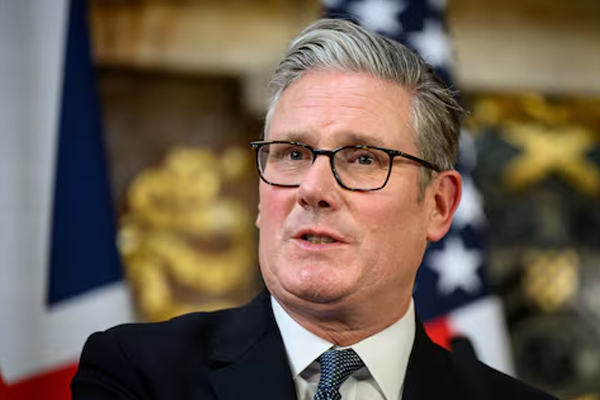
The scandal returned to the top of the political agenda in Britain this year following criticism from Elon Musk of Prime Minister Keir Starmer.
The owner of social media platform X accused Starmer of failing to tackle the scandal when he was Britain’s chief prosecutor, which Starmer angrily rejected.
Starmer in June announced he would accept a recommendation for a national inquiry into grooming gangs who sexually abused thousands of girls, the day after the seven men were convicted.
A 2014 inquiry found at least 1,400 children were subjected to sexual exploitation in Rotherham, northern England, between 1997 and 2013.
The report said the majority of known perpetrators were of Pakistani heritage and that in some cases local officials and other agencies had been wary of identifying ethnic origins for fear of upsetting community cohesion, or being seen as racist.
Grooming gangs in other towns and cities in England have also prompted criminal prosecutions and local inquiries.
(With inputs from Reuters)
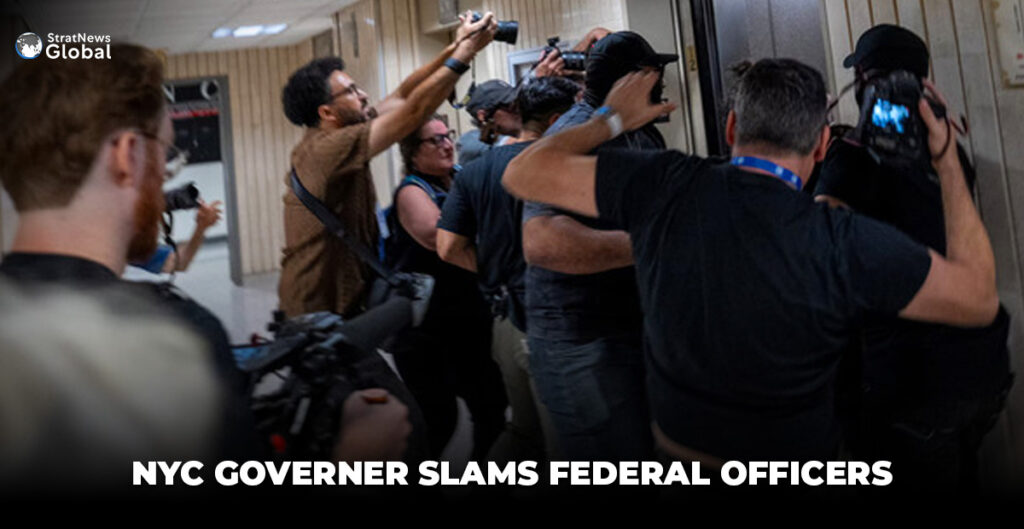
Hochul Criticises Federal Officers After Journalists Injured At NYC Courthouse
New York Governor Kathy Hochul condemned federal officers for shoving and injuring journalists, calling the incident part of rising tensions over U.S. immigration enforcement clashes.
The confrontation occurred Tuesday at a New York City courthouse amid President Donald Trump’s crackdown on illegal immigration.
Hochul shared a video posted to X, opens new tab by a New York Daily News reporter that showed masked men boarding an elevator in a federal building in downtown Manhattan that houses immigration courts.
Several of the men, one of whom appeared to be wearing a U.S. Immigration and Customs Enforcement badge, pushed photographers near the elevator, sending at least two people crashing to the floor.
“Masked ICE agents shoved and injured journalists today at Federal Plaza. One reporter left on a stretcher,” Hochul said on X. “This abuse of law-abiding immigrants and the reporters telling their stories must end. What the hell are we doing here?”
Trump, a Republican, has escalated immigration enforcement in Democratic-led cities, including New York, Chicago, Los Angeles and Washington, D.C., as part of his bid to deport record numbers of immigrants without legal status.
In recent months, ICE adopted a strategy of arresting migrants appearing in court for their immigration cases, a tactic critics say punishes people trying to follow the law.
Department of Homeland Security spokeswoman Tricia McLaughlin said officers were “swarmed by agitators and members of the press” while arresting “an illegal alien from Peru.”
“Rioters and sanctuary politicians who encourage individuals to interfere with arrests are actively creating hostile environments that put officers, detainees and the public in harm’s way,” she said in a statement.
Trump officials have blamed politicians critical of ICE for fueling sentiment against officers, amping up that message following a shooting at a Dallas ICE facility that killed two immigrants and seriously wounded a third.
ICE briefly relieved an officer of his duties on Friday after he was captured on video shoving a woman to the ground in the same New York City courthouse after she pleaded for her husband’s release. CBS News reported on Monday the officer had been returned to duty.
The U.S. Department of Homeland Security did not immediately respond to a request for comment.
Hochul, a Democrat, criticized the Trump administration and DHS earlier in the day over $187 million in cuts to counterterrorism funding for New York.
Zohran Mamdani, the leading Democratic candidate in New York City’s mayoral race, criticized the violent acts allegedly perpetrated by ICE officers at the courthouse, located at 26 Federal Plaza.
“We cannot accept or normalize what has now become routine violence at 26 Federal Plaza,” he said.
In the incident on Tuesday, a Reuters witness said a journalist from amNewYork, a local news outlet, followed ICE officers into an elevator after a woman was detained.
After one officer yelled for the journalist to be removed, other officers pushed a videographer and another reporter to the ground, the Reuters witness said.
L. Vural Elibol, a videographer with the Turkish state-run Anadolu Agency, said in an interview he was trying to film ICE officers taking a migrant into custody when he was pushed down by an officer.
“I was trying to get the video and someone yanked me and threw me to the ground,” he said.
Elibol said he hurt his back and head. He was removed on a stretcher and taken to the hospital, where he was examined and discharged with pain medicine, he said.
(With inputs from Reuters)
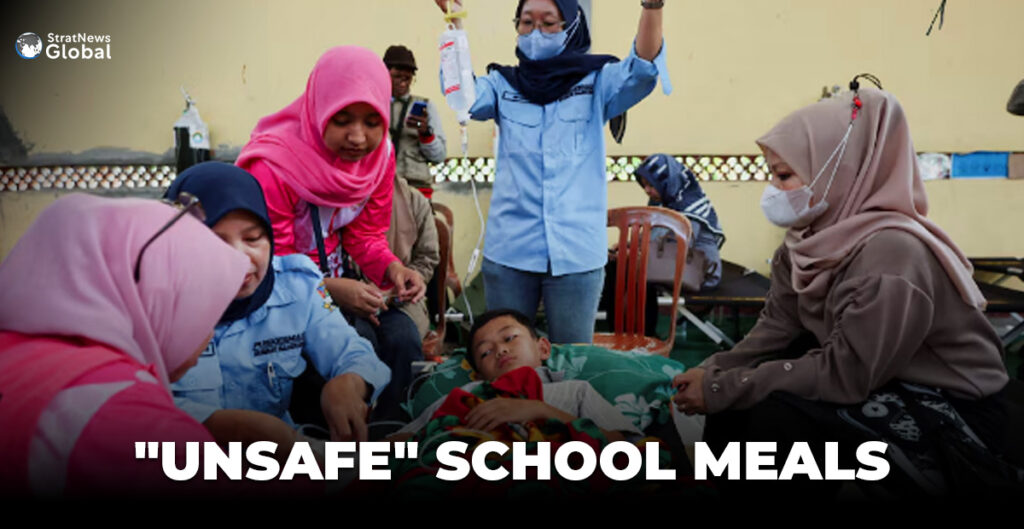
Over 9,000 Indonesian Children Suffered Food Poisoning From Free School Meals In 2025
Indonesia’s food and drug agency reported on Wednesday that over 9,000 children have suffered food poisoning from free school meals this year, a higher figure than previously disclosed, prompting lawmakers to call for improved safety standards.
The food poisoning cases have caused public outcry, and health organisations have called for the suspension of President Prabowo Subianto’s $10 billion free school meals programme. Prabowo has defended it, saying the percentage of those affected was small.
“Yes, there were shortcomings, food poisoning. We counted all the meals served; the deviation, the deficiency, or error represents 0.00017%,” he said at a political party event.
Prabowo said the programme, which aims to prevent childhood stunting, has improved nutrition for many children and created jobs as well as opportunities for local farmers and fishermen to sell produce.
“This doesn’t mean we’re satisfied. But a human endeavour of this magnitude has never been undertaken before, I think, in the history of the world. It took Brazil 11 years to reach 40 million recipients,” he said.
The government said previously that 6,000 children had suffered from food poisoning.
Over 100 Food Poisoning Cases
Indonesia’s food and drug agency told a parliamentary hearing there were 103 food poisoning cases, affecting 9,089 children from January until September.
“In August, from the end of July, the cases really spiked,” Taruna Ikrar, the agency’s head, told the hearing, adding that problems stemmed from the kitchens cooking the food. Most kitchens involved in food poisoning cases had only been operating for less than a month, he added.
Based on the agency’s investigations, food poisoning stemmed from the distribution of meals four hours after cooking, improper storage of ingredients and lack of knowledge of food security, Ikrar said.
In the same hearing, Dadan Hindayana, the head of the National Nutrition Agency, which runs the programme, said poisoning cases jumped in the past two months because kitchens were violating standards and operation procedures, such as procuring ingredients four days instead of two days ahead of requirement.
Dadan said from January to September, 6,517 children had food poisoning.
Lawmaker Edy Wuryanto noted only 36 of 8,000 kitchens had earned certification for food hygiene and sanitation, while lawmaker Ade Rizki Pratama urged the government to reduce the number of students served by one kitchen.
(With inputs from Reuters)
EU Plans ‘Drone Wall’ Against Russian Drones
Days after unidentified drones were seen around several airports in Denmark, European Union leaders gathered in Copenhagen and discussed building a “drone wall” to protect the continent from Russian drones. Additionally, all drone flights over Denmark have been banned until Friday.
A drone wall is a network of sensors and weapons to detect, track and neutralise intruding unmanned aircraft. A meeting by EU leaders was held on Wednesday, as a move to boost European defence systems, amidst the ongoing Russia-Ukraine war.
Measures By Europe
According to a Reuters report, several European nations have committed to deploying troops and anti-drone systems to assist Copenhagen. According to a BBC report, Zelenskyy said Kyiv is sending a mission to Denmark for joint exercises to provide “Ukrainian experience in drone defence”, and Stockholm too has loaned “a handful of powerful radar systems” to its neighbour for the two summits.
In the coming days, Denmark will also host a broader summit of the European Political Community.
Drone Incursions
The upcoming summit is a result of the recent drone incursions in Germany, Denmark, Norway and Poland. Fighter jets were also spotted over Estonia.
These instances have increased the need for stronger defence systems in Europe. While Danish PM Mette Frederiksen has not named anybody responsible, he has suggested it could be Moscow.
Other EU nations, such as Sweden and Germany, have also recognised Russia as the probable culprit. German Chancellor Friedrich Merz said at an event this week, “We are not at war, but we are no longer at peace either. We must do much more for our own security.”
While Russia has accepted the activity of fighter jets, it has denied responsibility for the drones over Denmark. French President Emmanuel Macron said that this incident with drones showed that Europe needs pre-alert systems, and we need to cooperate.
(with inputs from Reuters)
Rising Violence Redraws Borders And Breaks Societies
The resurgence of interstate conflict in recent years is striking — but even more remarkable is the parallel surge in political violence and the erosion of respect for norms of order.
In an article for World Politics Review, Dr Paul Poast, associate professor in the Department of Political Science and a nonresident fellow at the Chicago Council on Global Affairs, highlights how lawlessness has grown not only across borders but within states themselves, as the lines between external aggression and internal coercion become blurred.
The result is a world not merely at war, but increasingly willing to embrace force as a tool of politics, domestically and internationally.
Poast warns that the classic paradigm of civil war or interstate conflict is no longer sufficient to capture the current turbulence: instead, we are witnessing a “general acceptance and even encouragement of violence”. He notes that this trend is visible in both the United States and other democracies, where political assassination attempts, attacks on public officials, and violence directed at minorities are no longer fringe events but symptoms of deeper disorder.
Simultaneously, across international theatres, powerful states are flouting sovereignty and even norms of civilian immunity, whether through drone strikes in third countries or direct military incursions. In sum, Poast’s thesis is that international disorder and domestic violence are interconnected expressions of a broader collapse of restraint.
One of the central strengths of Poast’s argument is the empirical grounding: he catalogues recent episodes of political violence in the U.S. — from attempted assassinations of high-profile figures to other targeted killings — and situates them alongside domestic upheavals in Brazil and intensifying cartel-politicised violence in Mexico.
He also points to rising attacks on elected officials in Europe and hostility toward refugees and asylum seekers. On the interstate front, the article highlights Russia’s outright invasion of Ukraine, its drone incursions into Poland and Romania, and Israeli strikes on Hamas targets in Doha—operations that bypass legal norms and flout state sovereignty. Through these examples, Poast shows that the threshold for “acceptable” violence is shifting upward.
Another compelling element is the linkage Poast draws between internal and external forms of violence. He invokes Martin Luther King Jr’s critique that violence abroad erodes moral authority at home, arguing that a state that condones aggressive warfare erodes the legitimacy of nonviolence in its domestic politics.
In his view, policies at home and abroad are not separate; the external posture of force seeps into domestic culture, enabling assaults on political opponents, minorities, or dissenters. In the U.S. context, Poast argues, the Trump administration’s penchant for projecting a warrior image internationally dovetails with long-standing reluctance to restrain guns and political violence domestically. This symbiosis, he suggests, is emblematic of the new age of normalisation of violence.
Yet Poast does not adopt fatalism. He concedes that structural shifts in the international order—namely, the decline of U.S. dominance and rise of multipolar power competition—create incentives for disorder. He also allows for cyclical explanations of domestic violence: perhaps we are merely passing through a particularly intense cycle of political polarisation and breakdown. Nevertheless, he emphasises that even if these currents are transient, their interaction reinforces each other, amplifying the risk that lawlessness becomes entrenched.
Still, some tensions in the article warrant closer reflection.
First, while Poast’s examples are compelling, the leap from episodic violence to broad normalisation is strong — he does not systematically address countervailing trends of institutional resilience (courts, independent media, civil society) that may still check such impulses.
Second, the interface between domestic and international violence is powerful in principle, but the causal pathways remain somewhat underdrawn: do states adopt harsher foreign tactics because domestic constraints weaken, or vice versa? It may be both, but disentangling directionality would sharpen the case.
Third, Poast treats multipolarity as a structural driver but does not fully explore why rising powers might prefer to contest norms rather than incorporate them — that is, why the breakdown occurs rather than a renegotiation of norms under a new order.
Nonetheless, Poast’s warnings are timely and essential. If states perceive that violence is now politically acceptable — whether in drone strikes that cross boundaries or assassination attempts at home — then the threshold for escalation drops dramatically. The mutual reinforcement between domestic breakdown and external adventurism raises the spectre of fracturing diplomatic architectures, regional spillovers, and perpetual cycles of conflict.
Policymakers must take seriously the argument that preserving order is not only about interstate deterrence but also about curbing internal permissiveness toward violence. International actors who condemn foreign violations of sovereignty must also speak up when political leaders normalise assassination, targeted killings, or overt intimidation at home.
Civil society must reassert nonviolent norms, not only as moral bulwarks but also as stabilising frameworks for political contestation — both local and global. And scholars should further investigate the feedback loops Poast sketches: What institutional reforms might sever the vicious cycle between foreign adventurism and domestic coercion?
In the final reckoning, Poast’s piece in World Politics Review delivers a trenchant diagnosis: we now live in a world in which violence is no longer the aberration but increasingly an instrument of politics. The stakes of resisting that shift are existential — to prevent a slide into orderless brutality, states and societies must re-establish restraint, accountability, and a renewed faith in nonviolent rule.
India Weighs Chinese Lessons on Digital Sovereignty
As India debates the future of digital sovereignty, policymakers and experts face a pressing question: Can the country safeguard its digital infrastructure and user data in a world dominated by global technology giants and foreign powers?
With China’s model of strict state control and a self-reliant digital ecosystem serving as both a challenge and a point of reference, Indian leaders are confronting difficult choices—particularly as upcoming Free Trade Agreements (FTAs) could shape policies on data and economic security.
At a recent panel discussion in New Delhi, “Digital Sovereignty, FTAs and National Security”, participants examined China’s approach and its relevance for India. Ambassador Smita Purshottam, Chair of the Science, Indigenous Technology and Advanced Research Accelerator (SITARA), noted that 10% of China’s GDP comes from its digital economy. “China has created its own platforms and apps. Through this, they have built up capabilities because they have policies with preferential procurement to promote their own industry,” she said.
Dr. Sasmit Patra, a Member of Parliament, pointed out the self-contained nature of China’s ecosystem. “China has its own Facebook. So data migration doesn’t take place because their data is hosted and sustained within their own demography,” he said.
For India, however, replicating China’s model is neither feasible nor desirable. “India cannot have an ecosystem of a democracy and the approach of a one-party communist system because then we’ll be neither here nor there,” Dr. Patra observed. The distinction is crucial: China’s government controls everything from apps to infrastructure, while India’s digital space remains open, pluralistic, and largely dependent on international technology.
Still, India can adapt lessons from China without copying them wholesale. As Dr. Patra cautioned, the goal must be to control India’s own platforms while setting an example for free societies.
The idea of a dedicated Digital Sovereignty Law has been formally proposed in a letter to the Prime Minister by digital society researcher Parminder Jeet Singh, Orkash Labs CEO Ashish Sonal, Ambassador Smita Purushottam and others. The letter urges the government to move high-risk sectors containing critical data—such as DigiLocker, GeM, national highways data repositories, and other sensitive platforms—onto sovereign, indigenous Indian clouds.
The authors stress that this is an urgent need, especially as India negotiates FTAs. The broad consensus is that India’s approach must anchor itself in constitutional digital sovereignty, protect national security, and promote inclusive economic growth.
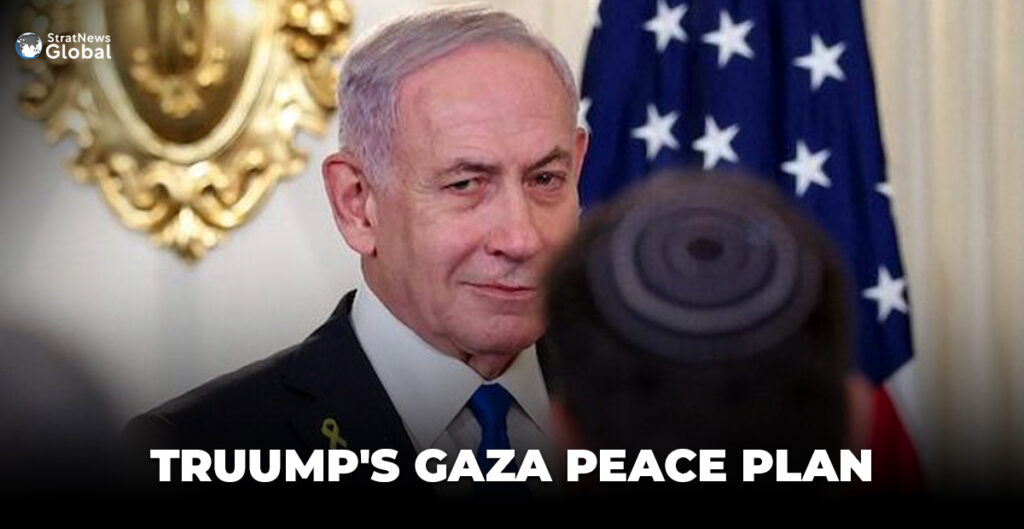
Netanyahu Backs Trump’s Gaza Plan Under Shadow Of Coalition Risks
Prime Minister Benjamin Netanyahu is engaging in a high-stakes political gamble by throwing his support behind U.S. President Donald Trump‘s new Gaza plan.
Trump’s Gaza Plan
Netanyahu’s support for Donald Trump’s Gaza plan is a gamble that may win back estranged allies abroad and repair his political base at home but risks a battle with coalition partners opposed to any hint of a Palestinian state.
Netanyahu, aligning himself with Trump, framed the plan as a joint effort that advances his government’s goals while shifting international criticism about the war on Hamas, which must now choose between accepting it or facing continued siege.
The move could shore up Netanyahu’s support at home by ending an increasingly unpopular war and winning the release of hostages still held by the Palestinian militant group, bolstering his chances at elections due in a year’s time.
But the plan’s reference to a Palestinian state is likely to antagonise members of Netanyahu’s governing coalition, the most right-wing in Israel’s history, where ultra-nationalist allies Itamar Ben-Gvir and Bezalel Smotrich hold outsized influence.
Pressure On Hamas
Nadav Shtrauchler, a former adviser to Netanyahu, called the deal a “win-win” for the prime minister, saying that it shifts all the pressure onto Hamas while easing international scrutiny of Israel and leaves coalition critics with no alternative.
“For him, it’s checkmate. It’s a very strong move,” he said, that could see Netanyahu enter the next election with the hostages released and Israel’s push to expand ties with Arab and Muslim nations, a process derailed by the war in Gaza, revived.
Trump’s proposal, quickly endorsed by leaders across the Arab and Muslim world, asks little of Israel in the short term.
Instead, it puts all the pressure on Hamas, demanding the freedom for all of the remaining hostages and the surrender of its weapons as a precondition for ending Israel’s siege of Gaza.
Israel’s military would remain in Gaza for now, pulling back to positions along the border only once an international force assumes control.
Netanyahu, who has insisted that Israel must retain overall security control after the war, said on Tuesday the military would stay in most of Gaza but offered no timeline.
“Political Illusions”
In a lengthy post on X on Tuesday, Smotrich, who has openly called for Israel’s Gaza campaign to continue, denounced Trump’s plan, arguing it would trade “real achievements on the ground for political illusions”.
His Religious Zionism party holds seven of the Knesset’s 120 seats, though recent polls indicate that he would struggle to win any if elections were held today.
Israel’s war in Gaza, launched in response to Hamas’ October 2023 surprise attack, has lost support among much of the public.
A survey published on Tuesday by the Jerusalem-based Israel Democracy Institute found that 66% of Israelis believe that it is time to end the war, including 48.5% on the political right.
Eran Lerman, a former deputy national security adviser, said that Netanyahu knows Hamas’ acceptance of Trump’s plan could shatter his ruling coalition, but may still hope to be able to face voters with “a very different perspective on what happened over the last two years” than he would able to present today.
“I’m not sure that this is true, but you know, politicians are easily tempted to believe in things that cohere with their ambitions,” said Lerman, who is also vice president of the Jerusalem Institute for Strategy and Security think tank.
Israel’s opposition, made up of right, centre and left parties, has also called for an end to the war and is often critical of Smotrich and Ben-Gvir, another far-right minister with outsized coalition influence.
Many have also ruled out joining a future coalition with Netanyahu’s ultra-Orthodox allies over their communities’ refusal to serve in the military.
A source briefed on the matter said that Netanyahu would not bring Trump’s 20-point plan to the government for approval and would instead ask ministers only to vote on the terms to free the hostages.
Israel is to free hundreds of Palestinian detainees in exchange.
Former Israeli diplomat Alon Pinkas cautioned that Netanyahu would likely draw out negotiations on issues that remain ambiguous, such as the withdrawal of Israel’s military, with the aim of both surviving politically and undermining Trump’s plan.
Mounting Pressure On Netanyahu
Israel has faced mounting international isolation over the nearly two-year-old war in Gaza. This month, some of its closest allies have formally recognized a Palestinian state despite Israeli objections, while others have sanctioned senior government ministers and imposed bans on weapons transfers to Israel.
Hamas, for its part, has little diplomatic leverage. It can accept the terms or try to negotiate, but that would risk the plan being enforced in areas it no longer controls while Trump gives Israel a green light to continue attacking the group.
A source briefed on the matter said that Netanyahu had pushed to remove a reference in Trump’s plan to Palestinian statehood, which the Israeli leader has said would never happen.
The document does not offer a clear path to statehood. Instead, it says that as Gaza is rebuilt and once the Palestinian Authority’s reform program is “faithfully carried out”, conditions “may finally be in place for a credible pathway to Palestinian self-determination and statehood, which we recognize as the aspiration of the Palestinian people.”
That language is likely to anger many of Netanyahu’s right-wing coalition allies, who had publicly warned ahead of his meeting with Trump against any mention of a Palestinian state.
But standing beside Trump, Netanyahu said the document laid the groundwork for dramatically advancing peace in the region and beyond, signaling both leaders’ ambitions to expand Israel’s ties with Muslim states that still do not recognize it.
Neve Gordon, an Israeli scholar at Queen Mary University of London, said that Netanyahu likely believes he can win the next election, scheduled to be held by October 2026, if he has a plan in place to normalise ties with more Arab and Muslim states.
But he cautioned that even after accepting Trump’s plan, Netanyahu could later break from it and place the blame on Hamas, a tactic the Israeli scholar noted he has used before, and which could even strengthen his standing politically.
(With inputs from Reuters)
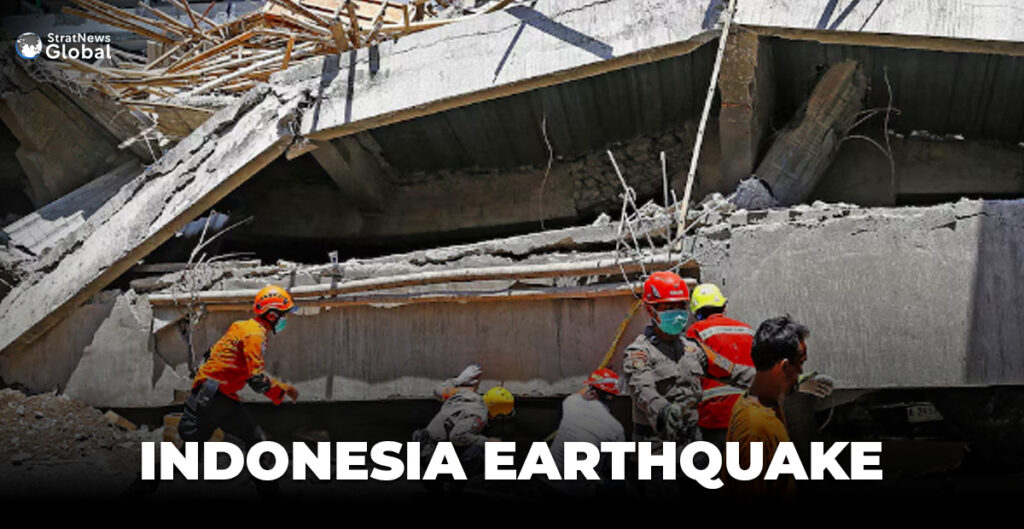
Indonesia: Earthquake Complicates Rescue Of East Java School Collapse Victims
Rescuers attempting to free students trapped in the rubble of a collapsed Islamic school in Indonesia‘s East Java province, where three people were killed, faced greater challenges on Wednesday after an earthquake that officials fear may have compacted the debris further.
Authorities said 91 people were listed as missing, with 100 evacuated and dozens injured after the collapse during students’ late afternoon prayers in a mosque on the lower floor of a building whose upper floors were still under construction.
Tuesday’s quake of magnitude 6.5 reduced the space for the people still trapped, complicating the task of rescue by narrowing the room for manoeuvre, said Emi Frizer, an official of Indonesia’s search and rescue agency.
“How to hold on to the targets’ lives while still having the same access — that’s going to take us a little longer,” he said, adding that searchers had to be careful not to injure victims’ limbs during their rescue.
“If the space was initially 50 cm (20 inches) high, it caved in to 10 cm (4 inches), and we fear it impacts the constriction of the victims,” said Mohammad Syafii, the chief of the search and rescue agency.
Casualties Reported
Disaster officials said three people died in the collapse of the boarding school in the town of Sidoarjo, about 780 km (480 miles) east of Jakarta, the capital.
The earthquake that struck the region of Sumenep, about 200 km (124 miles) from the collapse site, injured three people and damaged dozens of homes, Indonesia’s disaster mitigation agency said on Wednesday.
Rescuers detected signs of life that helped them narrow the search for survivors, Emi said.
Authorities have said the building’s foundations could not support construction work on its upper levels, leading to the collapse.
“This is all foundational failure,” Emi added.
An excavator and a crane were at the site to help rescuers shift rubble, but local official Nanang Sigit ruled out their use for fear it could set off a wider collapse.
(With inputs from Reuters)
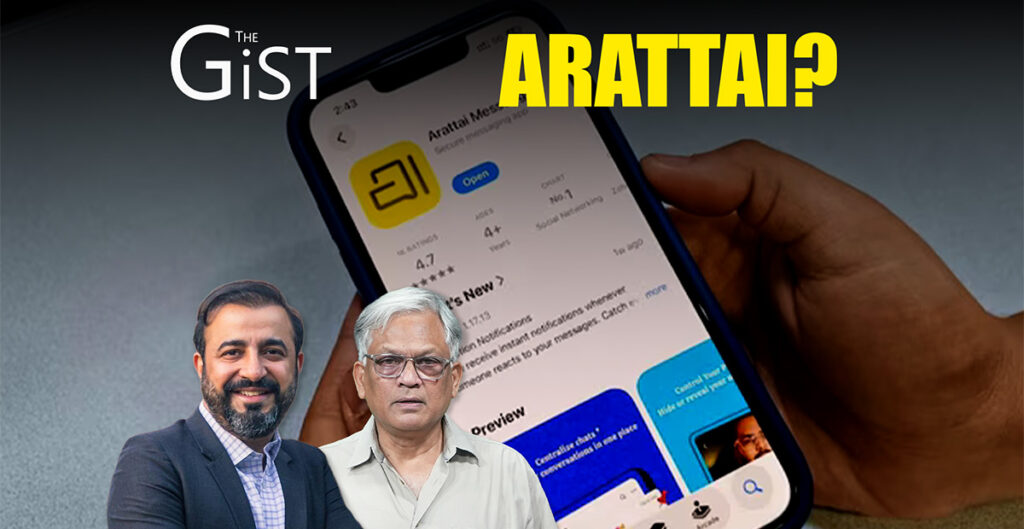
Arattai Vs WhatsApp? It’s Still Early For That But Don’t Discount The Potential
Arattai is a Tamil word meaning banter or gossip, it’s also the name of a messaging software developed by the Indian IT firm Zoho of Sridhar Vembu.
“You’ve seen many competitors to WhatsApp emerge over the last few years, Telegram, Signal and many others. I would say even locally, you’ve had some,” said Anirudh Suri, non-resident scholar at Carnegie India who works at the intersection of technology and geopolitics.
Suri was on The Gist, answering questions about Arattai and its larger implications for India’s ecosystem where such products have been launched and failed in the past, Koo for instance, which was the Indian twitter.
“I think it’s never too late to start, to mount a challenge to a company or a product like WhatsApp. I think there are many unknowns today for anyone to definitively say that this will be India’s answer to WhatsApp,” he said.
But he noted that Sridhar Vembu has long been a proponent of India’s tech stack. It’s early days to be able to say definitively but it seems Arattai is not based on the typical AWS, Microsoft Azure servers, though, it is built on its own cloud servers based in India. There’s also no doubt it’s been built by a purely Indian team.
Is Arattai a superior offering to WhatsApp? Suri believes that certain features are still a work in progress. The end to end encryption, which is a highly favoured element on WhatsApp, is still being worked on for Arattai. Then again, Arattai is okay with voice calling but the chat element has some way to go.
It’s also important to note that consumers will not move easily from one product to another unless they are being offered something much superior. This is where the stabiliyt of the existing product and its viability are huge attractions.
Is Arattai trying to copy WhatsApp?
“I hope not. I think that for any competitor to emerge, typically you cannot be a pure replica or a copy of the the existing incumbent which is such a massive winner currently,” Suri said.
“I think you have to adopt what I would say is a guerrilla strategy, where you find a niche where you are better than the incumbent, where the incumbent is not focused on building let’s say, the best features or the best infrastructure or the right targeted set of features for the end user.”
In that case, by focusing on the niche, one could emerge the winner even if it is a smaller niche.
Tune in for more in this conversation with Anirudh Suri, non-resident scholar at Carnegie India, on Arattai, India’s version of WhatsApp.