

Support us by contributing to StratNewsGlobal on the following UPI ID
ultramodern@hdfcbank

Strategic affairs is our game, South Asia and beyond our playground. Put together by an experienced team led by Nitin A. Gokhale. Our focus is on strategic affairs, foreign policy and international relations, with higher quality reportage, analysis and commentary with new tie-ups across the South Asian region.
You can support our endeavours. Visit us at www.stratnewsglobal.com and follow us on YouTube, Twitter, Facebook and Instagram.
र 500 per month
र 1000 per month
र 5000 per year
र 10000 per year
Donate an amount of your choice
र 500 per month
Donate र 500 per month

र 1000 per month
Donate र 1000 per month
र 5000 per year
Donate र 5,000 per year
र 10000 per year
Donate र 10,000 per year
Donate an amount of your choice
Donate an amount of your choice
Pentagon Forms New Task Force To Lead Anti-Drug Operations In Latin America
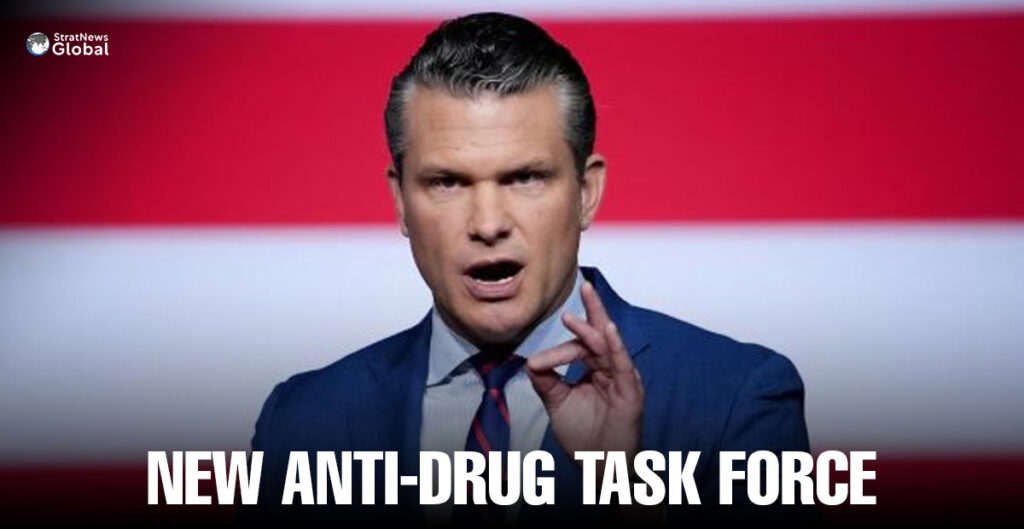
The Pentagon announced on Friday the formation of a new counter-narcotics joint task force to oversee operations across Latin America, aiming to reinforce its expanding military efforts in the region — a move that has drawn scrutiny from legal experts.
Defence Secretary Pete Hegseth said the task force aimed “to crush the cartels, stop the poison, and keep America safe.”
“The message is clear: if you traffic drugs toward our shores, we will stop you cold,” Hegseth said on X.
So far the missions have focused entirely on striking suspected drug boats in the waters of the Caribbean. The U.S. military has blown up at least four so far, killing 21 people.
The U.S. military’s Southern Command, which oversees U.S. operations in Latin America, said the new task force would be led by II Marine Expeditionary Force, a muscular unit capable of rapid overseas operations which is based at Camp Lejeune in North Carolina.
The Southern Command said the II MEF, as it’s known in military parlance, would “synchronize and augment counter-narcotics efforts across the Western Hemisphere.”
“By forming a (task force) around II MEF headquarters, we enhance our ability to detect, disrupt, and dismantle illicit trafficking networks faster and at greater depth – together with our U.S. and partner-nation counterparts,” Admiral Alvin Holsey, who leads Southern Command, said in a statement.
Focus Is On Maritime Operations
It was unclear if the creation of the task force granted the U.S. troops in Latin America any additional authorities as President Donald Trump mulls potentially striking suspected drug trafficking sites inside Venezuela.
In a statement, Marine Lieutenant General Calvert Worth, who leads the II MEF and will head the task force, suggested the focus was still operations at sea. “This is principally a maritime effort, and our team will leverage maritime patrols, aerial surveillance, precision interdictions, and intelligence sharing to counter illicit traffic, uphold the rule of law, and ultimately better protect vulnerable communities here at home,” Worth said.
The attacks have alarmed Democratic lawmakers and raised questions among some legal experts, who see Trump testing the limits of the law as he expands the scope of presidential power.
The administration has not detailed what evidence it has against the vessels or individuals, has not said what type of munitions or platforms were used in the strikes or even what quantity of drugs the vessels were allegedly carrying.
Some former military lawyers say the legal explanations given by the Trump administration for killing suspected drug traffickers at sea instead of apprehending them fail to satisfy requirements under the law of war, which requires several criteria to be met before taking lethal action – including first using non-lethal means like firing warning shots.
Last week, the Pentagon disclosed to Congress in a notification that Trump has determined the United States is engaged in “a non-international armed conflict” with drug cartels.
The document aimed to explain the Trump administration’s legal rationale for unleashing U.S. military force in the Caribbean.
(With inputs from Reuters)
North Korea Unveils New Intercontinental Missile At Grand Military Parade
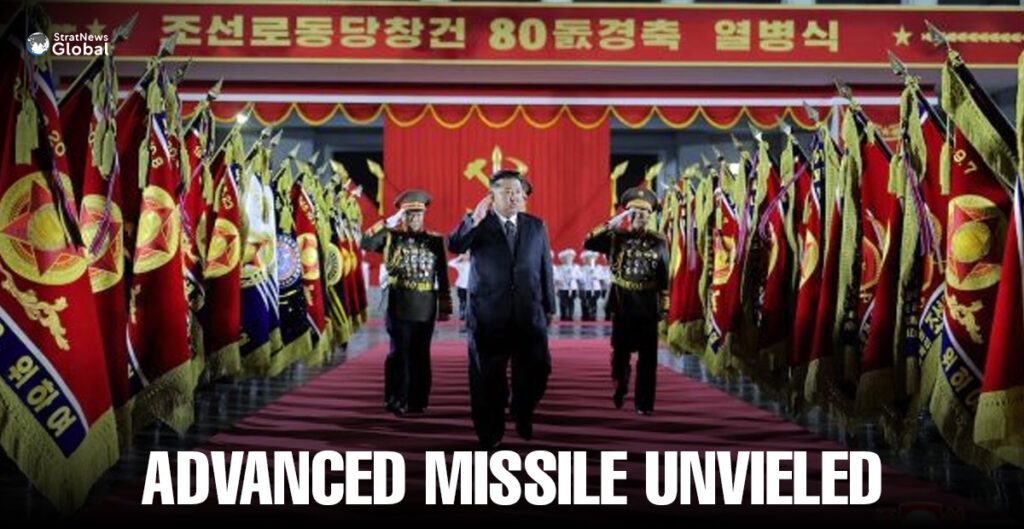
North Korean leader Kim Jong Un presided over a grand military parade showcasing the country’s latest intercontinental ballistic missile, held in the presence of foreign dignitaries, state media KCNA reported on Saturday.
The parade, which began late on Friday, marked the 80th anniversary of the foundation of its ruling Workers’ Party and followed celebrations on Thursday.
Chinese Premier Li Qiang, a delegation from Russia led by former President Dmitry Medvedev, as well as Vietnam’s Communist Party chief To Lam were among the foreign dignitaries in Pyongyang for the anniversary.
In the military parade, nuclear-armed North Korea displayed its most advanced Hwasong-20 intercontinental ballistic missile, described by KCNA as the country’s “strongest nuclear strategic weapon system.”
The Hwasong series of ICBMs has given North Korea the capacity to target anywhere on the U.S. mainland, but questions remain over the sophistication of its guidance system to reach a target, and the ability of a warhead it carries to withstand atmospheric re-entry.
Long-Range Nuclear Missile
“The Hwasong-20 represents, for the moment, the apotheosis of North Korea’s ambitions for long-range nuclear delivery capabilities. We should expect to see the system tested before the end of this year,” said Ankit Panda of the U.S.-based Carnegie Endowment for International Peace.
“The system is likely designed for the delivery of multiple warheads… Multiple warheads will increase stresses on existing U.S. missile defence systems and augment what Kim sees as necessary to achieve meaningful deterrence effects against Washington.”
At the military parade, Kim gave a speech in which he expressed “warm encouragement” for North Korean troops in overseas operations, adding its military’s heroism will not only be seen in the defence of North Korea but also in “outposts of socialist construction,” KCNA said.
“Our army should continue to grow into an invincible entity that destroys all threats,” Kim said.
Kim also held talks on Friday with Medvedev, who said the sacrifice of North Korean soldiers fighting for Russia in its military campaign in Ukraine proved the trust in relations between the two countries.
Kim told Medvedev he hopes to continue strengthening cooperation with Russia and to closely engage in diverse exchanges to achieve common goals, KCNA said.
(With inputs from Reuters)
China Targets Taiwan’s Psy-Ops Team, Issues Bounty
In a sharp move amid rising cross-strait tensions, police in China on Saturday announced rewards of $1,400 for information on 18 individuals identified as Taiwanese military psychological operations officers, accusing them of spreading “separatist” propaganda — just a day after Taiwan vowed to strengthen its defences.
China views democratically-governed Taiwan as its own territory, over the strong objections of the government in Taipei, and has increased its military and political pressure against the island.
‘Plotted To Incite Separatist Activities’
The public security bureau in the Chinese city of Xiamen, which sits opposite Taiwan on the other side of the Taiwan Strait, said the 18 were core members of Taiwan military’s “psychological warfare unit”, and published their pictures, names and Taiwan identity card numbers.
The unit handles tasks such as disinformation, intelligence gathering, psychological warfare and the broadcast of propaganda, the security bureau said in a statement.
“For a long time they plotted to incite separatist activities,” the bureau said, adding there would be rewards of up to 10,000 yuan ($1,401.74) for tips leading to their arrest.
They launched websites for smear campaigns, created seditious games to incite secession, produced fake video content to mislead people, operated illegal radios for “infiltration”, and manipulated public opinion with resources from “external forces”, the state Xinhua news agency said in a separate report.
Notice Largely Symbolic
Taiwan’s defence ministry had no immediate comment. The wanted notice is largely symbolic given that Taiwanese intelligence officers do not openly visit the country and China’s legal system has no jurisdiction on the island.
On Friday, President Lai Ching-te pledged greater efforts to boost Taiwan’s defences, calling on China to renounce the use of force to seize the island. China reacted with anger, calling Lai a troublemaker and a “war-maker”.
In June of this year, China issued a similar bounty for the arrest of 20 people Beijing said were Taiwanese military hackers. Taiwan dismissed that threat, saying it would not be intimidated.
(With inputs from Reuters)
China’s Move On Critical Minerals Triggers Broad US Countermeasures
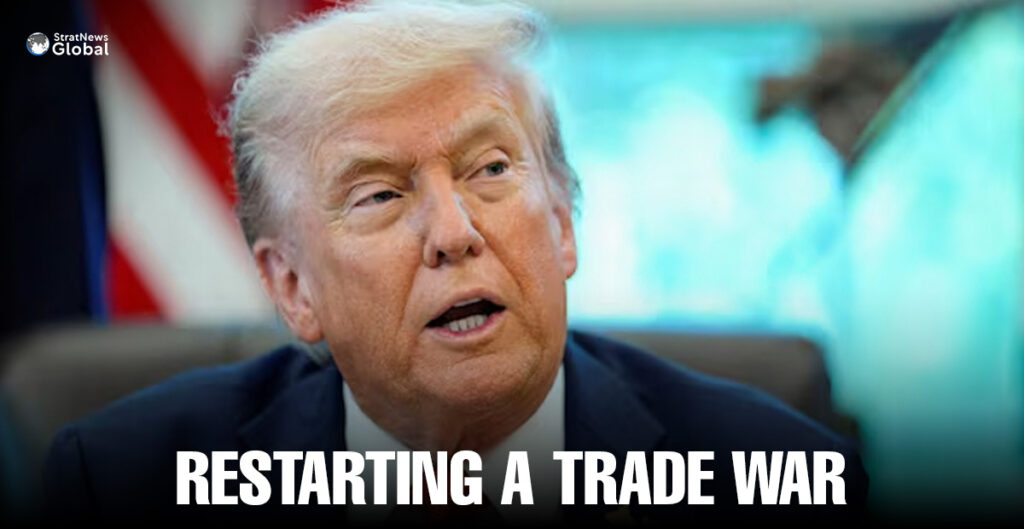
In a sharp escalation of tensions, US President Donald Trump on Friday reignited the trade war with China, breaking a fragile truce by announcing steep tariff hikes in response to Beijing’s move to restrict critical mineral exports.
The president unveiled additional levies of 100% on China’s US-bound exports, along with new export controls on “any and all critical software” by November 1, nine days before existing tariff relief is set to expire.
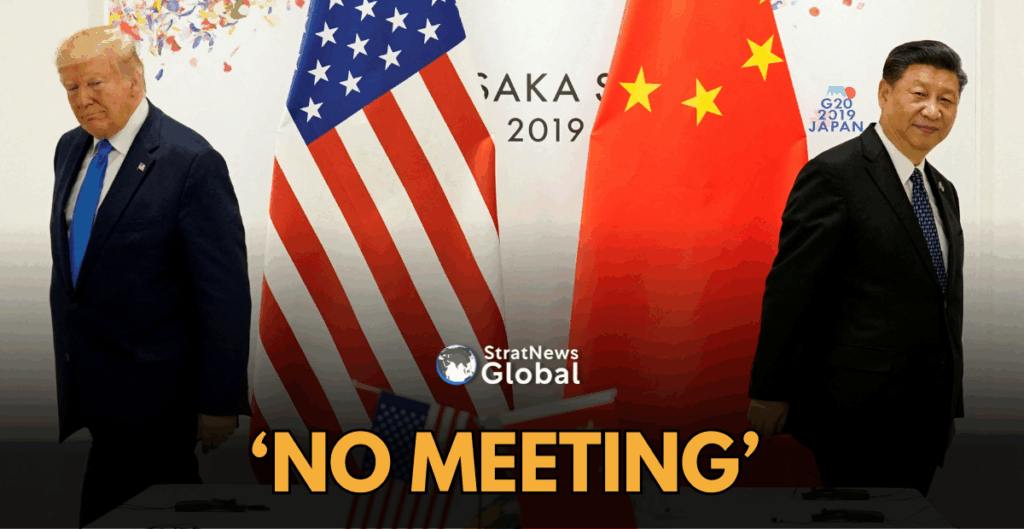
Trump also called into question the prospects for a previously announced meeting set for three weeks from now with Chinese President Xi Jinping in South Korea, saying on Truth Social that “now there seems to be no reason to do so”.
“I haven’t canceled,” Trump later told reporters at the White House. “I would assume we might have it.” Beijing has never confirmed the meeting.
‘It Was Shocking’
The new trade steps were Trump’s reaction to China dramatically expanding its rare earth element export controls. China dominates the market for such elements, which are essential to tech manufacturing.
“It was shocking,” Trump said of China’s steps, which did not specifically target Washington. “I thought it was very, very bad.”
The actions signaled the biggest rupture in relations in six months between Beijing and Washington – the world’s biggest factory and its biggest consumer. Many questioned whether an uneasy economic detente reached over the summer can survive.
It was a swift and dramatic response by Trump, a Republican who has wielded tariffs paid by US importers against friends and foes. It could escalate a trade war that Washington and Beijing paused earlier this year after painstaking diplomacy.
Potential Blow To Tech Industry
Experts said restrictions on US software shipments to China could be a massive blow to the country’s tech industry, including cloud computing and artificial intelligence.
Trump also threatened new export controls on airplanes and airplane parts, and a person familiar with the matter said the administration was sketching out other possible targets.
Beijing has long called for Washington to abandon unilateral trade restrictions it says undermine global commerce.
Markets Dive On New Threats
Trump’s trade threats – delivered in a series of social media posts and a public back-and-forth with reporters – sent markets and relations between the world’s largest economies into a spiral.
China produces over 90% of the world’s processed rare earths and rare earth magnets. Many are vital materials in products ranging from electric vehicles to aircraft engines and military radars.
Trump’s unexpected broadside shook global financial markets, sending the benchmark S&P 500 Index sliding by more than 2%, its biggest one-day drop since April when a steady barrage of tariff announcements by Trump stoked market volatility.
Investors fled into the safe haven of gold and US Treasury securities, and the US dollar weakened against a basket of foreign currencies.
Tech stocks piled on losses in after-market trading after Trump detailed the tariff and export control measures.
“Trump’s post could mark the beginning of the end of the tariff truce,” said Craig Singleton, a China expert at the Foundation for Defense of Democracies. Singleton said Washington viewed China’s export control steps as a betrayal. “Beijing appears to have overplayed its hand.”
In his first social media post on Friday, Trump said China has been sending letters to countries worldwide saying it planned to impose export controls on every element of production related to rare earths. The reference to letters was an apparent reference to Beijing’s policy papers.
Trump said he had been contacted by unnamed countries incensed over Beijing’s steps and said he was surprised because of the “very good” recent relationship with China.
Trump Condemns Beijing’s ‘Hostile Order’
Terming China’s actions a “hostile order,” Trump said he had been forced “to financially counter their move.”
“For every Element that they have been able to monopolize, we have two,” Trump said.
The White House and the Chinese embassy in Washington did not respond to a request for comment.
A spokesperson for the US Trade Representative declined comment on what countermeasures Trump was contemplating while a spokesperson for the US Treasury did not respond to a request for comment. The two offices have led talks with Beijing on trade.
Economic tensions had been rising in recent days. On Thursday, the Trump administration proposed banning Chinese airlines from flying over Russia on routes to and from the US On Friday, the US Federal Communications Commission said on major US online retail websites have removed millions of listings for prohibited Chinese electronics.
China’s move on Thursday included adding five new elements as well as dozens of pieces of refining technology to its export-restricting control list. It also required foreign rare earth producers that use Chinese materials to comply with its rules.
Analysts said the stakes had risen for a positive outcome from a Trump-Xi summit, if it still happens, on the sidelines of the Asia-Pacific Economic Cooperation forum starting October 31 in South Korea.
“Things are going to get interesting,” said Scott Kennedy, a China business and economics expert at Washington’s Center for Strategic and International Studies think tank.
“They both are hoping that amping up pressure will lead the other to make concessions in advance of APEC, or they are now re-escalating assuming a deal at APEC is impossible and are gaining leverage for the next round of the fight.”
(With inputs from Reuters)
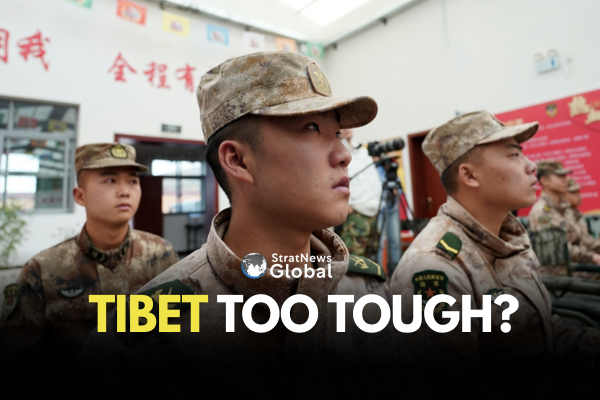
China: Young PLA Soldiers Don’t Want To Serve In Tibet
Chinese netizens are engaged in a divisive debate over a young soldier punished for refusing to serve in a Tibet-based People’s Liberation Army (PLA) brigade. The incident has become a trending topic on Chinese social media platforms like Weibo, drawing millions of views.
The soldier, identified as Huang Moumou, a university graduate from Guangzhou, had voluntarily enlisted in March 2025 but, according to his service records, showed “a negative attitude” after being assigned to Tibet. Despite repeated counselling, Huang could not adapt and was thrown out of the army.
He was fined the yuan equivalent of around $4000, stripped of family benefits, and permanently barred from public employment, overseas travel, and higher education. Details of his failed army career will also remain recorded in his household registration and personal credit file, branding him a military defaulter for life.
Tibet Posting : A Symbol of Hardship
Was Huang’s case a simple one of military disobedience? Online reactions focused on a deeper issue: fear of being stationed in Tibet, one of the most demanding postings in the Chinese military.
One viral comment summed it up:“He probably saw that he was being sent to Tibet and didn’t want to endure hardship.”
Tibet, known for its high altitude, freezing winds, and isolation, is seen as one of the toughest postings in the PLA. The state media calls it heroic but many young Chinese recruits differ.
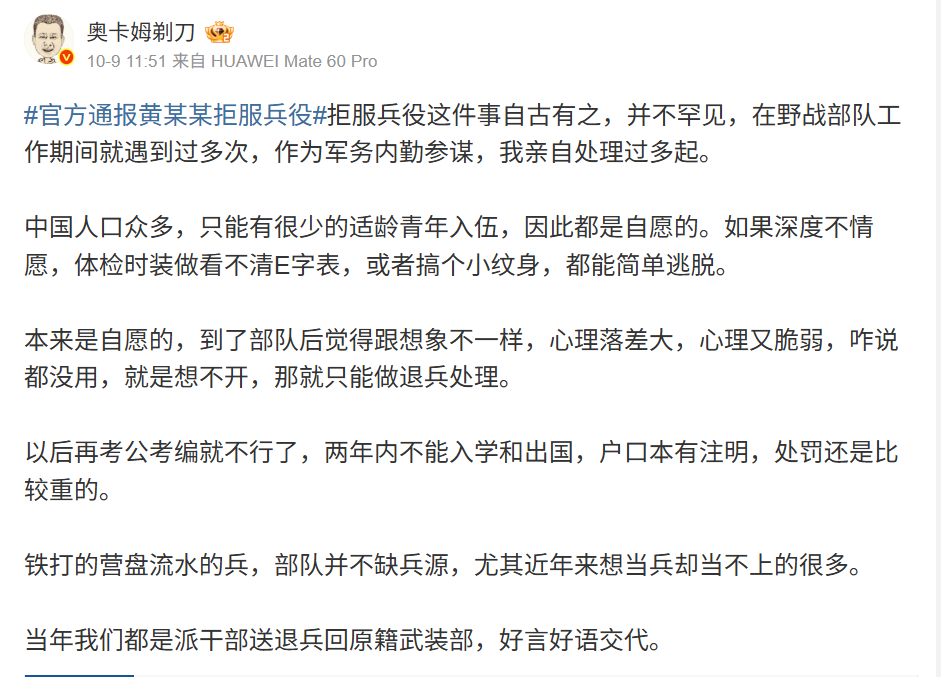
Comments flooded Weibo. While some posts joked about it, others offered advice on how to avoid going there. Get a tatto recommended a verified account adding that “If someone really doesn’t want to serve, they can easily avoid it during the medical check-up, pretend you can’t read the eye chart or show a small tattoo, and you’ll be excused.” (Screenshot below)
But there are always the “Little Pinks” — young, loyal supporters of China’s Communist Party (CCP). They are known for jumping into online debates to defend the government and the PLA.
One Little Pink wrote: “Huang Moumou has been expelled and permanently marked for refusing military service, banned from public exams for life. The red line of the law is not a joke, think carefully before making such choices.”
But many young users were worried about the harsh life in Tibet, not the law. One comment ran “I want to join the army, but I’m afraid of the hardships.”
The posts showed that while the nationalists still rule online talk, young people are risking punishment to make known their views on serving in Tibet. But few dared to defend him openly, their understated comments indicating a deeper unease with what the military demands from its recruits.
The wider trend on Weibo suggests that China’s youth are increasingly reluctant to join the PLA. To many, army life especially in remote regions like Tibet and Xinjiang, feels harsh, distant and too controlling. What older generations saw as an honour now seems more like a hard bargain: long separations, freezing weather, and limited personal freedom.
Young Chinese, raised in an age of digital comfort and city life, often struggle to accept the strict discipline and hardships that define the PLA particularly in places like Tibet, where conditions test both the body and the mind. Some netizens argued that voluntary enlistment should come with stronger psychological support, saying that patriotic slogans alone cannot sustain morale in such environments.
The story reflects a generational divide between a government demanding loyalty and sacrifice, and a younger population more focused on mental health, comfort, and personal choice.
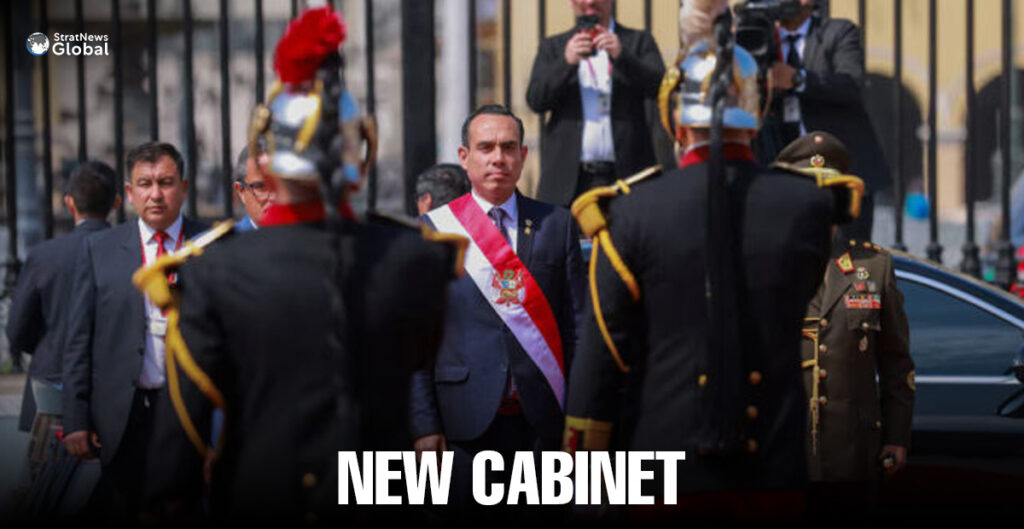
Peru: Jeri Scrambles To Form Cabinet After Sudden Presidential Shift
Peru’s newly sworn-in President Jose Jeri began efforts on Friday to form a fresh government, aiming to ease growing public frustration over rising crime and corruption as the country heads towards elections next year.
Jeri is now pulling together his 19-member cabinet, two sources at his office told Reuters, a critical test in his efforts to form a consensus cabinet to calm a volatile nation.
Ousted Overnight
The 38-year-old took office after his predecessor, Dina Boluarte, was ousted in an overnight congressional session. Congress voted to remove the deeply unpopular leader for “moral incapacity” after mounting public anger and protests over a surge in crime that has seen extortion and murders skyrocket.
Public anger came to a head after one of the country’s most popular cumbia bands was attacked mid-concert on Wednesday at a venue owned by the Peruvian army. Congress introduced multiple motions to impeach Boluarte on Thursday.
Jeri, a conservative politician who has been embroiled in controversy of his own, including a shelved sexual assault investigation and allegations of corruption that he has denied, is Peru’s seventh president since 2016.
Most of his predecessors over the past nine years were removed from office or resigned amid scandals and some Peruvians reacted to the latest presidential change with skepticism.
‘May God Help Us’
“As for President Jeri, we don’t have much faith in him either, but unfortunately, there is no one else to steer the ship,” said Edwar Sandoval, a shopper at a popular Lima market. “May God help us.”
Jeri has maintained he has a clean record and called for unity during his first address as president.
“It is time to ask for forgiveness for any mistakes that may have been made,” Jeri said.
“To all Peruvians, I offer my apologies and a promise: the promise to begin building and laying the foundations of a country that, through empathy, allows for reconciliation among all Peruvians.”
Jeri, who headed Congress before becoming president, is now set to finish the current presidential term ending in July. General elections are scheduled for April.
(With inputs from Reuters)
Qualcomm Faces China Probe Over Israeli Chipmaker Deal
China on Friday announced an antitrust probe into US chipmaker Qualcomm over its planned acquisition of Israeli tech firm Autotalks, according to the country’s market regulator.
China’s State Administration for Market Regulation said the probe would look at whether Qualcomm violated China’s antitrust law by not lawfully declaring some details in its acquisition of the Israeli chip designer.
Shares Tumble
Qualcomm’s shares fell more than 5% after US President Donald Trump also threatened to hike tariffs against China and cancel a planned meeting with President Xi Jinping.
Companies in both countries are walking a tightrope amid the US and China’s tussle for a lead in the intense artificial intelligence race, where semiconductor trade has become a flashpoint.
Qualcomm completed the Autotalks deal in June and integrated V2X technology into its Snapdragon car stack just as China is standardizing vehicle-to-everything communication across pilot regions by 2026, Carthage Capital founder and managing partner Stephen Wu said.
“China could have penalized Qualcomm as a “no-harm” jumping the gun penalty, but they instead may choose a higher sanction. That combination signals pressure on US chip and auto supply chains,” Wu added.
China, US Trade Tensions
San Diego-based Qualcomm said in June it had finalised the deal for Autotalks, which makes communications chips to help prevent car crashes, without disclosing the size, or how it had resolved earlier sticking points.
Qualcomm had said in 2024 it would drop the bid for Autotalks after it failed to get regulatory approvals in a timely manner.
Qualcomm and Autotalks did not immediately respond to Reuters’ requests for comment on the Chinese probe.
In 2015, the major supplier of mobile phone chips paid a $975 million fine to resolve a Chinese antitrust case.
Scrutiny On US Companies
The latest investigation comes after Beijing last month accused US AI chip maker Nvidia of violating China’s anti-monopoly law.
“The investigation adds to broader regulatory scrutiny of US chipmakers in China,” Equisights Research analyst Parth Talsania said.
“With Qualcomm deriving a notable portion of revenue from Chinese handset and automotive customers, we believe the announcement amplifies existing investor caution around geopolitical and regulatory risk,” Talsania added.
Qualcomm derived 46% of its revenue in its fiscal 2024 from customers with headquarters in China.
Both probes could heighten tensions between China and the US at a time when they appear to be struggling to move beyond a trade tariff truce.
(With inputs from Reuters)
China Seeks Greater Swiss Investment As Deal Talks Gain Pace
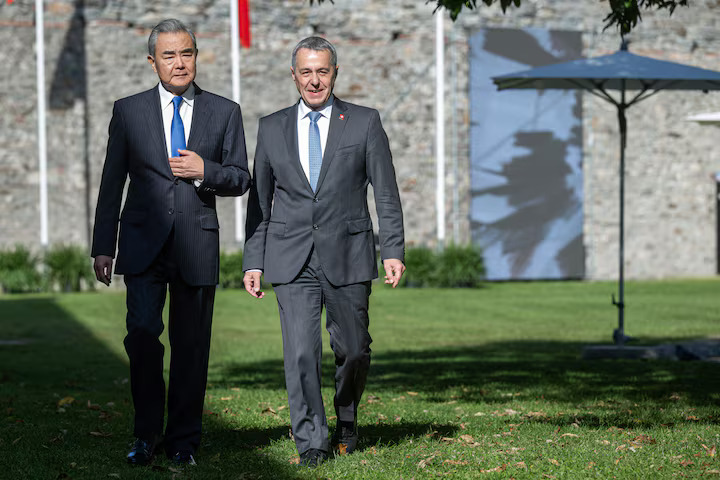
Switzerland is looking to wrap up an updated free trade deal with China by early 2026, Foreign Minister Ignazio Cassis said on Friday, after holding discussions with his Chinese counterpart Wang Yi.
China is Switzerland’s third-biggest trading partner after the United States and the European Union, and the need to update their existing deal – which entered into force in 2014 – has become more important after the US imposed tariffs of 39% on Swiss imports in August.
“We are pleased that the discussions on modernising (our free trade agreement) are proceeding constructively, and we both hope to be able to complete this work soon,” Cassis told reporters after the pair met in Bellinzona.
“We will probably not achieve this by the end of this year as we had hoped, but we are counting on the beginning of next year for a more open, fair trade based on international free trade rules,” Cassis added.
More Products To Benefit From Zero Tariffs
China and Switzerland signed a free trade agreement in 2013, Beijing’s first such deal with an economy in continental Europe.
But some Swiss products like watches and pharmaceuticals still face significant Chinese tariffs, while China wants more Swiss investment. The original agreement also had limited provisions for services.
Efforts to refresh the deal have previously stalled amid reports of concerns about China’s human rights record.
On Friday Wang said that both sides were accelerating their effort to “optimise” the free trade agreement, which he said would increase the number of products subject to zero tariffs.
Forward-Looking Dialogue
“We had in-depth, pragmatic and friendly discussions, and this dialogue was strategic, constructive and forward-looking,” Wang told reporters. “Currently, both parties are stepping up efforts to optimise the free trade agreement, and more products will benefit from zero tariffs, greatly benefiting businesses and consumers in both countries.”
In July, the European Free Trade Association, which includes Switzerland, Norway, Iceland and Liechtenstein, signed a free-trade agreement with the Mercosur countries in South America that covers 95% of Swiss exports. Last year, EFTA signed a deal with India to reduce tariffs on exports including pharmaceuticals, machinery, watches and optical instruments.
(With inputs from Reuters)
After China Tightens Grip Over High Tech, Trump Cancels Meeting With Xi
U.S. President Donald Trump threatened to hike tariffs against China and cancel a planned meeting with President Xi Jinping, in a broadside against Beijing that sent markets and relations between the world’s largest economies into a spiral on Friday.
Trump, due to meet Xi in about three weeks in South Korea, complained on social media about what he called China’s plans to hold the global economy hostage after China dramatically expanded its rare earths export controls on Thursday.
He said there was no reason to hold the meeting with Xi that he had previously announced. Beijing had never publicly confirmed the meeting between the leaders.
Increase In Tariffs
Trump also threatened a “massive” increase in tariffs on U.S. imports from China. The step could revive a destabilising tit-for-tat trade war that Washington and Beijing paused amid painstaking diplomacy earlier this year.
Trump’s unexpected broadside had an immediate impact on U.S. stock prices, with the benchmark S&P 500 Index sliding by 2% after his social media post. The remarks sent investors into the safe haven of U.S. Treasury securities, sending yields on those assets lower, as well as into gold. The U.S. dollar weakened against a basket of foreign currencies.
In his post, Trump said China has been sending letters to countries worldwide saying it planned to impose export controls on every element of production related to rare earths.
“Dependent on what China says about the hostile ‘order’ that they have just put out, I will be forced, as President of the United States of America, to financially counter their move,” Trump said on Truth Social. “For every Element that they have been able to monopolise, we have two.”
China’s Moves
The White House and the Chinese embassy in Washington did not immediately respond to a request for comment.
A spokesperson for the U.S. trade representative declined comment, while a spokesperson for the U.S. Treasury did not immediately respond to a request for comment. The two offices have led talks with Beijing on trade.
China’s move on Thursday included adding five new elements and extra scrutiny for semiconductor users, and adding dozens of pieces of refining technology to its export-restricting control list. It also required foreign rare earth producers who use Chinese materials to comply with its rules.
China produces over 90% of the world’s processed rare earths and rare earth magnets. The 17 rare earths are vital materials in products ranging from electric vehicles to aircraft engines and military radars.
(with inputs from Reuters)
Madagascar PM Criticises Force Used By Both Police And Protesters
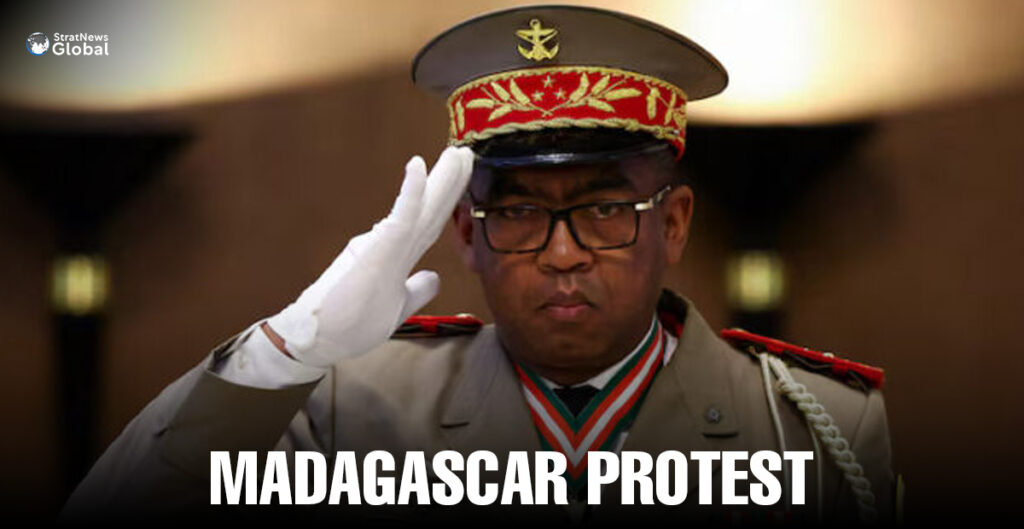
Madagascar’s newly appointed Prime Minister, General Ruphin Fortunat Zafisambo, on Friday criticised what he called the “excessive use of force” by both security forces and protesters, following three weeks of anti-government demonstrations across the island nation.
Protesters have blocked roads with rocks and in some cases hurled stones at security forces who have responded with rounds of teargas. One woman whose husband was shot dead on September 25 when he went to close his shop, told Reuters this week that his death had been “entirely preventable”.
The demonstrations were initially sparked by water and electricity shortages but later expanded to include calls for President Andry Rajoelina to step down, apologise to the nation and dissolve the senate and election commission.
Conflicting Numbers
The United Nations says at least 22 people were killed and more than 100 injured in the initial days of the protests – figures the government has rejected. Rajoelina put the number of those killed at 12 and said they were mostly looters.
On Friday, hundreds of protesters took to the streets in the capital Antananarivo again calling for Rajoelina to go.
“We firmly condemn all excesses, and we totally condemn the excessive use of force among Malagasy people. Malagasy values, our sense of solidarity and brotherhood, must prevail, whether within the military or among the protesters,” Zafisambo told reporters when asked to respond to criticism of the use of force by security forces.
‘Troubling Reports’
Also on Friday, the United Nations Office on Human Rights urged security forces to refrain from using unnecessary force against demonstrators.
“We’re receiving troubling reports of continued violence against protesters by the gendarmerie, particularly in #Antananarivo,” it said on its X account.
Rajoelina appointed Zafisambo and a new defence and security minister after dissolving the previous government last week.
On Wednesday, he told a meeting in his office he was ready to resign if he failed to fix Madagascar’s power problems within a year.
The unrest comes at a vulnerable time for Madagascar’s export-reliant economy. While the country is best known for producing most of the world’s vanilla, other exports including nickel, cobalt, textiles and shrimp are also vital to foreign earnings and employment.
Protesters’ call for a nationwide strike on Thursday went largely unheeded.
One business executive who did not wish to be named told Reuters the disruptions from the protest and an ensuing curfew had exacerbated the already dire economic situation in the country.
(With inputs from Reuters)