

Support us by contributing to StratNewsGlobal on the following UPI ID
ultramodern@hdfcbank

Strategic affairs is our game, South Asia and beyond our playground. Put together by an experienced team led by Nitin A. Gokhale. Our focus is on strategic affairs, foreign policy and international relations, with higher quality reportage, analysis and commentary with new tie-ups across the South Asian region.
You can support our endeavours. Visit us at www.stratnewsglobal.com and follow us on YouTube, Twitter, Facebook and Instagram.
र 500 per month
र 1000 per month
र 5000 per year
र 10000 per year
Donate an amount of your choice
र 500 per month
Donate र 500 per month

र 1000 per month
Donate र 1000 per month
र 5000 per year
Donate र 5,000 per year
र 10000 per year
Donate र 10,000 per year
Donate an amount of your choice
Donate an amount of your choice





Colombian Officials Report Attack On Venezuelan Activist, Political Adviser In Bogota
Colombian authorities said on Monday that a Venezuelan human rights activist and a political consultant were shot and wounded in Bogotá in what appeared to be a targeted, hitman-style attack.
Yendri Velasquez, a human rights and LGBT activist, and political consultant Luis Alejandro Peche were stable after being shot while leaving a building in Bogota, Colombia’s national police reported, adding that Velasquez was to undergo surgery.
The two had been in Colombia since September 2024, officials said.
Velásquez is founder of the Venezuelan Observatory of LGBTQ+ Violence and fled Venezuela in 2024 alleging persecution after being detained during post-election unrest.
Luis Peche served as a consultant to Venezuela’s National Assembly and other institutions.
Venezuelan opposition leader Maria Corina Machado, who last week was awarded the Nobel Peace Prize for her pro-democracy activism in Venezuela, condemned the attack on social media and said the two men had been targeted by the government of Venezuelan President Nicolas Maduro.
‘Serious Aggression’
According to Machado, Velasquez had sought refugee status in Colombia after being abducted in Venezuela in 2024 “for his work as a human rights defender,” while Peche “was also in Bogota due to political persecution by the Maduro regime.”
“This attack constitutes a serious aggression not only against them but against all the work of protecting and promoting human rights in the region,” Machado said.
Venezuela’s government did not immediately respond to a request for comment.
In the past decade, overlapping economic and political crises in Venezuela have prompted millions to migrate to neighbouring Colombia, including social and political activists and members of Venezuela’s political opposition.
Colombian President Gustavo Petro on Monday condemned the attack and pledged enhanced protections for Venezuelan human rights defenders residing in Colombia.
He said that Venezuelans seeking asylum in Colombia were welcome “regardless of their views” and said the Colombian government would expand protections for human rights activists in the country.
(With inputs from Reuters)
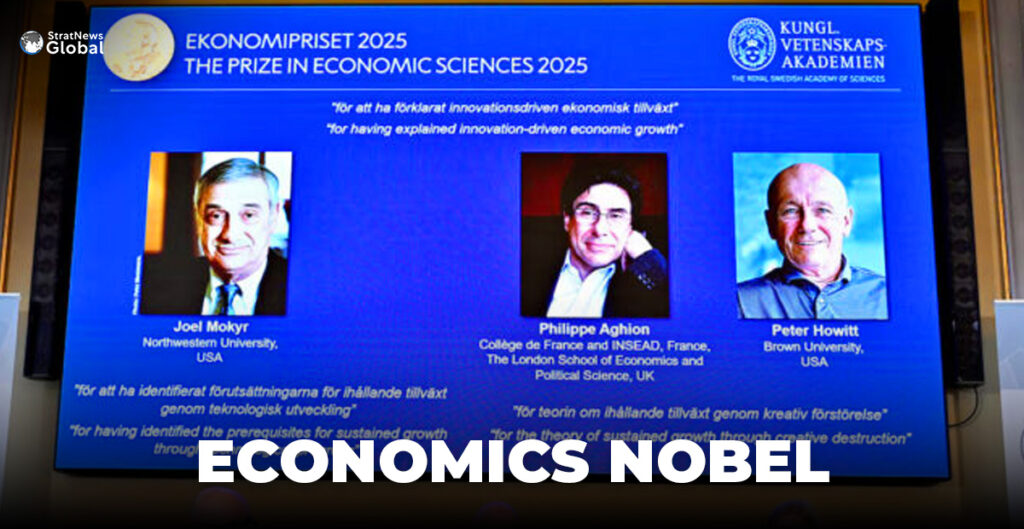
2025 Economics Nobel Honours Pioneers Of Innovation-Led Growth
Joel Mokyr, Philippe Aghion, and Peter Howitt were awarded the 2025 Nobel Prize in Economics on Monday for their groundbreaking work on how innovation and the concept of “creative destruction” fuel economic growth and improve global living standards.
Their research explains how technology gives rise to new products and production methods which replace old ones, resulting in a better standard of living, health and quality of life.
The Royal Swedish Academy of Sciences, which awards the prize, said the laureates had also shown that such progress cannot be taken for granted.
“Economic stagnation, not growth, has been the norm for most of human history. Their work shows that we must be aware of, and counteract, threats to continued growth,” the Academy said.
The prize winners themselves highlighted challenges from US President Donald Trump’s trade policies and his administration’s higher education reforms which are considered by some as an attack on academic freedom.
Mokyr Warns Of US Scientific Own Goal
While most economists view economic growth as a driver of prosperity, there are some who do not see it as an unalloyed good.
The 2024 Economics prize was won by Daron Acemoglu, Simon Johnson and James Robinson for work on inequality and Johnson in particular has pointed to how the benefits of technological innovation can be skewed toward powerful elites.
There is also a fierce debate about what level of growth is sustainable in light of man-made climate change and environmental degradation.
The prestigious award, formally known as the Sveriges Riksbank Prize in Economic Sciences in Memory of Alfred Nobel, is the final prize to be given out this year and is worth 11 million Swedish crowns ($1.2 million).
Mokyr, a professor at Northwestern University in the United States, was awarded half the prize.
An Israeli-American, Mokyr said he had been up very early to see the news of the return of Israeli hostages from captivity in Gaza. “I had forgotten about the Nobel Prize completely,” he told Reuters.
His research looks at “why we are so much richer and live so much better than our great-great-grandfathers”, he said, adding he was worried that the US may lose its place at the vanguard of scientific research and education under President Trump.
“The current administration’s assault on higher education and scientific research may be the biggest own-goal in history, or at least the biggest self-goal since the Ming Dynasty in China essentially prohibited scientific research and exploration,” he told Reuters.
“It is self-destructive and is completely driven by irrelevant politics.”
The Trump administration says the US is the largest funder of scientific research in the world and that its measures will cut waste and promote innovation.
Aghion, a professor at the College de France and INSEAD in Paris and at the London School of Economics and Political Science, and Howitt, a professor at Brown University in the United States, shared the other half of the prize.
Aghion Says Tariffs Are Obstacles To Growth
The award comes at a potential inflexion point for the global economy with many expecting artificial intelligence to spark a new growth spurt.
It also highlights the strategic risks for Europe of falling further behind the United States and China in the technologies of the future.
Aghion said de-globalization and tariff barriers were “obstacles to growth” adding that the bigger the market the more possibilities to exchange ideas, transfer technologies and for healthy competition.
“Anything that gets in the way of openness is an obstacle to growth. So, I see there kind of dark clouds currently accumulating, pushing for barriers to trade and openness,” he said.
Aghion called on Europe to learn from the US and China, which he said have found ways to reconcile competition and industrial policy.
“In Europe, in the name of competition policy, we became very anti any form of industrial policy. I think we need to evolve on that and find ways to reconcile industrial policy in areas like defense, climate, AI, biotech,” he said.
Howitt Questions Returning Manufacturing Jobs To US
Howitt, who said he had been “absolutely stunned” by the award, was also critical of President Trump’s trade policies.
“It’s pretty clear that these are going to discourage innovation by reducing what we call the scale effect,” he told Reuters. “Starting a tariff war just reduces the size of the market for everybody.”
He said that trying to bring manufacturing jobs back to the US could perhaps make some political sense but was not good economic policy.
“We’re good at designing running shoes, but it’s best for us to leave others to make them,” he said.
The Nobel prizes for medicine, physics, chemistry, peace and literature were announced last week.
The Economics prize was first handed out in 1969.
While few economists are household names, relatively well-known winners include former US Federal Reserve chairman Ben Bernanke, and Paul Krugman and Milton Friedman.
(With inputs from Reuters)
Madagascar President Flees Amid Gen Z-Led Uprising
Madagascar’s President Andry Rajoelina has left the country, as confirmed by the opposition, a military official, and a foreign diplomat — making it the second government to fall within weeks amid a growing wave of Gen Z-led protests around the world.
Siteny Randrianasoloniaiko, leader of the opposition in parliament, told Reuters that Rajoelina left Madagascar on Sunday after units of the army defected and joined the protesters.
“We called the staff of the presidency and they confirmed that he left the country,” he said, adding that Rajoelina’s whereabouts were unknown.
The president’s office did not reply to requests for comment.
In an address to the nation broadcast on Facebook late on Monday, Rajoelina said he had to move to a safe location to protect his own life. He did not disclose his whereabouts but appeared defiant, saying that he would not “allow Madagascar to be destroyed”.
The diplomatic source said after the speech that Rajoelina was refusing to step down.
President Left On French Military Plane
A military source told Reuters that Rajoelina flew out of Madagascar, a former French colony, on a French military aircraft on Sunday. French radio RFI said he had struck a deal with President Emmanuel Macron.
Macron, speaking in Egypt after a summit on the Gaza ceasefire and hostage deal, said he could not immediately confirm reports that France had helped Rajoelina to flee the country. He added that constitutional order must be preserved in Madagascar and that while France understood the grievances of the country’s youth, those grievances should not be exploited by military factions.
The military source said a French Army Casa aircraft landed in Madagascar’s Sainte Marie airport on Sunday. “Five minutes later, a helicopter arrived and transferred its passenger into the Casa,” the source said, adding that the passenger was Rajoelina.
Demonstrations had erupted in the country on September 25 over water and power shortages but quickly escalated into an uprising over broader grievances, including corruption, bad governance and a lack of basic services.
The anger mirrored recent protests against ruling elites elsewhere, including in Nepal, where the prime minister was forced to resign last month, and in Morocco.
Lost Support Of Army, Gendarmerie
Rajoelina had appeared increasingly isolated after losing the support of CAPSAT, an elite unit which had helped him to seize power in a 2009 coup.
CAPSAT joined the protesters over the weekend, saying it would refuse to fire on them and escorting thousands of demonstrators in the main square of the capital Antananarivo.
It later said it was taking charge of the military and appointed a new army chief, prompting Rajoelina to warn on Sunday of an attempt to seize power.
On Monday, a faction of the paramilitary gendarmerie supporting the protests also took control of the gendarmerie, naming a new chief for the force at a formal ceremony in the presence of senior government officials, a Reuters witness said.
The president of the Senate, a focus of public anger during the protests, was relieved of his functions, the Senate said in a statement. Jean André Ndremanjary was appointed as his replacement on a temporary basis.
If the president’s office falls vacant, the leader of the Senate takes the post until elections are held.
‘The President Must Quit’
On Monday, thousands of people gathered in a square in the capital, shouting: “the president must quit now”.
Hotel worker Adrianarivony Fanomegantsoa, 22, told Reuters he was joining the protests because his 300,000-ariary ($67) monthly salary was barely enough to cover food.
“In 16 years the president and his government have done nothing except enrich themselves while the people stay poor. And the youth, the Gen Z, suffer the most,” he said.
At least 22 people have been killed in clashes between protesters and the security forces since September 25, according to the United Nations.
Madagascar, where the median age is less than 20, has a population of about 30 million, three-quarters of whom live in poverty. GDP per capita plunged 45% from the time of independence in 1960 to 2020, according to the World Bank.
In what appeared to have been one of his last acts before leaving the country, Rajoelina issued pardons to several people on Sunday, including two French nationals, according to an internal document seen by Reuters whose contents were verified by a presidency source.
The two French nationals, Paul Maillot Rafanoharana and Francois Marc Philippe, had been convicted of undermining state security over an attempted coup in 2021.
(With inputs from Reuters)
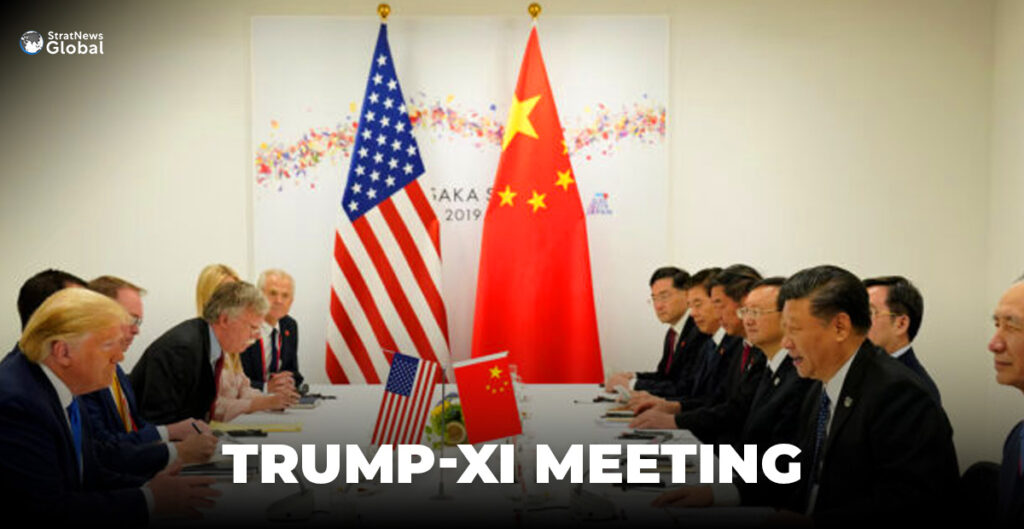
Trump-Xi Meet Still On Track Despite Trade Tensions
US President Donald Trump is still expected to meet Chinese President Xi Jinping in South Korea later this October, as both nations work to ease tensions over tariffs and export controls, US Treasury Secretary Scott Bessent said on Monday.
The latest rupture followed China’s announcement on Thursday that it would dramatically expand its rare earths export controls. That drew a sharp countermeasure from Trump on Friday that sent markets and relations between the world’s two largest economies into a spiral.
‘We Have Substantially De-Escalated’
Bessent said there were substantial communications between the two sides over the weekend and more meetings were expected.
“We have substantially de-escalated,” Bessent said in an interview with Fox Business Network. “President Trump said that the tariffs would not go into effect until November 1. He will be meeting with Party Chair Xi in Korea. I believe that meeting will still be on.”
Trump and Xi had planned to meet during the summit of the Asia-Pacific Economic Cooperation forum hosted by South Korea in late October.
China Unwilling For Talks?
China’s Commerce Ministry on Tuesday said it had informed the US in advance it planned to tighten its rare earth controls, and confirmed that the two sides remain in communication, adding that a working-level meeting took place on Monday.
But the statement from a Commerce Ministry spokesperson warned “the US cannot ask for talks while simultaneously threatening new restrictive measures”.
Stock Markets React
Asian stocks made a tentative rebound in early trade on Tuesday, after Wall Street’s main indexes ended as much as 2.2% higher on Monday, following Bessent’s signal that trade negotiations between the two superpowers remain on track.
Trump’s threat on Friday sparked a big sell-off at a time when investors and top policymakers were already growing anxious about a frothy stock market fueled by an investment boom in artificial intelligence that some officials fear could hurt future employment.
Bessent said there would be US-China staff-level meetings this week in Washington on the sidelines of the World Bank and International Monetary Fund annual gatherings.
“The 100% tariff does not have to happen,” Bessent said. “The relationship, despite this announcement last week, is good. Lines of communication have reopened, so we’ll see where it goes.”
US Pushback Aggressive
Still, Bessent called the China move provocative and said the US pushed back aggressively.
The United States has been in contact with allies and expects support from the Europeans, India and democracies in Asia, he said.
“China is a command-and-control economy. They are neither going to command nor control us,” Bessent said.
China blamed the United States for the rising trade tensions on Sunday and called Trump’s latest threatened tariffs of 100% on Chinese goods hypocritical. It defended its curbs on exports of rare earth elements and equipment. China dominates the market for such elements, which are essential to tech manufacturing.
Under China’s new regulations, foreign companies producing some of the rare earths and related magnets on the list will now also need a Chinese export license if the final product contains or is made with Chinese equipment or material. This applies even if the transaction includes no Chinese companies.
The United States would reject licensing requirements from China, Bessent said in the interview on “Mornings with Maria”.
(With inputs from Reuters)
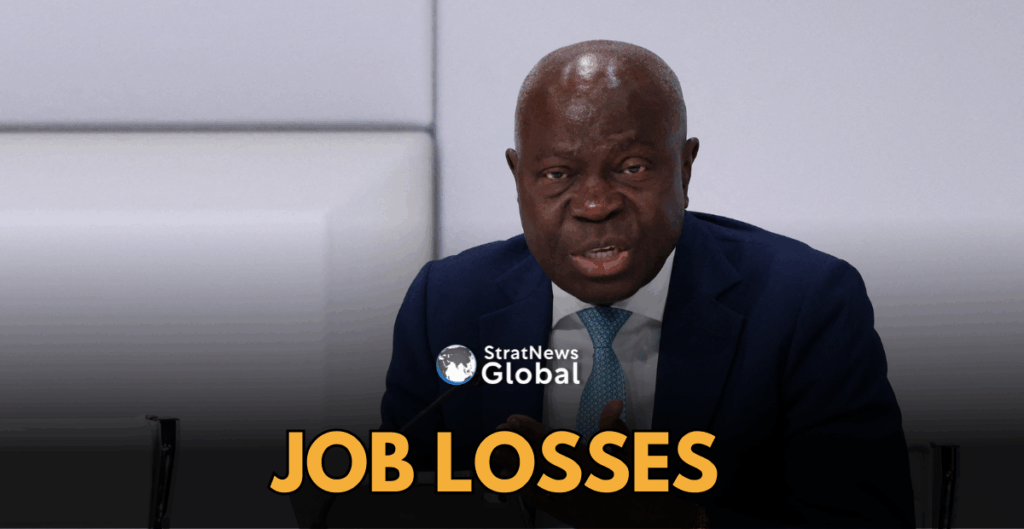
International Labour Organization To Face 8% Job Losses If U.S. Doesn’t Pay Dues
The International Labour Organisation faces “critical” cash flow problems and could abolish up to 295 posts – about 8% of its workforce – if the United States and other countries do not pay their dues, according to an internal document.
The 35-page draft document, sent to staff on Monday by ILO Director-General Gilbert Houngbo and seen by Reuters, outlines proposals to reform the U.N. agency, which promotes international labour rights, and reduce costs.
The proposals, which also include the possibility of moving dozens of staff out of the ILO’s Geneva headquarters, will be subject to further consultations before being presented to its governing body in November.
“With arrears from several Member States totalling over 260 million Swiss francs ($323.34 million) – about a third of the biennial assessment – the cash flow situation has become critical,” the document states.
‘Challenging Situation’
The U.S. is the largest donor to the ILO, which won the Nobel Peace Prize in 1969 for its contributions to improving labour conditions globally and protecting human rights. It has helped remove many children from child labour.
It was not immediately clear what impact job cuts would have on operations.
The U.S. contributes 22% of the ILO’s regular budget but owes over 173 million francs, with China, Germany and others also behind on payments. The U.S. did not immediately respond to a request for comment.
The ILO, which says on its website it employs around 3,500 staff, brings together governments, employers and workers to set labour standards around the world.
In a statement to Reuters, the ILO said it was, like the wider U.N. system, facing “a challenging financial and liquidity situation due to delayed assessed contributions” that had affected its cash flow.
“The ILO senior management keeps staff regularly informed about developments and is in dialogue with the Staff Union as part of this process.”
Worst-Case Scenarios
The document seen by Reuters sets out two main scenarios. In what it depicts as the worst case, a 20% budget cut in 2026-27, up to 295 posts could be axed across all locations, and grades could be cut to help make savings of $93.2 million.
Some 225 jobs have already been shed at the ILO’s Geneva headquarters and field offices this year because of cutbacks in U.S. funding under President Donald Trump. The ILO’s $930 million budget for 2026-27 was approved after this, in June.
The document said regular budget contribution collection had slowed in September “to the point where programme needs could no longer be fully funded”. Reserves are sufficient to pay staff salaries until the end of 2025 only if costs are controlled through travel and hiring freezes, it said.
Potential Job Relocation
Under proposals involving a less severe funding situation, a quarter of professional staff in administration, communication and research in Geneva – 72 positions – could be relocated.
Relocating 50 Geneva staff to a training centre in Turin could save $6 million over two years, the document said.
Some posts covering Europe and Central Asia could move to Budapest, and some responsibilities for Arab States could relocate from Beirut to Doha, it said.
(with inputs from Reuters)
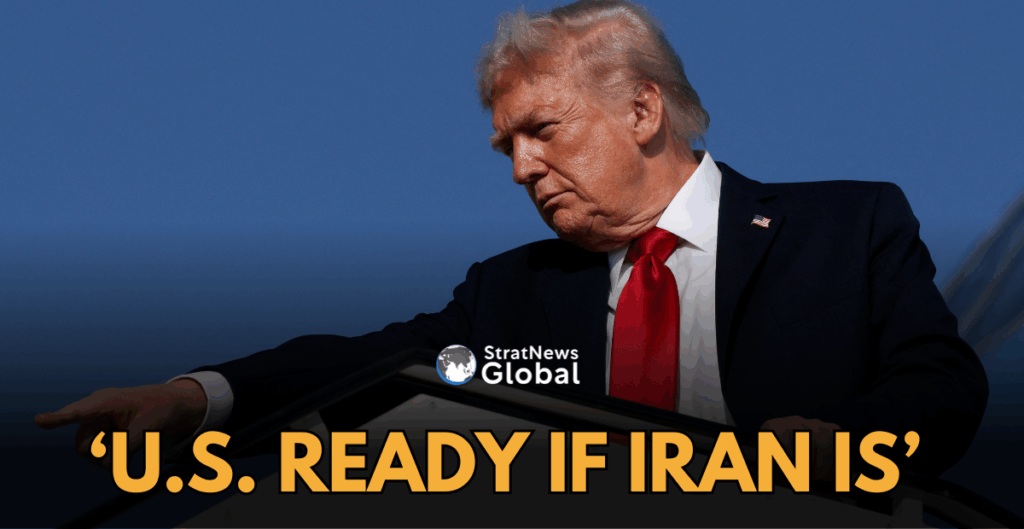
Trump Says US Will Deal With Iran When Tehran Ready
The United States is prepared to make a deal with Iran when Tehran is ready, U.S. President Donald Trump said in a speech to the Israeli parliament on Monday.
Tehran and Washington held five rounds of nuclear talks, prior to a 12-day war between Iran and Israel in June, which Washington joined by striking key Iranian nuclear sites.
‘Open To Cooperate’
The talks faced major stumbling blocks, such as the issue of uranium enrichment on Iranian soil, which the West wants to bring down to zero to minimise any risk of weaponisation, a plan that Tehran has rejected.
“We are ready when you are, and it will be the best decision that Iran has ever made, and it’s going to happen,” Trump said, referring to a deal with Iran.
“The hand of friendship and cooperation is open. I’m telling you, they (Iran) want to make a deal… it would be great if we could make a deal,” Trump told the Israeli Knesset.
U.S. Proposal
On Saturday, Iran’s foreign minister welcomed a potential “fair and balanced” U.S. proposal on its nuclear programme, but said Tehran has not received any starting points for negotiation.
“If we receive a reasonable, balanced, and fair proposal from the Americans for negotiations, we will certainly consider it,” Abbas Araqchi told state television on Saturday, adding that Tehran and Washington had been exchanging messages through mediators.
Trump was welcomed in Israel on Monday, where he addressed the Knesset ahead of a planned trip to Egypt for a summit aimed at building conditions for a lasting peace in Gaza.
Iran-Israel Relations
“There’s nothing that would do more good for this part of the world than for Iran’s leaders to renounce terrorists…and finally recognise Israel’s right to existence,” Trump said.
But Araqchi said on Saturday the notion that Iran could normalise relations with Israel was “wishful thinking.”
“Iran will never recognise an occupying regime that has committed genocide and killed children,” he said.
Araqchi declined an Egyptian invitation to attend the summit in a post on X on Monday: “While favouring diplomatic engagement, neither President Pezeshkian nor I can engage with counterparts who have attacked the Iranian people and continue to threaten and sanction us.”
(with inputs from Reuters)
OpenAI Ties Up With Broadcom For In-House AI Chips
In a bid to boost computing power amid rising demand, OpenAI has joined hands with Broadcom to develop its own AI chips — marking its first move into in-house processor production.
Shares of Broadcom rose more than 10%.
The companies said on Monday that OpenAI would design the chips, which Broadcom will develop and deploy starting in the second half of 2026. They will roll out 10 gigawatts worth of custom chips, whose power consumption is roughly equivalent to the needs of more than 8 million US households or five times the electricity produced by the Hoover Dam.
Most analysts do not expect the deal, the latest effort by a tech company to develop custom AI chips, to challenge Nvidia’s grip on the AI accelerator market, given the significant challenge of designing, scaling and manufacturing in-house chips from the ground up.
Critical Step
The OpenAI-Broadcom deal is the latest in a string of massive chip investments that have highlighted the technology industry’s surging appetite for computing power as it races to build the most sophisticated AI systems.
OpenAI last week unveiled a 6-gigawatt AI chip supply deal with AMD that includes an option to buy a stake in the chipmaker, days after disclosing that Nvidia plans to invest up to $100 billion in the startup and provide it with data-center systems with at least 10 gigawatts of capacity.
“Partnering with Broadcom is a critical step in building the infrastructure needed to unlock AI’s potential,” OpenAI CEO Sam Altman said in a statement.
Financial details of the agreement were not disclosed and it was not immediately clear how OpenAI would fund the deal.
A one-gigawatt data center can cost between $50 billion and $60 billion, Nvidia CEO Jensen Huang said in August, adding that Nvidia products, powering the data center, can represent more than half of those costs.
The 2026 timeline set out by OpenAI for the build-out is aggressive, but the startup is also best positioned to raise the funds required for the project, given the heights of investor confidence, said Gadjo Sevilla, an analyst at eMarketer.
“Financing such a large chip deal will likely require a combination of funding rounds, pre-orders, strategic investments, and support from Microsoft, as well as leveraging future revenue streams and potential credit facilities.”
Custom Chip Boom
The tie-up with Broadcom, first reported by Reuters last year, places OpenAI among cloud-computing giants such as Alphabet-owned Google and Amazon.com that are developing custom chips to meet surging AI demand and reduce dependence on costly, supply-constrained Nvidia processors.
However, similar efforts by Microsoft and Meta have failed to match the performance of Nvidia chips, according to media reports.
Still, the rise in demand for custom chips has turned Broadcom into one of the biggest winners of the generative AI boom, with its stock price rising nearly six-fold since the end of 2022.
Broadcom unveiled a $10 billion custom AI chip order in September from an unnamed new customer, which some analysts speculated was OpenAI. However, a company executive on Monday alluded that OpenAI was not that unnamed client.
Broadcom and OpenAI said on Monday that the deployment of the new custom chips would be completed by the end of 2029, building on their existing co-development and supply agreements.
The new systems will be scaled entirely using Broadcom’s Ethernet and other networking gear, challenging Nvidia’s InfiniBand networking solution.
(With inputs from Reuters)
Mongolian President Arrives On Four-Day State Visit
Russia: Medvedev Says U.S. Tomahawk Supply To Ukraine Could Backfire On Trump And Others
Former Russian President Dmitry Medvedev warned on Monday that the delivery of U.S. Tomahawk missiles to Ukraine could have serious repercussions for all parties involved, particularly for U.S. President Donald Trump.
Medvedev, an arch-hawk who has repeatedly goaded Trump on social media, said it is impossible to distinguish between Tomahawk missiles carrying nuclear warheads and conventional ones after they are launched – a point that President Vladimir Putin’s spokesman has also made.
“How should Russia respond? Exactly!” Medvedev said on Telegram, appearing to hint that Moscow’s response would be nuclear.
Trump on Sunday hinted at the possibility of providing Kyiv with long-range Tomahawk missiles, warning that such a move could be on the table if Putin fails to halt the war in Ukraine.
The United States would not sell missiles directly to Ukraine, but provide them to NATO, which can then offer them to the Ukrainians.
‘Empty Threat’?
“Yeah, I might tell him (Putin), if the war is not settled, we may very well do it,” Trump said. “We may not, but we may do it… Do they want to have Tomahawks going in their direction? I don’t think so.”
Medvedev wrote: “One can only hope that this is another empty threat… Like sending nuclear submarines closer to Russia.”
He was alluding to Trump’s statement in August that he had ordered two nuclear subs to move closer to Russia in response to what he called “highly provocative” comments from Medvedev about the risk of war.
Putin has said supplying Ukraine with Tomahawks – which have a range of 2,500 km (1,550 miles) and could therefore strike anywhere within European Russia, including Moscow – would destroy relations between the United States and Russia.
Ukrainian President Volodymyr Zelenskyy said Ukraine would only use Tomahawk missiles for military purposes and not attack civilians in Russia, should the U.S. provide them.
(With inputs from Reuters)