

Support us by contributing to StratNewsGlobal on the following UPI ID
ultramodern@hdfcbank

Strategic affairs is our game, South Asia and beyond our playground. Put together by an experienced team led by Nitin A. Gokhale. Our focus is on strategic affairs, foreign policy and international relations, with higher quality reportage, analysis and commentary with new tie-ups across the South Asian region.
You can support our endeavours. Visit us at www.stratnewsglobal.com and follow us on YouTube, Twitter, Facebook and Instagram.
र 500 per month
र 1000 per month
र 5000 per year
र 10000 per year
Donate an amount of your choice
र 500 per month
Donate र 500 per month

र 1000 per month
Donate र 1000 per month
र 5000 per year
Donate र 5,000 per year
र 10000 per year
Donate र 10,000 per year
Donate an amount of your choice
Donate an amount of your choice
As Trump And Tehran Raise The Heat, War Clouds Gather
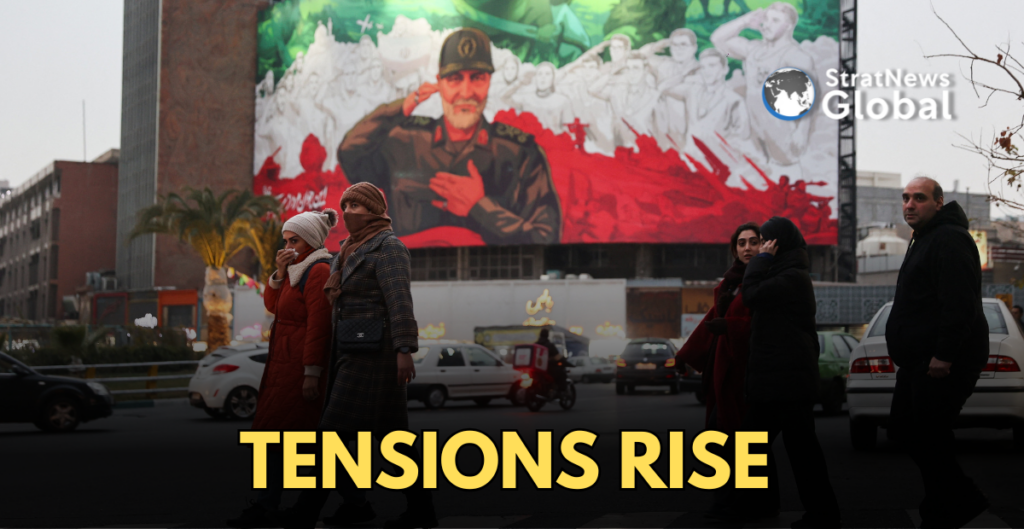
Are the mass protests in Iran coming to a head? India’s former ambassador to Iran, Gaddam Dharmendra, believes that these protests are different from the mass anti-government demonstrations of 2022 and earlier. If not dealt with urgently, these have the potential to pose a more serious systemic challenge.
“For the 1st time, the bazaaris, an influential merchant class, have shut their shops and come out in protest. This is due to the crash of the Iranian currency, the Rial, which in turn is due to a combination of US economic sanctions and long-standing economic mismanagement. The current protests have brought together whole segments of society, including students, seniors, pensioners, etc, onto the streets,” he told StratNewsGlobal.
A Newsweek report quoting senior academic Alex Vatanka of the Middle East Institute echoes a similar line.
“The point is this regime has mishandled the economy, the society, and he foreign policy. It’s mishandled so badly for so long that you have created this desperation among people for change, particularly younger people who don’t see any hope.”
But Dharmendra does not believe the Pezeshkian Government is in imminent danger of falling.
“It has been 40 years since the Islamic Revolution. The system is deeply embedded, and Iran’s institutional frameworks are strong. The people do receive health, educational and social welfare facilities, whatever their shortcomings. I don’t think the system is going to collapse as it has in Syria or Iraq. It’s much more durable.”
Yet the sabre-rattling is getting louder and worse. In the last 24 hours, Iran’s ambassador to the UN shot off an angry letter to Secretary-General Guterres, urging him to condemn “unlawful threats” directed at his country by President Trump.
Recall that the latter had warned Tehran against cracking down on the demonstrations, saying he was “locked and loaded”, meaning ready to strike Iran. The US is not short of military assets in the region.
Its Fifth Fleet comprising aircraft carriers is headquartered in Bahrain, in Qatar is the Al Udeid Airbase, the biggest in the region with every kind of combat aircraft and bombers, two bases in Iraq house more than 2000 US troops, several bases in Kuwait including one that handles logistics delivery and the Al Dhafra Airbase in the UAE where F-22 jets and MQ-9 drones are stationed.
But Indian diplomats who monitor the region and the protests closely warn that while Iran has been debilitated by sanctions, it still retains the ability to hit back. It can mine the Strait of Hormuz through which 20% of the world’s supply of oil transits. Those mines can also bottle up the US Navy and limit its movement.
The larger danger, diplomats say, is that any blockade in the supply of oil could see prices shoot up. If the blockade escalates into war, it could engulf the entire region as Iran is certain to encourage its proxies, Hamas and Hezbollah, to strike at US interests.
Any war will threaten the livelihoods of the estimated 15 to 20 million-strong Indian diaspora, besides disrupting the flow of energy. Remember, India imports 35% of its energy from the Persian Gulf region.
For now, Iran’s moderate President Masood Pezeshkian has chosen a conciliatory line, admitted faults and promised to make things right. But sanctions have severely weakened the regime’s ability to help its own people. The currency has fallen steeply in value, and prices of everyday items are going beyond the common man’s reach.
Pezeshkian is doing the best he can, but he cannot take on the clerical establishment and its militant backers, the Revolutionary Guards and the Quds Force. Forty-seven years since the founding of the Islamic Republic, the regime remains well entrenched and is going nowhere.
Trump Says Venezuela’s Maduro Captured After US Strikes
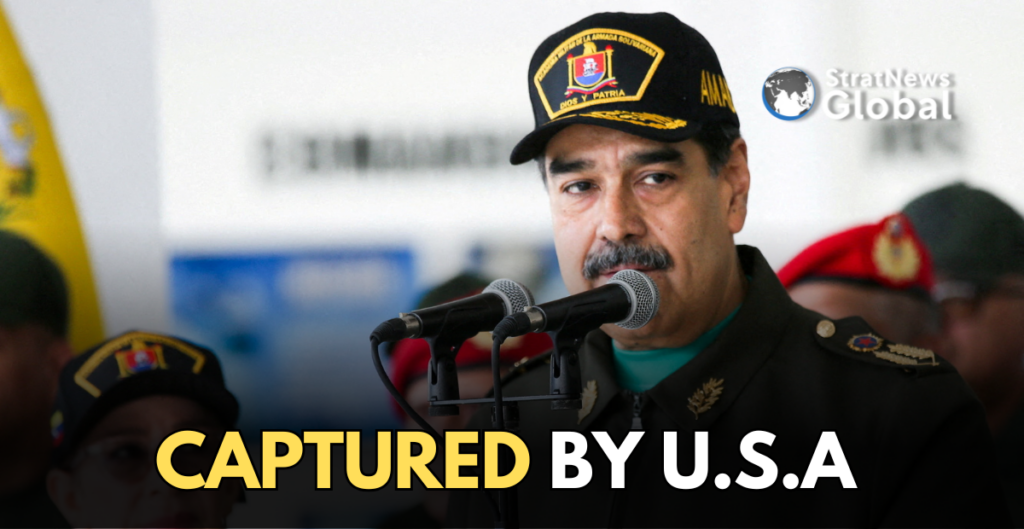
The U.S. has struck Venezuela and captured its President Nicolas Maduro, who has been taken out of the country, President Donald Trump said on Saturday.
Trump added on Truth Social that there will be a news conference at 11:00 EST (16:00 BST), at the president’s Florida residence, Mar-a-Lago.
The U.S. has not made such a direct intervention in Latin America since the invasion of Panama in 1989 to depose military leader Manuel Noriega.
No Confirmation
“The United States of America has successfully carried out a large-scale strike against Venezuela and its leader, President Nicolas Maduro, who has been, along with his wife, captured and flown out of the country,” Trump said in a Truth Social post.
There was no immediate confirmation from the Venezuelan government.
The U.S. has accused Maduro of running a “narco-state” and rigging an election. The Venezuelan leader, who succeeded Hugo Chavez to take power in 2013, has said Washington wants to take control of its oil reserves, the largest in the world.
Trump did not give any other details about how Maduro was captured or where he had been taken.
Background
That, along with the huge military build-up in the region over the last few months, was interpreted in the region as encouragement for someone inside the country to turn against him.
(with inputs from Reuters)
Bangladesh Readies For High-Pitch Potboiler As Campaign Set To Begin
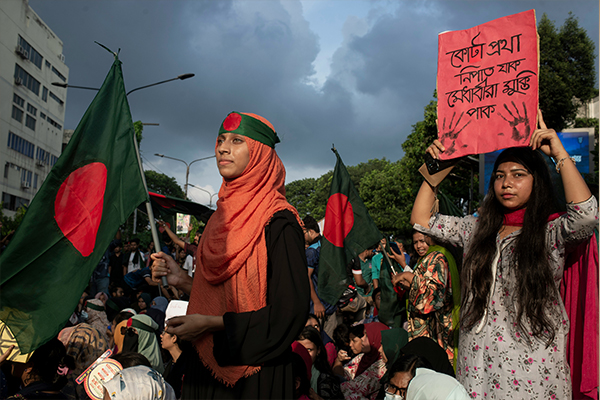
Bangladesh is yet to witness the sound and fury of election campaigning. But with BNP leader Khaleda Zia now laid to rest and the official period of mourning to end on Monday, the stage is set for what could be a bruising fight.
On paper, the BNP is expected to emerge the single largest party given the ban on the Awami League. Runners up is the Jammat-e-Islami although there is talk of BNP and Jamaat joining hands as they have in the past.
The other contender the National Citizens Party (NCP), shows signs of splitting after it sealed an electoral understanding with the Jamaat. According to the Dhaka Tribune, “more than half a dozen frontline leaders (have) resigned or withdrawn from party activities in protest against the agreement with the Jamaat.”
The NCP comprises those students who took part in the protests against Sheikh Hasina and who appear to have frittered away their standing with the public by engaging in extortion, intimidation and so on.
The big question centres around Tarique Rahman: can he lead his party to victory on the back of the “sympathy wave” generated by Khaleda Zia’s death? Much will depend on his ability to inspire ground level cadres, win over middle level leaders and soothe the insecurities of the old guard left adrift by Khaleda’s death.
For India, Sheikh Hasina’s unceremonious exit is a serious setback, more so as Tarique is not a figure it has much confidence in. StratNewsGlobal learns that his proximity to Pakistan is of long standing and he may have even conspired to have her overthrown, as some reports claim.
Pakistan’s ISI is also known to have close links with the Jamaat, and Tarique Rahman had met its leader Shafiqur Rahman only the other day in Dhaka.
“We have worked together in the past in the interest of our beloved country, and, God willing, we will continue to work together in the future for the country’s sake,” Tarique was reported as saying.
The Jamaat leader said much the same: “For the sake of national stability over the next five years and to restore a healthy political environment, we should consider whether we can collectively think through constructive options.”
The two coming together could mean double trouble for India. But it’s important to note than an Indian envoy had called on Jamaat leader last year. So India has kept open links with that party.
Tarique has also called for communal and ethnic harmony, pointing out that Christians, Buddhists and Hindus also live in Bangladesh.
External Affairs Minister Jaishankar had called on him the other day to condole the death of his mother and handed over a letter from Prime Minister Modi. These are courtesies but such gestures carry their own diplomatic weight.
Many in India would hope that Tarique, after having lived so many years overseas, may have changed his views on this country and would value benefits for his people by linking up with an economy growing at over 7%.
But all that for later. All eyes on Jan 5 when campaigning gets underway. A lot will be said and India will be monitoring closely, hopeful that if the Tarique-led dispensation emerges victorious, the doors can be shut on the ghosts of the past.
Grok AI Floods X With Sexualized Photos Of Women, Minors
Julie Yukari, a musician based in Rio de Janeiro, posted a photo taken by her fiancé to the social media site X just before midnight on New Year’s Eve, showing her in a red dress snuggling in bed with her black cat, Nori. The next day, somewhere among the hundreds of likes attached to the picture, she saw notifications that users were asking Grok, X’s built-in artificial intelligence chatbot, to digitally strip her down to a bikini.
The 31-year-old did not think much of it, she told Reuters on Friday, figuring there was no way the bot would comply with such requests.
She was wrong. Soon, Grok-generated pictures of her, nearly naked, were circulating across the Elon Musk-owned platform.
“I was naive,” Yukari said.
Yukari’s experience is being repeated across X, a Reuters analysis has found. Reuters has also identified several cases where Grok created sexualized images of children. X did not respond to a message seeking comment on Reuters’ findings. In an earlier statement to the news agency about reports that sexualized images of children were circulating on the platform, X’s owner xAI, said: “Legacy Media Lies.”
The flood of nearly nude images of real people has rung alarm bells internationally.
Ministers in France have reported X to prosecutors and regulators over the disturbing images, saying in a statement on Friday that the “sexual and sexist” content was “manifestly illegal.” India’s IT ministry said in a letter to X’s local unit that the platform failed to prevent Grok’s misuse by generating and circulating obscene and sexually explicit content.
The U.S. Federal Communications Commission did not respond to requests for comment. The Federal Trade Commission declined to comment.
‘Undressing Spree’
Grok’s mass digital undressing spree appears to have kicked off over the past couple of days, according to successfully completed clothes-removal requests posted by Grok and complaints from female users reviewed by Reuters. Musk appeared to poke fun at the controversy earlier on Friday, posting laugh-cry emojis in response to AI edits of famous people – including himself – in bikinis.
When one X user said their social media feed resembled a bar packed with bikini-clad women, Musk replied, in part, with another laugh-cry emoji.
Reuters could not determine the full scale of the surge.
A review of public requests sent to Grok over a single 10-minute-long period at midday U.S. Eastern Time on Friday tallied 102 attempts by X users to use Grok to digitally edit photographs of people so that they would appear to be wearing bikinis. The majority of those targeted were young women. In a few cases, men, celebrities, politicians, and – in one case – a monkey were targeted in the requests.
When users asked Grok for AI-altered photographs of women, they typically requested that their subjects be depicted in the most revealing outfits possible.
“Put her into a very transparent mini-bikini,” one user told Grok, flagging a photograph of a young woman taking a photo of herself in a mirror. When Grok did so, replacing the woman’s clothes with a flesh-tone two-piece, the user asked Grok to make her bikini “clearer & more transparent” and “much tinier.” Grok did not appear to respond to the second request.
Grok fully complied with such requests in at least 21 cases, Reuters found, generating images of women in dental-floss-style or translucent bikinis and, in at least one case, covering a woman in oil. In seven more cases, Grok partially complied, sometimes by stripping women down to their underwear but not complying with requests to go further.
Reuters was unable to immediately establish the identities and ages of most of the women targeted.
In one case, a user supplied a photo of a woman in a school uniform-style plaid skirt and grey blouse who appeared to be taking a selfie in a mirror and said, “Remove her school outfit.” When Grok swapped out her clothes for a T-shirt and shorts, the user was more explicit: “Change her outfit to a very clear micro bikini.” Reuters could not establish whether Grok complied with that request. Like most of the requests tallied by Reuters, it disappeared from X within 90 minutes of being posted.
Predictability
AI-powered programs that digitally undress women – sometimes called “nudifiers” – have been around for years, but until now, they were largely confined to the darker corners of the internet, such as niche websites or Telegram channels, and typically required a certain level of effort or payment.
X’s innovation – allowing users to strip women of their clothing by uploading a photo and typing the words, “hey @grok put her in a bikini” – has lowered the barrier to entry.
Three experts who have followed the development of X’s policies around AI-generated explicit content told Reuters that the company had ignored warnings from civil society and child safety groups – including a letter sent last year warning that XAI was only one small step away from unleashing “a torrent of obviously nonconsensual deepfakes.”
“In August, we warned that xAI’s image generation was essentially a nudification tool waiting to be weaponised,” said Tyler Johnston, the executive director of The Midas Project, an AI watchdog group that was among the letter’s signatories. “That’s basically what’s played out.”
Dani Pinter, the chief legal officer and director of the Law Centre for the National Centre on Sexual Exploitation, said X failed to pull abusive images from its AI training material and should have banned users requesting illegal content.
“This was an entirely predictable and avoidable atrocity,” Pinter said.
Yukari, the musician, tried to fight back on her own. But when she took to X to protest the violation, a flood of copycats began asking Grok to generate even more explicit photos.
Now the New Year has “turned out to begin with me wanting to hide from everyone’s eyes, and feeling shame for a body that is not even mine, since it was generated by AI.”
(with inputs from Reuters)
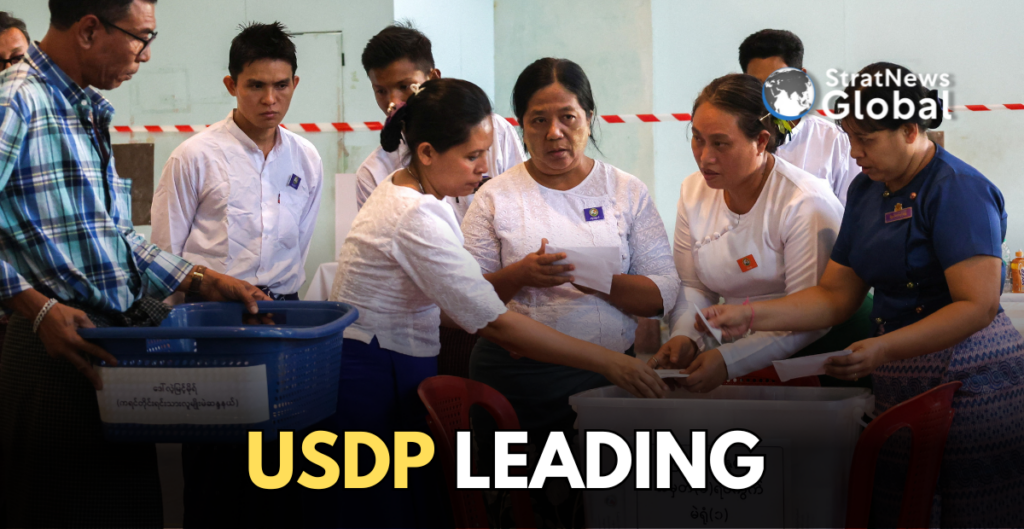
Myanmar Polls: Junta-Backed USDP Takes Lead in Phase One
Myanmar’s military-backed Union Solidarity and Development Party is leading after the first phase of a contentious general election, early results cited by state media showed, in the first vote since a 2021 coup.
Having sparked a nationwide rebellion after crushing pro-democracy protests in the wake of its coup, the ruling junta has said the three-phase vote would bring political stability to the impoverished Southeast Asian nation.
Partial results from Myanmar’s first election since 2020, released by the Union Election Commission (UEC) for 56 constituencies, showed the junta-backed party winning by a wide margin as expected, despite thin turnout.
Election Outcomes So Far
The results published on Friday show the Union Solidarity and Development Party (USDP), led by retired generals, winning 38 of 40 seats in the Pyithu Hluttaw, or lower house, whose outcomes have been tallied.
The Shan Nationalities Democratic Party, also known as the White Tiger Party and the Mon Unity Party (MUP), got one seat each.
Among a diminished field of competitors handpicked by the military, the USDP also won 14 seats of the 15 regional or State Hluttaw seats tallied in the first-past-the-post system, while the Akha National Development Party took one.
For the upper house, or Amyotha Hluttaw, only one seat has been declared, which was won by the Wa National Party.
No date has been set for the final result of the election, criticised by the United Nations, some Western countries and human rights groups, as anti-junta political parties are not in the running, and it is illegal to criticise the polls.
Partial Results
The election panel has not revealed the total number of constituencies voting in the first phase, opting instead to release partial results on a constituency-by-constituency basis.
On Wednesday, the junta said 52% of voters, or more than half of those eligible, had cast ballots in the first phase.
That fell short of the turnout of about 70% in general elections in 2020 and 2015, however, according to the U.S.-based nonprofit International Foundation for Electoral Systems.
Two more rounds of voting set for January 11 and January 25 will cover 265 of Myanmar’s 330 townships, in some of which the junta does not have complete control.
Aung San Suu Kyi, the Nobel Peace Prize winner deposed by the military months after she won the last general election by a landslide in 2020, remains in detention. Her National League for Democracy has been dissolved.
Analysts say the junta’s bid to establish a stable government amid war is fraught with risk, and broad foreign recognition is also unlikely for any military-controlled administration with a civilian veneer.
(with inputs from Reuters)
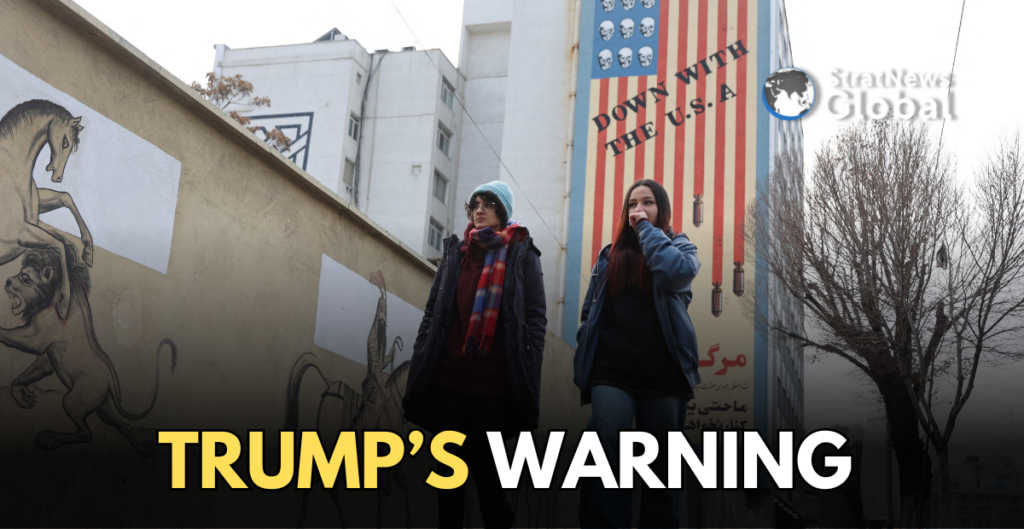
Trump Threatens Iran Over Protest Crackdown As Deadly Unrest Flares
American President Donald Trump threatened on Friday to come to the aid of protesters in Iran if security forces fire on them, days into unrest that has left several dead and posed the biggest internal threat to Iranian authorities in years.
“We are locked and loaded and ready to go,” he said in a social media post. The United States struck Iranian nuclear facilities in June, joining an Israeli air campaign that targeted Tehran’s atomic programme and military leadership.
Top Iranian official Ali Larijani responded to Trump’s comments, warning that U.S. interference in domestic Iranian issues would equal the destabilisation of the whole region. Iran backs groups in Lebanon, Iraq and Yemen.
The comments came as a local official in western Iran, where several deaths were reported, was cited by state media as warning that any unrest or illegal gatherings would be met “decisively and without leniency”, raising the likelihood of escalation.
Biggest Protests
This week’s protests over soaring inflation have spread across Iran, with deadly confrontations between demonstrators and security forces focused in western provinces.
State-affiliated media and rights groups have reported at least six deaths since Wednesday, including one man who authorities said was a member of the Basij paramilitary affiliated with the Revolutionary Guards.
Iran has seen off repeated bouts of major unrest in recent decades, often quelling protests with heavy security measures and mass arrests. But economic problems may leave authorities more vulnerable now.
This week’s protests are the biggest in three years, since nationwide demonstrations triggered by the death of a young woman in custody in late 2022 paralysed Iran for weeks, with rights groups reporting hundreds killed.
Video verified by Reuters showed dozens of people gathered in front of a burning police station overnight, as gunshots sporadically rang out and people shouted “shameless, shameless” at the authorities.
In the southern city of Zahedan, where Iran’s Baluch minority predominates, the human rights news group Hengaw reported that protesters had chanted slogans including “Death to the dictator”.
Hengaw has reported 29 arrests so far over the unrest, mostly in the west, and including 14 members of Iran’s Kurdish minority.
State television also reported the arrest of an unspecified number of people in another western city, Kermanshah, accused of manufacturing petrol bombs and home-made pistols.
The deaths acknowledged by official or semi-official Iranian media have been in the small western cities of Lordegan and Kuhdasht. Hengaw also reported that a man was killed in Fars province in central Iran, though state news sites denied this.
President Acknowledges Mistake
During the latest unrest, the elected President Masoud Pezeshkian has struck a conciliatory tone, pledging dialogue with protest leaders over the cost-of-living crisis, even as rights groups said security forces had fired on demonstrators.
Speaking on Thursday, before Trump threatened U.S. action, Pezeshkian acknowledged that failings by the authorities were behind the crisis.
“We are to blame… Do not look for America or anyone else to blame. We must serve properly so that people are satisfied with us…. It is we who have to find a solution to these problems,” he said.
Pezeshkian’s government is attempting a programme of economic liberalisation, but one of its measures, deregulating some currency exchange, has contributed to a sharp decline in the value of Iran’s rial on the unofficial market.
The sliding currency has compounded inflation, which has hovered above 36% since March, even by official estimates, in an economy battered by Western sanctions.
The Israeli and U.S. strikes last year have added to the pressure on the authorities, as have the ousting of Syria’s Bashar al-Assad, a close Tehran ally, and the Israeli pounding of its main regional partner, Lebanon’s Hezbollah.
Iran continues to back groups in Iraq that have previously fired rockets at U.S. forces in the country, as well as the Houthis group that controls much of northern Yemen.
“American people should know that Trump started the adventurism. They ought to watch over their soldiers,” said Larijani, the head of Iran’s National Security Council and a top adviser to Supreme Leader Ayatollah Ali Khamenei.
(with inputs from Reuters)
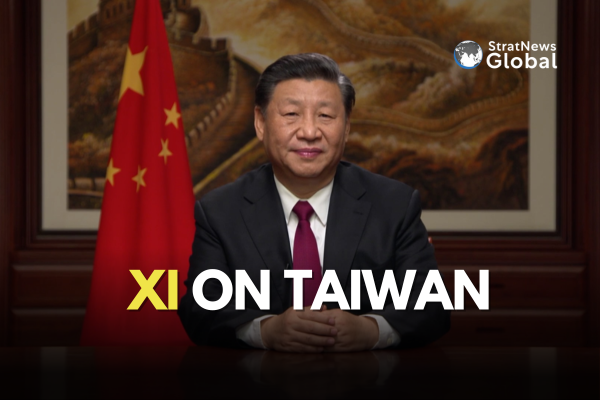
Xi Jinping Recycles Old Tropes, From Taiwan To Economic Growth
China’s President Xi Jinping used his New Year 2026 address to deliver a broadside on Taiwan: reunification with the mainland is an “unstoppable trend”, he said, underscoring that “The people on both sides of the strait are bound by blood ties thicker than water.”
If that was indeed the case, why did his military spend two days carrying out naval exercises and firing drills around the little island? As many as 200 fighter jets flew intimidatory missions and Taiwan reported 27 missiles being fired that hit near the coast. ,
The president’s address was beamed live nationwide on state media, and perhaps just to drive the point home, it was interspersed with images of China’s national day parade last September to mark the end of World War II. The parade featured top of the line military equipment including nuclear missiles.
Promises of Growth and Global Stability
He said the world was facing a period of “intertwined turbulence and transformation”, an indirect reminder of the tariff war, and promised that China would continue to stand on “the right side of history” and would work with other countries to promote peace, development and global cooperation.
In an article in Qiushi, the Communist Party’s main theoretical journal, Xi said China must secure the “strategic initiative” in global competition. Warning that the coming years would be important for the country’s future, he urged people to ” “remain confident, seize the momentum and steadily advance high-quality development”.
Confidence Amid Global Challenges
Xi said China was on track to meet its growth target of around 5 per cent for 2025, adding that GDP would reach nearly $20 trillion. This would provide a solid base for the 15th Five-Year Plan, which runs from 2026 to 2030.
He said the government would follow “more proactive macroeconomic policies” to keep growth at a healthy and reasonable level and to maintain social stability.
Technology was a major theme of the speech. Xi said China had become one of the world’s fastest-growing innovation economies. He pointed to progress in areas such as artificial intelligence, chip development, aerospace and military technology. These advances, he said, had lifted China’s scientific and technological strength to new heights.
Overall, Xi’s New Year messages aimed to reassure the country that China is moving forward steadily, with confidence in its economy, faith in technology and a clear sense of direction for the years ahead.
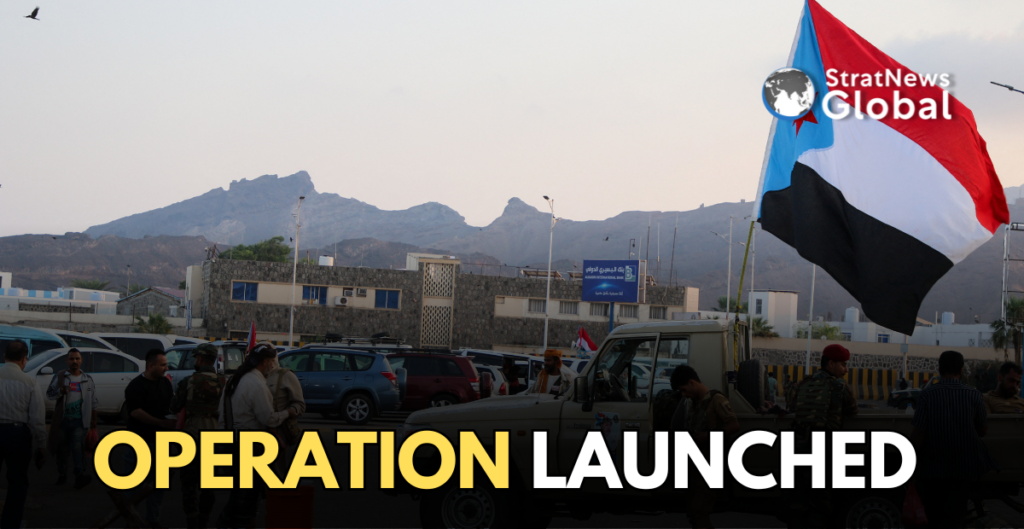
Yemen: Saudi-Allied Govt Targets UAE-Backed Separatists
Yemen’s Saudi-backed government launched an operation to take back military positions from the UAE-backed southern separatists on Friday and said it had reclaimed one of the largest military camps in Hadramout province.
The operation in Hadramout marks the latest escalation in Yemen, where a rift between Gulf powers Saudi Arabia and the United Arab Emirates, who back opposing sides, has been playing out since December.
Once the twin pillars of regional security, the two Gulf heavyweights have seen their interests diverge on everything from oil quotas to geopolitical influence.
Reclaiming Major Base
Hadramout’s Saudi-backed governor, Salem Ahmed Saeed al-Khunbashi, said in a statement on Friday that his forces had taken control of a military camp in al-Khasha’a, the largest and most important base in the province.
The governor had earlier said his forces were launching what he called a “peaceful” operation.
A senior official of the UAE-backed Southern Transitional Council told Reuters the operation had not been peaceful.
“Saudi Arabia knowingly misled the international community by announcing a peaceful operation that they never had any intention to keep peaceful,” Amr Al Bidh said in a statement.
“This was evidenced by the fact that they launched seven airstrikes minutes later,” he said.
Saudi Arabia did not immediately respond to a request for comment on the airstrikes.
It was unclear if there were any casualties.
Military Sites Targeted
Yemen’s Saudi-backed government said it had appointed Hadramout’s governor to take overall command of the “Homeland Shield” forces in the eastern province, granting him full military, security and administrative authority in what it said was a move to restore security and order.
“This is not a declaration of war,” the governor said in a speech on Yemen TV, adding that the move aims to prevent the use of camps to threaten security and to protect Hadramout from sliding into chaos.
The oil-producing Hadramout province borders Saudi Arabia, and many prominent Saudis trace their origins to it, lending it cultural and historical significance for the kingdom.
A spokesperson for the STC, Mohammed al-Naqeeb, said on Friday that forces were on full alert across the region and warned that it was ready to respond forcefully in a post on X.
The STC’s Bidh told Reuters that three of the airstrikes targeted the al-Khasha’a military camp.
Three Yemeni sources told Reuters armoured vehicles belonging to the Saudi-backed government had been moving towards the Khasha’a camp, which has the capacity to house thousands of troops and was taken over by the STC in December.
The UAE backs the STC, which seized large swathes of southern Yemen last month from the internationally recognised government, backed by Saudi Arabia, which in turn saw the move as a threat.
The UAE last week said it was pulling its remaining forces out of Yemen after Saudi Arabia backed a call for its forces to leave within 24 hours in one of the severest disagreements between the two Gulf oil powers to ever play out in public.
The move briefly eased tensions, but disagreements between the various groups on the ground in Yemen have persisted since then.
Saudi Arabia and the UAE are both major players in the OPEC oil exporters’ group, and any disagreements between them in Yemen or elsewhere could hamper consensus on oil output.
They and six other OPEC+ members meet online on Sunday, and OPEC+ delegates have said they will extend a policy of maintaining first-quarter production unchanged.
(with inputs from Reuters)
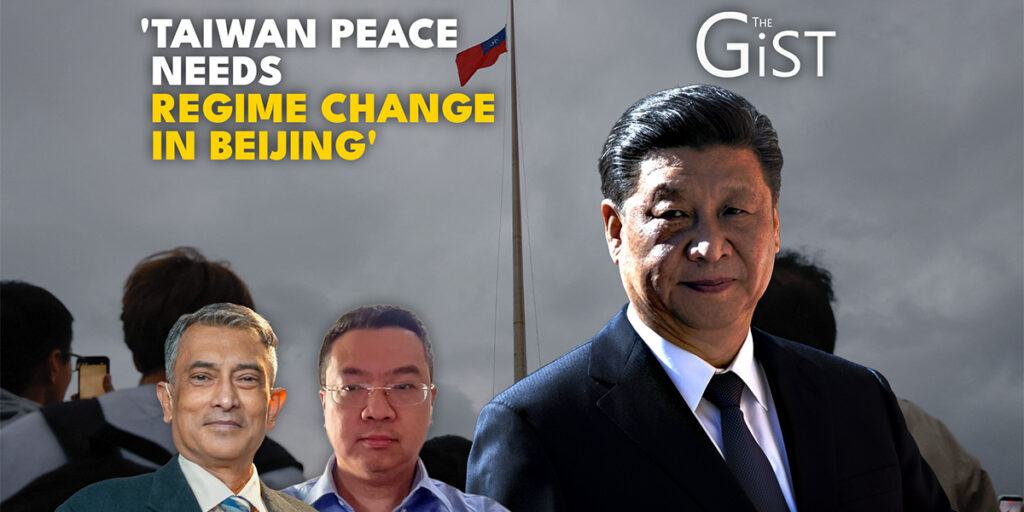
“Xi’s Rule Blocks Any Cross-Strait Peace”
China’s sustained military pressure on Taiwan reflects not just strategic signaling but deeper political constraints inside Beijing, according to Dr. Roger Chi-Feng Liu, Deputy Director of the Integrated Diplomacy Program at the DIMEs Center, Taiwan Think Tank.
Dr. Liu, who previously taught and conducted research in India for nearly eight years and is now an assistant professor at National Sun Yat-sen University, said the exercise—termed “Justice Mission 2025” by Beijing—was not a surprise. Taiwanese and US intelligence agencies were aware of the drills at least a week in advance, despite the absence of an initial public announcement
Speaking after the People’s Liberation Army’s latest exercises around Taiwan, Dr. Liu said prospects for lasting cross-strait peace remain limited under the current Chinese political system. Any meaningful de-escalation, he argued, would require fundamental political change in Beijing rather than tactical adjustments or confidence-building measures
The recent drills, described by the PLA as “Justice Mission 2025,” were not unexpected. Taiwanese and US intelligence agencies had advance warning of the exercise, despite the lack of an early public announcement. What distinguished the operation was proximity rather than scale. A PLA-designated target area in southern waters came within four nautical miles of Taiwan—its closest approach so far—though Chinese forces stayed outside Taiwan’s 24-nautical-mile territorial limit
“They are testing and moving closer every time,” Dr. Liu said, characterising the pattern as incremental escalation rather than preparation for immediate invasion
He linked the timing of the drills to two developments: recent US arms sales to Taiwan and statements by Japan’s new prime minister describing a Taiwan contingency as a Japanese contingency—moves Beijing appears intent on countering through calibrated pressure
Dr. Liu said Taiwan’s internal politics also shape its defence posture. The ruling Democratic Progressive Party lacks a legislative majority, allowing opposition parties to delay defence budgets by citing slow US weapons deliveries and unresolved problems with Taiwan’s indigenous submarine programme
Despite repeated PLA activity, Taiwanese society remains outwardly calm. Dr. Liu said most people do not expect an imminent invasion, even as the government strengthens civil resilience and energy stockpiles against blockade or quarantine scenarios.
On China’s long-term intent, Dr. Liu was blunt. Taiwan and China, he said, could only engage meaningfully if China’s political trajectory changed. Under Xi Jinping, Beijing prioritises regime control over reconciliation, leaving little room for durable peace across the Strait.
Watch closely—because the tactics Taiwan faces today echo across the Indo-Pacific, including India’s own strategic challenges.
Nvidia Rushes to Meet Surging Chinese Demand for H200 AI Chips
Nvidia is racing to boost production of its H200 artificial intelligence chips to meet soaring demand from Chinese technology firms and has approached contract manufacturer Taiwan Semiconductor Manufacturing Co (TSMC) to ramp up output, sources told Reuters.
Chinese companies have reportedly ordered more than 2 million H200 chips for 2026, while Nvidia currently holds only about 700,000 units in stock, two people familiar with the discussions said. A third source confirmed that Nvidia has asked TSMC to begin additional production in the second quarter of 2026, though the exact volume remains unclear.
The move underscores both the intensity of global demand for Nvidia’s AI chips and the supply pressures facing the industry. It also poses potential geopolitical risks, as Beijing has yet to approve imports of the H200, even after the U.S. government recently lifted restrictions on exports of the chip to China.
Balancing Supply and Political Risk
The U.S. Coast Guard’s decision to permit H200 sales subject to a 25% fee reversed the earlier export ban imposed by the Biden administration. But while Washington has given the green light, Chinese authorities have not yet decided whether to allow shipments, citing concerns about overreliance on foreign technology and its impact on the growth of the domestic semiconductor sector.
“Licensed sales of the H200 to authorised customers in China will have no impact on our ability to supply customers in the United States,” an Nvidia spokesperson said. “China is a highly competitive market with rapidly growing local chip suppliers. Blocking all U.S. exports undercut our national and economic security and only benefited foreign competition.”
TSMC declined to comment on the discussions, while China’s Ministry of Industry and Information Technology did not immediately respond to a request for comment.
Chinese Tech Giants Drive Demand
According to industry sources, most of the 2026 orders come from China’s leading internet and AI firms, which see the H200 as a major leap forward from current-generation processors. The chip part of Nvidia’s Hopper architecture uses TSMC’s 4-nanometre process and delivers about six times the performance of the H20, the downgraded version Nvidia had previously designed for the Chinese market.
Of Nvidia’s existing inventory, around 100,000 units are GH200 Grace Hopper superchips, combining the Grace CPU with the Hopper GPU architecture, while the rest are standalone H200 chips. Both types will be offered to Chinese buyers.
Pricing for Chinese clients is expected to average around $27,000 per chip, or roughly 1.5 million yuan for an eight-chip module. While this is higher than the 1.2 million yuan H20 module previously sold in China, analysts say buyers consider the H200’s performance-to-cost ratio attractive. It is also about 15% cheaper than comparable units sold on the grey market, which currently exceed 1.75 million yuan.
ByteDance, parent company of TikTok, reportedly plans to spend about 100 billion yuan on Nvidia chips in 2026 up from 85 billion yuan this year if Chinese regulators approve H200 imports, according to the South China Morning Post.
Global Supply Strains and Strategic Implications
If confirmed, the large-scale order would mark a major expansion of H200 production at a time when Nvidia is focusing on its newer Blackwell and upcoming Rubin chip lines. The company’s push to satisfy Chinese demand could exacerbate global supply shortages for AI processors, as data centre operators and cloud providers worldwide compete for limited inventory.
Analysts warn that Nvidia must strike a careful balance between maintaining its U.S. and European commitments and meeting Chinese orders. The regulatory uncertainty in China further complicates planning, with officials considering proposals that would require companies purchasing H200 chips to also buy a set ratio of domestically produced processors.
Despite the risks, the surge in demand from China underscores Nvidia’s dominance in the AI hardware market and highlights how political and economic pressures continue to shape the global semiconductor supply chain.
with inputs from Reuters