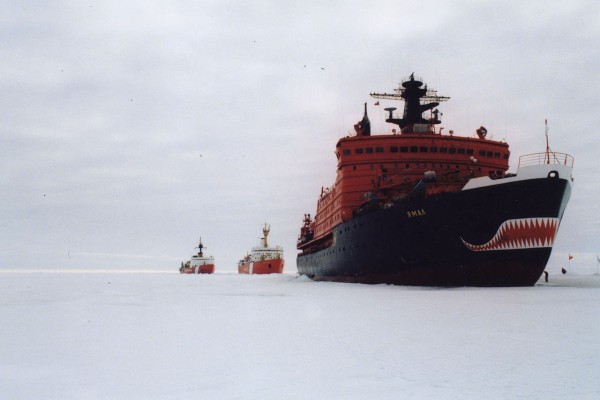
India and Russia are preparing to open a new chapter in their long-standing strategic partnership, with both nations exploring the joint construction of Arctic-class ships. These vessels are specifically engineered to operate in some of the planet’s most extreme maritime environments.
The proposal is expected to feature prominently during Russian President Vladimir Putin’s two-day state visit to India beginning today.
The idea gained traction after Russia’s First Deputy Prime Minister Denis Manturov revealed that both sides are assessing opportunities in the Arctic shipbuilding sector. He said the harsh and increasingly strategic Arctic region demands “high ice-class vessels capable of safe navigation in challenging hydro-meteorological conditions, making collaboration timely and mutually beneficial.”
Why Arctic-Class Ships Matter
Arctic-class ships, whether tankers, bulk carriers, LNG transports or support vessels are designed with reinforced hulls, advanced navigation systems, and propulsion technologies that allow them to cut through thick sea ice.
As the Arctic warms and new shipping routes like the Northern Sea Route (NSR) open up for longer periods each year, these vessels are becoming crucial for global trade and energy transport.
For India, access to Arctic-capable technology offers several long-term advantages:
Strategic Reach in a Changing Maritime Landscape: The melting Arctic ice is transforming the NSR into a viable corridor linking Asia and Europe. By developing Arctic-class ships, India positions itself to participate in future commercial traffic, resource exploration, and scientific missions in the High North.
Enhanced Security and Operational Mobility: The recently approved Reciprocal Exchange of Logistics (RELOS) agreement allows Indian naval and air assets to use Russian military facilities including those in the Arctic and Pacific regions. Arctic-class vessels would enable India to fully exploit this access, improving mobility for joint exercises, humanitarian missions, and maritime security operations.
Entry Into a High-Value, High-Technology Niche: The global demand for ice-class and polar vessels is set to grow as Arctic navigation increases and countries ramp up polar research. Mastering this niche would lift India into an elite category of advanced shipbuilding nations.
Opportunity for India’s Shipbuilding Sector: The proposed partnership comes as India is making a decisive push to scale up its maritime manufacturing capabilities. In September, the Union Cabinet approved a Rs 69,725-crore package to bolster shipbuilding, including:
- A revamped Rs 24,736-crore Shipbuilding Finance Assistance Scheme
- A Rs 25,000-crore Maritime Development Fund
- Nearly Rs 20,000 crore for new shipbuilding clusters
- This financial infusion aims to position India as a competitive global shipbuilding hub, reducing dependence on imports and capturing a share of international orders.
- A collaboration with Russia widely regarded as a world leader in nuclear icebreaker construction would accelerate India’s climb up the technology ladder.
Industry Benefits
- Technology transfer in hull reinforcement, propulsion, and navigation systems
- Skilled jobs in coastal manufacturing hubs
- Better utilisation of the new shipbuilding clusters under development
- Export potential for ice-class vessels to friendly nations
- Strengthening domestic innovation, especially in materials and marine engineering
Experts say India could eventually adapt ice-class design principles for its own naval and coast guard fleets operating in the Antarctic and Southern Indian Ocean.
The Arctic shipbuilding proposal is being examined by a bilateral working group led by Rosatom on the Russian side and the Ministry of Ports, Shipping and Waterways for India. The initiative fits into a broader pattern of growing civil-industrial ties.
If approved during President Putin’s visit, joint production of Arctic-class vessels could become one of the most significant Indo-Russian industrial projects of the decade. It aligns with India’s maritime ambitions, supports its shipbuilding revival, and leverages Russia’s unmatched expertise in polar engineering.
More importantly, it could give India a foothold in the evolving geopolitics of the Arctic, where new trade routes, new energy frontiers, and new strategic dynamics are rapidly taking shape.