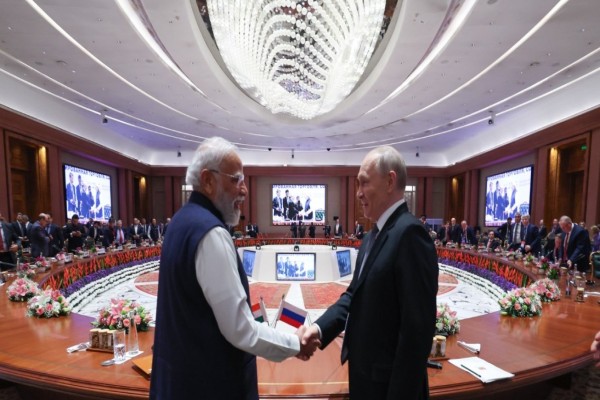
India and Russia are actively seeking to broaden their longstanding commercial relationship so that it extends beyond the traditional focus on energy.
That is the basic argument of a December 8, 2025 publication by Sharmila Kantha in NatStrat (an independent strategic research centre). The piece underscores how the two countries, commemorating 25 years of a “special and privileged strategic partnership,” are pursuing policies to deepen and diversify bilateral trade in the face of shifting global economic and geopolitical pressures.
Kantha notes that during Russian President Vladimir Putin’s state visit to India on December 4–5, 2025, leaders reaffirmed their commitment to expanding economic cooperation, including advancing work on a free trade agreement with the Eurasian Economic Union, addressing tariff and non-tariff barriers, improving logistics, promoting connectivity, and enhancing financial and payment mechanisms.
These negotiations form part of a broader Programme for the Development of Strategic Areas of India-Russia Economic Cooperation till 2030, with both countries targeting $100 billion in bilateral trade by 2030.
The article highlights a diplomatic balancing act for New Delhi. Historically, India’s trade with Russia has been heavily concentrated in crude oil, which accounted for the bulk of bilateral commerce—surging from about $8.7 billion in 2021 to over $64 billion in 2024-25 due to energy imports.
But because of Western sanctions on Russian oil, including bans on refined products and additional U.S. tariffs aimed at deterring Russian oil purchases, India’s energy imports have declined sharply, prompting policymakers to rethink the structure of their economic ties.
Stripping out oil, bilateral trade remains modest: India’s trade with Russia outside of energy was only about $12 billion in 2024-25, meaning most of the economic relationship rests on energy and related commodities. Kantha argues that this residual figure reveals the need for concerted efforts to expand trade in non-energy sectors.
Doing so would better align India’s export strengths—such as machinery, pharmaceuticals, organic chemicals, electronics, apparel, and other manufactured goods—with Russian import needs, while also diversifying Russian exports to India beyond traditional fuels and basic commodities.
India already imports a range of products from Russia, including fertilisers, vegetable oils, diamonds, iron and steel, and newsprint, though these are relatively low-value items compared with crude oil.
On India’s side, exports to Russia include machinery and parts, pharmaceutical products, organic chemicals, and electronics, but total values remain small. With targeted market access efforts and efforts to dismantle non-tariff barriers, both countries see scope to build a more balanced and sustainable trade portfolio.
The report cites institutional mechanisms such as the Inter-governmental Commission on Trade, Economic, Scientific, Technological and Cultural Cooperation (IRIGC-TEC), which brings together multiple working groups focused on sectors like agriculture, banking, transport, and industrial cooperation.
Regular engagement through these groups, including efforts to harmonise certification and conformity testing, is intended to reduce regulatory hurdles that have hindered broader commerce to date.
Financial cooperation and payments infrastructure also figure prominently as areas needing attention. Sanctions and restrictions have complicated cross-border payments, leading to a large build-up of rupee balances with Russian banks. Both sides are exploring enhanced interbank cooperation, interoperability of payment systems, and even central bank digital currency linkages to facilitate smoother trade settlement and reduce currency risk.
The report points to services trade and tourism as additional frontiers for growth, noting that India’s substantial services exports—especially in IT, transport, and tourism—have yet to take root significantly in the Russian market. Proposals such as free e-visas for Russian tourists and greater collaboration in information and communications technology are seen as avenues to expand economic engagement beyond goods trade.
Kantha’s analysis also stresses the broader geopolitical context. India must balance its deepening economic cooperation with Russia against its growing commercial ties with Western markets and the strategic pressures that those relationships bring.
Achieving ambitious bilateral trade targets will require both governments to build confidence among private sector actors, mitigate sanctions-related risks, and equip businesses with the certainty and predictability necessary for deeper investment and engagement.
In sum, India-Russia Trade: Expanding Beyond Energy emphasises that the relationship is evolving from one dominated by energy into a multifaceted economic partnership with significant room to grow.
Success in this transition depends on tackling barriers to diversified commerce, strengthening institutional cooperation, and building resilient financial and logistical frameworks that support balanced and sustained trade growth.

In a career spanning three decades and counting, Ramananda (Ram to his friends) has been the foreign editor of The Telegraph, Outlook Magazine and the New Indian Express. He helped set up rediff.com’s editorial operations in San Jose and New York, helmed sify.com, and was the founder editor of India.com.
His work has featured in national and international publications like the Al Jazeera Centre for Studies, Global Times and Ashahi Shimbun. But his one constant over all these years, he says, has been the attempt to understand rising India’s place in the world.
He can rustle up a mean salad, his oil-less pepper chicken is to die for, and all it takes is some beer and rhythm and blues to rock his soul.
Talk to him about foreign and strategic affairs, media, South Asia, China, and of course India.