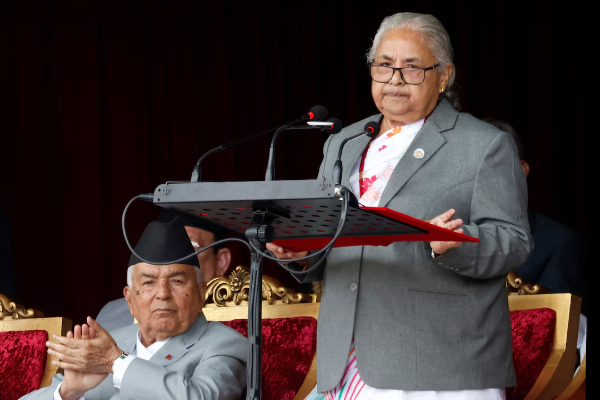
After witnessing the violent Gen-Z protests of September, Nepal is now gearing up for elections in March 2026 which, it is hoped, will “settle down” tensions and usher in stability.
That’s the hope expressed by Baburam Bhattarai, former Nepal prime minister, who was addressing an event in Delhi recently. He was confident elections would go ahead as scheduled on March 5.
“Nepal believes in inclusivity. Nepal believes in democracy … Nepal will never declare Hinduism as state religion. Also, let me dispel a misconception that monarchy might come back in Nepal. No, it is not so. Monarchy in Nepal is dead. You don’t resurrect a dead body,” he said.
Bhattarai, former guerrilla leader who played a key role in Nepal’s revolutionary Maoist insurgency, said that the Constitution of Nepal was shaped by the aspirations of common people.
“Nepalese have allegiance towards Hinduism, but Nepal will not declare any religion as the state religion … We don’t want to declare a state religion because then there will be exclusion and that is why we never did it in Nepal. We wanted a secular Nepal where there will be freedom to practice all religions,” he stressed.
“For the first time in the history of Nepal, people’s elected representatives made their own constitution through the constituent assembly. I had the opportunity to lead that process … And I was heavily influenced by Babasaheb Ambedkar, I was also influenced by European enlightenment – liberty, equality and fraternity,” Bhattarai said.
He said Nepal’s constitution is “very inclusive” and “one of the most progressive, democratic constitutions in the world.”
“Despite this we failed to transform our economy, failed to provide jobs to the youth, failed to promote a strong economic base,” he said, adding that Nepal’s constitution has a provision of free education for the Dalits but these provisions were never implemented.
Elections In March
He attributed the Gen-Z protests to the “leadership failure” of then prime minister KP Sharma Oli.
“Our leadership failed to deliver while aspirations of the youth increased and outcome was Gen-Z uprising,” said Bhattarai. But he also claimed “internal as well as external factors” were at play even as resentment amongst the youth got entangled with the “penetration of various interests.”
The protests were triggered by ongoing tensions among various sections of the Nepali society which realised that the government under Oli was failing in governance and also failed to uphold democratic values as enshrined in the Constitution.
“Elections will happen and it should happen. If we don’t have elections and power is not handed over to elected representatives of the people then democratic values will take a hit. And such a scenario will not only adversely impact Nepal, but the impact will be felt in India too,” he said.
“I have seen the struggle for democracy so even if old parties are replaced by new parties (post March elections) they will have to follow democratic principles and democratic rights,” he said.
Delhi-Kathmandu Trust Deficit
Despite tensions with India, he said both countries share a deep relationship across all spheres and both sides must address the growing “trust deficit.”
“We have a tremendous trust deficit … Serious trust deficit. India and Nepal are closely linked. But we have to upgrade our relationship according to the needs of the 21st century,” he said.
India has to understand and realise that “Nepal has no intention to give space to those who want to do harmful activities against India.”