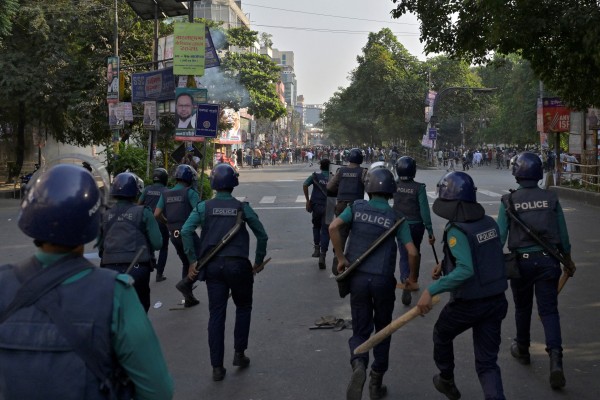
The killing of student leader Sharif Osman Hadi in Dhaka, followed days later by the attempted assassination of Motaleb Shikder in Khulna, has pushed Bangladesh into a familiar but dangerous phase: shock, speculation, and a growing sense of political drift. When violence strikes at moments of uncertainty, attention naturally turns outward.
Who benefits? Who is watching? And who is shaping the story as it unfolds? These questions matter. But they are often asked in the wrong order.
The recent attacks do not require external planning to explain how they occurred. Bangladesh is in the middle of a fragile political transition. Authority is contested. Institutions are under strain. Rival groups are testing limits.
In such environments, targeted violence can emerge from internal rivalries alone. History, in Bangladesh and elsewhere, offers no shortage of such examples. Where the external dimension becomes relevant is not at the point of execution, but after the fact.
In modern geopolitics, influence rarely begins with action. It begins with interpretation. Once violence occurs, the political environment shifts. Emotions rise. Trust weakens. Rumour fills the gaps left by incomplete information. This is where indirect influence becomes effective not by causing events, but by shaping how they are understood.
Pakistan’s approach to Bangladesh has long reflected this logic. Direct interference carries costs: attribution, diplomatic fallout, and the risk of escalation. Indirect influence, by contrast, offers flexibility. It allows engagement without ownership and relevance without responsibility. The recent assassinations have created precisely the kind of environment where this method works best.
Bangladesh’s internal debates provide the entry points. Questions around national identity, secularism, and the legacy of 1971 have never fully disappeared. They resurface during moments of stress, often with sharper edges. Violence accelerates this process. It turns political disagreement into moral outrage and narrows the space for nuance.
In such conditions, certain narratives gain traction almost on their own. Claims that historical settlements remain unsettled. Arguments that accountability itself fuels instability. Appeals to broader ideological or religious identity.
These themes are not imported wholesale. They already exist within Bangladesh’s political ecosystem. What changes is their intensity and reach.
Pakistan’s role, where it exists, is largely confined to intensification rather than direction. Sympathetic voices, aligned commentators, diaspora discussions, and digital platforms reinforce narratives that resonate with long-standing positions in Pakistan’s own political discourse. This does not require coordination. Alignment is enough.
Crucially, this method leaves no fingerprints. There are no orders to trace, no operational links to expose. If challenged, the absence of evidence becomes part of the defence. If ignored, the narratives still circulate. Either way, plausible deniability is preserved.
The effectiveness of this approach lies in its patience. Pakistan does not need to manufacture crises in Bangladesh. It waits for them. Domestic instability creates openings that cannot be engineered as easily from the outside. Once those openings appear, influence flows with minimal effort.
The danger for Bangladesh is not that it is being controlled externally, but that its internal vulnerabilities make it susceptible to narrative capture. Each unresolved attack erodes confidence and each delayed investigation fuels speculation. Over time, the political conversation shifts from facts to frames, from accountability to accusation.
Responding to this challenge is not straightforward. Overreaction risks amplifying external narratives. Silence allows them to settle. The most effective counter, though also the hardest, is internal: credible investigations, visible enforcement, and political restraint across factions. Confidence is the enemy of indirect influence.
It is also important to avoid misdiagnosis. Treating indirect influence as direct aggression invites escalation without solving the underlying problem. Ignoring it entirely leaves the information space unguarded. The balance lies in recognising how influence operates today quietly, laterally, and often without a single identifiable author.