Begum Khaleda Zia, the first woman to serve as prime minister of Bangladesh, has died at the age of 80, leaving behind a complex legacy in her nation’s politics and in South Asia’s diplomatic history.
As the long-time leader of the Bangladesh Nationalist Party (BNP), Zia shaped Bangladesh’s domestic life for over three decades and played a defining role in Dhaka’s relations with its giant neighbour, India — a relationship marked by periods of strain, cautious cooperation, and mutual diplomatic regard even amid deep political differences.
Born 15 August 1945 in Jalpaiguri, then part of British India, Khaleda Zia’s early years were rooted in a shared South Asian past before partition reshaped the subcontinent. Her family moved to Dinajpur in East Bengal (now Bangladesh) after 1947, embodying the complex human history that underlies modern India-Bangladesh ties.
Zia entered politics reluctantly after the assassination of her husband, President Ziaur Rahman, in 1981. Taking the reins of the BNP—a party he had founded—she transformed herself from political novice to one of the most formidable leaders in Bangladesh. She led the nation as prime minister three times across the 1990s and early 2000s, spearheading the return to parliamentary democracy and implementing key domestic reforms.
Yet, her relationship with India was complex, shifting between cooperation, suspicion, and strategic distancing — reflecting both ideological differences and geopolitical realignments in the region.
The broader arc of Khaleda Zia’s career was dominated by her intense rivalry with Sheikh Hasina, leader of the Awami League. Known as the “Battle of the Begums,” this rivalry shaped Bangladeshi politics for decades and coloured perceptions in New Delhi, where the Awami League was often viewed as a more familiar partner due to its historic ties with India.
During her early years in power, Zia and the BNP cultivated a foreign policy that was notably cautious towards India. This stance was shaped in part by her party’s ideological orientation and historical concerns about India’s influence in Bangladesh’s internal affairs. The BNP’s foreign policy under Khaleda often emphasized balancing relations with multiple powers — including the Muslim world, the West, and China — and was sceptical of undue Indian influence.
As one academic analysis notes, elements within Khaleda Zia’s leadership at times held India responsible for broader regional dynamics that they viewed as unfavourable, and this perception influenced Dhaka’s diplomatic posture in the 1990s.
During this period, ties with India were tense, particularly over trade imbalances, water sharing, and border management issues. While Bangladesh and India had established formal diplomatic relations after 1971, lingering mistrust often undercut deeper cooperation when Khaleda’s BNP was in power.
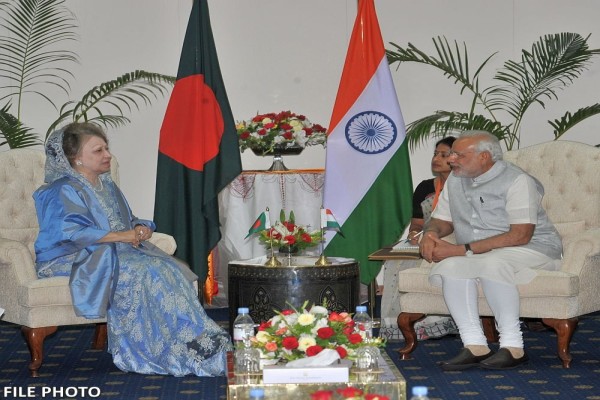
But despite ideological reservations, Khaleda Zia did undertake high-level engagement with India. Official visits to New Delhi and meetings with Indian leaders were part of the diplomatic routine, even as her government maintained a cautious approach to bilateral issues. Reports from past research show that her visits often included discussions on critical matters like water sharing, trade, and border agreements — matters that remain central to India-Bangladesh relations.
These interactions highlighted the pragmatic side of her leadership. Even when the BNP’s rhetoric was wary, practical diplomacy continued. For example, during visits and negotiations, Indian officials engaged with her government on issues of mutual concern, seeking to bridge gaps while advancing cooperation.
The longstanding rivalry between Khaleda Zia and Sheikh Hasina profoundly influenced Bangladesh’s internal politics and, by extension, its foreign relations. The two leaders alternated power for decades in a deeply polarized political landscape. India traditionally maintained a closer relationship with Sheikh Hasina’s Awami League, whose party roots traced back to the Bangladeshi independence movement of 1971.
In contrast, the BNP’s nationalist ideology and its alliance with more conservative forces in Bangladesh made India more cautious about deep strategic engagement during Khaleda’s tenures. Over time, this divergence shaped the character of India-Bangladesh relations, with cooperative thrusts often occurring under Awami League governments and cooler phases under BNP leadership.
In her later years, as Khaleda Zia’s health deteriorated and she stepped back from active politics, overtures between India and the BNP leadership took on new significance. In 2025, amidst broader shifts in Dhaka’s political landscape, there were signs that India was exploring ways to broaden ties beyond traditional allies. Reports from recent weeks suggest that messages and gestures from Indian leadership to Khaleda Zia while she was ailing were interpreted by some analysts as India’s attempt to foster goodwill with the BNP ahead of pivotal elections.
These gestures hinted at a diplomatic evolution, where bilateral relations might transcend the personal rivalries of Bangladesh’s two most prominent political families. Such moves underscored the enduring importance New Delhi places on stable, multifaceted ties with Dhaka — irrespective of which party leads Bangladesh.
Khaleda Zia’s legacy in India-Bangladesh relations is neither straightforward nor uniformly adversarial. Instead, it reflects the ebb and flow of geopolitical and domestic calculations: early scepticism tempered by pragmatic diplomacy, ideological caution counterbalanced by mutual interests, and later attempts at rapprochement amid changing political currents.
Her political path — from reluctant entry into politics to decades at the centre of power — illustrates how personal leadership and national strategy can intersect with regional relationships. For India, her tenure was a reminder that Dhaka’s foreign policy orientation would often be shaped by internal political dynamics as much as by external factors.
As South Asia contemplates the impact of her passing, Khaleda Zia’s life offers a lens on the complexities of Bangladesh’s engagement with India — marked by wariness, negotiation, competition, and ultimately recognition that stable ties between neighbouring democracies are essential for peace and prosperity in the region.
Her death not only marks the end of a defining chapter in Bangladeshi politics but also invites reflection on the evolving nature of India-Bangladesh cooperation in a rapidly changing geopolitical landscape.

In a career spanning three decades and counting, Ramananda (Ram to his friends) has been the foreign editor of The Telegraph, Outlook Magazine and the New Indian Express. He helped set up rediff.com’s editorial operations in San Jose and New York, helmed sify.com, and was the founder editor of India.com.
His work has featured in national and international publications like the Al Jazeera Centre for Studies, Global Times and Ashahi Shimbun. But his one constant over all these years, he says, has been the attempt to understand rising India’s place in the world.
He can rustle up a mean salad, his oil-less pepper chicken is to die for, and all it takes is some beer and rhythm and blues to rock his soul.
Talk to him about foreign and strategic affairs, media, South Asia, China, and of course India.