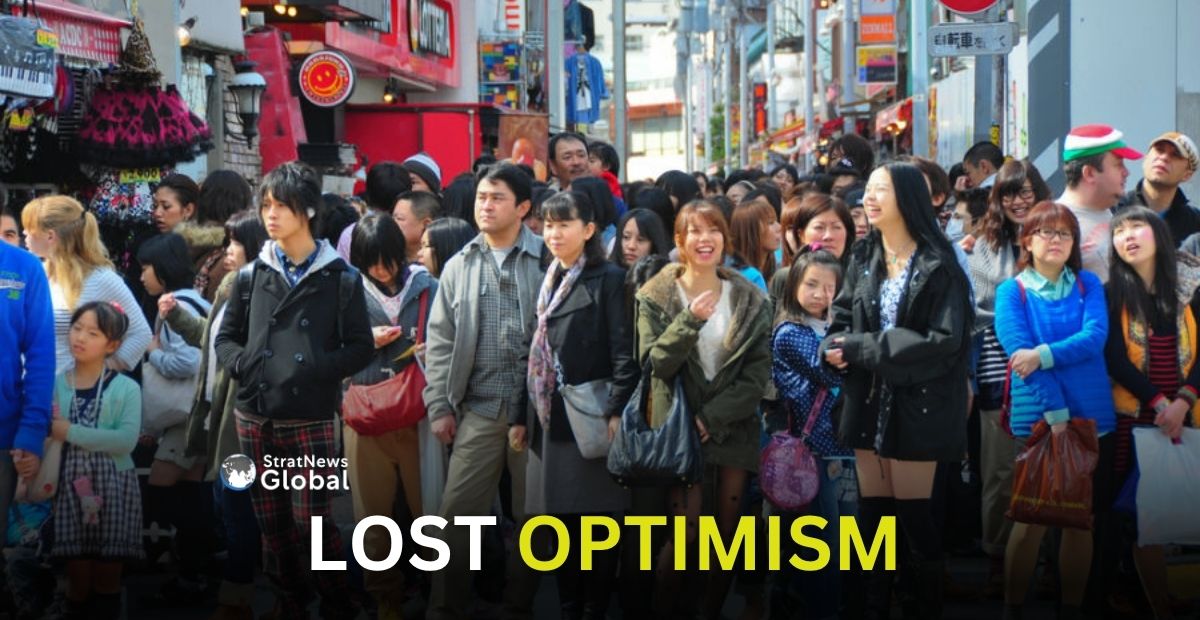
A new survey, published in The Japan Times, suggests that young people in Japan are more pessimistic about their personal prospects and the future of their country, reflecting a trend that echoes a wider social pattern of withdrawal and low expectation among youth.
The Nippon Foundation Awareness Survey of 18-Year-Olds, which polled 1,000 respondents aged 17 to 19 across Japan, U.S, China, South Korea, UK and India, found that only about 16% of Japanese respondents believed their country’s future would improve, the lowest among all those surveyed.
This pessimism is reflected on how young people view their own lives. Only around 62% of Japanese respondents said they had dreams for the future, far below their counterparts in India which is about 86%. They were also the least likely to feel they had something meaningful to devote themselves to or that they were needed by others.
Such responses align with a broader discourse in Japan around social withdrawal. The phenomenon of ‘hikikomori’, where individuals isolate themselves from society for extended periods. Similarly, the idea of a ‘satori generation’ has been used to describe young people who have seemingly achieved a state of ‘enlightenment’ by giving up traditional material desires, ambition, and hope due to prolonged economic stagnation.
This detachment also appears in attitudes toward education and work. Nearly 20% of Japanese respondents said “none in particular”, far higher than in other countries.
Compared with their global peers, Japanese youth were also more likely to believe that factors such as gender, nationality or disability could limit their success. Japan recorded the lowest percentage of respondents who saw marriage and having children as desirable, at around 59%.
Across Japan, South Korea and China, respondents pointed to declining birth rates and aging populations as the most pressing national challenges. These factors may be contributing to the sense of uncertainty among youth.
(With inputs from agency)