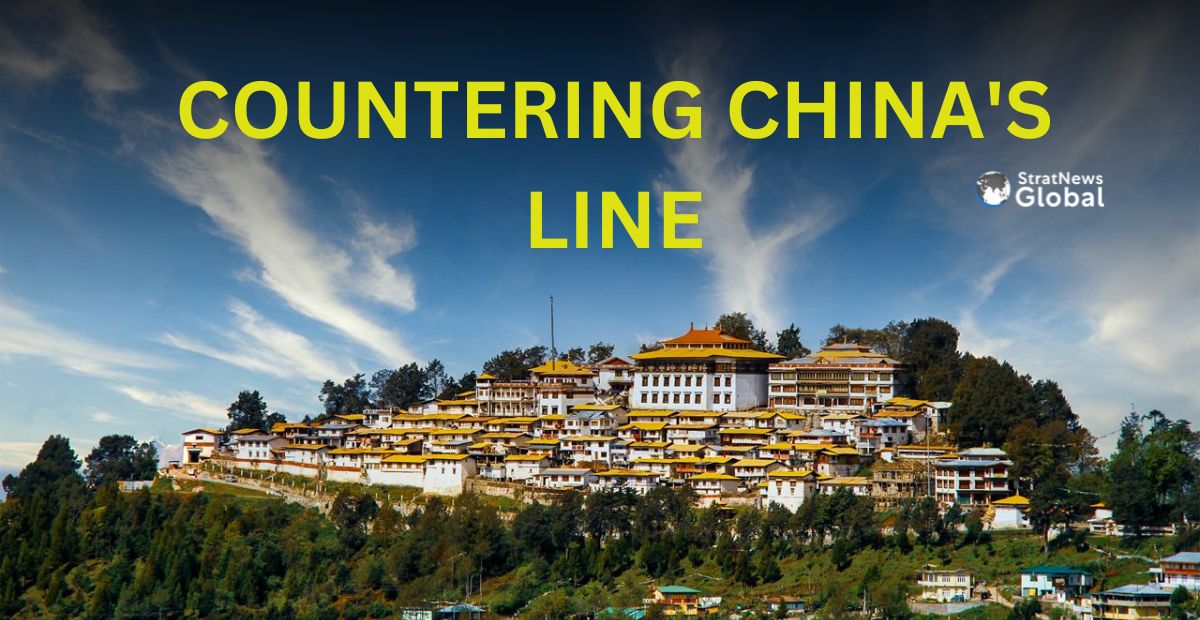
What’s the link between an international conference in Arunachal Pradesh on the life and teachings of a 17th century Buddhist spiritual leader and a mountaineering team which recently climbed a snow-clad peak in Tawang?
The international conference which took place in Tawang, birthplace of the sixth Dalai Lama Tsangyang Gyatso, celebrated not only for his spiritual discourses but also for his romantic poetry and songs that remain popular to this day among Tibetan communities.
The 29,000-foot plus peak that was scaled was named after Gyatso, marking another event in the tug-of-war over Buddhism between India and China. That and the international conference on Gyatso also seeks to counter China’s propaganda-driven narrative on Tibet.
Noted Tibetologist Vijay Kranti, who was in Tawang to attend the conference, noted that “The Indian government has in recent years started realising that Buddhism has its own international political and diplomatic value.
Claude Arpi, another renowned Tibetologist, warned that “Chinese leaders openly speak about the sinicization of Tibetan Buddhism. It means erasing the Nalanda origins of Tibetan Buddhism and replacing it with Chinese Buddhism, which is not a historical fact.”
China’s renaming of places in Tibet with distinct Chinese overtones, is a major concern for Tibetans all over the world. While the issue is expected to figure in the conference deliberations, the International Campaign for Tibet recently warned in a report that Beijing is doubling down with the call to fully implement “the party’s strategy for governing Tibet in the new era.”
The call by He Moubao, senior Communist Party leader in Tibet, mandates “political loyalty and socialist integration”. During a visit to the Labrang Monastery in Gansu province, he signaled a renewed push to align monastic institutions with Beijing’s political priorities.
In other words, in accordance with the decisions taken at the 4th plenary session of the communist party in October, Tibet “must forge a strong sense of community for the Chinese nation.” It must also adhere “to the sinicization of religion in China.”
This flows from Xi Jinping’s policy that requires religious traditions to conform to ‘Chinese characteristics.’ The underlying meaning is the greater state oversight of monastic life and an ideological curriculum that prioritizes patriotism, national identity, and adherence to the party’s narrative of history and culture.
In state-run boarding schools, children are instructed exclusively in Mandarin and prohibited from using their native language, eradicating their identity and asserting their cause from an early age. China went a step further, getting the Panchen Lama to preside over the Kalachakra ceremony, a serious step given that he has been appointed by the Chinese state and has no credibility.
Kranti underscored that “China has taken many steps that have irritated both the Indian government and the people of India and these actions have deeply offended the people of Arunachal Pradesh.”
The implication is if India doesn’t act, Tibetan Buddhism will slowly become Chinese Buddhism. This is where the international conference in Tawang will help counter China’s narrative on Tibet. Scholars and monks will debate extensively on a range of issues, its outcomes will have the blessings of the Dalai Lama, meaning it will have credibility and can be then disseminated among Tibetan communities worldwide.
The fact that it is taking place in Arunachal Pradesh is significant since the state has “high significance in the history of Buddhism and in issues related to India and China,” Kranti said.
A spokesman for the International Buddhist Confederation pointed to the fact that the sixth Dalai Lama was born in Arunachal and the Indian connection therefore is fact. The conference cannot destabilise China’s hold over Tibet but through the generation of ideas, help build the case for real Tibetan autonomy even within China’s fold.