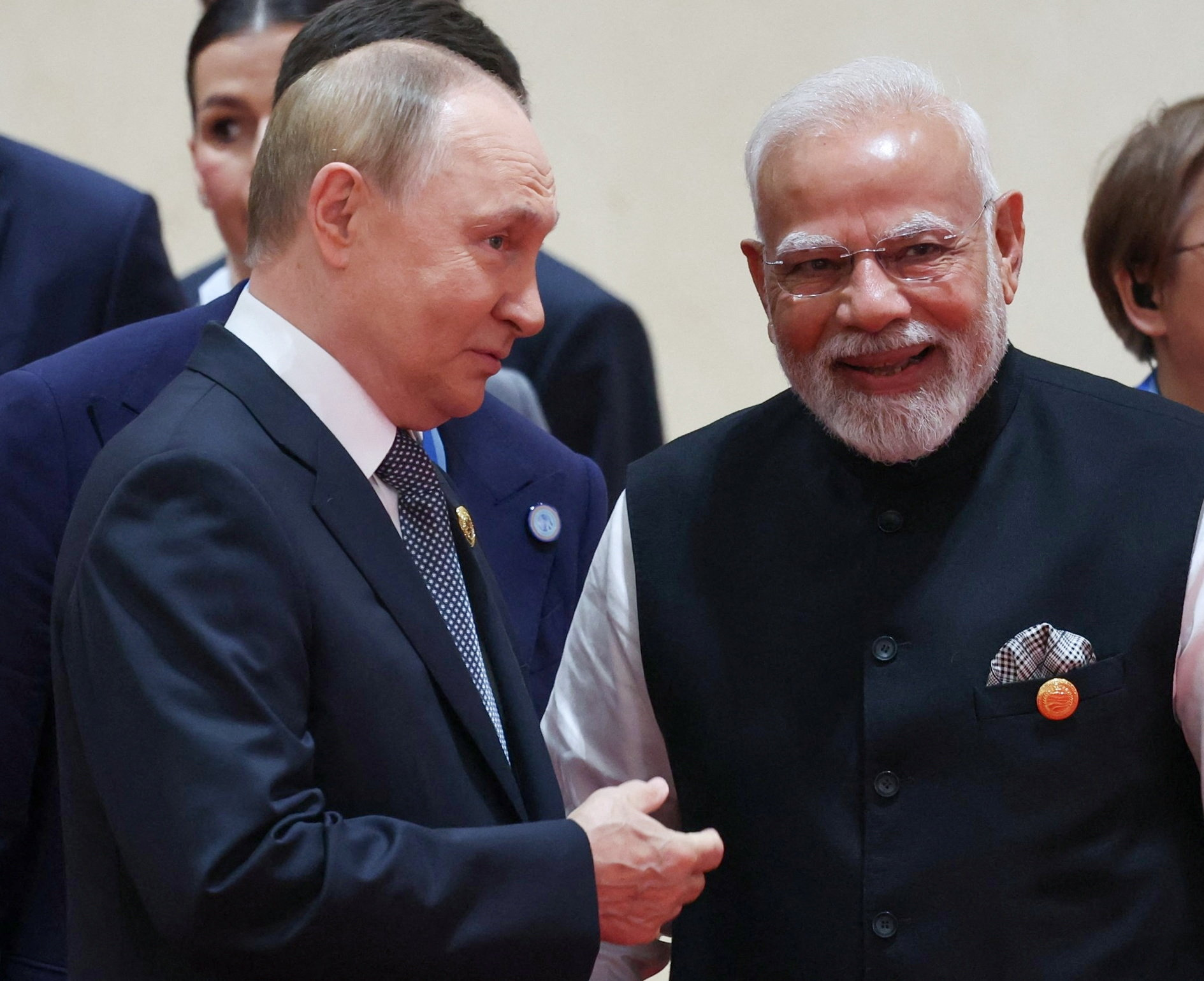
Russia’s President Vladimir Putin and Prime Minister Modi will review the full spectrum of their long-standing partnership, from defence and nuclear cooperation to energy, trade and mobility. The visit is being closely watched not only for the agreements New Delhi and Moscow intend to unveil, but also for the geopolitical signalling it sends amid ongoing Western pressure on India over its Russia ties.
Putin’s Presidential Aide Yury Ushakov noted that both leaders will “discuss the entire extensive agenda of Russian-Indian relations comprehensively.”
The bilateral dialogue remains “regular and confidential,” he said, pointing to five phone conversations this year and high-level exchanges in Moscow with India’s national security and foreign policy leadership.
Ushakov stressed that cooperation continues to widen across domains, rooted in what he described as “a strong and long-term friendship and mutual respect.”
The visit, he said, aims to reinforce progress in politics and security, economy and finance, transport and logistics, science and technology, education and culture, and will also mark the approaching 15th anniversary of the elevation of ties to a “special and privileged strategic partnership.”
What’s on the Agenda
India and Russia are expected to discuss ways to broaden the trade basket and insulate economic flows from sanctions-related disruptions. Bilateral trade has risen sharply over the past two years, driven predominantly by Russian energy exports.
For New Delhi, a key challenge is correcting the substantial trade imbalance, Indian exports stood at just under $5 billion last year against imports exceeding $63 billion.
Ushakov confirmed that a new Program for Strategic Economic Cooperation until 2030 is one of the documents likely to be adopted during the visit. Indian officials say the discussions will target new avenues for exports, particularly in pharmaceuticals, machinery, chemicals and food products.
One of the most consequential agreements expected at the summit is a bilateral labour mobility pact that will streamline the recruitment of skilled Indian workers for Russian industries. The framework would cover worker protections, legal migration channels and sector-specific employment opportunities, particularly in construction, textiles, engineering and electronics.
A major focus will be on strengthening financial architecture to avoid external disruptions. Both sides are considering linking India’s RuPay with Russia’s Mir payments network and expanding bilateral banking routes that bypass Western sanctions regimes.
Energy remains the strongest pillar of the partnership. Russia has quickly become India’s largest crude oil supplier, providing more than a third of its imports. Discussions are expected on long-term contracts and new investments, including Russia’s offer to partner with India on small modular nuclear reactors. While a full contract may not be finalized, government sources say an announcement is likely.
Defence Upgrades
Despite speculation, Indian officials insist that the visit should not be judged by “big-ticket deals.” While no major new defence acquisitions are expected, several significant areas will feature in the discussions:
- Additional long-range missiles for the S-400 air defence system.
- Progress on the delayed delivery of the Akula-class nuclear submarine now pushed to 2028.
- Talks on Russia’s offer of the Su-57 stealth fighter,
- India’s interest in upgrades for the Su-30MKI fleet and extended-range BrahMos missiles.
- Review of offers including the S-500 air defence system, Sprut light tanks, and Pantsir air defence units.
Space Cooperation
A high-profile contract is expected: a 100% transfer of technology for the RD-191M semi-cryogenic rocket engine, which will equip future GSLV Mk3/LVM3 launch vehicles and boost India’s geostationary payload capacity.
Ukraine War, Multilateral Cooperation
Both leaders will exchange views on current international developments, including the state of negotiations on the Russia-Ukraine conflict. Ushakov said the leaders would also discuss cooperation in forums such as the UN, SCO, G20 and BRICS, with India set to chair BRICS in 2026.
India is expected to reiterate its position that the “era of war” must give way to dialogue and diplomacy, even as it continues to steer clear of direct mediation.
Putin’s visit comes amid a complicated geopolitical environment. The EU has publicly urged India to consider European security concerns over Russia, while the United States has imposed steep tariffs on Indian exports — including penalties linked to India’s purchases of discounted Russian crude.
Yet New Delhi has made clear that its strategic ties with Moscow will not be diluted under external pressure. As one senior Indian official put it, the summit offers a chance to reaffirm ties with “an old and trusted partner” while addressing areas that need recalibration.
India’s approach described by External Affairs Minister S. Jaishankar as “multi-alignment” enables it to maintain strong ties with both Western partners and countries like Russia, based on issue-specific interests rather than blocs.
A Message Beyond Delhi
For Russia, Ushakov noted that the visit demonstrates that Moscow retains partnerships “of global significance.” For India, the meeting underscores that its strategic autonomy remains intact, despite Western scrutiny of its Russian oil purchases, defence deals and multilateral coordination with Moscow.
Putin will meet President Droupadi Murmu and participate in the Russia-India Business Forum, as well as the launch of the RT television channel in India. A joint statement and several agreements are expected before his departure on Friday evening.