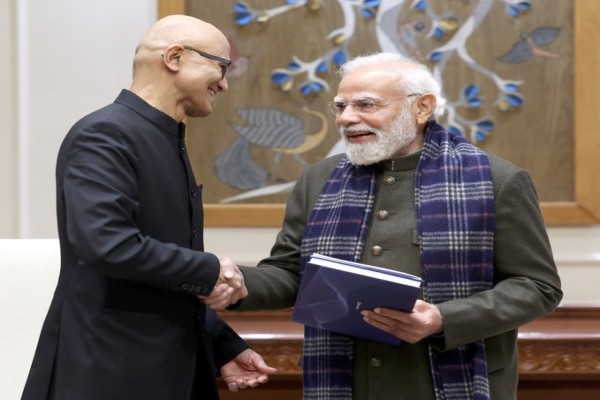
India’s ambitions to secure a stronger foothold in the global artificial intelligence race received a major boost this week as Microsoft and Amazon unveiled more than $50bn in planned investments, though analysts say the country still faces steep challenges in matching the scale and speed of leading AI nations.
The commitments include Microsoft CEO Satya Nadella’s $17.5bn investment — the company’s largest in Asia — aimed at expanding India’s AI infrastructure, skilling programmes and sovereign capabilities.
Amazon’s parallel plan to deploy over $35bn in India through 2030 adds heft to a narrative of renewed foreign confidence, even as global markets debate whether the extraordinary run-up in AI valuations represents a historic technological shift or the early contours of a speculative bubble.
The scale of these announcements also throws into sharper relief the structural deficiencies that continue to constrain India’s long-term competitive trajectory. Brokerages such as Jefferies and HSBC describe India as a “reverse AI trade,” arguing that the country’s markets could outperform if the broader AI surge falters.
This framing also underscores the reality that India has remained peripheral to the global AI boom: its stock indices have lagged behind those in South Korea and Taiwan, where AI-oriented hardware ecosystems have attracted billions in foreign inflows.
The latest mega-investments inject energy into India’s aspirations, but they do not resolve the central question of whether the country can meaningfully close the distance with the US and China, whose massive compute resources, cohesive data ecosystems and multi-decade R&D pipelines are difficult to replicate at speed.
India’s strengths are real — a deep pool of engineering talent, rapid enterprise adoption of AI, and growing investment in data centres and semiconductor manufacturing, illustrated by Intel’s new partnership with Tata Electronics — but they interact with systemic weaknesses that limit India’s ability to convert momentum into leadership.
At the heart of the challenge is India’s sovereign AI mission. The government is preparing to launch its first homegrown, multilingual AI model, backed by a $1.25bn programme to provide high-end chips to researchers and start-ups.
It is a symbolic milestone, but one that sits uncomfortably beside the expansive, long-horizon commitments made by France, Saudi Arabia, the US and China. These countries are not only spending vastly more, they are building institutional frameworks that link research labs, industry, government and defence—creating layered innovation ecosystems where India still exhibits fragmentation.
The country’s most strategically consequential vulnerability, however, may be talent mobility. India has 2.5 times the global average concentration of AI-skilled professionals, yet its most advanced researchers often leave.
A recent Ernst & Young report warns that without aggressive incentives—preferential visas, research grants, tax support, and liquidity pathways for deep-tech ventures—India will struggle to retain or repatriate the kind of elite talent that drives frontier AI breakthroughs. China’s extensive state-backed incentives have created precisely the opposite dynamic, turning talent acquisition into a competitive instrument of national strategy.
What the new investments reveal, then, is a dual truth: foreign firms increasingly see India as a critical AI market, but not yet as a global AI engine. To bridge that gap, India will need far more than capital inflows and enthusiasm. It must invest deeply in compute, reform data governance, build durable public-private research linkages and craft a talent strategy that treats AI not merely as a growth sector but as a pillar of national capability.
The country’s ability to “buck the AI trend”—to benefit from global volatility rather than be shaped by it—depends on whether it can shift from reactive catch-up to proactive ecosystem-building. The Amazon and Microsoft announcements may mark a turning point, but only if India uses this moment to address the foundational gaps.

In a career spanning three decades and counting, Ramananda (Ram to his friends) has been the foreign editor of The Telegraph, Outlook Magazine and the New Indian Express. He helped set up rediff.com’s editorial operations in San Jose and New York, helmed sify.com, and was the founder editor of India.com.
His work has featured in national and international publications like the Al Jazeera Centre for Studies, Global Times and Ashahi Shimbun. But his one constant over all these years, he says, has been the attempt to understand rising India’s place in the world.
He can rustle up a mean salad, his oil-less pepper chicken is to die for, and all it takes is some beer and rhythm and blues to rock his soul.
Talk to him about foreign and strategic affairs, media, South Asia, China, and of course India.