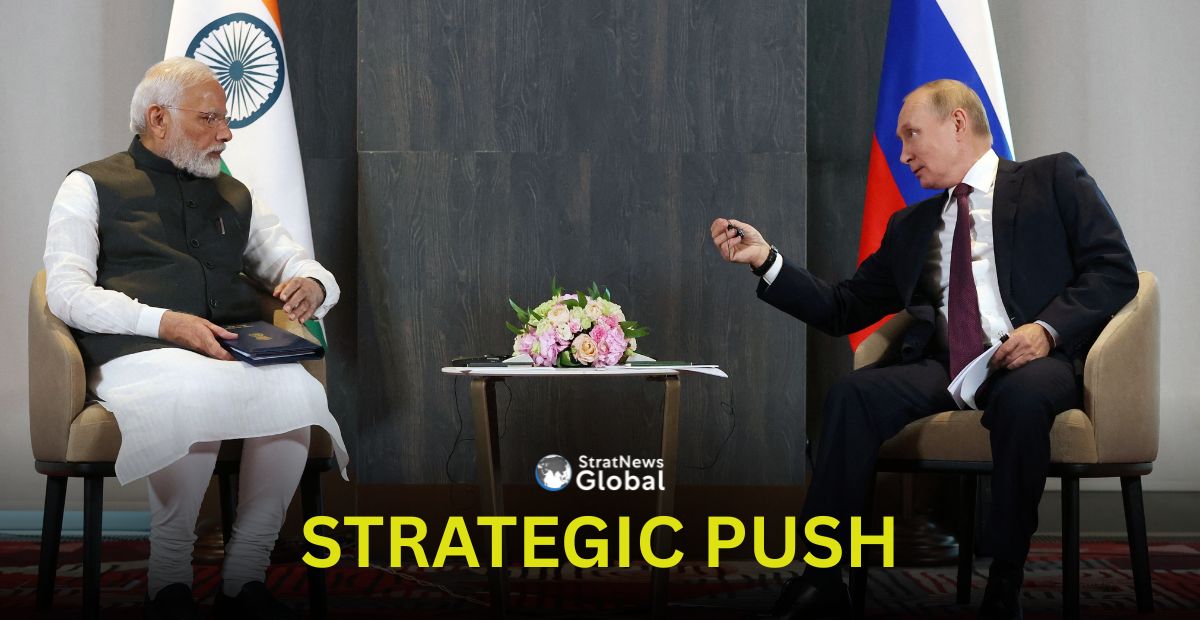
With bilateral trade at a crossroads and energy flows under strain, India is gearing up for a high-stakes summit with Russian President Vladimir Putin on Friday, an engagement officials say will prioritise “expansive, sector-wide economic agreements,” ranging from healthcare and mobility to a long-awaited Free Trade Agreement (FTA) with the Eurasian Economic Union (EAEU) and new transport corridors linking South Asia to Eurasia.
According to senior officials in the Ministry of External Affairs (MEA), the 23rd India–Russia Summit will place “unprecedented emphasis” on strengthening the economic architecture of the partnership at a time when global supply chains, energy markets and geopolitical alignments are in flux.
Growing Trade Ambitions
Officials noted that while India–Russia trade has expanded significantly in recent years, driven largely by energy purchases, the structure of trade remains “highly imbalanced” in Russia’s favour. India aims to correct this by expanding exports across a wide basket of goods.
“We have identified pharmaceuticals, agriculture, food-processing, marine products and several categories of consumer goods as priority sectors for expanding exports,” a senior MEA official said. Indian exporters of processed food, engineering goods, textiles and speciality chemicals are also being prepared for deeper engagement with Russian and Eurasian markets.
Multiple agreements across healthcare, trade, economics, media cooperation and mobility are expected to be signed during Putin’s visit.
India–EAEU FTA
For an India–Eurasian Economic Union (EAEU) FTA, the Terms of Reference were finalised in Moscow recently between India’s Commerce Ministry and the Eurasian Economic Commission. And the first round of negotiations has taken place.
“The FTA is a major priority for both sides,” MEA officials said. “This is not a new idea, but the urgency has increased. Once customs, standards and market-access issues are ironed out, it will open substantial opportunities for Indian businesses across the Eurasian region.”
Officials highlighted that the FTA could help offset fluctuations in energy trade and provide more predictable access for Indian exporters to Russia, Kazakhstan, Armenia, Belarus and Kyrgyzstan.
Connectivity Corridors
India and Russia are also doubling down on two major connectivity initiatives:
International North–South Transport Corridor (INSTC) linking India to Russia and onward to Europe via Iran, is being prioritised to reduce logistics costs and transit times.
“Technical-level discussions on customs harmonisation and digital tracking are in advanced stages,” an MEA official said.
Chennai–Vladivostok Maritime Corridor is expected to significantly shorten cargo transit between India and Russia’s Far East, boosting trade in coal, timber, seafood, and machinery.
“These corridors will be indispensable for taking advantage of the FTA once it is concluded,” officials noted.
Mobility
Mobility will be a major discussion point, especially after instances of Indian nationals being misled into combat or non-combat roles inside Russia.
“Mobility frameworks must ensure safety, legality and transparency,” an official said. India is expected to reiterate its demand that all Indians recruited into the conflict be returned, adding that “more than a dozen have already come back, and the process is ongoing.”
India and Russia are negotiating a structured mobility agreement to facilitate the recruitment of skilled Indian workers in sectors such as construction, infrastructure, transport and energy, but only through legal, government-approved channels.
Energy Trade
On declining oil imports from Russia, officials stressed that India’s energy sourcing remains “guided by commercial considerations and global market dynamics.”
“International sanctions and other market factors naturally affect the equation,” an MEA official said, adding that decisions “will continue to be made by Indian companies based on price, logistics and risk assessments.”
India is also working with Russia on clearing issues related to currency settlement, banking channels and repatriation of dividends from Indian investments in Russian energy projects.
Nuclear & Defence Cooperation
Officials said defence issues are always discussed at summits but “are never announced at that level,” referring to speculation about S-400 systems or aircraft deals.
On nuclear cooperation, both sides will review progress at Kudankulam and discuss future projects, including potential collaboration on small modular reactors.
“There is ongoing technical dialogue, but nothing can be confirmed before the leaders meet,” an official clarified.
Western Commentary
Asked about recent editorials by European ambassadors urging India to reconsider its Russia policy, officials were blunt: “It is not acceptable diplomatic practice for foreign envoys to offer public advice on third-country issues,” adding that India’s Russia policy is guided solely by its national interests.
Regarding Ukraine officials reiterated India’s consistent stance: “We support all efforts that lead to an immediate cessation of hostilities and a return to diplomacy.”
There is no indication that any specific peace proposal will be on the table during the summit.
A Pivotal Moment
As officials pointed out, India and Russia are marking 25 years of their strategic partnership, and the agenda for this summit reflects both continuity and expansion.
“This is not a transactional visit,” an MEA official stressed. “It is a strategic summit with wide-ranging implications for trade, connectivity, energy, mobility and emerging technologies.”