If 2024 was about political mandate, 2025 was the year India’s external environment stripped away remaining illusions. The neighbourhood grew more competitive, great-power pressure became more explicit, and strategic ambiguity proved less forgiving.
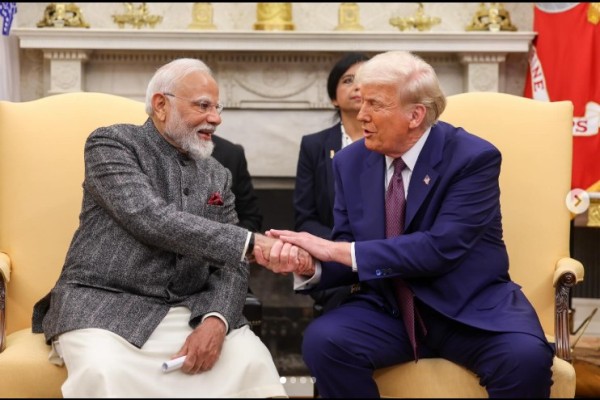
The most consequential recalibration unfolded with the United States. Prime Minister Narendra Modi’s visit to Washington early in the year reaffirmed strategic continuity, but old frictions quickly returned. The second Trump presidency reintroduced a bluntly transactional tone. Tariff threats resurfaced, underscoring that strategic convergence does not shield partners from economic leverage.
More politically sensitive were repeated claims by Donald Trump that Washington had “brokered” calm between India and Pakistan. The Prime Minister went to Parliament and denied any such role—effectively calling the US president a liar. The denial was necessary, but the optics were costly.
The real question is not whether Trump exaggerated—he often does—but whether India misjudged how little narrative restraint this White House would exercise, even with long-standing partners.
That misreading mattered because it intersected with a deeper shift. The US resumed limited engagement with Pakistan—not as a pivot or favour, but as a contingency hedge. Washington once again signalled that it would keep multiple South Asian channels open, regardless of Indian discomfort.
Despite this friction, Indo-US defence and technology cooperation continued to move forward. Co-production discussions, advanced platform access, jet-engine collaboration, space coordination, and semiconductor supply-chain initiatives progressed precisely because they were insulated from headline politics.
If the US relationship required balance, ties with Russia demanded calibration.
President Vladimir Putin’s December visit to India for the annual summit reaffirmed defence and energy cooperation, signalling continuity despite Western pressure. For Moscow, India remains a critical partner; for New Delhi, Russia remains a reliable friend, but not the only one.
At the same time, 2025 made the costs of that relationship more explicit. Western scrutiny of India’s Russian oil purchases and legacy defence dependence persisted, pushing India to accelerate diversification rather than posture defiance. The visit sent a deliberate message: India would not abandon old partnerships to validate new ones, but neither would it mortgage future flexibility to sentiment.
Defence ties with France deepened further, building on earlier fighter and submarine cooperation. New deals and follow-on negotiations covering aircraft, naval platforms, and advanced munitions reinforced Paris’s position as India’s most politically reliable Western defence partner, less prone to sanctions pressure or strategic conditionality.
Perhaps the clearest marker of India’s strategic maturation came not from imports, but exports.
BrahMos missile sales gathered momentum in 2025 as India positioned the system as a credible deterrence tool for friendly regional states. The 2023 delivery of the first BrahMos batch to the Philippines was a watershed. If ongoing negotiations with Vietnam and Indonesia conclude, the significance will go well beyond revenue—signalling India’s arrival as a selective but serious defence exporter capable of shaping regional military balances.
All of this unfolded against the unchanging backdrop of China. Border talks continued without resolution—and crucially, without expectation. There was no Modi–Xi reset and no informal summitry. India’s force posture along the LAC normalised permanence; infrastructure acceleration became routine. China is no longer a crisis to be managed, but a condition to be planned around.
This hardening forced India into a delicate global juggling act—deepening security coordination within the Quad while preparing for BRICS chairmanship, navigating debates on de-dollarisation, and absorbing the turbulence unleashed by Trump’s disruptive approach to trade, alliances, and institutions.
Strategic autonomy in 2025 was no longer about balance for its own sake, but about surviving a stressed system without being pulled into another power’s orbit.
That realism filtered into India’s neighbourhood policy. With Pakistan, deterrence replaced dialogue. With Bangladesh, political uncertainty was met with non-partisan engagement and institutional continuity.
In Nepal, nationalist rhetoric was countered not with rebuttal but with electricity exports, connectivity, and patience. In Sri Lanka, India stepped out of the spotlight as Colombo stabilised, confident that delivery had earned credibility.
India’s neighbourhood is no longer a comfort zone. Its great-power relationships—especially with the US, Russia, and France—are no longer ideological anchors but calibrated instruments.
Strategic autonomy, once a slogan, has become a discipline enforced by hard choices.
Tomorrow: India’s Next Test Is Strategic Choice

In a career spanning three decades and counting, Ramananda (Ram to his friends) has been the foreign editor of The Telegraph, Outlook Magazine and the New Indian Express. He helped set up rediff.com’s editorial operations in San Jose and New York, helmed sify.com, and was the founder editor of India.com.
His work has featured in national and international publications like the Al Jazeera Centre for Studies, Global Times and Ashahi Shimbun. But his one constant over all these years, he says, has been the attempt to understand rising India’s place in the world.
He can rustle up a mean salad, his oil-less pepper chicken is to die for, and all it takes is some beer and rhythm and blues to rock his soul.
Talk to him about foreign and strategic affairs, media, South Asia, China, and of course India.