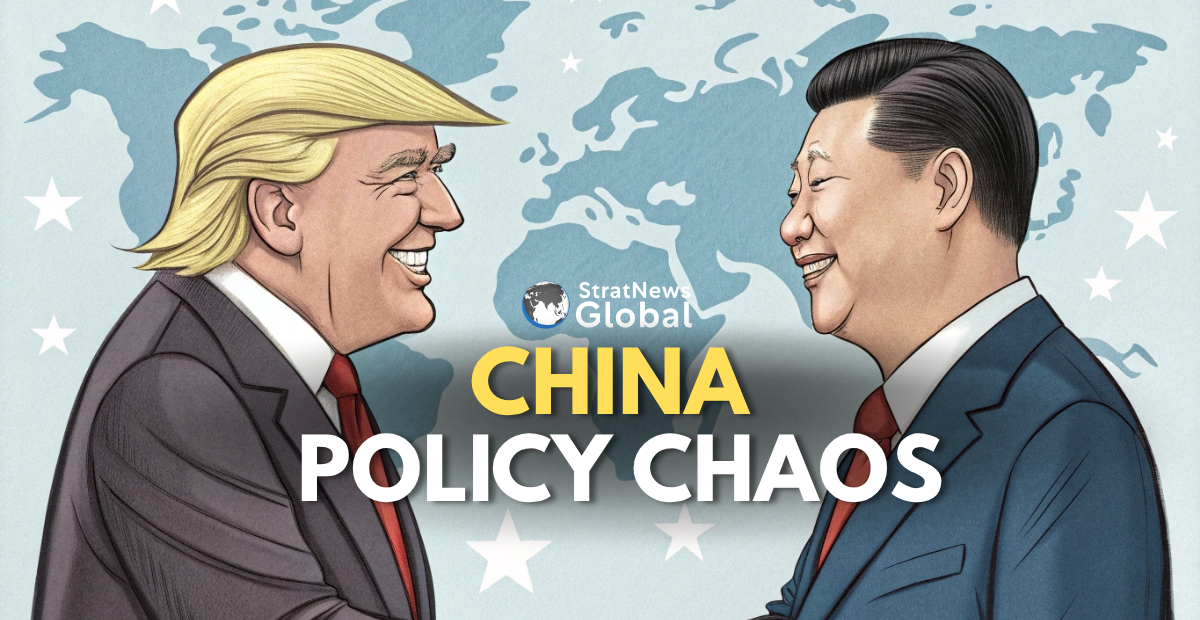
When Donald Trump returned to office in 2025, he vowed to use tariffs to reset relations with China, accusing Beijing of “killing” the United States with its trade policies.
More than a year into his second term, however, critics say those aggressive moves have failed to significantly alter China’s trade or military behaviour. Instead, Washington’s China policy appears inconsistent, marked by abrupt shifts and conflicting signals.
Policy Zigzags
Recent months have seen a series of reversals. The administration added top Chinese firms to a military blacklist, only to withdraw the list shortly after. In another instance, Trump approved sales of advanced AI semiconductors to China minutes after U.S. officials warned such access posed national security risks.
As Trump prepares for a May 14–15 visit to China to meet Xi Jinping the first such trip by a U.S. president in eight years analysts say these inconsistencies may undermine Washington’s strategic position.
“You have departments and agencies acting on their own accord, often with different objectives,” said Ely Ratner. “On any given day, it feels like the policy can zigzag in either direction.”
The White House, however, defended the approach, saying Trump’s trade agenda had “flipped the script” on decades of failed policy and strengthened America’s negotiating position.
No Clear Plan B
Trump began his second term with sweeping tariffs, raising duties on Chinese goods to around 145%. Beijing responded with retaliatory measures, and tensions escalated before both sides settled into an uneasy détente.
China’s leverage over rare earth supplies critical for U.S. industries played a key role in forcing a pause. A February ruling by the U.S. Supreme Court that invalidated many tariffs further weakened the strategy.
“Their entire original strategy was centered around using tariffs to pressure China into major concessions,” said Scott Kennedy. “There has been no coherent Plan B.”
While tariffs helped reduce the U.S. goods trade deficit with China by 32% in 2025, they failed to shift Beijing’s broader economic policies or significantly boost U.S. manufacturing.
Conflicting Signals on Technology
Policy contradictions have extended beyond tariffs. In December, Trump approved the sale of advanced AI chips from Nvidia to China, even as U.S. authorities warned such technology transfers posed security risks.
Similarly, the Pentagon briefly blacklisted major Chinese tech firms before reversing course within hours. Export controls targeting Chinese companies were also paused following Beijing’s threat to restrict rare earth exports.
“These contradictions ultimately trace back to President Trump,” said Zack Cooper, pointing to decision-making that appears driven by short-term considerations rather than a consistent strategy.
Strategic Gains and Risks
Some of Trump’s actions have pressured China indirectly. U.S. moves against Iran and Venezuela have weakened key Chinese partners, while an $11 billion arms package to Taiwan signalled continued support for the island.
However, analysts warn these steps come with trade-offs. Military engagements have stretched U.S. resources, and concerns persist that Washington could use Taiwan as leverage in trade negotiations with Beijing.
“If this is a chess match, the U.S. is taking pawns off the periphery rather than controlling the center,” said Jonathan Czin.
Credibility at Stake
At the same time, tensions with allies over tariffs and security issues risk weakening a broader coalition aimed at countering China’s influence.
From Beijing’s perspective, the shifting U.S. approach reflects deeper institutional challenges. Wang Dong said the inconsistency could erode U.S. credibility on the global stage.
“While transactional tactics and coercive signalling persist, they are increasingly overshadowed by coordination failures,” he said.
(with inputs from Reuters)