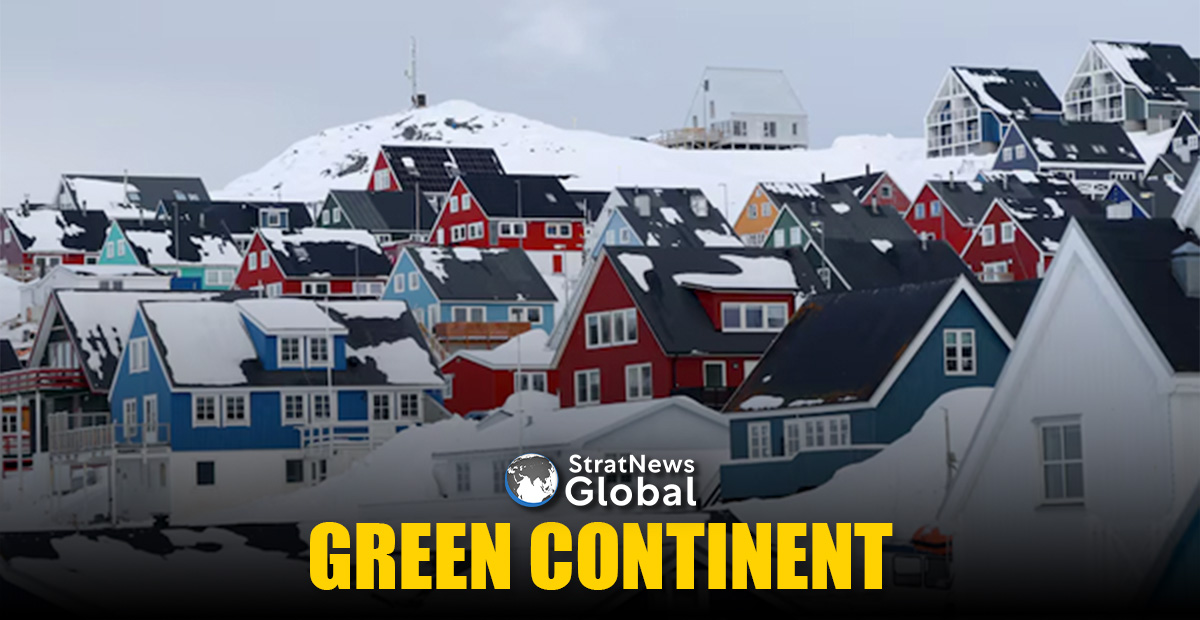
President Donald Trump’s renewed push to acquire Greenland reflects a deeper transformation in how the United States views power, territory, and global competition. Greenland sits at the centre of an intensifying geopolitical struggle involving the United States, China, and Russia.
His obsession about Greenland combines military strategy, economic security, resource control, and most importantly preventing rivals from gaining a foothold in the rapidly changing Arctic.
Strategic Geography
Greenland occupies a commanding location between North America and Eurasia, directly astride the shortest routes for intercontinental missiles, military aircraft, and Arctic shipping.
During the Cold War, this geography made Greenland indispensable to US missile-warning systems. Today, as polar ice retreats and Arctic access expand, that same geography has become even more valuable.
However, for Washington, Greenland is not just territory, it is a platform:
- A forward military buffer against Russia
- A monitoring point for missile launches and space activity
- A gatekeeper to Arctic sea lanes
- A territorial anchor in a region where sovereignty claims are sharpening
Trump has repeatedly claimed that Denmark lacks the capacity to defend Greenland against foreign encroachment.
Military Imperatives
The US already maintains a significant military presence in Greenland through the Pituffik Space Base (formerly Thule). This supports missile detection, space surveillance, and early-warning systems. As Russia modernises its Arctic bases and China expands its polar research and naval capabilities, US defence planners increasingly view Greenland as indispensable to maintaining strategic parity.
His administration has openly suggested that military force cannot be ruled out, a statement that has deeply alarmed NATO allies. An attack or coercive seizure of Greenland, which is part of the Kingdom of Denmark, would directly challenge the principle that NATO members do not threaten one another.
European leaders have warned that such an action would fundamentally undermine the alliance. Critics argue that this alone makes Trump’s position dangerously destabilising. Supporters counter that Arctic competition has already outgrown NATO’s old assumptions.
Keeping China Out
Greenland holds significant reserves of minerals essential for modern and green technologies, including: Rare earth elements; Lithium; Cobalt; Nickel; and Copper.
These materials are critical for electric vehicles, renewable energy infrastructure, batteries, defence systems, and advanced electronics. China currently dominates global rare earth processing and companies have already shown interest in Greenlandic mining and infrastructure projects. This has raised an alarm within US security circles.
By acquiring Greenland US hopes to block Chinese access to Arctic mineral reserves and Secure long-term resource independence for green and military technologies.
Economic Possibilities
Climate change has transformed Greenland from a frozen periphery into a zone of economic possibility. With the ice sheets melting land and seabeds are being exposed and these were previously inaccessible.
This has several consequences: New mining opportunities for critical minerals; Renewed interest in oil and gas exploration (despite Greenland halting new licences in 2021); and expanded access to Arctic shipping routes.
Although Greenland’s government has taken a cautious stance on fossil fuels, future economic pressures could reopen debates about extraction. The US sees early control as a way to shape how, and by whom these resources are developed.
Arctic Shipping Lanes
Melting sea ice is opening new Arctic maritime corridors that dramatically shorten travel between Europe and Asia, cutting journey times by up to 40–50% compared with the Suez Canal route.
Both Russia and China have agreed to cooperate on developing these northern shipping routes. What will US gain?
Once it takes over Greenland, it will have leverage over: Maritime surveillance; Major transit chokepoints; Port development; and Search-and-rescue infrastructure.
In strategic terms, whoever dominates Arctic logistics gains both economic advantage and military reach.