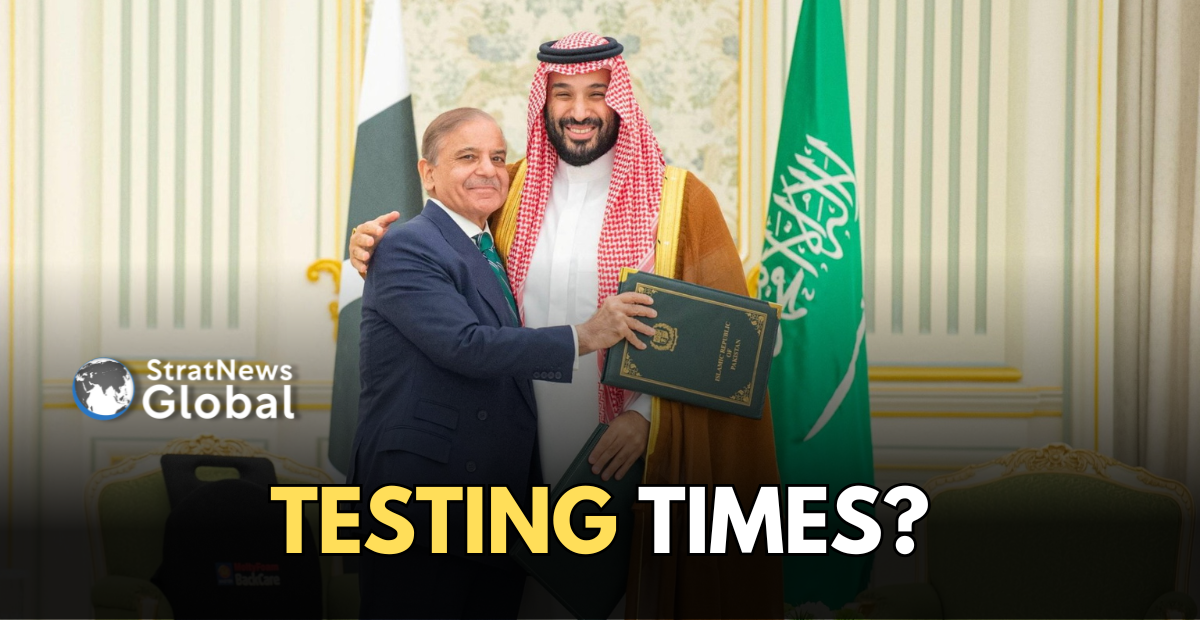
There’s a million-dollar question up in the air after Mosharraf Zaidi, spokesman for the Pakistan Prime Minister Shehbaz Sharif, said in an interview on Wednesday, “We will come to Saudi Arabia’s aid, no matter what and no matter when.”
The obvious question: Is he serious? Can he back it up?
On the face of it, the answer would be yes. The Saudi-Pakistan defence pact signed last year makes it clear that an attack on one would be deemed an attack on the other and would invite a response.
Lahore-based international relations expert Rashid Ahmad Khan told Bloomberg that there was “little clarity” around the defence pact, but “Pakistan might be asked to secure Hormuz” as part of the agreement. That would bring Pakistan directly in Iran’s line of fire.
“In Riyadh, the Saudi leadership is watching to see if its nuclear-armed partner means what it says,” warned an article in the journal of the Middle East Council for World Affairs. But this is dangerous ground as Islamabad well knows.
Pakistan’s 40 million Shia population will not like their government to attack Iran when it is being bombed by the US and Israel. Iran, too, for its part, can leverage tools (such as Pakistan’s Shias) to make things difficult for Islamabad.
Shias make up about 15-20% of Pakistan’s population, and the community had turned out in force in Karachi, Islamabad, and other areas following the assassination of Ayotollah Khamenei, Iran’s Supreme Leader.
Earlier this month, Pakistan’s Field Marshal Asim Munir met Saudi Arabia’s Defence Minister Prince Khalid bin Salman to discuss Riyadh’s defence mechanisms against Iranian attacks. But the Pakistanis are caught in a cleft stick: militarily siding with the Saudis will please them and ensure the financial and energy tap for Islamabad remains open.
But Iran won’t like it, and there’s every possibility it could go “ballistic” around the border with Pakistan that runs 900 km. The border has remained stable since the two sides exchanged missiles following cross-border attacks by terror groups. The two sides wish it to remain that way.
“Pakistan also risks handing the Afghan Taliban, which has committed to cooperating with Iran in the face of American aggression, an incentive to open a second front,” said the article in the Middle East Council for World Affairs.
Muhammad Khatibi, a political analyst based in Tehran, told Al Jazeera that geography also constrains Pakistan’s choices. “Any perception that Islamabad is siding militarily against Tehran could inflame domestic sectarian divisions in ways that a full-scale regional war would make very difficult to contain.”