The 1962 India–China war was sparked not by a sudden border dispute but by Cold War covert operations, as sustained CIA efforts to destabilise Tibet reshaped Beijing’s threat perceptions and dragged India—often unknowingly—into the resulting confrontation.
Recently declassified US government documents show that the Central Intelligence Agency ran a sustained covert war in Tibet in the late 1950s and pursued it despite clear awareness that it could provoke China and destabilise India–China relations.
This reconstruction draws on recently declassified US State Department records, including Foreign Relations of the United States volumes released decades after the war, as well as declassified intelligence material relating to covert operations in Tibet. These documents have been synthesised and analysed in investigative reporting by Kit Klarenberg and in recent peer-reviewed scholarship by D. Lakshmana Kumar, which reassesses the origins of the 1962 conflict using Indian, American, and Chinese archival sources.
For decades, the origins of the 1962 war were explained narrowly, framed either as a cartographic quarrel or as a failure of Indian military preparedness. Tibet, when mentioned at all, appeared as a peripheral complication. The documentary record now tells a different story. Tibet was not incidental to the conflict; it was the arena in which the strategic logic of the Cold War first collided with the fragile politics of post-colonial Asia.
By the mid-1950s, Washington had concluded that direct confrontation with the People’s Republic of China was neither feasible nor desirable. Instead, US planners sought indirect pressure points along China’s vast periphery. Tibet, recently brought under Beijing’s control and geographically isolated, emerged as a prime candidate. Declassified US planning documents and later official acknowledgements make clear that American policymakers did not believe Tibet could be liberated. Its value lay in distraction, attrition, and propaganda.
Beginning in 1957, Tibetan fighters were secretly removed from the region, trained abroad in guerrilla warfare, communications, and sabotage, and then parachuted back into Tibet. Arms and supplies followed through covert air drops. These operations expanded significantly in 1958 and 1959, precisely when China was already under acute internal strain from the failures of the Great Leap Forward and growing unrest in Tibet.
From the American perspective, success was measured not by battlefield outcomes but by pressure exerted. Later admissions by US officials acknowledged that even a failed insurgency served strategic purposes if it forced Beijing to divert troops, harden internal controls, and expose itself internationally. Tibet, in this calculus, was not a people or a place but an instrument.
For China, however, Tibet was existential. Chinese leaders had long believed that unrest in border regions invited imperial intervention, a lesson drawn from their own modern history. As resistance intensified and its sophistication became evident, Beijing concluded that it could not be indigenous. Formal Chinese protests from the period accused “imperialist forces” of orchestrating subversion against Chinese sovereignty.
India entered this picture not by design, but by geography and circumstance. Tibetan refugees crossed into India. Political activity centred in places like Kalimpong. Communications passed through Indian territory. While New Delhi neither authorised nor controlled the covert war in Tibet, Chinese leaders increasingly viewed India as a permissive conduit for hostile activity.
Secrecy proved decisive. The CIA’s Tibetan programme was covert not only from the public but also from much of the Indian political leadership. India had no operational oversight of actions unfolding in its immediate neighbourhood. Yet from Beijing’s perspective, distinctions between American action and Indian responsibility blurred. Geography collapsed nuance, and suspicion filled the gaps.
The Tibetan uprising of March 1959 and the Dalai Lama’s flight to India marked a turning point. For India, granting asylum was a humanitarian act consistent with its values. For China, it confirmed the belief that India had abandoned neutrality. Chinese internal discussions and public messaging from this period increasingly framed Tibet—not the boundary line—as the central grievance shaping Sino-Indian relations.
State Department and policy documents show that American officials were aware that covert action in Tibet could push China toward confrontation with India. Yet the programme continued. In Cold War logic, a widening rift between China and a major non-aligned Asian state was not an unintended consequence; it was strategically useful.
By the end of the 1950s, the effects were cumulative. China hardened its posture along the frontier. Diplomatic talks stalled. Chinese patrols moved forward in disputed areas. India, interpreting these moves as territorial aggression, responded with forward deployments of its own. Each step reinforced the other side’s worst assumptions, all against the unresolved backdrop of Tibet.
The crucial point is that the 1962 war did not erupt suddenly. It emerged from years of escalating mistrust rooted in covert action, misperception, and Cold War strategy. Chinese leaders repeatedly linked the need to “teach India a lesson” to what they saw as Indian interference in Tibet. At the same time, continued American covert activity ensured that Chinese anxieties about encirclement never receded.
India found itself trapped by forces it did not control. Its policy of non-alignment limited its leverage over the superpowers. Its humanitarian actions were reinterpreted as hostility. And its lack of visibility into covert American operations meant it bore the consequences of decisions taken elsewhere.
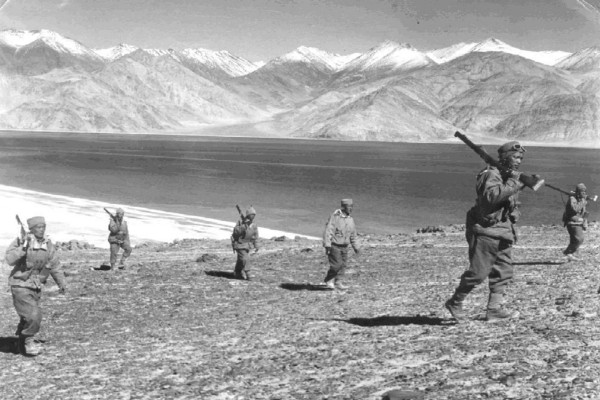
By the time Chinese forces crossed the Himalayas in October 1962, the war had already been prepared—by secret training camps, arms drops, intelligence assessments, and Cold War strategies that treated Tibet not as a society, but as a lever.
As Donald Trump later complained, India never truly entered Washington’s camp; the vast covert effort once invested in driving a lasting rupture between India and China ultimately dissolved against geopolitical reality, leaving behind little more than strategic wreckage and a war whose costs were borne by others.
Next: CIA Wrecked India–China Ties, But Won Nothing

In a career spanning three decades and counting, Ramananda (Ram to his friends) has been the foreign editor of The Telegraph, Outlook Magazine and the New Indian Express. He helped set up rediff.com’s editorial operations in San Jose and New York, helmed sify.com, and was the founder editor of India.com.
His work has featured in national and international publications like the Al Jazeera Centre for Studies, Global Times and Ashahi Shimbun. But his one constant over all these years, he says, has been the attempt to understand rising India’s place in the world.
He can rustle up a mean salad, his oil-less pepper chicken is to die for, and all it takes is some beer and rhythm and blues to rock his soul.
Talk to him about foreign and strategic affairs, media, South Asia, China, and of course India.