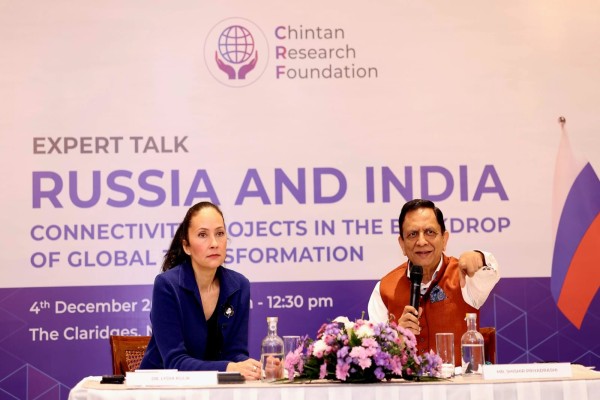
President Vladimir Putin’s visit to New Delhi provided the backdrop for a wide-ranging examination of the India–Russia partnership by Dr Lydia Kulik, Head of India Studies at the Moscow School of Management SKOLKOVO and Senior Research Fellow at the Russian Academy of Sciences’ Institute of Oriental Studies.
Her talk at an event hosted by the Chintan Research Foundation just ahead of President Putin’s arrival on December 4 offers a map of the constraints and opportunities shaping the next phase of the relationship.
A central theme was interdependence among four major powers: the United States, China, Russia and India. In her formulation, understanding how these states interact is essential to understanding global stability. India and Russia, she argued, occupy a unique niche in this matrix — a relationship marked by strategic trust but increasingly conditioned by the pressures of global fragmentation and the recalibration of supply chains.
Connectivity emerged as the hinge linking economic, political and security considerations. Russia’s renewed focus on transport corridors—from the North–South Transport Corridor to the Vladivostok maritime axis and eventual links to the Northern Sea Route—reflects a strategic need to diversify away from vulnerable maritime chokepoints in the Baltics and the Black Sea. India, for its part, views external connectivity through the lens of domestic consolidation; major investments in ports, logistics parks and rail modernisation remain foundational before external corridors can function at scale.
This dual focus — Russia outward, India inward — explains much of the slow progress on INSTC and other projects. Kulik emphasised that multimodal corridors require not only physical infrastructure but also digital integration, standardised logistics, and cold-chain systems for perishable goods.
The gap between conceptual ambition and operational readiness has kept trade below potential. Yet both sides recognise that diversified corridors are politically and economically necessary. The emphasis on using both Bandar Abbas and Chabahar, rather than choosing between them, underlines this approach of redundancy and resilience.
A second strategic shift lies in labour mobility. Russia’s demographic contraction has produced acute shortages in sectors like construction and services. India’s labour surplus and Russia’s systemic gap create conditions for a managed mobility framework that could reshape bilateral ties over the next decade.
Kulik indicated that policy responsibility is transitioning from Russia’s Interior Ministry to its Labour Ministry, signalling a move from control to coordination. Blue-collar mobility is the immediate focus, but a future layer of white-collar technical and managerial mobility — especially for Indian graduates of Russian universities — would mark a deeper integration of the two economies.
Trade diversification is another structural pillar. Russia’s annual import volume, approaching USD 300 billion, contrasts sharply with India’s small export share. This imbalance, Kulik argued, is less a sign of incompatibility than of under-explored opportunity — especially in engineering, machine-building, manufacturing and specialised SMEs. Entrepreneurs on both sides cite insufficient information as a key barrier. The scale of the business delegation accompanying the summit and the proposed investment roadmap for the Russian Far East signal an attempt to correct that information asymmetry.
Strategically, Russia’s Far East remains one of the least understood yet most consequential theatres for India. Since Prime Minister Modi’s “Act Far East” announcement in 2019, interest has grown, but gaps remain in investor awareness, logistics, and long-term planning.
Kulik noted that 18 investment projects have been identified for detailed joint examination, reflecting Russia’s intent to position the region as its gateway to Asia. For India, sustained involvement there offers diversification away from continental routes vulnerable to geopolitical friction.
Multilateral platforms form the third axis of the strategic conversation. As India assumes the BRICS chairmanship, the focus is shifting from political signalling to economic mechanisms — clearing systems, arbitration frameworks, investment channels and intra-BRICS trade, all areas that align with earlier Russian initiatives.
SCO, too, is evolving from a security-led organisation to one that increasingly hosts economic cooperation. Both frameworks intersect with Russia’s concept of “Greater Eurasia,” still a work in progress, but one that requires greater India–Russia dialogue to harmonise their differing geographic and conceptual interpretations.
Defence cooperation, despite sanctions-driven pressures, remains anchored in long-term localisation. Kulik maintained that Russia’s efforts to indigenise its own supply chains have reduced vulnerabilities created by Western sanctions. For India, this means that existing joint projects — whether aircraft, air-defence systems or naval platforms — continue without structural disruption.
The recently publicised reciprocal logistics support agreement signals a deepened operational trust, offering India more reliable access to Arctic corridors and giving Russia flexibility in the Indian Ocean region.
Underlying all these strands is the question of narrative. Information asymmetry — the absence of Indian media presence in Russia and reliance on Western intermediated reporting — creates distortions that influence public and policy perceptions. Russia’s decision to open a full-scale RT office in India is as much a strategic messaging move as a media expansion, and India’s own lack of permanent media presence in Russia remains a structural gap in understanding.
Kulik’s closing message was that India–Russia ties cannot be treated as self-sustaining. Their durability rests not on sentiment or history but on active maintenance: diversified economic corridors, updated labour and technology frameworks, SME-level integration, and better information flows.
In a world of fractured alignments, she argued, the partnership remains a stabilising factor — but only if both sides continue to invest in it deliberately and consistently.

In a career spanning three decades and counting, Ramananda (Ram to his friends) has been the foreign editor of The Telegraph, Outlook Magazine and the New Indian Express. He helped set up rediff.com’s editorial operations in San Jose and New York, helmed sify.com, and was the founder editor of India.com.
His work has featured in national and international publications like the Al Jazeera Centre for Studies, Global Times and Ashahi Shimbun. But his one constant over all these years, he says, has been the attempt to understand rising India’s place in the world.
He can rustle up a mean salad, his oil-less pepper chicken is to die for, and all it takes is some beer and rhythm and blues to rock his soul.
Talk to him about foreign and strategic affairs, media, South Asia, China, and of course India.