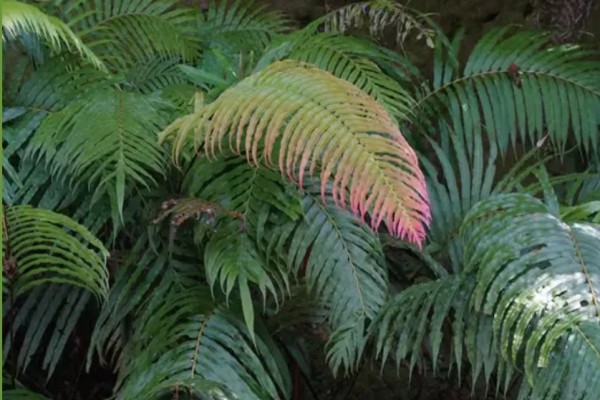
Chinese researchers have identified a remarkable biological process in the humble Blechnum orientale fern, which can draw rare-earth elements (REEs) from deep soil layers and crystallise them inside its tissues.
The discovery, made by a team from the Guangzhou Institute of Geochemistry under the Chinese Academy of Sciences in collaboration with scientists at Virginia Tech, marks the first time a living plant has been confirmed to biomineralise REEs into actual mineral crystals under natural conditions.
The fern forms nanoscale monazite crystals — a key rare-earth mineral — not through geological heat or pressure, but under ambient temperature, sunlight, and rain. For an industry long associated with pollution, radioactive waste, and land degradation, the idea that a leafy plant can safely grow its own rare-earth minerals is extraordinary.
Rare-earth elements are fundamental to the modern economy, powering everything from smartphone speakers and medical imaging equipment to electric vehicle motors and wind-turbine magnets. Demand is rising sharply as the global push for electrification accelerates, yet the supply chain remains heavily dependent on mining methods that scar landscapes and leave behind toxic tailings.
Traditional monazite deposits often contain uranium and thorium, creating radioactive by-products that require strict handling and disposal. By contrast, the monazite nanoparticles produced within Blechnum orientale appear strikingly pure and free of such radioactive elements, making the process potentially far safer than conventional extraction.
What astonished researchers was not just the fern’s ability to accumulate REEs — a trait some hyperaccumulator plants show with metals like nickel or manganese — but its ability to convert dissolved ions into solid, structured minerals. When REE-rich soil was examined, the fern’s roots absorbed ions which then moved through the plant’s vascular tissues, where they slowly nucleated into nanoparticles.
Over time, these nanoparticles coalesced into crystalline monazite embedded within the plant’s leaves and stems. This natural mineral factory operates without any intervention, catalysts, or engineered conditions. It is, as one researcher described, “geology conducted by biology.”
The finding has sparked intense interest in the concept of “phytomining,” in which plants are deliberately grown to extract metals from contaminated or low-grade soils. While phytomining has been studied for decades, particularly for nickel in certain tropical shrubs, no previous attempt involving rare-earth metals has demonstrated the formation of usable minerals inside living tissue.
Blechnum orientale could therefore represent a major conceptual leap: instead of using energy-intensive refining to tease rare earths out of complex ores, future systems might harvest these plants, burn or process the biomass, and collect the naturally formed crystals with far less waste.
Still, scientists caution that the discovery is a beginning, not a ready-made industry. The amount of REEs produced by each plant is currently extremely small, and scaling the system to industrial levels would require vast cultivation areas, time-intensive growth cycles, and efficient recovery methods.
Phytomining is unlikely to replace traditional mining in the foreseeable future, given global demand measured in thousands of tonnes. Instead, it may evolve into a complementary technique, particularly useful for rehabilitating polluted lands, scavenging REEs from low-yield soils, or sourcing smaller quantities of high-purity material for specialised applications.
The implications extend beyond China. Countries like India, which possess REE deposits but face environmental and regulatory constraints, could eventually deploy phytomining to restore degraded mines while extracting trace resources. For regions where mining faces local resistance or ecological risk, a “green extraction” model driven by plants rather than heavy machinery could offer a politically and environmentally palatable alternative.
For now, Blechnum orientale stands as a reminder that sophisticated natural processes often lie hidden in plain sight. A fern growing quietly in Asian forests may hold the blueprint for one of the cleanest rare-earth recovery methods imagined — a biological shortcut to minerals usually forged in deep, ancient geological systems.

In a career spanning three decades and counting, Ramananda (Ram to his friends) has been the foreign editor of The Telegraph, Outlook Magazine and the New Indian Express. He helped set up rediff.com’s editorial operations in San Jose and New York, helmed sify.com, and was the founder editor of India.com.
His work has featured in national and international publications like the Al Jazeera Centre for Studies, Global Times and Ashahi Shimbun. But his one constant over all these years, he says, has been the attempt to understand rising India’s place in the world.
He can rustle up a mean salad, his oil-less pepper chicken is to die for, and all it takes is some beer and rhythm and blues to rock his soul.
Talk to him about foreign and strategic affairs, media, South Asia, China, and of course India.