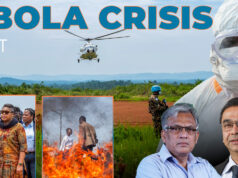
The Bundibugyo strain of Ebola is currently tearing through the Democratic Republic of Congo and Uganda. Uganda has detected two more confirmed cases of Ebola, its health ministry said on Monday, bringing the total number of cases reported in the country to seven.
The two new cases are health workers in a private health facility in the capital Kampala and both are Ugandans, the ministry said in a statement.
The world’s licensed Ebola toolkit is proving to be ineffective in dealing with it. Over 510 suspected cases have been reported since the first case emerged in early May, with over 130 dead.
The Africa Centres for Disease Control and Prevention (Africa CDC) has also officially declared the ongoing outbreak of Bundibugyo strain Ebola Virus Disease as a Public Health Emergency of Continental Security (PHECS). The WHO IHR Emergency Committee on 22 May 2026 issued temporary recommendations to strengthen disease surveillance at Points of Entry to “detect, assess, report and manage travellers with unexplained febrile illness arriving from areas with documented Bundibugyo virus detection”.
What Is Ebola Disease
Ebola Disease is a viral haemorrhagic fever caused by infection with the Bundibugyo virus strain of Ebola Virus. It is a serious disease with a high mortality rate of 25-50%.
VaccineWork, by Gavi reported that Bundibugyo virus is a zoonotic disease, with fruit bats thought to be the natural reservoir. Once in humans, it spreads through direct contact with the blood, secretions, organs or other bodily fluids of infected people, and with surfaces and materials contaminated by those fluids. People become infectious once they develop symptoms; the incubation period ranges from 2 to 21 days.
Are There Ebola Vaccines?
At present, no vaccines or specific treatments have been approved to prevent or treat Ebola Disease caused by the Bundibugyo virus strain.
India has not reported any case of Ebola Disease caused by the Bundibugyo virus strain, reported PIB.
This strain, first identified in western Uganda in 2007, is one of four Orthoebolavirus species known to cause disease in humans. It has surfaced only twice before — 131 cases in 2007, a mere 38 in 2012, the Australian Broadcasting Company reported.
While Ebola vaccines are now available, they target surface proteins on the EBOV/Zaire strain — proteins that are “quite different” on Bundibugyo.”
Advances in vaccine technology — accelerated by COVID-19 — have shortened development windows considerably; however, international funding cuts and vaccine hesitancy might slow efforts.