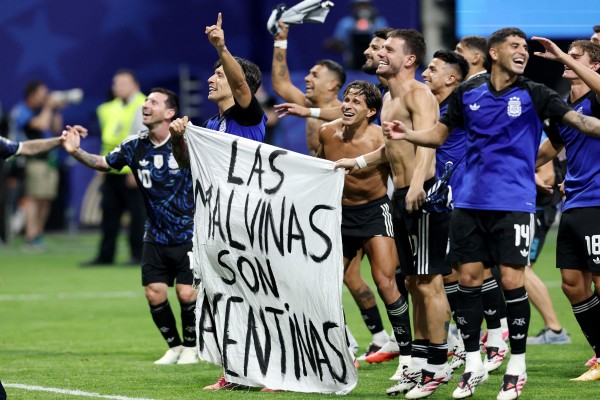
Argentina’s celebrations after a dramatic 2-1 FIFA World Cup 2026 semi-final victory over England have sparked fresh controversy after several players displayed a banner reading Las Malvinas son Argentinas (“The Falklands are Argentine”), prompting the possibility of FIFA disciplinary action over political messaging.
The reigning world champions booked a second successive World Cup final after coming from behind at Atlanta’s Mercedes-Benz Stadium. England, managed by Thomas Tuchel, had taken the lead before Lionel Messi inspired Argentina’s comeback, setting up goals for Enzo Fernández and Lautaro Martínez, whose stoppage-time header sealed victory.
Television cameras captured midfielder Giovani Lo Celso and defender Nicolás Otamendi holding the banner during the post-match celebrations. It was later briefly laid out on the pitch before celebrations continued.
The display immediately drew attention because FIFA prohibits political statements and symbols at its competitions. The governing body is expected to review reports from match officials and disciplinary delegates, along with broadcast footage, to determine whether Argentina breached tournament regulations.
The slogan refers to the long-running sovereignty dispute between Argentina and the United Kingdom over the Falkland Islands, known in Argentina as Las Malvinas. Britain has administered the South Atlantic archipelago since the 19th century, but Argentina continues to claim the territory as its own.
The dispute culminated in the 1982 Falklands War after Argentina’s military government invaded the islands on April 2. Britain responded by sending a naval task force, and the 74-day conflict ended with Argentina’s surrender on June 14. The war claimed the lives of 255 British servicemen, between 649 and 655 Argentine military personnel according to official records, and three Falkland Islanders. The sovereignty dispute remains unresolved.
FIFA and the International Football Association Board (IFAB) prohibit political, religious and personal slogans or symbols during matches and official tournament activities. Tournament regulations allow disciplinary action against players, teams or national associations that violate those rules.
Argentina has previously faced sanctions over the same message. In 2014, FIFA fined the Argentine Football Association £20,000 after players displayed an identical “Las Malvinas son Argentinas” banner before an international friendly against Slovenia, ruling that it breached regulations on political messaging.
The incident has also drawn political attention in Argentina.
Vice-President Victoria Villarruel posted on social media after the victory that “it wasn’t just another match,” alongside a video appearing to show Argentine soldiers, reiterating Argentina’s claim over the islands.
Separately, Argentina’s Foreign Ministry issued a statement reaffirming what it described as the country’s “legitimate and imprescriptible sovereign rights” over the Malvinas, South Georgia, the South Sandwich Islands and surrounding maritime areas.
Before the match, Argentina coach Lionel Scaloni had sought to distance the semi-final from politics, saying football should not become entangled with historical disputes despite the rivalry between the two nations.
England and Argentina’s football rivalry has long been shaped by the legacy of the 1982 war, most famously during the 1986 World Cup quarter-final when Diego Maradona scored both the controversial “Hand of God” goal and his celebrated solo effort.
FIFA has not announced whether formal disciplinary proceedings have been opened, but the governing body’s previous action over an identical banner suggests the incident will come under close scrutiny.
Argentina’s place in Sunday’s World Cup final against Spain is not in doubt, though the celebrations following their victory over England have been overshadowed by a renewed political row over one of the world’s longest-running territorial disputes.