Ten years after the landmark Permanent Court of Arbitration (PCA) ruling on the South China Sea, it is worth asking a simple question: what has actually changed?
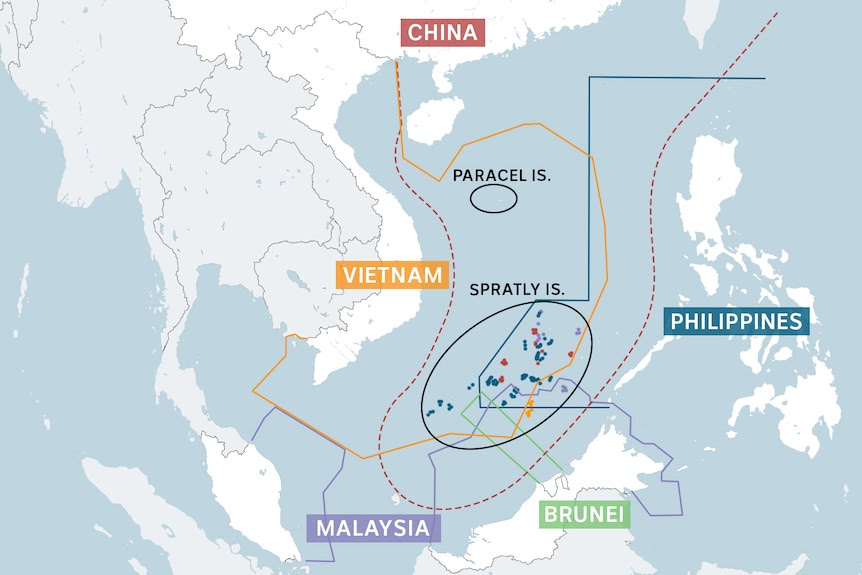
The July 12, 2016 ruling overwhelmingly favoured the Philippines, rejecting China’s sweeping “nine-dash line” claims. Yet Beijing ignored the verdict, continuing to expand its military presence and coercive activities across the disputed waters.
A decade later, the legal victory has not altered China’s behaviour. What it has done, however, is shape how regional claimants respond to an increasingly assertive Beijing.
The contrast between the Philippines and Vietnam is particularly instructive.
Only Manila pursued international legal action against China. Vietnam instead relied on a combination of diplomatic resistance, military restraint and quiet consolidation of its own positions in the South China Sea.
Yet despite these different starting points, both countries have gradually arrived at a remarkably similar strategic formula: resist Chinese coercion at sea while maintaining diplomatic engagement on land.
The convergence is striking, even if the pathways remain very different.
The Philippines today has adopted what is widely described as “assertive transparency.” Under President Ferdinand Marcos Jr., Manila has systematically publicised Chinese harassment of Philippine vessels, exposing incidents to international audiences and rallying diplomatic support.
From laser attacks on Philippine Coast Guard ships to confrontations around Scarborough Shoal, Sandy Cay and Iroquois Reef, every major encounter has become part of a broader information campaign designed to increase the political costs of Chinese coercion.
At the same time, Manila has significantly strengthened its military partnerships.
The 2026 Balikatan exercises became the largest ever, involving around 17,000 personnel from seven countries, including Japan’s first deployment of combat troops for the exercise.
Defence ties with Tokyo have expanded through the Reciprocal Access Agreement and the Acquisition and Cross-Servicing Agreement, while trilateral cooperation with the United States and Japan has gathered pace. Manila has also elevated defence cooperation with India, including the acquisition of BrahMos supersonic cruise missiles.
Yet this more robust posture has not closed the door to dialogue. Philippine and Chinese officials continue to meet through coast guard mechanisms and diplomatic channels, even as prospects for a meaningful Code of Conduct or joint resource development remain limited by political and constitutional realities.
Vietnam offers a different model.
Despite a long history of conflict with China and repeated maritime confrontations, Hanoi has largely avoided public escalation. Instead, it has quietly strengthened its physical presence across the Spratly Islands while preserving stable political and economic ties with Beijing.
Its strategy is perhaps best described as “resist at sea, trade on land.”
Over recent years, Vietnam has dramatically expanded infrastructure across the Spratlys, constructing military and maritime facilities at dozens of outposts.Reclaimed land has grown substantially, while new runways and logistical infrastructure have enhanced Hanoi’s ability to sustain its presence.
Formal diplomatic protests continue whenever Chinese activities cross perceived red lines, such as recent dredging operations around Antelope Reef in the Paracels.
But these protests are carefully balanced by continued political engagement. Vietnamese leader To Lam’s 2026 visit to Beijing produced notably warmer language and established a new “3+3” dialogue covering defence, security and infrastructure cooperation.
This balancing act reflects Vietnam’s long-standing non-alignment doctrine. Hanoi continues to avoid formal military alliances or alignment against any single power, preferring strategic autonomy while quietly expanding maritime cooperation with partners including the United States, India and the Philippines.
The two approaches therefore differ less in their objectives than in the institutional frameworks that sustain them.
For the Philippines, treaty alliances provide the foundation for external balancing. For Vietnam, strategic autonomy and carefully calibrated hedging remain central to preserving policy flexibility. Geography may be shared, but strategic culture is not.
A decade after the PCA ruling, this comparison offers an important lesson for understanding middle powers confronting great-power competition.
Common threats do not necessarily produce common strategies. Instead, they often produce common restraint.
Both Manila and Hanoi have concluded that outright confrontation with China is neither desirable nor sustainable. Both have also recognised that passivity invites further coercion.
Their answer has been to resist Chinese pressure where necessary, strengthen their own maritime positions, deepen ties with external partners where possible, and keep diplomatic channels open throughout.
The result is a nuanced strategy that avoids both capitulation and escalation.
That evolution also reinforces a broader conclusion. The Philippines and Vietnam may have travelled different roads over the past decade, but they have arrived at much the same destination: a pragmatic approach that combines firmness at sea with engagement on land.
In today’s Indo-Pacific, that may prove to be the most sustainable model available to middle powers navigating an increasingly contested strategic landscape.