The European Parliament’s latest resolution is about more than the case of Maria Shahbaz. It raises the prospect that Pakistan’s human rights record could eventually jeopardise the preferential trade access that underpins much of its export economy.
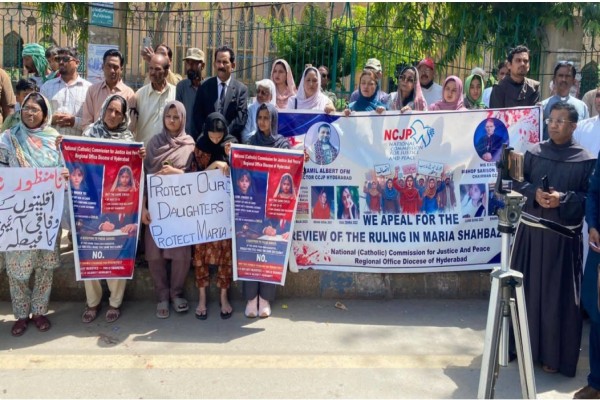
Maria Shahbaz, a Christian girl from Lahore, was abducted at 13, allegedly forced to convert to Islam and married to her abductor. Earlier this year, Pakistan’s Federal Constitutional Court upheld the marriage despite evidence presented by her family that she was a minor. The case has since become an international symbol of what rights groups say is the vulnerability of Pakistan’s religious minorities.
The European Parliament’s resolution goes well beyond Shahbaz’s case. It points to what it describes as a persistent pattern of forced conversions and child marriages involving Hindu and Christian girls, misuse of blasphemy laws, enforced disappearances, intimidation of journalists, shrinking space for civil society and discrimination against religious minorities, including Christians, Hindus, Ahmadis and Shias.
It warns that failure to honour Pakistan’s human rights obligations under the European Union’s Generalised Scheme of Preferences Plus (GSP+) should lead to the withdrawal of those trade benefits.
Pakistan’s admission to the GSP+ programme in 2014 transformed its trade relationship with Europe. Preferential tariff access helped drive a sharp rise in exports, particularly textiles and garments, while the EU has become Pakistan’s largest export destination, accounting for roughly one-third of overseas shipments.
For an economy still reliant on IMF support, burdened by weak industrial growth and recurring foreign exchange shortages, GSP+ is one of Pakistan’s most valuable economic assets.
Islamabad has dismissed similar European resolutions before as politically motivated. Brussels, meanwhile, has generally preferred engagement over sanctions, allowing Pakistan to retain GSP+ despite repeated concerns over labour rights, press freedom, minority protections and the misuse of blasphemy laws.
That approach may now be hardening.
Across Europe, trade policy is increasingly being used to promote governance and human rights. Countries benefiting from GSP+ are facing closer scrutiny over whether they are implementing, rather than merely signing, international conventions. Although the European Parliament cannot revoke Pakistan’s GSP+ status, its resolutions shape the political climate in which the European Commission assesses compliance.
Pakistan is particularly exposed because it has few viable alternatives. China remains its closest strategic partner but cannot replace European demand for Pakistani textiles. Gulf countries provide financial assistance rather than comparable export markets, while the United States offers no equivalent preferential trading arrangement.
If GSP+ were withdrawn, Pakistani exports would become less competitive against suppliers such as Bangladesh, Vietnam and India. The impact would likely be felt through lower export earnings, reduced manufacturing employment and further pressure on already fragile foreign exchange reserves.
Rather than treating the Shahbaz case as an isolated miscarriage of justice, the European Parliament presents it as evidence of broader institutional failures affecting minority rights, judicial independence and the rule of law. In doing so, it has reminded Islamabad that GSP+ is a conditional arrangement linked to international commitments, not a permanent economic entitlement.
None of this means Europe is about to suspend Pakistan’s trade preferences. Such a move would also affect European importers and deprive Brussels of one of its strongest sources of leverage. A more likely outcome is tighter monitoring and growing pressure on Islamabad to demonstrate measurable progress before the next compliance review.
For years, Pakistan has been able to dismiss European human rights resolutions as diplomatic irritants. This one is different because it links those concerns directly to the country’s most important export market.
If that scrutiny intensifies, the consequences will be felt not only in diplomatic circles but also in Pakistan’s textile mills, export houses and balance sheets.