There are few institutions in South Asia more resilient than the Indo-Pakistan peace lobby.
Governments rise and fall. Generals retire. Terrorists kill. Prime Ministers change. Strategic doctrines are rewritten.
Yet, with almost liturgical punctuality, the same collection of retired diplomats, former intelligence officials, politicians, academics and professional custodians of hope gather to compose another open letter urging India to “choose dialogue.”
The latest, signed by 117 eminent Indians and Pakistanis, asks Prime Ministers Narendra Modi and Shehbaz Sharif to restore High Commissioners, reopen trade, revive transport links, ease visas and resume structured negotiations.
The language is warm, civilised and morally reassuring. It invokes humanity, divided families and the welfare of two billion South Asians. Only one awkward subject intrudes upon this humanitarian symphony: Pakistan.
Or, more precisely, Pakistan’s persistent use of terrorism as an instrument of state policy.
The letter treats this not as the central obstacle but almost as an unfortunate background irritation, like drizzle interrupting a garden party. It demands a return to diplomacy without first demanding that Pakistan abandon the one policy that has systematically destroyed every previous diplomatic initiative.
One searches the letter almost in vain for the obvious proposition that dialogue is not an entitlement but a reward for civilised conduct. Instead, every collapse of earlier dialogues is treated as proof that even more dialogue is required.
Medicine has quack cures. Economics has perpetual theories of painless prosperity. Indo-Pak diplomacy has the open letter.
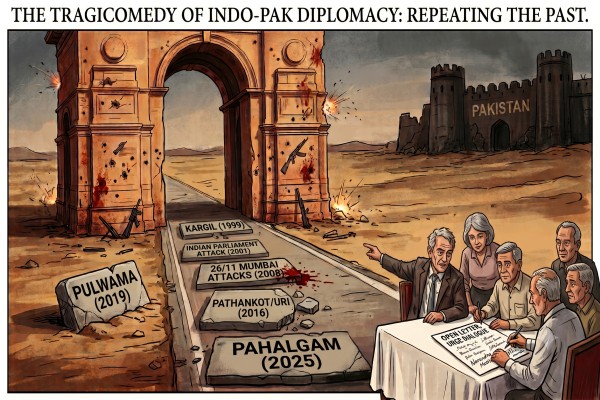
Independent India’s engagement with Pakistan resembles a tragicomedy in which every act begins with statesmanship and ends in bloodshed.
Jawaharlal Nehru accepted the post-war framework after Partition. Pakistan persisted with infiltration.
Lal Bahadur Shastri signed the Tashkent Declaration. Pakistan resumed covert hostility.
Indira Gandhi offered the Simla framework after a crushing military victory. Pakistan invested in proxy warfare.
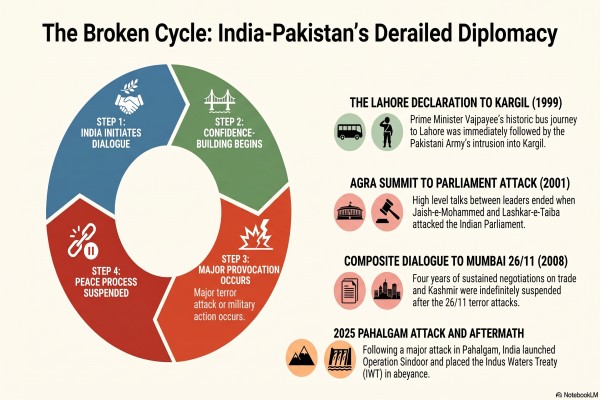
Then came perhaps the greatest act of political courage by any Indian Prime Minister on Pakistan. Atal Bihari Vajpayee boarded a bus to Lahore. The Pakistan Army led by General Pervez Musharraf responded by sending soldiers into Kargil.
The Agra Summit promised a fresh beginning, though it ended in a stalemate. But then came attack on the Jammu and Kashmir Assembly, followed by the storming of the Indian Parliament itself.
The celebrated Composite Dialogue of 2004-08 was hailed internationally as a triumph of patient diplomacy. But while negotiators discussed confidence-building measures, Pakistan-based terrorists prepared the assault on Mumbai.
Prime Minister Narendra Modi’s surprise visit to Lahore in December 2015 was greeted as bold statesmanship. Within days came Pathankot. Then Uri. Then Pulwama. Then Pahalgam.
At what point does a pattern cease to be coincidence and become policy?
The Pahalgam attack in 2025 changed more than India’s security situation.
It changed India’s doctrine. Operation Sindoor, the suspension of the Indus Waters Treaty, diplomatic downgrading, visa curbs and the insistence that normalisation depends on verifiable, irreversible action against cross-border terrorism ended the old ritual of attack, outrage and renewed dialogue.
Even within India, the debate is narrower than the letter’s authors suggest.
Farooq Abdullah and Mehbooba Mufti continue to argue that dialogue is the only path forward.
But the national consensus has shifted decisively since Operation Sindoor. Even the hardline RSS, while advocating dialogue, has maintained that it can only follow an uncompromising response to terrorism. The era of separating terrorists from the state that nurtures them is over.
Track-Two conclaves in Colombo may still produce earnest communiqués, they neither carry official sanction nor shape India’s strategic calculus.
The authors of the letter speak movingly of ordinary Pakistanis. So do most Indians.
But India doesn’t negotiate with ordinary Pakistanis, it deals with with the one institution that runs the country and has repeatedly sabotaged peace whenever it threatened to become politically profitable.
The Pakistan Army does not fear conflict, it depends upon it. India is not merely its external adversary, it is its principal domestic justification. Peace is destabilising because peace invites uncomfortable questions: Why maintain such military dominance? Why retain extraordinary political privilege? Why continue funding the infrastructure of permanent hostility?
A genuine settlement with India would require Pakistan’s establishment to discover a purpose beyond India itself.
And that may be South Asia’s least discussed security challenge.
Curiously, every fresh appeal for dialogue also assumes that India alone possesses agency. India must reopen embassies. India must restart trade. India must resume talks. India must demonstrate magnanimity.
Pakistan, meanwhile, is gently encouraged to improve its behaviour at some undefined point in the future.
Former diplomat Vivek Katju recently captured the central issue with admirable clarity.
Dialogue, he argues, has become the prize Pakistan seeks. and this raises an elementary negotiating question: Why surrender the prize before receiving the concession?
Not another promise. Not another anti-terror mechanism destined to generate minutes rather than arrests. Not another declaration whose commitments evaporate before the ink dries. Only one benchmark matters: the complete, verifiable and irreversible abandonment of terrorism as an instrument of state policy. Katju goes further. Even ending terrorism would merely qualify Pakistan for serious negotiations.
Genuine peace requires something far more difficult than dismantling a few terror camps. It requires abandoning the ideological architecture that portrays India as the permanent existential adversary essential to Pakistan’s national identity.
As long as sections of Pakistan’s establishment, currently led by self-appointed Field Marshal Asim Munir, remain intellectually imprisoned by the unfinished business of the Two-Nation Theory, diplomacy will merely decorate an unresolved conflict.
The advocates of perpetual engagement are undoubtedly sincere. But sincerity is no substitute for evidence.
None of this is an argument against peace. It is an argument against pretending.
India should pursue peace with relentless seriousness. But serious countries do not confuse dialogue with achievement. Nor do they mistake repetition or open letters for wisdom.
There is an old diplomatic temptation to believe that because neighbours cannot change geography, they must keep talking.
But while geography is permanent, trust is earned.
And Pakistan has spent the better part of seventy-five years treating every Indian hand extended in friendship as an opportunity to conceal another clenched fist.
The open letter asks India to ignore the evidence. But the blood-soaked evidence keeps accumulating.
As the old saying goes, insanity is doing the same thing over and over again and expecting different results.