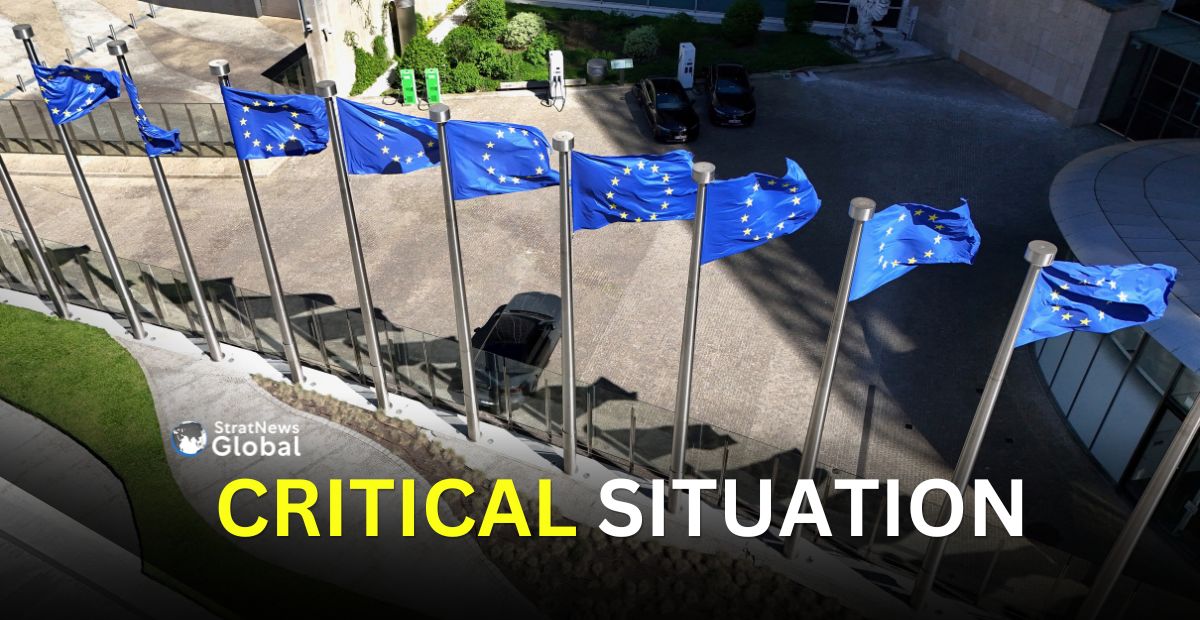
European Union leaders debated on Thursday new and tougher measures that could be needed to curb the bloc’s growing trade deficit with China and its heavy reliance on the world’s second-largest economy for rare earths and other critical supplies.
EU diplomats say there is a gradual convergence of views among the 27 EU members that there is a problem with the goods trade deficit with China, which now amounts to some €1 billion per day. The situation is more critical as transatlantic tariffs diminish access to the U.S. market. Luxembourg Prime Minister Luc Frieden said he favoured dialogue with China, while insisting that trade relations had to be fair and not “a one-way street.”
China’s goods trade surplus with the EU hit €360.6 billion in 2025, a 15% increase on 2024, and has expanded by 10% in the first four months of this year as Chinese firms have sold more to the EU and imported less. Beijing has also exploited its dominance in processing critical minerals by placing export restrictions on rare earths in April 2025, a response to Trump’s tariffs that has also hit EU companies. “We live in a world of wolves now. We no longer live in a world of pink ponies and rainbows,” said one EU diplomat.
Agreement On The Problem, Splits Over Response
Keenly aware it needs to diversify its trade, the EU has concluded multiple mineral partnerships and free trade deals with Australia, India and Indonesia in the past year. EU leaders at a summit in Brussels agreed it needs to go further, diplomats said, asking the European Commission to produce results from dialogue with the bloc’s main trading partners and ensure it has all the instruments needed to defend its interests.
There is less unity on how to do this. France advocates for a tougher line, while Germany, the EU’s biggest exporter, and Spain, increasingly home to Chinese investments, are more cautious. The split was exposed last month when France, Italy, the Netherlands and Lithuania said in a joint paper the EU should look into limiting over-reliance on single foreign countries, possibly with additional duties or quotas. Spain had initially been listed as a signatory but later distanced itself. “We need friends, we need balanced relationships,” Spanish PM Pedro Sanchez said. “We need to be pragmatic, and we need to build bridges both with major economies, potential allies such as China, and traditional allies, such as the United States.”
Trade Defences Already Focused On China
EU trade defences are already focused on China. Of 21 new anti-dumping and anti-subsidy investigations, 18 target Chinese producers. The bloc has also imposed additional duties on imported electric vehicles made in China since 2024, sparking Chinese retaliation on EU dairy products and brandy.
Critics say the EU needs to speed up investigations and prioritise cases rather than handling them first-come-first-served, and argue current cases are too narrow, with Chinese producers often able to overcome tariffs.
The Commission said Chinese EV imports fell following the tariffs, but producers simply shipped more hybrids instead, and EV imports have rebounded in the first quarter of this year. The Commission is due to conduct a broad review of trade defences in the third quarter, with potential new measures mooted to tackle overcapacity and overreliance on single suppliers, possibly requiring EU companies in sensitive sectors to find three possible sources.
(with input from Reuters)