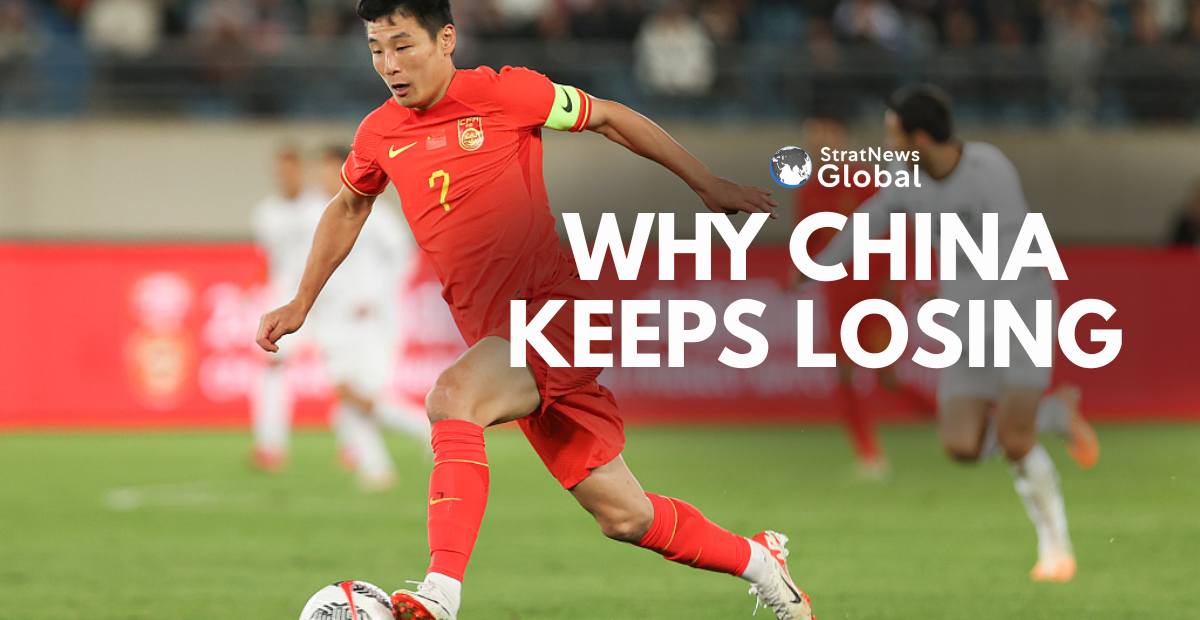
Despite football being one of China’s most popular sports and receiving strong backing from President Xi Jinping, the country continues to struggle on the international stage. According to a report by Foreign Policy (FP) authored by James Palmer, China’s failure to qualify consistently for the FIFA World Cup reflects deep-rooted problems that go far beyond the pitch.
https://foreignpolicy.com/2026/06/23/world-cup-china-soccer-xi-jinping-corruption-reform/
Another World Cup, Another Miss
Chinese fans are once again watching the World Cup from the sidelines after the men’s national team failed to qualify.
The disappointment is even greater this time because the tournament has expanded from 32 to 48 teams, with a record nine Asian nations securing places. While traditional rivals Japan and South Korea qualified comfortably, newer footballing nations such as Jordan and Uzbekistan also booked their tickets, leaving China behind.
China has qualified for the men’s World Cup only once, in 2002, when it exited in the group stage without scoring a goal.
Billions Spent, Few Results
According to FP, Xi Jinping has long viewed football as a national priority.
Before becoming president, Xi publicly expressed three ambitions for Chinese football: qualifying for the World Cup, hosting the tournament and eventually winning it.
More than a decade later, those ambitions remain distant despite billions of dollars in investment, repeated anti-corruption drives and an official plan to turn China into a “world-class football superpower” by 2050.
A Broken Football System
FP argues that one of China’s biggest problems lies within its domestic football system.
Although the Chinese Super League attracts large crowds, it has struggled with financial instability, poor management, unpaid wages and repeated corruption scandals.
Unlike many leading football nations, none of the current Chinese men’s national team players compete for overseas clubs. Many promising players begin their careers abroad but return to China, where limited competition and systemic problems hinder their development.
Corruption Remains a Major Obstacle
According to FP, corruption continues to undermine Chinese football despite repeated government crackdowns.
Earlier this year, authorities handed lifetime bans to 73 players and officials over match-fixing and bribery. Former national team coach Li Tie is among several high-profile figures already serving prison sentences.
FP notes that previous anti-corruption campaigns also resulted in arrests and reforms, yet many of the same problems have resurfaced.
Xi’s Ambition May Have Backfired
The report argues that Xi’s strong personal interest in football may have unintentionally fuelled corruption.
As more government funding flowed into the sport, opportunities for misuse of public money increased, while weak oversight allowed corruption to persist.
FP says similar patterns have appeared in other priority sectors in China, where large state investments have often been followed by corruption scandals.
Hope Lies in Grassroots Football
Despite the challenges, FP notes that many Chinese fans remain optimistic about the rise of grassroots village football leagues, which have grown rapidly in recent years.
Supporters hope these local competitions could help uncover untapped talent across China’s population of 1.4 billion.
However, FP cautions that unless deeper structural reforms are introduced, even grassroots success could eventually be absorbed into the same system that has hindered Chinese football for decades.