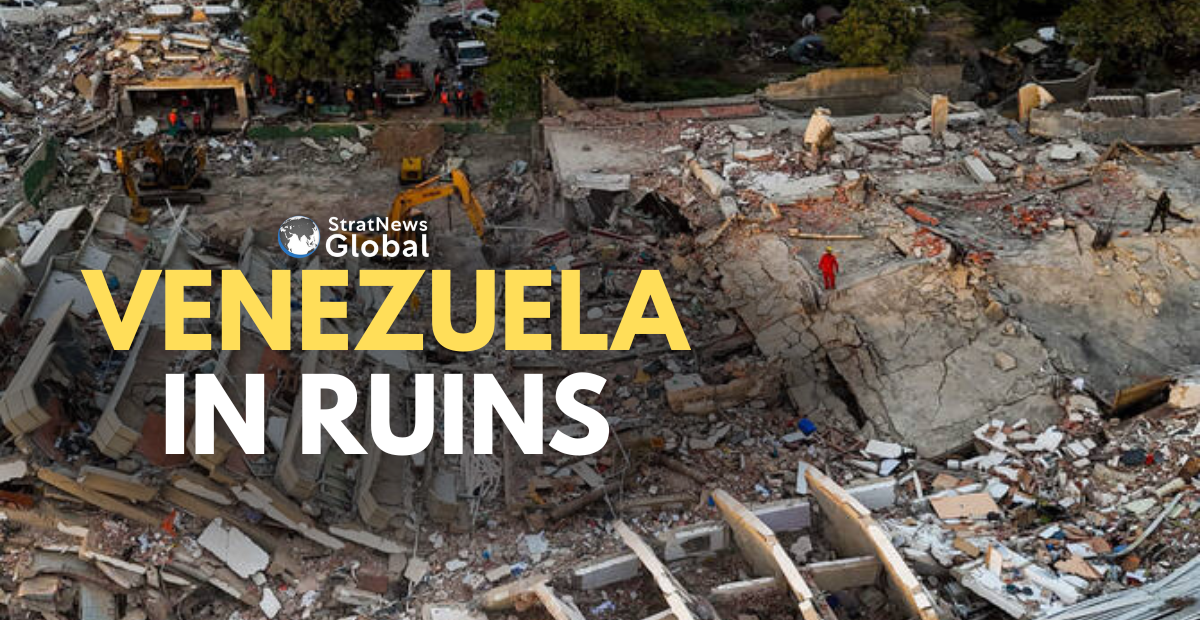
Engineers in Venezuela are calling for immediate structural inspections of public housing developments after two powerful earthquakes destroyed parts of a residential complex built during former President Hugo Chávez’s administration.
The appeal comes as rescue operations continue in La Guaira state, where parts of the 1,100-unit Los Cocos housing complex collapsed following back-to-back earthquakes.
Residents Count the Cost
Many residents lost their homes when sections of the Chávez-era development were flattened.
“I lost my whole apartment,” said resident Yelsa Rojas, who survived only because she was attending a medical appointment when the earthquakes struck.
She said many people living on the second floor of her building were feared dead.
Engineers Raise Safety Concerns
While experts say it is too early to determine the exact cause of individual building failures, engineers believe several factors may have worsened the disaster.
They point to decades of neglected maintenance, weak enforcement of building regulations and poor construction oversight during the Chávez and Nicolás Maduro administrations.
Experts also highlight La Guaira’s unstable coastal terrain, which makes the area particularly vulnerable during major earthquakes.
Civil engineers are urging authorities to inspect similar housing developments that remain standing to ensure they are structurally safe.
Government Under Pressure
Architect and urban planner Enrique Larrañaga criticised the government’s pace of response, saying offers of assistance from engineers and universities should have been accepted more quickly.
Although the government has met with Venezuela’s main engineering association, large-scale structural assessments have yet to begin.
Interim President Delcy Rodríguez has announced the creation of a commission to evaluate damaged housing, but no timeline has been provided.
The government has also faced criticism over delays in deploying heavy equipment and specialist search-and-rescue teams following the disaster.
Geography Adds to the Risk
Engineers say La Guaira’s geography significantly increases earthquake risks.
The narrow coastal strip sits between steep mountains and the Caribbean Sea, with loose sand, gravel and debris capable of amplifying seismic shaking.
The region also suffered one of Venezuela’s worst natural disasters in 1999, when catastrophic mudslides killed between 10,000 and 30,000 people.
Experts say construction remains possible in the area but requires strict compliance with building regulations and modern engineering standards.
Questions Over Building Standards
Architects and engineers argue that Venezuela’s construction regulations are not the primary problem.
Instead, they say weak enforcement, inadequate inspections and poor quality control have undermined housing safety.
Following the 1999 disaster, Venezuela strengthened its building codes, but experts believe those standards have often not been properly enforced.
Several engineers also point to reports of corruption, rushed construction and inadequate supervision during the rollout of Chávez’s large-scale public housing programme, which was later expanded under President Nicolás Maduro.
Growing Humanitarian Crisis
Five days after the magnitude 7.2 and 7.5 earthquakes, Venezuelan authorities confirmed at least 1,719 people had been killed, 5,034 injured and 15,866 left homeless.
Citizen-led efforts to identify missing people have collected nearly 50,000 names, highlighting the scale of the humanitarian crisis.
As rescue efforts continue, engineers warn that comprehensive inspections of surviving public housing will be critical to preventing further tragedies.
(with inputs from Reuters)