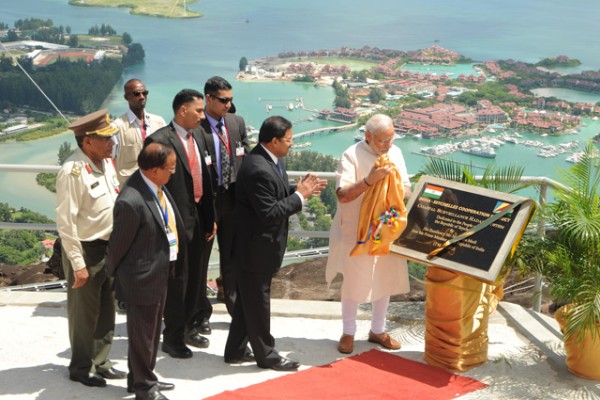
Prime Minister Narendra Modi will pay a three-day visit to Seychelles June 27-29, where he will attend the country’s 50th Independence Day celebrations as the Guest of Honour.
The visit marks his first trip to the island nation in 11 years and comes at a time when the western Indian Ocean has become a key arena of geopolitical competition.
For India, it is an opportunity to reinforce a relationship that has evolved from one centred on development assistance into a broad strategic partnership encompassing maritime security, economic cooperation, digital transformation and sustainable development.
The visit reflects the growing importance New Delhi attaches to the Indian Ocean at a time when major powers are expanding their presence across the region.
Island states such as Seychelles, once seen primarily as tourism destinations, have become strategically significant because of their location along vital sea lanes connecting the Persian Gulf, eastern Africa and Asia.
When Modi last visited Seychelles in March 2015, it was the first visit by an Indian Prime Minister in 34 years and came soon after India unveiled its Security and Growth for All in the Region (SAGAR) vision.
That visit marked a turning point in bilateral ties. Agreements on renewable energy, hydrography and the development of facilities on Assumption Island were signed, the Coastal Surveillance Radar System was inaugurated, and India announced the gift of a second Dornier maritime surveillance aircraft to Seychelles.
The proposed naval and infrastructure project on Assumption Island, however, never materialised. It was effectively shelved after facing sustained domestic political opposition in Seychelles and concerns over its environmental impact.
Over the past decade, the regional environment has changed significantly.
China has steadily expanded its diplomatic, economic and maritime footprint across the Indian Ocean through infrastructure investments, port development and closer defence ties with several island nations.
That prompted India to strengthen relationships with countries that occupy critical positions along the region’s maritime routes while offering an alternative model based on capacity building, development partnerships and respect for national priorities.
Seychelles occupies a strategically important location in this approach. Situated northeast of Madagascar, the archipelago overlooks shipping lanes that carry a substantial share of global trade and energy supplies.
The surrounding waters also face persistent challenges from piracy, illegal fishing, narcotics trafficking and other transnational crimes, making maritime security a shared priority.
This explains why defence and maritime cooperation have become the cornerstone of India-Seychelles relations.
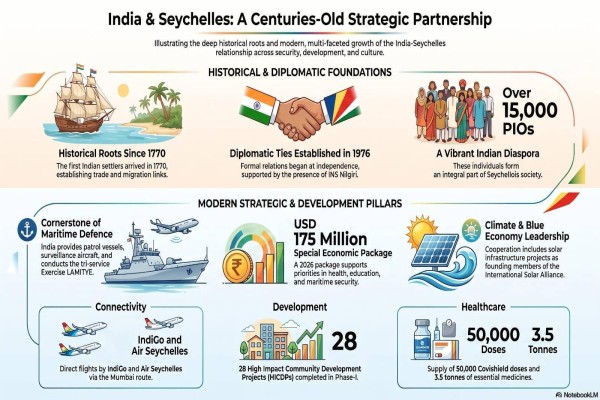
Over the years, India has supplied patrol vessels, fast interceptor boats and two Dornier maritime surveillance aircraft, established a coastal surveillance radar network, conducted hydrographic surveys and trained Seychelles’ defence personnel.
The biennial Exercise Lamitye has evolved into a tri-service exercise, while Indian naval ships make regular deployments to the island nation. India’s support now extends beyond supplying equipment to maintenance, logistics and institutional capacity building, reflecting a long-term security partnership.
The expected handover of another patrol vessel during Modi’s visit fits squarely within that framework. Rather than seeking a permanent military presence, India has consistently focused on helping Seychelles strengthen its own maritime capabilities and improve awareness across its vast exclusive economic zone.
The visit also follows an unusually active phase in bilateral diplomacy.
During Seychelles President Dr Patrick Herminie’s state visit to India in February this year, the two countries announced a USD 175 million Special Economic Package and adopted the Joint Vision for Sustainability, Economic Growth and Security through Enhanced Linkages (SESEL).
They also signed seven agreements covering healthcare, pharmaceuticals, marine science, food security, digital transformation, culture and capacity building, while announcing the establishment of a Seychelles Hydrographic Unit with Indian assistance.
Modi’s visit is expected to translate that vision into concrete outcomes by reviewing progress on these commitments, advancing priority projects and identifying new areas of cooperation.
Rather than launching an entirely new agenda, the visit is likely to accelerate implementation of a partnership that now extends well beyond security into economic resilience, technology, sustainability and human development, while reinforcing India’s broader objective of promoting stability across the western Indian Ocean.
Economic engagement, although modest, continues to expand. Bilateral trade remains below USD 100 million annually, but connectivity has improved with IndiGo’s direct Mumbai-Mahé flights complementing Air Seychelles’ services.
Indian companies have an established presence in banking, telecommunications and transport, while cooperation has widened to renewable energy, healthcare, education, digital governance and community development. India’s development assistance has increasingly focused on institution-building, grants and high-impact local projects alongside traditional lines of credit.
The relationship is also rooted in history. Indians first arrived in Seychelles in 1770, and today people of Indian origin account for a significant share of the country’s population. The diaspora remains influential in business and public life, while thousands of Indian professionals continue to contribute to sectors ranging from healthcare to construction.
Modi’s participation in Seychelles’ golden jubilee celebrations carries significance beyond the ceremonial honour. It underlines the political trust that has developed between the two countries over five decades of diplomatic relations and signals India’s intention to remain a dependable long-term partner for island states navigating an increasingly competitive strategic environment.
Ultimately, the visit is about more than India-Seychelles relations. It reflects New Delhi’s broader Indian Ocean strategy, where trusted partnerships, maritime security, sustainable development and capacity building are increasingly central to its regional engagement.
Seychelles may be one of Africa’s smallest countries, but its strategic location gives it an importance far greater than its size.
Modi’s visit is expected to reaffirm that reality while strengthening one of India’s closest partnerships in the western Indian Ocean.