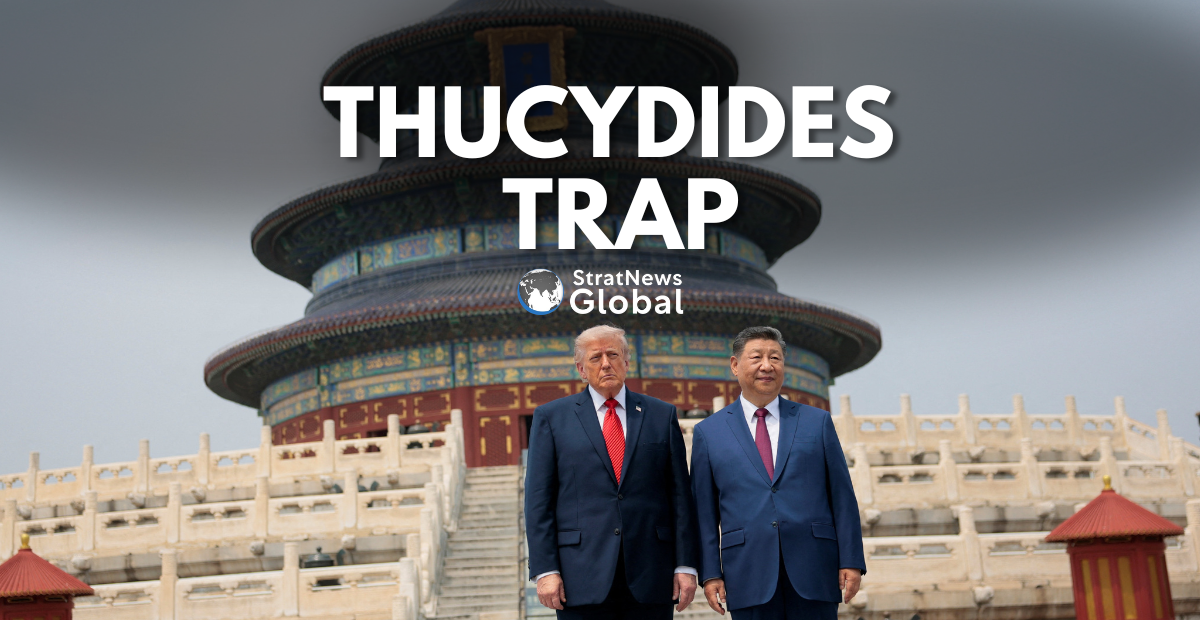
Chinese President Xi Jinping used one of the most politically loaded phrases in international relations during his summit with U.S. President Donald Trump on Wednesday, warning that China and the United States must avoid falling into the so-called “Thucydides Trap.”
The concept frequently used by Chinese strategists and global political analysts refers to the historical tendency for conflict between a rising power and an established dominant power.
Speaking at the Great Hall of the People in Beijing, Xi framed the future of U.S.-China relations as one of the defining questions of the modern era.
Xi Raises ‘Thucydides Trap’ During High-Stakes Talks
“Can China and the United States overcome the ‘Thucydides Trap’ and create a new paradigm for major-country relations?” Xi asked during his opening remarks with Trump.
He said the answer would shape not only bilateral ties but also global stability and the future international order.
“These are questions of history, questions of the world, and questions of the people,” Xi said.
The phrase “Thucydides Trap” has become shorthand for fears that strategic rivalry between Washington and Beijing could eventually lead to direct confrontation, much like historical clashes between rising and ruling powers.
By invoking the term directly in front of Trump, Xi appeared to signal both concern over deteriorating ties and a willingness to stabilise relations despite growing geopolitical competition.
Beijing Pushes New Framework For Relations
Xi said he and Trump had agreed to pursue what China called a “constructive strategic and stable relationship” that would guide bilateral ties over the coming years.
According to Xi, the framework would combine cooperation, manageable competition and controlled differences while maintaining long-term peace.
“Constructive strategic stability should be positive stability based on cooperation, benign stability with moderate competition, normalized stability with manageable differences, and lasting stability with a promising future of peace,” Xi said.
The Chinese leader also stressed that the idea must become more than diplomatic rhetoric and translate into practical cooperation.
Taiwan Remains The Most Dangerous Flashpoint
Even while speaking about stability, Xi issued a sharp warning over Taiwan, which Beijing considers the most sensitive issue in relations with Washington.
“If handled poorly, the two countries will clash or even enter into conflict, pushing the entire China-U.S. relationship into a very dangerous situation,” Xi warned.
China claims democratically governed Taiwan as part of its territory, while the United States remains Taipei’s most important international security partner.
The issue has become increasingly tense amid discussions in Washington over additional arms sales to Taiwan and deeper strategic cooperation in the Indo-Pacific.
Trump Signals Desire For Better Relations
Trump praised Xi during the summit, calling him “a great leader” and describing the meeting as globally significant.
“The U.S. and China are the most important and powerful countries in the world,” Trump said.
He expressed hope that both sides could build “the best U.S.-China relationship in history” and encouraged stronger economic cooperation between American businesses and China.
Trump travelled to Beijing with a delegation of senior U.S. business leaders and cabinet officials, including executives from the technology and manufacturing sectors.
Why The ‘Thucydides Trap’ Matters
The term originates from the writings of ancient Greek historian Thucydides, who argued that the rise of Athens and the fear it created in Sparta made war inevitable.
In recent years, the phrase has been widely used in debates over whether China’s rise could eventually bring it into direct confrontation with the United States.
Xi’s decision to revive the concept publicly during the summit signals Beijing’s growing concern over escalating rivalry in areas ranging from trade and technology to Taiwan and military competition in the Indo-Pacific.
The Beijing summit also covered trade, global conflicts and economic cooperation, but Xi’s use of the “Thucydides Trap” underscored the deeper strategic anxieties shaping the future of U.S.-China relations.