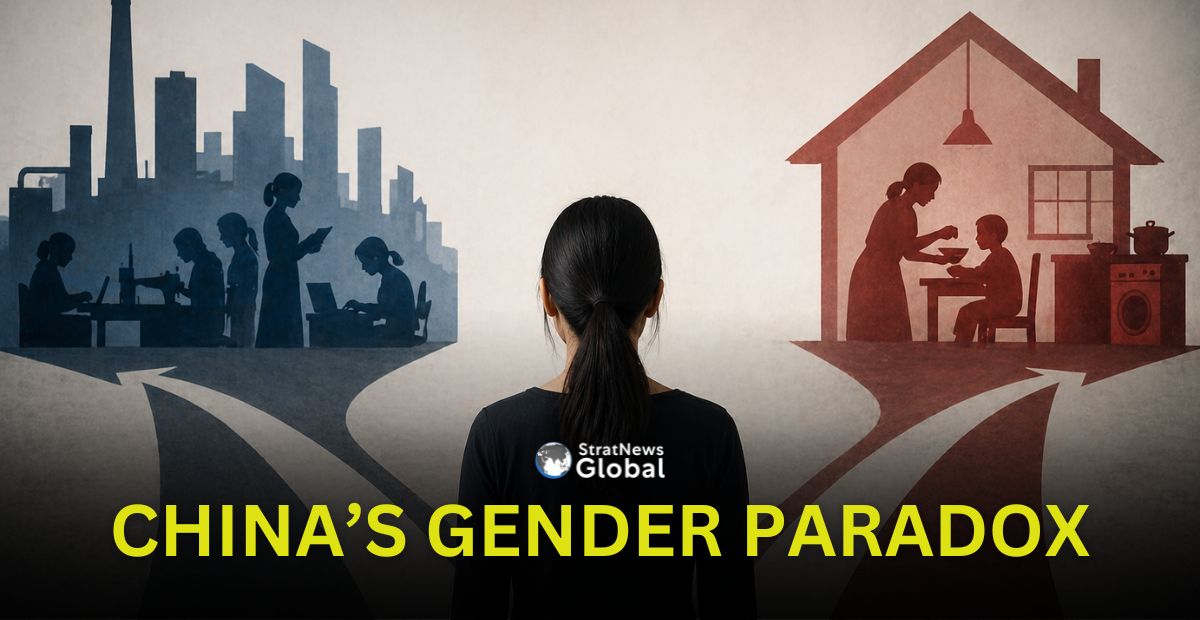
In 1949, when the Communist Party took power, it made a promise to Chinese women. Mao Zedong gave the slogan of “Women hold up half the sky” and it wasn’t just propaganda. It was a declaration that women would be liberated from centuries of feudal oppression, that they would work alongside men as equals, that the revolution would transform not just politics but the very fabric of society.
Seventy-six years later, that promise looks fragile.
A recent academic panel on gender and labor in China highlighted the extent of the problem. The discussion revealed a deeper issue: how market priorities have steadily undermined earlier commitments to gender equality.
As Dr. Usha Chandran, Assistant Professor at JNU argued, China succeeded in delivering economic liberation, but failed to secure gender equality. She describes this as a “paradox of equality and difference” , where women were made equal by being treated the same as men, without addressing the deeper social and structural inequalities they continued to face.
The turning point came in the 1970s with Deng Xiaoping’s reform and opening up policies. Dr. Hemant Adlakha, Vice Chairperson, Institute of Chinese Studies noted: “The first 30 years were China with socialist characteristics. The second era is socialism with Chinese characteristics. The difference? In the first, there was a sincere attempt to change the feudal mindset. In the second, class struggle is gone.”
Under Mao, state propaganda showed women as capable laborers, strong, productive, essential. After the 1980s, that image vanished. In its place came fashion magazines, makeup tutorials, and luxury brands. Universities began opening departments dedicated to training women for domestic roles. The transformation was complete: from liberation to domestication, all under the guise of progress.
Govind Kelkar, Executive Director, GenDev Centre for Research and Innovation, argued that patriarchy did not disappear, it adapted. Women’s labour remains “undercounted and undervalued,” while they are expected to manage both professional and domestic roles.
Dr. Ritu Agarwal, of JNU pointed out: “the state supports the redistributive role, giving access to education and jobs, but it silences the emancipatory potential. It disciplines the family so that women don’t question the patriarchal foundation.”
The reality of inequality is much more clear. Women applying to male-dominated fields on the Gaokao college entrance exam must score 5 to 10 points higher than men to gain admission.
Today, Xi Jinping has made his position clear. He instructed the All-China Women’s Federation that “women’s work is linked to family harmony.” Women should marry, have children, and stabilize the nation. The state wants them to work, the economy depends on it, but not to demand equality.
Sixty percent of young Chinese women now say marriage is not their only option. On social media and in universities, they debate their rights. They resist the trap that previous generations could not escape. When five feminist activists were arrested in 2015 for speaking out against sexual harassment, it didn’t silence the movement, it radicalized it.
The state continues to blame women for China’s falling birth rate while simultaneously pushing them back into the home.
Women remain underrepresented in political power as well. The Communist Party’s highest decision-making bodies continue to be overwhelmingly male, with the Politburo effectively an all-male space.
As Govind Kelkar pointed out, this concentration of authority reflects a deeper ‘male authoritarianism’, one that shapes policy priorities and limits the scope of gender reform. Without representation at the top, equality remains a controlled narrative rather than a negotiated reality.
The question today is no longer whether women can hold up half the sky. It is whether they are allowed to shape the system that decides what that sky looks like.