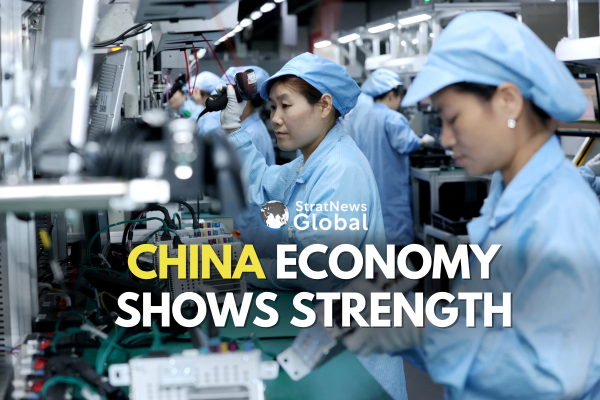
China’s factory output growth accelerated in the first two months of the year while retail sales rebounded, offering a steady start for an economy facing multiple global and domestic challenges.
Data released by China’s National Bureau of Statistics showed industrial output rose 6.3% year-on-year in January and February, faster than the 5.2% growth recorded in December. The figure exceeded the 5% forecast in a Reuters poll and marked the strongest expansion since September last year.
The data follow earlier reports showing Chinese exports surged in the first two months of the year, driven in part by strong global demand for artificial intelligence-related technology and related manufacturing.
Economists said the figures suggest the economy entered the year with slightly stronger momentum than expected despite geopolitical tensions and disruptions in global trade and energy markets.
Retail Sales Show Modest Recovery
Retail sales, an important indicator of consumer spending, increased 2.8% year-on-year, up from 0.9% growth in December. The figure also exceeded analysts’ expectations of 2.5%.
The improvement was partly supported by the country’s long Lunar New Year holiday in February, which boosted tourism and consumer activity.
Tourism spending during the holiday period rose nearly 19% compared with the previous year, although spending per trip slipped slightly, indicating that consumers remain cautious.
Investment Growth Offers Support
The data also showed some improvement in investment, providing relief for policymakers concerned about the ongoing downturn in China’s property sector.
Fixed asset investment, which includes spending on infrastructure and property, rose 1.8% in January-February, beating expectations for a decline.
Infrastructure investment grew strongly, increasing 11.4%, helped by policy measures and new financing tools aimed at supporting major projects.
Challenges Remain For Economy
Despite signs of improvement in industry and investment, analysts say China’s economy still faces structural challenges.
Household consumption remains relatively weak compared with strong export performance. Passenger vehicle sales, for example, dropped 26% year-on-year in the first two months after the end of tax incentives and reduced subsidies for electric vehicles.
The urban unemployment rate also rose to 5.3%, compared with 5.1% in December, raising concerns about income growth and consumer confidence.
Geopolitical Risks Add Uncertainty
Analysts say geopolitical tensions, including the conflict in the Middle East, could weigh on the global economy and affect China’s outlook in the coming months.
Higher energy prices and disruptions to global trade routes could add pressure to growth.
At the same time, markets are closely watching a planned meeting later this month between U.S. President Donald Trump and Chinese President Xi Jinping, which could influence trade relations and economic cooperation between the two countries.
(with inputs from Reuters)