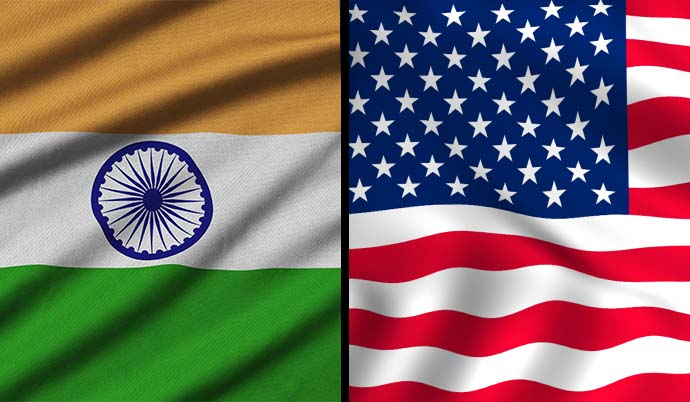
The United States and India have issued a Joint Statement announcing the framework for the interim trade agreement on February 6, 2026. Both sides will implement this framework and work to finalise the Interim Agreement that will be part of the BTA. Key outcomes of the Interim Agreement include:
Goods
India will reduce or eliminate its MFN tariffs on all U.S. industrial goods and on many food and agricultural products, including dried distillers’ grains (DDGs), red sorghum for animal feed, tree nuts, fresh and processed fruits, soybean oil, wine and spirits, and other agricultural items.
Tariff reductions on U.S. fresh fruits such as apples and oranges, and on soybean oil, are likely to hurt Indian farmers and could face strong opposition from farmer groups. It is also unclear which “additional agricultural products” have also been included for tariff cuts.
India has earlier agreed to limited tariff reductions on automobiles under its FTAs with the UK and the EU, but it is not clear whether concessions to USA involve limited quotas and limited duty cuts or unlimited quota and full tariff elimination.
Further, tariff elimination on electronic components, smartphones, and solar panels could adversely affect domestic manufacturing of these products in the future.
The United States will not reduce regular MFN tariffs on any products. Instead, it will only lower reciprocal tariffs that currently apply to about 55 percent of Indian exports to the U.S., bringing them down from 50 percent to 18 percent.
The main beneficiaries will be Indian exports of textiles and apparel, leather and footwear, plastic and rubber products, organic chemicals, home décor and artisanal products, and certain categories of machinery. Further tariff reductions will be subject to future negotiations.
Security
Both sides have agreed to strengthen economic security alignment to enhance supply chain resilience and innovation through complementary actions to address non- market policies of third parties. This provision seeks to aligns India’s security and economic policies with those of the United States, and therefore requires great caution.
Agreeing to such a provision could have far-reaching adverse implications. If the United States were to impose 100% tariffs on imports from countries such as Russia or China on economic security grounds, India will be expected to adopt similar measures. India will also have to restrict transactions in third countries that are sanctioned by the United States. No independent foreign policy for India.
Further, India may be required to consult the United States before entering into new digital trade agreements with other countries, to ensure that such agreements do not affect U.S. interests. India may also be constrained from entering into agreements on technical or health standards with other countries if those standards are seen as disadvantaging the United States.
Similar commitments have been obtained by the U.S. from Malaysia which now seeks to extend these to India. Given India’s size and sovereign interests, tying its economic and security policies too closely to any single country carries significant risks.
India’s Buying Commitments
India intends to purchase $500 billion worth of U.S. goods over the next five years, including energy products, aircraft and aircraft parts, precious metals, technology products, and coking coal. This would require India’s annual imports from the United States to rise from about $45 billion to nearly $100 billion, which appears unrealistic.
Aircraft purchases are presented as a major component of this commitment. At present, India operates around 200 Boeing aircraft. Even if India were to add another 200 Boeing aircraft over the next five years, at an estimated cost of $300 million per aircraft, the total value would be about $60 billion.
Moreover, such purchasing decisions are made by private airlines, not by the government, further raising questions about the feasibility of meeting this commitment.
Non-Tariff Barriers
India has agreed to relax restrictions on imports of U.S. medical devices and to eliminate import licensing requirements for U.S. Information and Communication Technology goods. India will also decide, within six months of the Agreement coming into force, whether U.S. or international standards, including testing requirements, will be accepted for U.S. exports in selected sectors.
In addition, India has agreed to address non-tariff barriers affecting U.S. food and agricultural products.
Many such provisions are part of US trade deals with Malaysia and likely to be extended to India. For example, for agricultural products, Malaysia has committed to allow imports of dairy, meat, and poultry products from the US if they are accompanied with the sanitary/health certificates from the relevant American authorities.
This concession implies that the US certification would prevail over Malaysia’s domestic health and sanitary requirements. This is a one-sided concession, as the US has not made a commitment in respect of imports of these products from Malaysia. Same is likely to happen in India.
Digital Trade
The United States is seeking largely one-sided commitments from India on digital trade by pushing for the removal of barriers to digital commerce and the adoption of clear digital trade rules under the BTA. In doing so, the U.S. is likely aiming to secure from India the same concessions it obtained from Malaysia, including a ban on digital services taxes and similar levies.
Malaysia has agreed not to levy customs duties on electronic transmissions or impose digital services taxes or similar measures that discriminate against U.S. companies. It has also given up the right to apply certain internal taxes on imports or collect them at the border where such taxes would disadvantage U.S. goods.
In addition, Malaysia has accepted a permanent moratorium on customs duties on electronic transmissions and removed the requirement for U.S. social media platforms and cloud service providers to contribute six percent of their local revenue to a domestic fund. Similar demands are likely to be made of India.
If accepted, these provisions would weaken India’s long-standing position at the WTO against a permanent moratorium on customs duties on electronic transmissions. They could also limit India’s ability to levy equalisation taxes or regulate its digital sector in the future, thereby reducing its digital policy space.
(Ajay Srivastava is head of the Global Trade Research Initiative)
Disclaimer: The views and opinions expressed in this article are those of the author and do not necessarily reflect the official policy or position of StratNews Global.