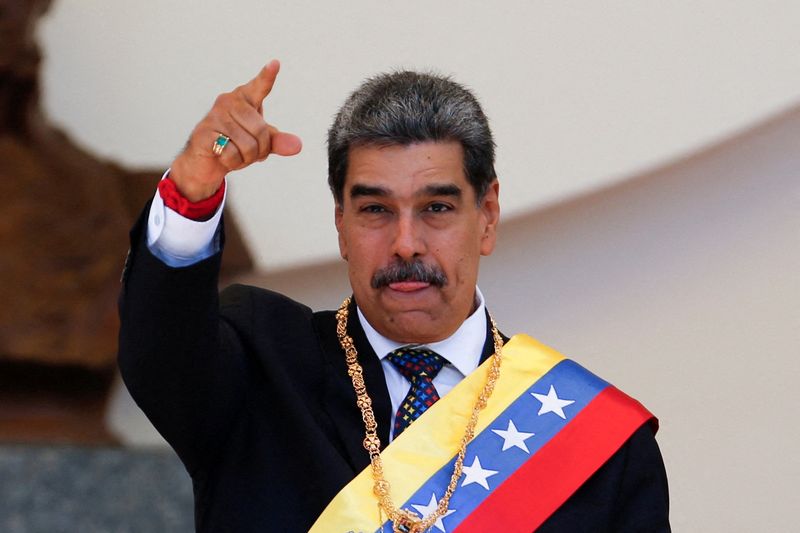
The photograph on X showed Venezuela’s President Nicolas Maduro, hands behind his back, in the custody of two men from the Drug Enforcement Agency. It appears to confirm President Donald Trump’s claim that Maduro and his wife are in the custody of US law enforcement.
Add to that, a media report from Caracas quoting Venezuela’s Vice President Delcy Rodriguez saying “We do not know the whereabouts of President Nicolás Maduro and First Lady Cilia Flores, we demand proof of life.”
For now, at least one Maduro ally has vowed to fight on.
“We will not negotiate, we will not surrender, and we will ultimately triumph,” Defence Minister Vladimir Padrino said, framing the events not as the end of the Maduro government, but as the beginning of a broader confrontation.
Former Indian diplomat R Swaminathan believes that “This is not going to open up the space for the Nobel Peace prize winner María Corina Machado,” he said, referring to speculation about an opposition takeover. “Before that happens, the US will have to carry out major operations to remove thousands of generals and followers of Maduro.”
Prof Aparjita Pandey of Jawaharlal Nehru University believes that military pressure may actually reinforce the existing power structure. Rather than weakening Maduro’s camp, it could consolidate it and accelerate an internal succession managed by the armed forces.
Why Maduro?
In other words, Trump has Maduro but his loyalists in Caracas may ensure their regime continues and nothing changes. That would be bad news for Trump who is evidently hoping that with Maduro in custody, he can now control Venezuela’s oil, the world’s largest proven reserves.
So all of Trump’s talk of Maduro heading a drug cartel and trafficking into the US may have some truth to it, but the real reason is oil. For over two decades, Venezuela has operated outside the realm of US policy on oil.
That was an irritant. Why? Because easy access to Venezuelan heavy crude would reduce US exposure to the ongoing uncertainties in West Asia and soften the economic risks of a future confrontation with Iran. In simple terms, it would make escalation elsewhere cheaper and easier to absorb.
Control over oil flows still translates into influence over pricing and currency use, and by extension, the durability of the dollar’s role in global energy markets. That is why the South American nation has never been treated as a purely regional issue.
More Questions
China’s special envoy Qiu Xiaoqi, was in Caracas just hours before the US launched its grab Maduro operation. His presence signals how important Venezuela is to China as an energy supplier. Any forced political change in Caracas would inevitably push Beijing out of a strategic energy relationship it has invested heavily in.
Moscow condemned the attack as “armed aggression” and warned that ideological hostility had replaced pragmatic diplomacy. It reiterated that Latin America had declared itself a zone of peace, and called for the issue to be taken to the UN Security Council.
Neither China nor Russia may fight for Maduro. But both clearly see Venezuela as a test case, one that could set precedents for how far the US is willing to go when strategic resources are involved.
Quagmire Risk?
At this point it’s not clear if US forces remain in Venezuela. But can it afford to get drawn into a long drawn out crisis? It would drain attention and resources and limit America’s ability to project power elsewhere. It would also complicate Israeli planning in the Middle East, which depends heavily on US leverage and credibility.
What happens next in Venezuela will not remain contained within Latin America. If the US succeeds, it will reinforce the idea that force and economic pressure can still be used to reshape sovereign states in strategically valuable regions.
If it does not, it may expose the limits of American power at a moment when rivals are increasingly willing to test those limits. Either outcome will be watched closely, not just in Caracas, but in Tehran, Beijing, Moscow, India and beyond.